
Grace Wang Portfolio Management Practice
September 8, 2026
Dear Investors,
Long-term readers of our investment journal installments will know that we anchor our research-informed methodology in how our investment holdings are being valued. We care about valuation, and how this valuation is being arrived at, because it has strong implications for the durability and the longevity of an investment. We characterize an investment that appreciates because of valuation multiple expansion very differently than we do an investment that steadily appreciates because of compounding earnings growth. For example, in two of our prior chapters (Chapter 43 and Chapter 51), we described one of our highest-weighted investment holdings, Alphabet, whose valuation multiple had actually compressed, even as the share price appreciated; and this was due to underlying earnings growth outpacing the share price. In other words, while the business had become more profitable, its valuation relative to this business strength also became more attractive, rendering Alphabet a continued high conviction idea. Likewise, what we observe about companies’ valuation profiles can be extrapolated to markets (i.e. the S&P500), and that will be the focus of this installment.
Most mainstream investors will observe the price performance of the S&P500 and conclude that valuations have risen. This may have been true in prior years, but not true in 2026. In veteran strategist Dr. Ed Yardeni’s most recent pieces, he makes a careful distinction between FEMO (fabulous earnings momentum) versus FOMO (fear of missing out). While FOMO is a stock market phenomenon that has a tendency to inflate equity prices, FEMO is a fundamentally driven phenomenon, which denotes that the bottom-line earnings growth of companies is actually accelerating. FEMO is a very good thing, because it denotes durable returns. Indeed, if we decompose the price return on the S&P500 referenced above, investors may be surprised to learn that YTD (up until the end of August 2026), forward 12-month earnings have grown by 28%, but valuation multiple compression has been negative 13%. In other words, because of FEMO, the markets have become cheaper from a valuation-stance, even as prices have risen. This makes the holdings in our portfolio even more compelling – both the businesses and their accompanying valuations have become more attractive.
On the other hand, a FOMO market was last experienced during the cyclical price momentum-driven highs of November 2021, with meme stocks such as GameStop trading at exorbitant valuations. In fact, GameStop didn’t even have a valuation because its earnings were so deeply negative. We avoided these speculative, meme-based areas, especially those with no intrinsic values, with the baseline thinking that they would eventually mean revert. Since its November 2021 levels, GameStop is deeply negative, being a substantial underperformer. As clients can witness from these examples, FOMO is a form of price speculation and not a durable investment strategy. Indeed, we would invite investors to contrast the price charts of Alphabet (FEMO) versus GameStop (FOMO) from November 2021 to present:
Exhibit 1: Alphabet Price Performance - FEMO | Exhibit 2: GameStop Price Performance - FOMO |
|
|
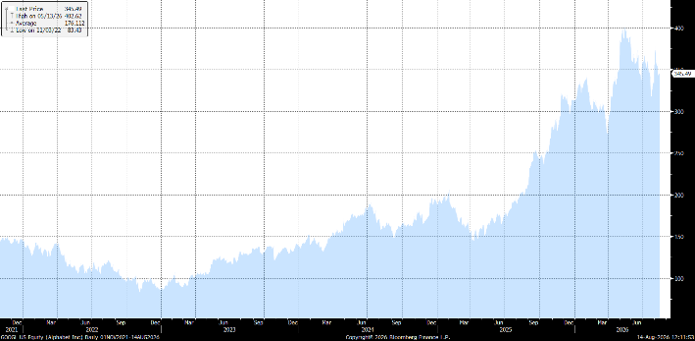
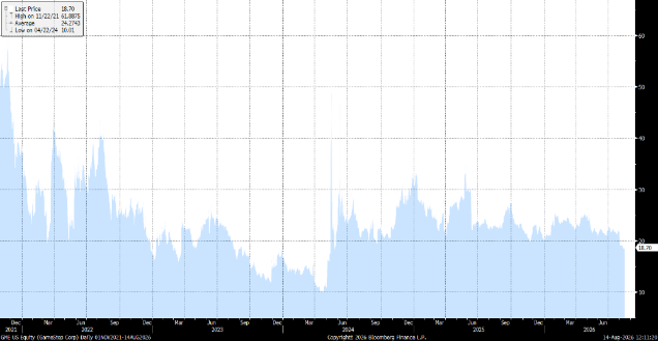
Furthermore, decomposing FEMO and FOMO across sectors, we come to some important insights. While FEMO has been the primary driver of our investment holdings in attractive growth and value-oriented sectors such as consumer discretionary, technology, and financials; FOMO has been the driver of sectors we do not own such as healthcare and consumer staples. This would suggest that the FEMO sector valuations are more sustainable, because their multiples have not yet caught up to their fabulous earnings growth.
In conclusion, broadly speaking, FEMO has been the main driver of S&P500 and portfolio holding valuations this year, and that’s a very favourable outcome. That there is very little FOMO embedded into the market is evidenced by rising prices driven by rising earnings, while the overall valuation multiple continues to compress and remains restrained. This would relate to our prior installment where we discussed an earnings-driven bull market, far more sustainable and long-lived in nature than the extended valuations created by FOMO (Chapter 46).
We hope clients have found this installment revealing and are enjoying the early transition into the beautiful fall foliage.
Warmest regards,
Grace Wang | Senior Portfolio Manager
Samuel Jang, CFA | Investment Associate
Leslie Mah | Associate Advisor
Katherine Yang | Associate
Steven Bos | Administrative Assistant
Heidi Xu | Administrative Assistant
Grace Wang Portfolio Management Practice of RBC Dominion Securities
Email: gracewangpractice@rbc.com
Phone: 604-257-2483
745 Thurlow Street, 20th Floor
Vancouver BC, V6E 0C5
gracewangpractice.com
This information is not investment advice and should be used only in conjunction with a discussion with your RBC Dominion Securities Inc. Investment Advisor. This will ensure that your own circumstances have been considered properly and that action is taken on the latest available information. The information contained herein has been obtained from sources believed to be reliable at the time obtained but neither RBC Dominion Securities Inc. nor its employees, agents, or information suppliers can guarantee its accuracy or completeness. This report is not and under no circumstances is to be construed as an offer to sell or the solicitation of an offer to buy any securities. This report is furnished on the basis and understanding that neither RBC Dominion Securities Inc. nor its employees, agents, or information suppliers is to be under any responsibility or liability whatsoever in respect thereof. The inventories of RBC Dominion Securities Inc. may from time to time include securities mentioned herein. RBC Dominion Securities Inc.* and Royal Bank of Canada are separate corporate entities which are affiliated. *Member-Canadian Investor Protection Fund. RBC Dominion Securities Inc. is a member company of RBC Wealth Management, a business segment of Royal Bank of Canada. ®/ TM Trademark(s) of Royal Bank of Canada. Used under license. © 2026 RBC Dominion Securities Inc. All rights reserved.