Henderson Family Wealth
October 25, 2026
Good mornin’,
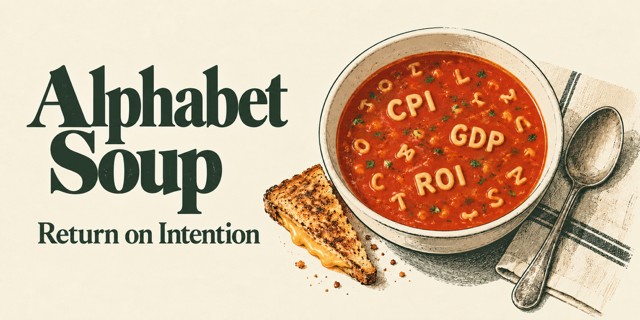
Saturday, somewhere between early-morning hockey and a dash from the dance studio, I had Bloomberg on in the kitchen. I was heating up a simple lunch of Campbell’s soup and grilled cheese when Bowie looked up at the screen and asked, “Dad, what do all those letters mean?”
I had to laugh…. CPI. PCE. FOMC. GDP. PMI. QT. WTI. Tickers scrolling in red and green. At our house we call that screen the Christmas tree, which feels fitting as the holidays get closer. Through his eyes, though, it looked more like alphabet soup.
He isn’t wrong, and our industry is hardly innocent. We judge a stock by its P/E and EPS, a company by its EBITDA, a bond by its YTM, and a REIT by its FFO and then, because that wasn’t enough letters, by its AFFO. We hold it all in ETFs with MERs, report it as AUM, and tuck it into RRSPs, TFSAs, FHSAs, RESPs and eventually RRIFs. Some days I think we invent acronyms faster than we invent ideas……
Curiosity is healthy. But sorting the signal from the soup isn’t your job. It’s mine. That’s what you have us for.
What The Letters Said This Week
CPI. Inflation is back, and most of it is at the pump. U.S. CPI rose to 3.7% in September and Canada’s to 3.1%, driven by gasoline as conflict in the Middle East keeps oil above US$100. Take energy out and Canada’s core inflation sits just under 2%.
FOMC and BoC. The central banks are heading in different directions. Markets see little chance the Fed hikes on Wednesday, days before the U.S. midterms; December looks more likely. The Bank of Canada is expected to lift its rate from 2.25% to 2.50% the same day, even after Canada lost 68,000 jobs in September.
Markets. A choppy week that went nowhere in particular. Thursday’s tech sell-off, after Meta and Tesla renewed questions about AI spending, left the Nasdaq with a second weekly loss, while the Dow held its gains and the S&P 500 finished roughly flat. Bonds did their job, with the 10-year U.S. yield slipping back below 5%.
Put the letters in order and the message is simple: an energy shock is lifting inflation, central banks are trying not to overreact, and none of it, on its own, changes what you own or why you own it.
Every Letter Asks the Same Question
Back in the kitchen, something struck me. Almost every acronym in the bowl asks one question: what is my money earning? P/E is what you pay for a dollar of a company’s profit. FFO and AFFO are how real estate trusts, REITs, measure the cash their properties actually throw off. YTM is what a bond pays you if you hold it to the end. They are all measures of ROI, return on investment. They matter, but none of them can answer the question underneath.
What is the money for?
It sounds simple. In my experience it’s the hardest question in wealth, and the one most people never quite get around to answering. Not because they don’t care, but because the letters are louder. The question waits until something, a sale, a death, a disagreement, forces it to the front.
The Can on My Stove
In 1897 a young chemist named John T. Dorrance joined his uncle’s canning company for $7.50 a week. His insight was simple: take the water out. Condensed soup was cheaper to ship and affordable for millions of families. Within two decades he owned the company.
For about a century his family held control. But fortunes branch the way family trees do. By the fourth generation, ownership was spread across dozens of heirs with different lives and time horizons. In 2018, when an activist investor pushed to replace the board, one descendant sided with him while others stood with the company.
I don’t read that as a family that lost its way. Owners can share values and still disagree about strategy. It shows how hard it becomes to hold a shared answer to “what is this for?” as a family grows. One founder can carry that answer in his head. Four generations can’t.
I’ve sat at a lot of family tables over the past twenty years. The moment that matters most is rarely the sale or the valuation. It’s the quiet that falls when someone finally asks, “What is all of this for?” and the family realizes no one has ever said the answer out loud. Often the parents and the children have been carrying different answers for years without knowing it. The families that do well aren’t the ones that agree on everything. They’re the ones that keep asking, while everyone is still at the same table.
Return On Intention
In The Wealth of Intention I wrote about another ROI: return on intention. Before you allocate a dollar, you’ve already committed yourself. Long before returns show up on a statement, they show up in your days, in how you spend your time and energy, and whether that spending is taking you where you want to go. I frame it as
Time × Energy = Return on Intention.
It’s a reflective device more than a formula. Time and energy can just as easily compound into exhaustion; intention is the direction that decides which way they go. You can earn more money and feel poor in time. You can achieve more goals and feel bankrupt in energy. No P/E ratio will ever show you that.
So our work doesn’t start with a portfolio. It starts with the question. Name the intention first, then invest toward it. When both kinds of ROI point the same way, wealth stops being a number and starts being a life.
How We Invest Toward It
Simplicity. A good plan can be explained in a sentence and kept to on a bad day. More data rarely makes people more accurate; it mostly makes them more confident.
Consistency. For families, that means writing it down while everyone is still at the table, and revisiting it as lives change. For investors, it means the same principles in good markets and bad.
Patience. Daily checking turns ordinary volatility into a steady drip of worry. Annual reflection mostly reveals growth. The Dorrance fortune took a century to build. Both kinds of ROI compound quietly.
A Note for Every Investor
The next time the screen lights up like a Christmas tree, try three questions. Does this change what I own? Does it change why I own it? Does it change what the money is for? Most weeks the honest answer is no. When it’s yes, that’s the conversation we should be having. And if you can’t answer the third question at all, that’s the most valuable conversation of the lot.
Looking Ahead
Wednesday brings both central-bank decisions, and next Tuesday the U.S. midterms. Our approach doesn’t change: higher yields mean bonds are finally paying investors to be patient, and diversification is doing what it was built to do.
As for Bowie, he finished his soup, lost interest in the Christmas tree and went back to his grilled cheese.
He knew exactly what lunch was for.
Have a wonderful week!