Henderson Family Wealth
July 19, 2026
Good mornin’
Hope you had a chance to settle into the weekend and recharge for the week ahead. For those of us in Portfolio Management, Friday afternoon gave us something we haven’t seen in quite some time: a market that remembered uncertainty exists. The surprise wasn’t that we had a selloff. The surprise was that we hadn’t had one sooner.
A weekend worth sitting with. A Monday worth thinking about.
The Week: Confidence Gets Repriced
Markets spent most of the week last week, reaching for records and one session giving a good piece of the confidence back.
The Nasdaq dropped 4.18%. The S&P 500 fell 2.64%. The semiconductor index….the part of the market that had been carrying so much of the optimism, fell more than 10% in a single session. Broadcom cracked something Thursday, and Friday’s jobs report did the rest.
Which is the joke and the warning. The bulls had been rooting for a strong economy. The strong economy turned around and ate them.
Strong jobs are good news for households and businesses. They are less comfortable for a market that has been counting on rate relief. When bond yields move higher and rate cuts get pushed further into the future, the long-duration parts of the equity market….semiconductors, mega-cap technology, anything priced on a long growth story….can get repriced quickly.
The broader backdrop remains unsettled. Iran talks are unresolved. The Strait of Hormuz remains a pressure point for energy markets. Trade policy is still creating noise. Canadian economic data remains mixed.
The latest GDP headlines looked soft, but the underlying details were better than the first read. Households are still spending. Parts of business investment are holding up. Real GDP per person improved. Canadian bank earnings were generally better than feared.
So the picture is not simple. Sluggish, yes. Uneven, yes. But not broadly broken.
We remain encouraged by the durability of corporate profits, but recent gains in risk assets had begun to reflect a high level of confidence that several open questions would resolve favorably. Friday was a reminder that confidence can be repriced in a hurry. So, we remain positioned for volatility, and we are watching closely for opportunities to add to strong companies amid market adjustments.
Anyone can feel disciplined when markets rise. Anyone can feel confident when uncertainty is fading and portfolios are climbing. But discipline is not tested during calm seas…it is tested when the waves arrive.
And Friday gave everyone inside or outside of the markets a teaching moment, whether they wanted one or not.
Volatility does not create character. It reveals it.
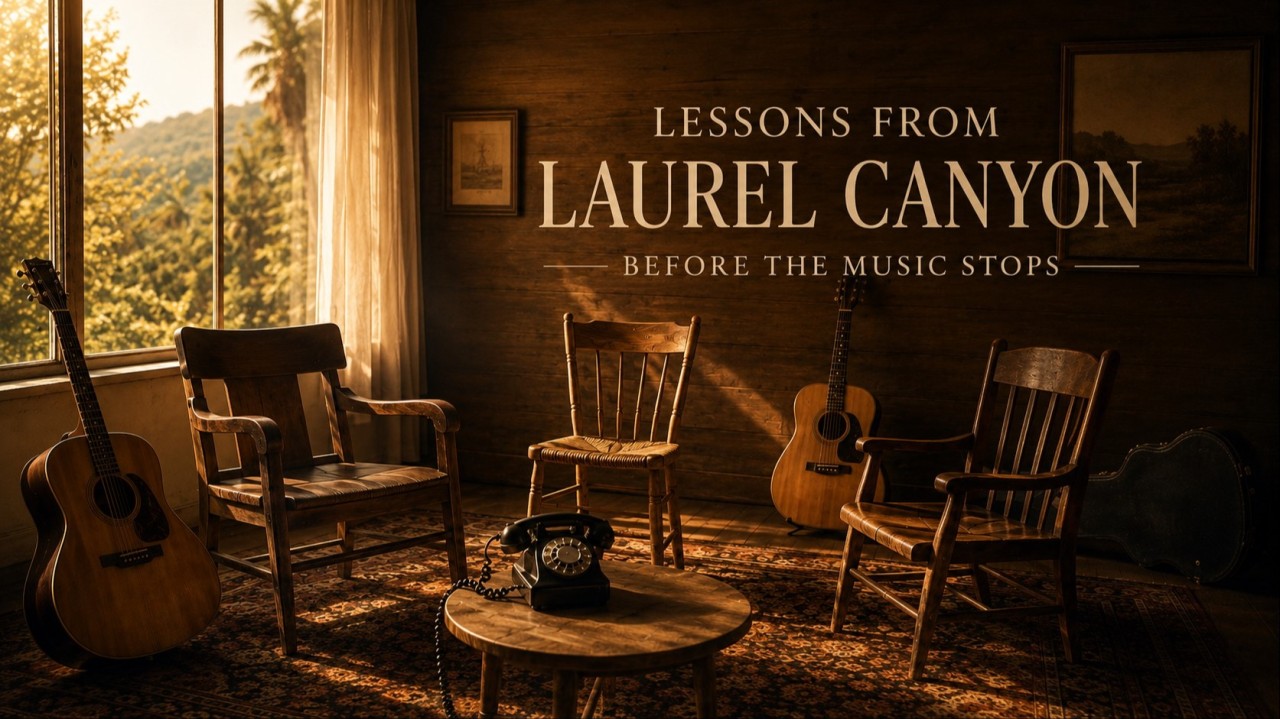
Markets have a way of exposing the difference….which brings us to a little story about Laurel Canyon and some lessons from legends that we can lean in to…..
Lesson One: Partnership Is Built in the Room
Three men met at Joni Mitchell’s house….
David Crosby had just been fired from the Byrds. Stephen Stills had watched Buffalo Springfield collapse around him. Graham Nash was about to leave the Hollies, the British band that had given him his start.
Three gifted men. Three bruised partnerships. One living room in Laurel Canyon.
Crosby and Stills had been working on a song together…You Don’t Have to Cry. They sang it for Nash. Then they sang it again. The third time, Nash, who had never sung with either of them before, quietly added the harmony he had been working out in his head while they played.
The room changed.
Crosby’s middle. Stills’s bottom. Nash’s high-floating top. A sound that did not exist in any of their previous bands and could not be reproduced with any other three voices on earth.
They named the band after themselves….Crosby, Stills & Nash. A literal accounting of who was in the room. That was not just branding….it was governance. Each man’s name was his own collateral. The partnership depended on the people in it. When Neil Young joined, they added the Y. The structure changed because the partnership had changed.
The songs came quickly.
Judy Blue Eyes. Helplessly Hoping. Our House. Ohio. Teach Your Children.
That last one was Graham Nash’s. And it may be the key to the whole story.
Lesson Two: What Gets Taught Is What Gets Lived
Nash had written Teach Your Children before CSN existed; while working through the unfinished relationship he had with his father. His father had served time in prison after taking responsibility for a friend’s stolen camera equipment. He came out diminished. He died not long after. Nash was a young man at the time and never got the conversation with his father that he had been carrying around in his head.
So he wrote a song about transmission. Not instruction, exactly. Transmission.
The lesson that lands is rarely the one delivered. It is the one observed. The way people speak to each other when the room is tense. The way they disagree. The way they repair. The way they do not. The way they act when money is moving, stress is rising, and no one has had enough sleep.
That is the curriculum.
A year after the music began, in late September of 1969, Crosby’s girlfriend Christine Hinton was killed in a car accident. She was twenty-one, driving Crosby’s cats to the vet on a road outside San Francisco. Crosby could not bring himself to identify the body. Graham Nash went to the hospital and did it instead, then came back to the house and held Crosby through what followed. They made an album together in the aftermath….If I Could Only Remember My Name…. with Joni Mitchell, Jerry Garcia, Phil Lesh, and Neil Young drifting in and out of the studio, gathering around the broken man. The harmonies on that record are not technical. They are structural. People holding each other up by singing into the gaps.
That was the foundation the band was built on. Not three voices that happened to fit. A friendship that had already survived the worst possible weather together by the time they were thirty.
Harmony is not the absence of tension. Harmony is the work of staying close enough to hear each other.
Lesson Three: Harmony Requires Maintenance
The harmony lasted longer than the partnership did.
By the late seventies, the band was already splintering. Crosby’s addictions. Stills’s intensity. Young’s restlessness. Nash playing diplomat between them. They would reform, tour, fracture, and reform again. Each cycle brought back the sound. Not always the trust.
Then, years later, old tensions hardened into silence.
In 2014, Crosby said some things in an interview about Neil Young’s then-girlfriend, later wife, Daryl Hannah. He called her a poisonous predator. Young read it and was done. Never spoke to him again. Not on the phone. Not in person. Not for the next nine years.
Around the same time, the decades-long friendship between Crosby and Nash also broke. The details were petty. The grievances real. Both men were old enough to know better. Neither quite did.
Nash, in the last few years, tried.
He wrote Crosby a letter. Sent it through Crosby’s manager. Said something like…we’re at the end of our lives, why don’t we put this behind us. Crosby never wrote back…..
Nash has talked about this in interviews since. He could have picked up the phone. He didn’t. He sent a letter and then waited for a response that did not arrive. He told himself he had reached out. He had reached toward, which is not the same thing.
But near the end, something shifted.
Crosby left Nash a voicemail. He wanted to talk. He wanted to apologize. Nash replied and gave him a time to call the next day.
The call never came.
On January 13, 2023, David Crosby posted what would be his last public message. He said he had heard the place he was going to was overrated….
Five days later he was gone.
Nash got the news the same way the rest of us did.
Regret rarely arrives all at once.
It arrives in fragments.
A song you haven’t heard in years. A photograph tucked inside a book. A birthday. An anniversary. A number still sitting in a phone that no longer rings.
The argument fades.
The details blur.
What remains is the window.
The realization that there was a moment when the bridge could have been crossed.
And then there wasn’t.
He has not stopped talking about the regret since.
The men who wrote Teach Your Children could not teach themselves to make a phone call.
The Partnerships We Keep
Almost every meaningful thing we build, in business and in life, is built in partnership.
Business leaders are in partnership with employees, clients, lenders, boards, and successors. Founders are in partnership with co-founders, early believers, and the people who take the call when things are hardest. Entrepreneurs are in partnership with risk, with capital, with timing, and with the families who often absorb more of the strain than the outside world ever sees.
Family enterprises are partnerships across generations, whether anyone uses the word. Parents and children are in partnership. Spouses are in partnership. Siblings are in partnership. Even old friends, after enough years, become a kind of enterprise together.
And every partnership carries the same risk. Not that it will fail all at once. But that it will drift. Quietly. Until one day the distance feels structural.
The strange thing about partnerships is that most of them do not require constant agreement. They require maintenance. A willingness to keep the bridge open. To say the thing before it becomes unsayable. To repair while repair is still ordinary.
To understand that partnership is not a posture. It is a process.
What Volatility Reveals
Markets remind us of this in their own way. Volatility exposes what was already there.
A strong company does not become strong because the market is calm. Its strength is revealed when conditions turn. Balance sheets matter more when capital is expensive. Cash flows matter more when sentiment fades. Management quality matters more when the easy assumptions stop working.
Partnerships are similar. The test is not how people behave when everyone is making money and the room is easy. The test is what happens when something goes wrong. When expectations are missed. When one person feels unseen. When a founder cannot let go. When a child wants a voice. When a sibling believes the system is fair on paper but not in practice.
That is when the real partnership shows itself.
Friday was a stress test. The chart was one version. The family system is another.
Who panics? Who communicates? Who steadies the room?
In our families, and in family enterprise, those observations compound. They shape trust. They shape succession. They shape whether the next generation sees stewardship as an inheritance or a burden.
A portfolio can be rebalanced. A partnership can be repaired. But both are easier to tend before the damage becomes structural.
The Difference Between Markets and People
Markets are generous in one important way. They keep giving us new prices.
A good company can be marked down for temporary reasons. We can study it, debate it, and decide whether the lower price has created opportunity. That is why we stay disciplined. That is why we diversify. That is why volatility, uncomfortable as it is, can be useful.
Relationships do not always work that way. When a partnership drifts too far, the opportunity set can narrow quickly. The call becomes harder. The apology becomes heavier. The silence becomes its own institution. And eventually the bridge that would have been difficult to cross becomes unavailable.
That is the uncomfortable difference.
Markets will give you another opening.
People may not.
Reflections for the Week
A few questions as we cruise in into the week.
The Call with a Time on It. Where has repair already begun, but not yet happened? Is there a conversation that has been vaguely agreed to, postponed, softened, or left for a better moment? What would it mean to put an actual time on it?
Before the Silence Becomes Structural. What relationship in your family, or your enterprise is structurally important and personally fraught? When the next correction arrives…. and there will be a next correction….will the bridge have been tended, or will you find yourself wishing you had made the call sooner?
The Work Before the Silence
Crosby, Stills & Nash gave the world harmony. But their harder lesson may be about partnership. How rare it is. How powerful it can be when the voices hold. How easily it can drift when repair is delayed.
The music was recorded, so the harmony survived. Most partnerships do not have that luxury. They live in the maintenance. In the call. In the apology. In the willingness to stay close enough to hear the other person clearly.
So this week, perhaps the work is simple. Watch for opportunity. And make the call while the partnership is still there to be tended.
Markets close and reopen.
Cycles recover.
Relationships do not always get the same opportunity.
…..before the music stops.
Festina lente.
Henderson Family Wealth of RBC Dominion Securities