Henderson Family Wealth
July 19, 2026
Good morning,
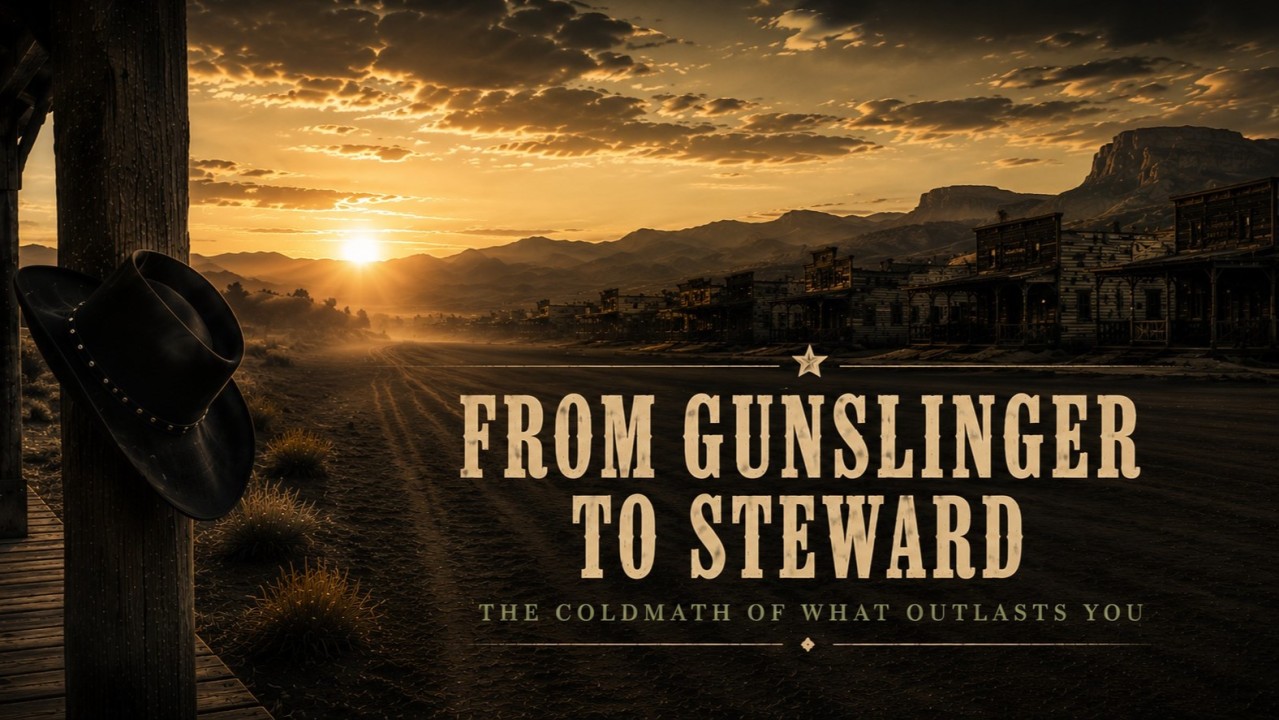
I was ten the first time I stood in Boot Hill.
My mom and dad had loaded the family into the car for a long road trip through the American Southwest, and Tombstone was on the itinerary because of course it was. My father read history the way others read box scores.
While we were there, what stuck wasn't the staged gunfight at the O.K. Corral. It was the crooked headstones. Names like Lester Moore…..and his tombstone
Four slugs from a .44 No Les No more.
Whoever wrote that epitaph had a future in marketing.
What I didn't understand at the time was that Tombstone wasn't really a town. It was a cemetery with a mining camp attached. My father saw the same dust I did, but he was reading the larger story….how places rise, break, and sometimes survive themselves. That was probably the first inheritance he ever gave me: a lens.
Because the Wild West wasn't a costume drama. It was a compressed demonstration of how wealth gets made, lost, and occasionally preserved. Strip away the dust and almost every story we tell today….about entrepreneurs, families, and people trying to build something durable, was already lived out on the frontier first. Faster. Dirtier. With the receipts buried in Boot Hill.
Markets have always had a frontier phase.
Periods where capital moves faster than wisdom, speculation outruns structure, and everyone starts confusing the strike for the business. This one just happens to involve semiconductors instead of silver.
Companies racing to stake claims in AI. Governments redrawing trade routes in real time. Investors oscillating daily between euphoria and panic. It's boomtown psychology, dressed in better fabric.
So I started pulling on the thread.
Lessons From The Frontier
In 1877, a U.S. Army scout named Ed Schieffelin wandered into southeastern Arizona Territory looking for silver. Other prospectors told him the only thing he'd find out there was his own tombstone.
He found silver instead.
Thirty-two million ounces of it eventually — the largest silver district in Arizona history. He named the first claim Tombstone out of spite, and the town that followed inherited the name.
Then he sold one of the richest claims, the Contention, for ten thousand dollars, and it would later produce millions.
I thought I’d share Six lessons we can draw from this history…let's start there.
Lesson #1. The strike isn't the business
Schieffelin was a brilliant prospector and a mediocre operator. He could find silver in the dirt, but what he couldn't do was turn it into a durable enterprise.
The folks that found richness off Tombstone weren't the discoverers. They were the ones who built the mills, financed the rails, structured the banks, and managed the chaos once the boom began.
Most builders are Schieffelin’s.
The thing you're great at…. the product insight, the deal, the inheritance, the technical edge, the lucky break…is rarely the thing that compounds. The compound is built by the structure surrounding the strike.
For founders, that means becoming the operator or hiring one. For families, it means recognizing that the patriarch's industry isn't the family's wealth….the structure preserving it across generations is. For individuals, it means understanding that a windfall is not the win.
What you build around it is the win.
The “graveyards” of Silicon Valley, family enterprise, and personal finance are full of people who confused being early with being durable.
Lesson #2. Improvised order has a shelf life
In April 1881, Tombstone passed an ordinance requiring visitors to deposit their firearms at a hotel, saloon, or livery.
Six months later, the Earps tried enforcing it on a group of Cowboys behind the O.K. Corral.
Thirty shots. Thirty seconds. Three dead.
For those of us that had read the history, or watched the movies, we remember it as a gunfight. But, what it was really the collision between two systems….improvised order on its way out, formal structure on its way in.
Every growing thing eventually hits this wall.
The early days run on shared context, founder authority, and decisions made at midnight around kitchen tables. It works while everyone knows everyone. It stops working the day someone shows up who doesn't.
For companies, that means processes, decision rights, and governance. For families, it means constitutions, councils, and structures that survive the founder's mood. For individuals, it's the moment your financial life can no longer live entirely inside your head.
The move toward formal systems is rarely glamorous, and the people who refuse to make it become the bottleneck.
Lesson #3. Pivot or perish
Doc Holliday was a Georgia dentist with a classical education before tuberculosis sent him west chasing a drier climate. The pivot from filling cavities to filling outlaws is, frankly, an underrated career arc.
But the point is this: he adapted.
Tombstone eventually had to do the same. The mines flooded, the silver became harder and more expensive to reach, and by 1900, the population had collapsed.
The town was one step from becoming another ghost town until an accidental tourism strategy emerged decades later. By the mid-twentieth century, Tombstone had reinvented itself entirely.
The silver disappeared, but the town survived.
Adobe was once a typesetting company. Netflix mailed DVDs. Nokia made paper.
The families and businesses that endure are rarely the ones clinging to the original model. They're the ones willing to evolve before necessity becomes desperation.
If your original business, industry, or role becomes your identity, you will eventually go down with it.
The pivot isn't failure. The pivot is survival.
Lesson #4. Sit with your back to the wall
Wild Bill Hickok had one operational rule: always face the door.
Hickok, the wild cowboy he was, certainly earned the paranoia.
On August 2, 1876, he walked into a saloon in Deadwood and the only available chair had its back to the entrance. He asked another man to switch seats. Twice. The man refused.
Hickok sat down anyway.
Moments later, Jack McCall walked in behind him and shot him in the back of the head.
Hickok was thirty-nine years old.
He was holding black aces and eights…..what we still call the “dead man's hand”.
Operational discipline is what you maintain when nothing appears wrong. The day you let it slide is rarely the day it costs you. The cost arrives later, disguised as an ordinary afternoon.
For businesses, this is controls, audits, and weekly reviews. For families, it's estate documents updated before the crisis instead of after it. Insurance properly structured. Difficult conversations had early. For individuals, it's diversification, liquidity, and the safeguards that feel unnecessary right until they aren't.
Founders, families, and investors are all romantic about exceptions.
The graveyard is full of them.
Lesson #5. The legend doesn't pay the bills
In his final years, Hickok drifted through the West trying to survive as a gambler. His eyesight was failing. He'd been arrested for vagrancy. The man whose name once cleared saloons could barely cover a hotel bill.
Past success doesn't compound automatically, it depreciates unless you keep building.
The founder dining out on a five-year-old exit. The family living on a great-grandfather's reputation. The investor still introducing themselves through a single great trade from a previous decade.
All running on legend.
Reputation is a yield, not principal.
You have to keep depositing.
Lesson #6. Build something the town survives
Tombstone became the seat of Cochise County in 1881. Long after the silver faded and the boom collapsed, the courthouse remained.
The strongest builds, at every scale, eventually develop a county seat at their center.
Not the original strike. Not the founder's charisma. Not the boom itself.
Something institutional. Something useful independent of the original story.
For companies, that might be infrastructure, trust, distribution, or customer relationships. For families, it's governance and a prepared next generation. For individuals, it's diversified skills, income streams, and capabilities that survive career cycles.
Ask yourself what part of what you've built would still matter if the original engine went quiet tomorrow. If the answer is nothing, you're still running a mining camp. Still a gunslinger waiting on the next draw.
The work is building the courthouse. The work is becoming the steward.
Wild West Reflections
As we cruise into the week, I thought I’d pull together three questions worth sitting with……..
- What's your strike, and what's your business? Be honest about which one you're actually good at.
- Where are you still relying on improvised order…founder authority, family memory, or pure willpower….because it worked when life was simpler?
- And what in your work, wealth, or family would still hold value if the person at the center of it all walked into a saloon tomorrow and sat down with their back to the door?
Six years after the gunfight at the O.K. Corral, Doc Holliday died in a hotel bed in Glenwood Springs, Colorado. He looked down at his bare feet and said:
"This is funny."
He'd always expected to die with his boots on. He was wrong about how, but probably right about why.
That's the whole game.
Everything else is noise.
“The most important lesson I learned… was that the winner of a gunplay usually was the one who took his time.” — Wyatt Earp.
Be well and enjoy the moments,
Henderson Family Wealth of RBC Dominion Securities