Henderson Family Wealth
July 19, 2026
Good mornin’.
I hope you all had a chance to slow down this weekend! And to those of you down in the US, wishing you a wonderful long weekend with the people who matter most. These long weekends are one of those quiet markers in the year….. a pause built into the calendar on purpose.
I’m going to share a few notes on the week behind us, and then a little story that’s always intrigued me.
The Week
Markets last week kept doing what they have been doing for two months. Climb.
The S&P closed Friday at a fresh all-time high….eighth straight week of gains, the longest run since the tail of 2023. The Dow set a new record. The Russell 2000 led on Friday as long yields finally moderated after spending Monday at their highest level in a year. Nvidia beat and raised midweek and the entire semis complex went with it. SoftBank added sixty-one billion dollars in market cap over two sessions. OpenAI and SpaceX filed to go public in the same week, two of the largest IPOs ever queued up at the same gate.
And while all of that was happening, oil settled near ninety-six dollars. Under a hundred for the first time in weeks, because someone in a back room said something hopeful about a war that has not ended. The Strait is still mostly closed. Inflation is still 3.8%. Kevin Warsh was sworn in as Fed Chair Friday morning, inherited a divided committee, and walked into a first FOMC meeting now three weeks out.
US markets are closed today for Memorial Day. The TSX is open. The world's largest equity market spends the day in silence while ours runs at half-attention.
A good morning to ask the question that records and rallies and Fed chairs don't ask of themselves.
What will any of this read like when it's read back to us?
One man got an early answer to that question. By accident.
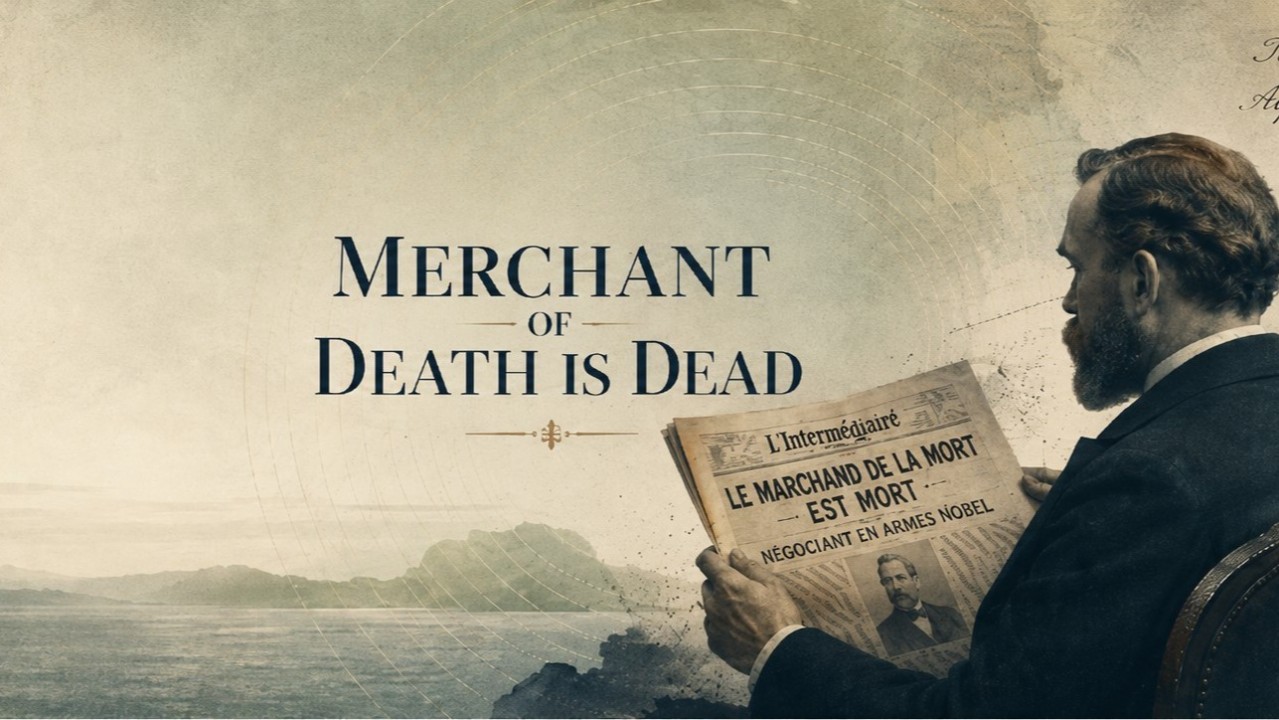
Paris, 1888
A French newspaper made a mistake.
Alfred Nobel was fifty-five years old, living between Paris and his laboratory in San Remo, working, as he had worked for three decades, on the chemistry of controlled explosion. His brother Ludvig had died in Cannes. The paper confused the two and ran Alfred's obituary instead.
He read it at breakfast.
“Le marchand de la mort est mort.”
The merchant of death is dead.
The article did not describe the man Nobel believed he had been. It described the man the world had decided he was. A maker of explosives. A profiteer from destruction. Someone whose inventions had been used on battlefields as readily as in tunnels. His name had become, in the hands of journalists and moralists and the ordinary public consciousness of the time, synonymous with industrial violence.
Nobel was not looking at what he had created.
He was looking at what his creation had become once it left his hands.
The two were not the same.
His work had moved into the world, and the world had done what the world does.
Absorbed it. Adapted it. Applied it.
Used it to blast the tunnel through Mont Cenis and the long bore through the Gotthard. Used it to open the American West for railroads. Used it to dig the deep mines that fed the Industrial Revolution. And used it, with the same chemistry and the same patents and the same enthusiasm, to kill people in numbers and at distances no previous weapon had reached.
Both happened…..simultaneously. With force that did not discriminate between purposes.
He had provided the force, but he could not control the direction.
By the time he read that obituary, his invention had travelled so far beyond his original intention that what he meant to build and what had actually been built were barely recognizable as the same thing.
There is a particular kind of silence that follows that kind of recognition.
Nobel had been given something almost no builder ever receives. The chance to see his ending before it arrived. Not the biological one, that would come eight years later. The other one. The meaning being assembled around his life by a world that had not asked his permission and did not require it.
Most of us don't get that morning.
We don't get to read our own obituary. We don't get to see the account that will outlive us, the story that continues generating consequence long after we stop generating it ourselves.
Nobel got to see it.
And then he sat down and rewrote his will.
The Prize
It took him seven years. He revised, withdrew, revised again. The final version was signed in a Paris club in November of 1895, witnessed by four men, leaving ninety-four percent of his fortune to fund prizes for those who, in the preceding year, had conferred the greatest benefit on humanity. His family contested it. His advisors thought him reckless. Sweden and Norway argued for years over jurisdiction. The first prize would not be awarded until 1901….five years after he was buried.
He didn't dismantle what he had built. He redirected what it would continue to generate. Recognition for work that advanced human understanding….physics, chemistry, medicine, literature, peace. A deliberate act of shaping the next ring of the ripple, even though he could not reach back and reshape the first.
The Other Ending
It was not that Nobel was uncertain about his legacy before that morning. It was that the question of his legacy had not, until then, been the most important question in his life. The most important question had been about building. Solving. Continuing to produce the specific kind of value his life's work had been dedicated to producing.
After the obituary, a different question moved to the center.
Not….what am I building.
But…what is being built by what I have built.
This is a harder question. The first one you can answer with intention. The second one you can only answer with patience….by living long enough to watch what your work generates once it has left your hands and become someone else's tool, someone else's inheritance, someone else's argument.
Most builders never confront the second question directly. They die before the second account is fully written. Their work continues, drawing ripples outward, but they are no longer there to read them. The compound takes over. The ledger keeps writing itself in their absence, in a language they no longer control.
Nobel was lucky.
He got an early reading.
The Second Portfolio
Eight weeks of gains. A new Fed chair. A war that will not end. Two of the largest IPOs in history about to land in the same season. We are building extraordinary things at extraordinary speed. AI, capital markets, fortunes…all compounding faster than any generation before us has had to metabolize.
But almost none of us, at any meaningful scale, are stopping to ask the Nobel question.
What is the account being assembled around us right now? What will be said about what we built, not in our own language, but in the language of a world that absorbed it and used it for whatever it needed?
That is not a morbid question. It is a portfolio question.
Every portfolio is two portfolios. The one you are constructing, positions, weights, allocation, intention. And the one being constructed by what your portfolio is doing in the world. What it is funding. What it is rewarding. What it is teaching the next generation about what was rewarded and how.
The first one shows up on a statement.
The second one shows up at a Sunday dinner thirty years from now.
Both compounds. That is the part almost nobody says out loud. The second portfolio compounds the same way the first one does….quietly, in fractions of a percent, in small habits that look harmless in any given month and become decisive across decades. The first compounds in dollars. The second compounds in character. Both arrive. Both keep arriving long after you have stopped paying attention. Only one of them is reported to you quarterly.
The other one is reported to your children, on their own timeline, in their own language, using a vocabulary you will not be present to edit
Reflections for the Week
A few questions to carry into the week, if you want them.
The Obituary Test. If a stranger had to write a paragraph about your work tomorrow, using only what your work has actually produced, not what you intended it to produce, what would they get right? What would they miss?
The Second Account. Beyond the statement, what is your wealth quietly funding, rewarding, and teaching? Who is watching, and what are they learning from what gets rewarded?
The Redirect. Nobel had eight years left and used them. What is one small, deliberate redirection….this week, not someday…that would change the ring being drawn around what you have built?
You do not get to see your own obituary. But you can ask the question without waiting for the obituary to arrive.
You can sit, this morning, with one of the largest markets in the world closed and the inbox quiet and a long weekend behind you, and ask what your life's force has been directing itself toward. Not what you intended. What it has actually become once it left your hands.
And then, like Nobel, with whatever years you have left, you can rewrite the will.
The next ring of the ripple is the only one still in your hands.
Festina lente
Henderson Family Wealth of RBC Dominion Securities