Henderson Family Wealth
July 19, 2026
Good mornin’
Well, it was another wild weekend, it seemed to end heavier than it began. What happened Saturday night at the Correspondents’ Dinner is a reminder that the headlines we navigate here are not abstractions. They land in real lives. The slower work continues alongside. That is what this morning is about, and I’m going to share a few stories with you.
The headlines are shifting quickly…geopolitics, trade friction, energy constraints. None of it is entirely new, but the form is changing.
Since late February, the Strait of Hormuz, through which roughly a fifth of global oil flows, has moved from open system to chokehold. Traffic collapsed. Prices surged. A two-week ceasefire announced in early April has since been extended indefinitely. But the strait has not meaningfully reopened.
This morning it seems that Iran is still managing who passes. The U.S. Navy is still blockading Iranian ports. Analysts are calling it a “dual blockade.”
A dozen vessels are crossing on a strong day. The normal number is over a hundred. And the picture shifted again over the weekend, the latest round of talks unraveled before it began. The U.S. delegation pulled back. Iran’s foreign minister moved on to Oman. Negotiations are to continue by phone.
Markets are digesting all of this as they tend to….quickly at first, then more thoughtfully.
Relief shows up in price, structure takes longer to reset, and that’s where this moment becomes interesting. Because markets don’t just react to events…they react to how “stable” those events feel.
A fixed rule can be managed; a moving constraint requires adaptation.
The S&P 500 closed Friday at a fresh all-time high while the University of Michigan’s consumer sentiment index closed April at 49.8 …..the lowest reading on record. Lower than the financial crisis. Lower than COVID. Lower than the post-invasion inflation shock. Markets and households are looking at the same world and arriving at very different conclusions.
In environments like this, discipline quietly compounds. The instruments change. The structure evolves, but the psychology does not.
Constraint doesn’t brake systems….it reveals them.
Which is partly why I’ve been rereading Extraordinary Popular Delusions and the Madness of Crowds.
What changes in markets is structure, and what endures is human behavior.
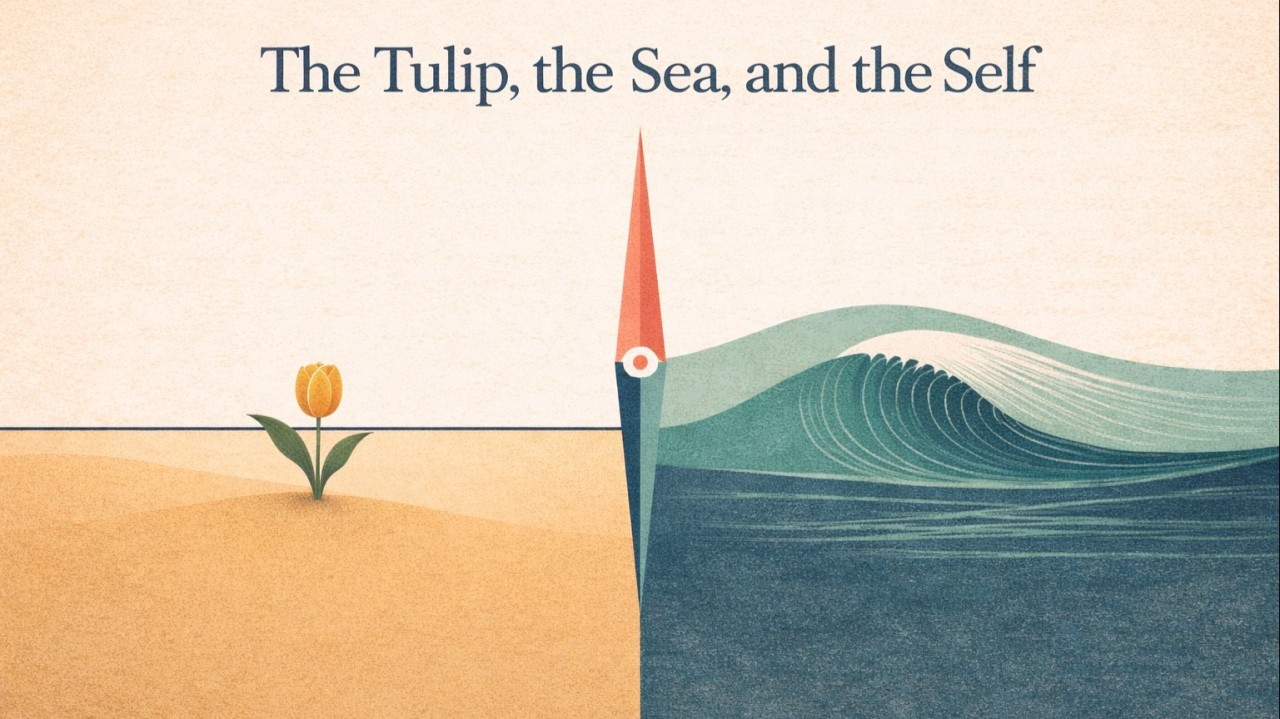
The Tulip
In the 1630s, in the Dutch Republic….one of the most advanced economies of its time, tulip bulbs became objects of speculation.
Not fields of flowers…..Bulbs.
Certain varieties were rare. Prices rose gradually, then rapidly. A single bulb could trade for more than a craftsman earned in a decade. Some were exchanged for the price of canal houses. Most of the traders never intended to plant them. Contracts were bought and sold in taverns. The bulb itself became secondary. What mattered was price direction.
It felt intelligent. Modern. Innovative.
There were persuasive arguments about scarcity and wealth creation. It wasn’t hysteria. It was narrative layered over momentum. Participation became proof of sophistication.
Tulips didn’t collapse because flowers were worthless. They collapsed because expectations became infinite. When prices hesitated, confidence faltered.
And yet commerce did not end. Capital did not disappear. Enterprise continued.
Cycles corrected excess…..and long-term wealth kept building.
That part is easy to forget.
The Sea
A century later, the geography changed. The psychology did not.
The South Sea Company promised extraordinary profits. Shares rose. Capital flowed. Even Isaac Newton was caught in the enthusiasm…later admitting he could calculate the motions of the heavens, but not the madness of people.
Intelligence does not immunize us from momentum.
At the height of the frenzy, new ventures launched daily. One famously advertised itself as “a company for carrying on an undertaking of great advantage, but nobody to know what it is.”
It raised money anyway, and it felt inevitable.
And yet markets matured. Institutions strengthened. Capital markets evolved.
History’s manias did not erase progress. They refined it.
We see similar dynamics in modern asset classes.
When prices rise, purpose goes unquestioned. When prices stall, the question shifts to role. Not “what is it worth?” but “what is it for?”
That question is not a verdict; it is a phase.
Gold went through it. Technology equities did. Credit markets did. Crypto is not unique in that regard. Price discovery eventually gives way to role discovery and markets, over time, tend to sort utility from enthusiasm.
Manias are the loud examples. But the same psychology runs in reverse….crowds can also miss what’s quietly working while they’re busy debating what’s loudly broken.
The Self
As we sit here this morning….Tulips aren’t the point. The South Sea isn’t the point.
The point is us.
Crowds form in markets, in careers, in boardrooms, on social feeds, in expectations we inherit without noticing. Every era has its tulips. Every generation its South Sea.
The object changes. The psychology does not.
The danger is not volatility. It is unconscious drift….into urgency that isn’t necessary, into narratives that aren’t examined. This is not pessimism, I’d call it grounded optimism, because awareness compounds too.
And this is where markets today feel less like threat, and more like opportunity quietly arriving while attention is fixed elsewhere. Beneath the indices, the week’s gains were narrower than they looked. Intel reignited semis. Nvidia reclaimed five trillion. The Magnificent Seven is once again carrying disproportionate weight. But outside the megacaps, something quieter is happening. International equities are participating again. Cyclicals are stabilizing. Cash flow is being rewarded. Diversification…long out of fashion…is starting to look strategic again.
While crowds debate narratives, fundamentals do their slower work.
Discipline matters more than prediction. Valuation matters again, and patience regains its edge. Rotation doesn’t feel dramatic when you’re diversified.
It feels like progress.
Reflection
There are evenings when I look at my kids around the dinner table and I’m reminded that the real audience of our decisions isn’t the market. It’s the future.
They won’t remember tariff cycles….they will remember tone.
You do not have to withdraw from the tide, you simply have to know why you are in it…because in the end, the wealth that lasts is not the tide we rode, it is the self we kept while it was rising.
So as we head into the week, past headlines, past whatever feels urgent this morning, whether you are an investor, a leader, a parent, a partner, it may be worth asking:
- Where am I modeling steadiness, and where am I amplifying noise?
- Am I leading from conviction, or from reaction?
- What uncertainty can I absorb calmly so others don’t have to?
- Where is opportunity emerging quietly while attention is fixed elsewhere?
- If conditions shift, does my character remain consistent?
Enjoy the spring sun out there this week!
Be well and enjoy the moments,
Henderson Family Wealth of RBC Dominion Securities