Henderson Family Wealth
September 13, 2026
Good mornin’
Well, with the kids back at school last week, most of the week was spent adjusting and bracing, much like was felt across global markets over the week.
Friday's inflation print landed almost exactly where forecasters expected, and markets exhaled. Then they did what markets do: priced the next worry. Rate expectations shifted. Bond yields climbed…the U.S. 10-year brushing 5%. Oil pushed higher as tensions around the Strait of Hormuz reminded investors that uncertainty rarely disappears. It simply changes shape.
Strip away the basis points, though, and you're left with two emotions doing much of the work: the fear of what might be lost, and the appreciation of what still holds.
Regret and gratitude
The Two Flavours
In our investing world, every investor eventually learns the two flavours of regret: the loss you took, and the gain you watched from shore. The first hurts immediately. The second can stay with you for years.
Psychologists Thomas Gilovich and Victoria Medvec found something similar outside markets. In the short run, people tend to regret what they did. Over longer periods, it is often what they didn't do that stays with them…..the business never started, the wave allowed to pass.
Investing has its own version. We sell winners too early because being right feels good, and we hold losers too long because admitting we were wrong feels worse. Think of the investors around the globe, and there were many, who sold in the spring of 2020 and then watched the recovery from the sidelines. The market forgave the drawdown within months. They never quite forgave themselves. That regret never showed up on a statement, but it showed up in every decision afterward: the hesitation, the waiting for a re-entry that never felt safe, the quiet certainty that the next wave would be the one they deserved.
But the deeper problem with regret is not that it hurts. It's that it masquerades as wisdom. Regret pretends to be information…it feels like analysis, like experience, like something useful to carry forward.
Often, it is simply the past charging rent.
The Patient Emotion
Gratitude works differently.
David DeSteno and his colleagues once asked people to choose between receiving money immediately or receiving more money later.
Before choosing, some participants were asked to recall something that made them feel grateful. Those people became measurably more patient…not because someone taught them about compound interest, and not because they developed more discipline in the preceding five minutes. They simply spent a moment appreciating what they already had.
Robert Emmons and Michael McCullough found something similar using little more than a notebook. People who regularly recorded things they were grateful for reported greater optimism and better sleep compared with people who focused on hassles.
Same lives. Different ledger.
Maybe that shouldn't surprise us. Gratitude tells us that enough already exists….and once enough exists, waiting becomes easier. That is useful in markets. It may be even more useful everywhere else.
At the Family Table
I come from a long line of agricultural heritage. My parents didn't farm, but their parents did…and some inheritances travel anyway. The arithmetic came down to me intact: a farmer can curse the rain, but he still has to plant again. There is little use building an identity around the harvest that should have been.
Families are not so different. Every family enterprise I've advised eventually encounters some version of the same question: will the next generation receive what came before them with gratitude, or measure it against what might have been?
Gratitude says: “look what was carried here for us.”
Regret says: “imagine what this could have been.”
One creates stewardship. The other creates scorekeeping. And families can keep score for a very long time…..the estate that wasn't equal, the business that sold too early, the sibling who got the opportunity, the cottage, the shares, the decision made in 1987 that somehow still occupies a chair at Sunday dinner. I have watched families of extraordinary financial wealth sit around tables poor in nearly every way that matters, because regret had been given the head seat.
But I have also sat with families who begin every annual meeting the same way: with the story of how it started.
The first truck.
The mortgage on the house nobody talks about anymore.
The grandmother who kept the books at the kitchen table.
Not nostalgia. Orientation. The next generation cannot be grateful for what it has never been told.
Gratitude makes wealth transferable. Regret makes it radioactive.
The Deferred Life
The regrets I hear from successful people are rarely about the things you might expect. It usually isn't the stock they sold too soon, or the acquisition they missed, or the year the portfolio trailed the index.
It's the deferred life.
The trip that kept getting moved. The sabbatical that never quite made sense. The recital missed for a meeting nobody remembers. The friend they meant to call. The years spent telling themselves that after the next deal, the next promotion, the next liquidity event, the next number “then” they would live differently.
Bronnie Ware spent years caring for people near the end of their lives and later wrote about the regrets she heard repeatedly. They wished they had lived more truly to themselves. Worked less. Expressed what they felt. Stayed closer to friends. Allowed themselves to be happier.
There is something unsettling about that list: almost none of it requires more money. Mostly, it requires noticing what is already there.
And nearly every regret on it is the same thing.
A wave watched from shore.
The Anchor and the Dolphin
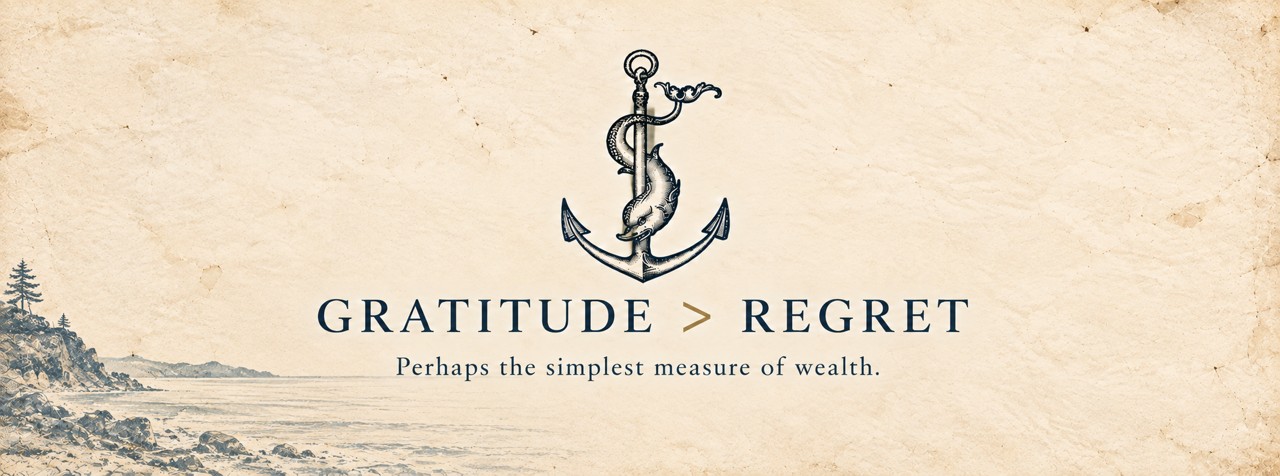
Five hundred years ago in Venice, a printer named Aldus Manutius was making books. Not ordinary books….beautiful ones, durable ones, some small enough to carry with you rather than leave chained to a desk or lectern. Onto each he pressed an emblem: a dolphin wrapped around an anchor. The dolphin represented speed; the anchor, steadiness. Together they gave form to an ancient idea associated with the Roman emperor Augustus:
Festina lente.
Make haste, slowly.
Readers of this letter will recognize the phrase; I've mentioned it in these musings with it for years. But lately I've been thinking less about the dolphin and more about the anchor.
We usually imagine an anchor as something that stops us: weight, drag, something preventing movement. But that isn't what an anchor is for.
An anchor lets you stop drifting.
There is a difference.
Gratitude does the same thing. It does not ask us to stop wanting, building, investing, improving, or moving forward. It simply gives us somewhere to stand while we do.
Gratitude says: this matters. This is enough to notice. Do not sail past this.
Regret is an anchor too…except regret catches behind us. It holds us to the decision already made, the opportunity already missed, the life that might have been.
Same iron. Different direction. Entirely different life.
Perhaps that is why gratitude and regret belong beside one another. Both look backward. But only one lets you move forward.
Lately I've been tempted to open client reviews with a different first question. Not "how did the portfolio perform?"….we always get to that…but: “what did the money make possible this year?”
The tuition paid. The month at the lake. The parent moved closer to home. It changes the room. Performance tells you where you stand. Gratitude tells you what the standing is for.
So after all the research, markets, families, portfolios, and years spent thinking about what wealth actually means, I keep coming back to an embarrassingly simple equation:
Gratitude > Regret
Not because a wealthy life contains no regret. It will. But perhaps wealth has less to do with eliminating regret than making sure gratitude remains greater.
Greater for what you have.
Greater for who is still at the table.
Greater for the waves you caught.
Greater, even, for the ones you didn't.
Because eventually the market closes. The harvest comes in. The children grow up. And the tide goes out.
The question is not whether you could have had more.
The question is whether you noticed what you had.
Festina lente.
If this found something in you, send it to one person who'd feel the same, these Musings travel entirely by hand. And if someone handed you this one, subscribe and it'll find you every Monday.