Henderson Family Wealth
August 26, 2026
I once was lost, but now am found – John Newton, 1779
Good morning and happy Monday!
I had last week off, a rare stretch of days to relax, reflect, and write without a clock running. So, this one runs a little longer than usual. The story at the center of it waited 131 years to be read….it earns the extra few minutes.
The Water Last Week
Markets spent the week doing what August water does….glassy on top, busy underneath.
The S&P 500 reached another record Thursday before easing into the weekend, still finishing higher for a third straight week. Inflation readings had calmed some fears about another rate increase. Gold strengthened. Energy moved with renewed tension around the Strait of Hormuz. And then came the undertow: American retail sales fell 0.6% in July, the weakest reading in more than a year, and consumer sentiment dropped sharply. The market was near a record while the people underneath it were feeling a lot less sure.
Records above. Doubt beneath.
Hold that thought, because this week's story is about currents. What they carry, what they hide, and how long it sometimes takes before we know where something has landed.
The Beach
I spent last week at our place in Sauble Beach, on Lake Huron, with the family. A whole week of nothing with a schedule attached to it …the sand, the water, the kids burying whatever wasn't fast enough to escape them. Huron does a convincing impression of an ocean: a wide sandy beach, waves with some shoulder on them, a horizon with no far side. Stand there long enough and your geography starts to slip. Mine slipped all the way to Australia…to the beaches off the Great Ocean Road I walked half a lifetime ago on exchange, back when the far side of the world was my mailing address.
Maybe that's why, somewhere around day three, once my mind finally stopped composing emails to nobody, it reached for a story I'd recently come across.
It begins with a sailor. It ends on an Australian beach. And between the two are 131 years in which almost everyone would have assumed nothing was happening.
They would have been wrong.
The Throw
On June 12, 1886, a German sailing barque called the Paula was crossing the Indian Ocean from Cardiff toward what was then the Dutch East Indies. Somewhere west of Australia, her captain dropped a bottle overboard.
It wasn't romantic. There was no love letter inside, no confession, no treasure map. There was a printed card: the date, the coordinates, the name of the ship, the route, and a simple request to whoever might eventually find it. Record where and when it was found, and return the information to the German Naval Observatory in Hamburg.
The captain then opened the ship's meteorological journal and made an entry.
“Drift bottle thrown overboard.”
That was it. A bottle, a line in a journal, and the Paula sailed on.
The Experiment
The bottle was one of thousands. For decades, German ships had been dropping them into oceans around the world as part of an experiment to understand currents and improve navigation. The idea was beautifully simple: throw something into the water from a known position, then wait. If somebody finds it, the distance and location tell you something about what happened in between.
More than 6,000 bottles were released during the program. Only 662 replies made their way back. Eventually the experiment ended, the scientists moved on, and the journals went into archives. In 1934, the replies stopped coming, and for more than eighty years the count remained the same. You can imagine the conclusion.
The rest were lost.
The Wait
Except at least one wasn't.
Researchers believe the Paula's bottle probably reached the Western Australian coast within roughly a year of being thrown. Think about that…..
The ocean crossing…the dramatic part, the part we'd make the movie about, may have taken only months. Then the bottle reached the sand and disappeared. The dunes buried it deeply enough that the cool, damp conditions preserved the paper inside.
Year after year passed above it. People walked the beach. Children played there. Storms came through, governments changed, wars began and ended. The men aboard the Paula grew old and died, and the experiment itself disappeared into history. And still the bottle sat there.
Which means something I've been thinking about ever since:
The bottle wasn't lost. It had already arrived. Nobody knew it yet.
There is a difference.
The Bogged Car
On January 21, 2018, a family was driving along a beach in Australia, just north of Perth, when their car became bogged in soft sand. While the others worked to free it, Tonya Illman went walking through the dunes with a friend. She noticed an old bottle sticking partly out of the sand and picked it up because she thought it might look nice on a bookshelf. Only later did anyone notice the damp roll of paper inside, tied with string.
The Western Australian Museum traced the ship and the experiment. Researchers in Germany searched the archives. And there, in the Paula's original meteorological journal, was the entry from June 12, 1886. The coordinates matched. The date matched. The handwriting matched.
Drift bottle thrown overboard.
One hundred and thirty-one years and 223 days after the captain made that entry, his bottle had been found….the oldest known message in a bottle. The experiment had been over for generations. Everyone involved was gone.
But the answer still counted.
The Things We Call Lost
That's the part I can't stop thinking about. Not that the bottle survived..that for most of its existence, anyone keeping score would have put it in the wrong column. Lost. Failed. No reply. No result. And yet for perhaps 130 of those years, it wasn't moving at all. The current had already done its work. The bottle was sitting on the shore. The problem wasn't that nothing had happened. The problem was that nobody could see what had happened yet.
We make that mistake constantly.
We confuse unseen with unfinished.
Investors do it. Parents do it. Leaders do it. We make a good decision and look around for evidence that it worked. We have a conversation with someone and wonder whether it landed. We teach something to our children and become frustrated when they appear not to hear a word of it. We build carefully, save patiently, show up consistently, love imperfectly, and because there is no immediate reply, we wonder whether any of it carried.
Maybe that's because we're measuring the wrong thing. Or maybe we're simply measuring too soon.
The Ink
I should probably tell you why this story stopped me cold.
I have a message in a bottle tattooed on my arm. It's been part of me long enough that I mostly forget it's there…the way you sometimes forget the things you believe most. I didn't get it because of the Paula; I'd never heard of the Paula. I got it because something about the image had always made sense to me. You put something into the world. You don't control the current. You don't choose the shore. You may never know who finds it.
You send it anyway.
The message in the bottle on my arm simply says Amazing Grace
When my kids were small, it’s the song I sang them at bedtime. I wasn't trying to teach them anything. I certainly wasn't thinking about inheritance or legacy or what parts of us continue in other people. It was bedtime.
A dark room, a tired dad, a small heartbeat against my chest, and a song.
I once was lost, but now am found.
I must have sung those words hundreds of times. Maybe thousands.
At the time, they felt like nothing more than something that helped a child fall asleep. But Presley knew the words to Amazing Grace before she could speak. The song had landed before the language did….the reply coming back before I understood I'd sent anything at all.
Now I'm not so sure.
The Small Things
We spend a lot of time deciding what will matter, and we are remarkably bad at knowing. We imagine it will be the big things….the inheritance, the business, the house, the advice we carefully prepared, the family meeting where everyone finally understood what we were trying to say. Maybe. But I suspect much of what actually travels leaves us much more quietly. A phrase repeated around the dinner table. How your father reacted when something went wrong. The way your mother made people feel when they came through the door. A Saturday at the beach. The fact that somebody always called.
A song sung in the dark.
Things nobody thought to put in the estate plan. Things nobody thought were being inherited at all.
We may spend years trying to preserve the obvious things while the important ones are already moving through the current.
Reflection
Maybe this is one of the harder truths about wealth: not everything valuable gives us a receipt. Some investments compound where we can see them. Others compound inside people, and those may take much longer to report back.
That doesn't make the work passive. The captain of the Paula didn't simply throw a bottle anywhere and hope. He knew his position, recorded the conditions, made the throw deliberately….and then continued the voyage.
Do the work carefully. Know where you are. Make the throw deliberately. Then give the current some room.
The Long Reply
Which brings me back to the markets. A record high tells us where the market is; it doesn't necessarily tell us everything about the current beneath it. Neither does a bad month of retail sales, a frightening headline, or a particularly good one. They are positions in a much longer journey.
Our temptation is to redraw the route every time the water changes colour. The captain of the Paula did something different: he logged the position, noted the conditions, and sailed the plan.
Maybe that's still the job….
In markets, in families, in life.
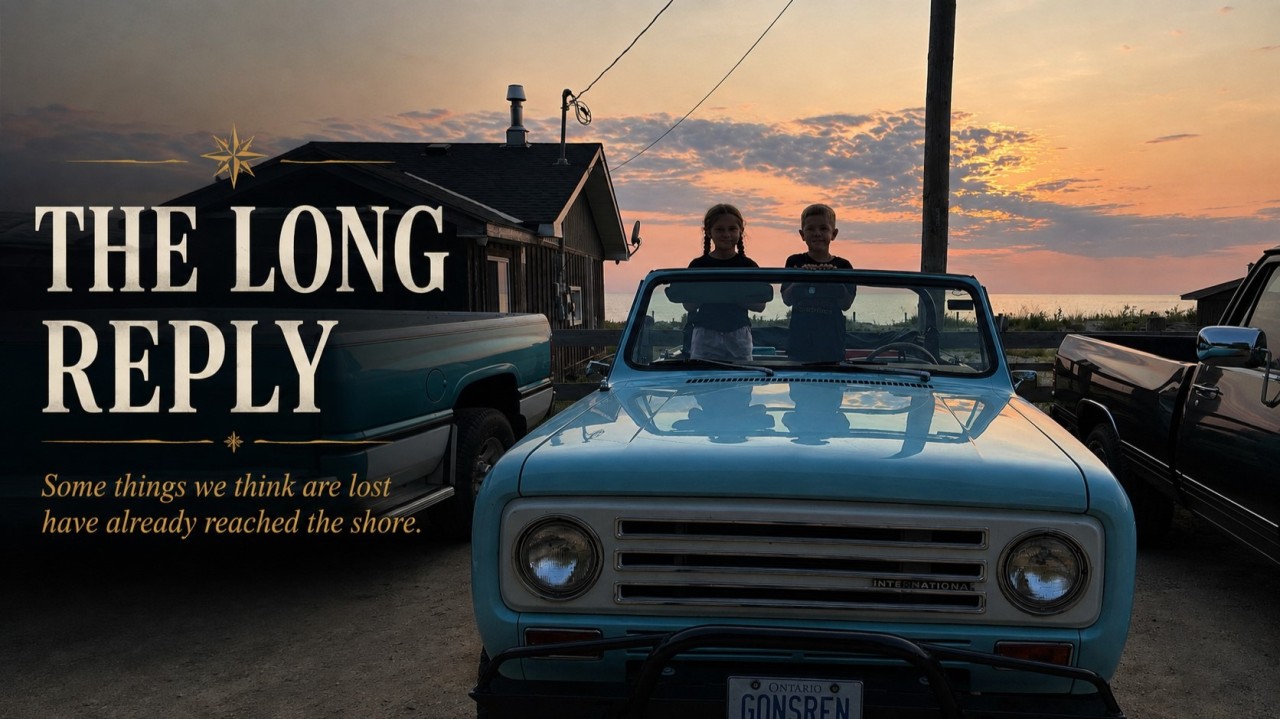
Because some things we think are lost have already reached the shore, they are simply waiting to be found. And sometimes the thing that travels furthest isn't the thing we worked hardest to preserve. It's the thing we barely knew we were sending.
The note in the bottle asked whoever found it to do something simple: say where you are, say when it is, and send word back.
Or just sing it to somebody small.
Same thing.
Festina lente.