
Mark Krygier
Senior Portfolio Manager & Wealth Advisor
September 30, 2026
Here we go again! Over the past few decades, we have been conditioned to believe that if a crisis will arise in the economy or the stock markets, it will be confronted head-on by the U.S. Federal Reserve (the “Fed”) or other Central Bank, and everyone will be “rescued” at the last moment – a virtual economic “thriller” right out of Hollywood. The U.S. banks were bailed out in 2008-09 after they assumed excessive leverage during the subprime mortgage crisis. They were also bailed out after the Long-Term Capital Hedge fund collapse in the late 90s, after too many banks assumed “counterparty” exposure to what was the largest hedge fund in the world. Small businesses were bailed out during Covid, following their near economic collapse following government-induced closures, and the consumer seems to be getting bailed out every few years, by the lowering of interest rates any time the economy slows or faces adverse conditions. One should be asking if it is safe to assume this cycle of crisis and rescue can occur indefinitely without repercussions? In a recent Memo by the financial guru Howard Marks of Oaktree Capital, entitled, “Shall we repeal the laws of economics – Part III”, Mr. Marks discusses the latest Central Bank (the “Fed”) intervention in the “natural laws” of economics – the purchasing of government issued bonds by the Central bank (i.e. by the government itself).
Marks compares the normal workings of an economy to the laws of nature, in which “survival of the fittest” helps weed out the animals that will not be successful as they fend for themselves in what can be a brutal world. For instance, when the government tries to tackle the problem of too many predators, such as wolves, foxes or bears in a given area, it can lead to an excessive number of deer, racoon, skunks, etc., which then become the source of other problems. In the ocean it is the killing of sharks that can lead to too many dolphins, and too many dolphins can deplete various types of fish, or other creatures. We know from the laws of physics that for every action there is an equal and opposite reaction. In the world of economics, it is assumed that those who take the risks of failure are entitled to the profits they make when they are successful. However, when governments or Central Banks interfere with the normal process, then this assumption can collapse, as some businesses or consumers which have assumed excessive risk in the attempt to achieve profits, are allowed to remain in business, rather than learning “the hard way” that assuming excessive risk (often in the form of too much leverage) can lead to financial ruin. For instance, CEOs of banks and other large corporations, like GM and Chrysler, have been allowed to keep taking risks for their own personal or for their corporation’s own profit, knowing that, as some have coined the phrase, in the governments eyes they are “too big to fail.” In addition to a breakdown in the relationship between risk-taking and profit making, there are also “victims” of this government meddling. Who are the “victims”? We the taxpayers. How does the government or Central Bank “bail out” businesses? The simple answer is by issuing debt, which is supposed to be “paid” for by the tax revenue collected by the government. Sadly, there seems to be no fiscal prudence in any developed nation today, nor on either side of the political spectrum, and the result is increasingly excessive amounts of debt which already appears to be beyond the point of being able to be paid off. Sadly, this excessive debt may dampen economic growth for generations.
For the individual, there are periodic times when some level of financial “rescue” occurs, such as former President Biden‘s proposed bailouts of student loans. Why should the government bailout students who took out loans (“leverage”) to take studies, many of which had little chance of providing a reasonable paying career. Why should taxpayers assume that financial burden any more than the debt assumed when large corporations get bailed out? What happened to the notion that assuming risk might pay off with reward, but it is not a guarantee? Taking away the “risk” part of the equation means such borrowers – whether corporate or individual get a “free ride” on their part, and somebody else (we the taxpayer) suffers the consequence.
When it comes to investing, similar principles apply. Generally, the theory is that when someone assumes a certain level of risk they should be rewarded accordingly. However, we all know that there is no guarantee in this process, which can make the process of investment decision-making challenging. One thing that we can say with certainty, is that those investors who choose the “safe” route – savings accounts, GICs/CDs, treasury bills or other such instruments, in order to avoid the “volatility” of money-making and inflation-beating investments, will never make a lot of money on their investments. Worse, while such investments may ensure that their “nominal” capital value may be preserved, but on an after-tax and after-inflation basis, this “safe” return may in fact be negative. So much for being “safe.” At the opposite end of the risk-taking spectrum are those who roll the proverbial dice to hit the investment homerun that will bring them into wealth nirvana. History however shows that for every one of those that hit a homerun, a significantly higher number of “investors” using this approach strikeout and have nothing to show for their assumption of risk. Neither of these extremes seem reasonable as a predictable process for building or preserving wealth. When the aggressive investors add leverage to their investment approach it can have the effect of turning the occasional homerun into a “grand slam” or the more likely strikeout into a game-ending miss.
Bottom line
Investors nervous about the risks involved in investing need to consider their tolerance for volatility in the short run versus their need to achieve levels of return on their capital above the level of inflation, but in a predictable manner. Knowing that government driven policies can upset the natural order of economic rules, investors need to rely on sensible approaches to investing their hard-earned capital and to avoid jumping in and out of investments which are by nature long-term in nature. If you are concerned that your investing approach is appropriate for your own needs, contact us and let’s chat!
Global benchmarks
As of September 30, 2026 (Canadian $ Returns – except where noted)
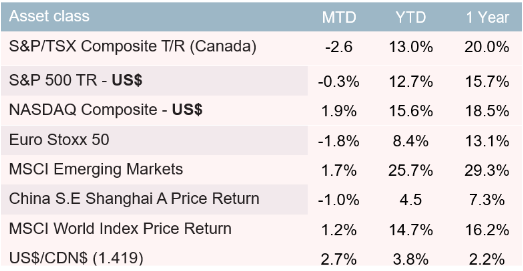
Source: Bloomberg