How tax-friendly is your estate plan?
It is so important to plan ahead to try and minimize taxes during one’s lifetime, as well as when planning for one’s estate. Such planning needs to be done in advance, with thought and professional advice, as tax and other laws are continually changing. If you or anyone you know would like to discuss planning to minimize your taxes, or if you have concerns about any retirement or other wealth planning needs, please contact us and let’s schedule a time to meet!
It is so important to plan ahead to try and minimize taxes during one’s lifetime, as well as when planning for one’s estate. Such planning needs to be done in advance, with thought and professional advice, as tax and other laws are continually changing. If you or anyone you know would like to discuss planning to minimize your taxes, or if you have concerns about any retirement or other wealth planning needs, please contact us and let’s schedule a time to meet!
Mark Krygier
Senior Portfolio Manager & Wealth Advisor
August 31, 2026
As I begin my 4th decade in the wealth advisory business, almost every week I find myself having discussions with somebody who is contemplating or is starting their retirement years. Some are downsizing, some are moving to retirement homes, others are moving to be closer to their children, and some are happy to just stay put. The challenges of retirement are certainly endless. How does one go from a 9-5, 5-day a week routine of getting up every morning for all of one’s daily activities, to one where you have to set the agenda each day. I have heard some retirees tell me they are busier than they have ever been, as they finally have a chance to do all of the things they couldn’t get to do while they had their work routine dictating a significant portion of their available time. Others are thrilled to have the opportunity to travel for more than a few days at a time and are content to check off their “bucket list” one journey at a time. There are those who are dealing with health challenges and navigating their way through the medical system, which can certainly add stress to one’s life. When it comes to the financing of retirement there is also a huge range of experiences, from those who can easily maintain their pre-retirement lifestyle in their post-working years, and those that find it quite challenging to do so, especially in light of an inflationary environment which keeps driving up the cost of daily living.
When it comes to planning for one’s estate, I have also seen a wide range of ideas as to how an estate will be distributed amongst beneficiaries. Do you leave your assets to your children? Grandchildren? Other family members? Do you leave it to them directly or “in trust?” Are there special considerations as to unequal financial needs amongst potential beneficiaries? Those with no obvious beneficiaries often look to bequeath their assets to nieces, nephews, cousins or even to charities with which they have a particular affinity. When trying to formulate one’s estate plan, something often overlooked is the impact of taxes when distributing an estate. To paraphrase George Orwell, “not all assets are created equal” when it comes to taxes.
In Canada, for tax purposes there is a “deemed disposition” upon death. In simpler terms, CRA deems all of one’s personal assets to have been disposed of, or sold, on the date of death. Generally, between spouses there are no tax implications, as generally spouses inherit each other’s cost base, and assets pass from the first one to pass away to the surviving spouse. However, upon the passing of a second spouse, or for those without a spouse, there are immediate tax implications for the estate on the date of death. Consider the various assets one might have at one’s passing – a house, a second home like a cottage or a rental property, a registered savings account like an RSP or a RIF, a Tax Free Savings Account (TFSA), a nonregistered investment account, shares in a private corporation, and valuables like art and jewelry. Each of these assets have different tax implications and in planning for one’s estate, it is crucial that these differences be considered, so I will briefly discuss each one of these individually. There are ways to plan to reduce estate taxes and sometimes insurance solutions may be available as a cheaper source for paying these taxes. In the end, it is important to consult with your own legal and tax advisors to confirm any plan you wish to make or solutions you consider are compliant with current legislation and practices.
What are the tax implications on one’s estate for the following assets:
A) Principal Residence: for Canadian taxpayers, the gains on the sale (or deemed sale) of one’s own home are exempt from paying capital gains tax. Often one’s home is one’s largest single asset and a great source for leaving a legacy. If amongst a married couple one is a Canadian taxpayer and one is a US taxpayer, consider registering the title of the home in the name of the Canadian taxpayer only, as US taxpayers have to report capital gains taxes on the sale of their homes.
B) Cottages or rental properties: there is a taxable “deemed disposition” on any property other than a principal residence. Tax will be payable based on the net capital gains, so it is important to keep copies of any bills paid to make capital improvements, such as extensions, new decks or built-ins, which can increase the cost base of the property and thereby decrease the taxable gains that will be owing.
C) Registered accounts like RSPs or RIFs: These accounts are the LEAST tax efficient to one’s estate, as 100% of the remaining balance is taxed as income at one’s marginal tax rate in the year of death. Between spouses that could easily mean a balance of over $1 million, leaving the estate paying tax at the highest marginal tax rate of about 53% in Ontario, or $530,000 for every $1 million. For Canadians, this is important, as RSPs or RIFs may form a significant portion of what they thought they would be leaving over as a legacy. However, without planning, there may not be much left.
D) Tax Free Savings Accounts (TFSAs) These accounts are the MOST tax efficient as they are bequeathed tax free even to a non-spouse beneficiary.
E) Nonregistered investment accounts and private company shares: there is a deemed disposition of these assets upon death and taxes will be payable on the capital gains which are not yet “realized” as of the date of death.
F) Valuables like art or jewelry:these generally fall into the category of “personal use property”, and at the time of death a capital gain or loss may arise. However, capital losses on these types of assets are usually deemed to be nil.
Bottom line
It is so important to plan ahead to try and minimize taxes during one’s lifetime, as well as when planning for one’s estate. Such planning needs to be done in advance, with thought and professional advice, as tax and other laws are continually changing. If you or anyone you know would like to discuss planning to minimize your taxes, or if you have concerns about any retirement or other wealth planning needs, please contact us and let’s schedule a time to meet!
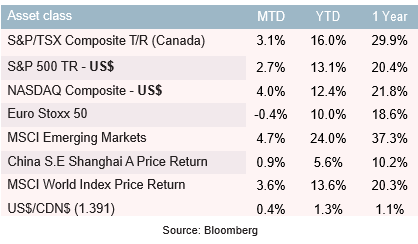
Global benchmarks
As of August 31, 2026 (Canadian $ Returns – except where noted)