The two biggest investing mistakes - beware!
With 30 years in the investment field under my belt, I can’t help but express my feelings of gratitude for the opportunity to have been able to advise clients through so many ups and downs that come with capital markets. I certainly look forward to the coming decades and being able to continue making a positive impact on our valued clients. One thing for certain is that with time comes experience, so should you or anyone you know have concerns about their portfolio, or about any retirement or other wealth planning needs, please contact us and let’s schedule a time to meet!
With 30 years in the investment field under my belt, I can’t help but express my feelings of gratitude for the opportunity to have been able to advise clients through so many ups and downs that come with capital markets. I certainly look forward to the coming decades and being able to continue making a positive impact on our valued clients. One thing for certain is that with time comes experience, so should you or anyone you know have concerns about their portfolio, or about any retirement or other wealth planning needs, please contact us and let’s schedule a time to meet!

Mark Krygier
Senior Portfolio Manager & Wealth Advisor
August 3, 2026
Happy anniversary! August 2026 marks three full decades of my start in the investment business, having joined RBC Dominion Securities in August 1996. To paraphrase Hercule Poirot of Agatha Christie fame, I am thrilled to be exercising the “little grey cells” in an era which is becoming increasingly more complex and therefore more demanding for investors. I sometimes joke that the three decades of my actual experience is equal to 50+ years of experience, when you consider all that has occurred since 1996, including: the Asian currency crisis, the Russian currency crisis, the collapse of Long Term Capital Hedge fund, the Bre-X gold fraud, the Dot Com era (which had eerily like similarities to the A.I. phenomenon), 9/11 which brought radical terrorism to the mainstream headlines, the subprime mortgage crisis, the Madoff Ponzi scheme, the fear of Covid and the aftermath of repressive restrictions, deflation, inflation, the Russian invasion of Ukraine, the terror invasion of Israel on October 7th, and more recently of course A.I., A.I. and more A.I. For investors, it has been a series of one hysterical set of headlines after another, reminding me of the famous cartoon of the doomsday sayer standing on the street corner, calling for the end of the world today, tomorrow, and each and every day…
So, how have stock investors fared since August 1996? Startlingly, quite good. The U.S. S&P 500 provided investors with a nominal return of 1,065% (including dividends) for an annual return of approximately 10.3-10.5% per annum. The Canadian S&P/TSX did not fare as well, yet it still provided a nominal return of approximately 596% or about 7.5-8.5% (including dividends) per annum over that same period. This growth is known as the power of compounding, which Benjamin Franklin famously described as “Money makes money” and which Albert Einstein was said to have described as “the eighth wonder of the world – he who understands it earns it…he who does not pays it.” Despite the upheaval and crisis over this lengthy period, one would think that investors should have had an easy time making money – buy, hold and prosper – as one famous marketing slogan would have us believe. The trouble is that investors continuously have to fight their own fear and greed, firstly just to invest and secondly to stay invested, to reap the rewards that capital markets have provided.
In my experience, there are two main mistakes made by investors and I have seen both repeated over and over again. The first mistake is something I have mentioned on multiple occasions and that is putting “short- term” money into “long-term” investments. If you have a large tax bill to pay in 6 months from now, or you are putting down a downpayment on a piece of property for yourself or, for instance, for an adult child, or if you are saving for that extravagant family vacation in a year from now – then when all is said and done you need that money to be there at a specific time in the future, end of story. That means investing the money set aside in something other than a short-term investment like a money-market fund, a Cashable GIC/CD or something comparable, would be to misalign your needs with how you are investing your money. In my mind, that is a form of gambling. You might “win” and make more money than the 1-3% you would make in a money-market fund, etc., but you could just as easily “lose” and that means losing actual capital.
The second common mistake investors often make is not recognizing when the money they have available to invest is in fact available for investing long-term. Common examples of this would be someone sitting on a large quantity of cash in the bank account, which resulted from the sale of a business, or a piece of real estate, or they have received an inheritance, and they have “parked” this money in their bank account or another short-term instrument like a money-market fund, etc. Unless such a person plans to reinvest that cash into another business, or into another piece of property, or to gift it to children or others, or to pay down debts like lines of credit or mortgages, then it is very likely that this money is not needed in the “short-term” and is more likely needed as a “rainy-day” fund or for that “what if?” scenario such as the unknown costs of future health care or retirement living. On more than one occasion I have heard from someone in one of these scenarios that they don’t need “income” from their investments, as they have plenty of cash in their bank account. What they often do not realize is that what they are referring to as their source of “income” is in fact a draw on their actual “capital” and that this capital is not producing much if any income. Not only can this mistake result in a permanent loss of capital to the investor but, when you throw the evil scourge of inflation into the equation, it can result in a reduced level of purchasing power over time, if that money is not invested to at least keep up with inflation.
The challenge of investing is of course compounded by the 24/7 hyper awareness of headline news and the deluge of information available. At one time an investment advisor was also the sole or main purveyor of information to investors, but today that obviously is no longer true. At the same time, the role of the investment advisor has in most cases evolved from being the provider of information and the executioner of tasks, such as stock trading, to being an actual advisor. Whether they choose to work with an advisor or whether they prefer the “DIY” approach, to avoid the two most common mistakes, an investor’s first challenge is to figure out what they need from the money they have available to invest. Undoubtedly, the distractions of the daily dose of crises which sell advertising certainly doesn’t help with this decision-making.
Bottom line
With 30 years in the investment field under my belt, I can’t help but express my feelings of gratitude for the opportunity to have been able to advise clients through so many ups and downs that come with capital markets. I certainly look forward to the coming decades and being able to continue making a positive impact on our valued clients. One thing for certain is that with time comes experience, so should you or anyone you know have concerns about their portfolio, or about any retirement or other wealth planning needs, please contact us and let’s schedule a time to meet!
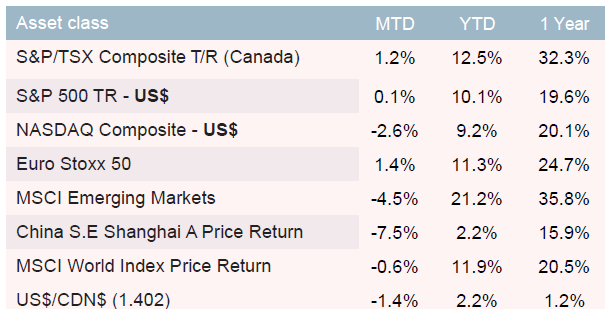
Global benchmarks
As of July 31, 2026 (Canadian $ Returns – except where noted)
Source: Bloomberg