Up, up and away! It’s super SpaceX!
Investors should take note of the SpaceX IPO, not necessarily as a good investment, but for what it might represent. When the last technology market bubble burst in 2000, it was the beginning of a “lost” decade on the American stock market, as the S&P 500 had a 10-year compounded return of 0% from 2000 to 2010. Successful investing over the long-term consists of buying good quality at a reasonable price. If you are concerned how today’s high valuations might impact your portfolio, or to discuss your retirement or other wealth planning, contact us and let’s schedule a time to chat!
Investors should take note of the SpaceX IPO, not necessarily as a good investment, but for what it might represent. When the last technology market bubble burst in 2000, it was the beginning of a “lost” decade on the American stock market, as the S&P 500 had a 10-year compounded return of 0% from 2000 to 2010. Successful investing over the long-term consists of buying good quality at a reasonable price. If you are concerned how today’s high valuations might impact your portfolio, or to discuss your retirement or other wealth planning, contact us and let’s schedule a time to chat!

Mark Krygier
Senior Portfolio Manager & Wealth Advisor
July 1, 2026
Do you remember when it was still impressive to hear that somebody was a millionaire? Today, with the average house price in Toronto and Vancouver at over $1 million, even after a 20-30% drop in housing prices over the past two years, being a millionaire is not so impressive anymore. However, being a billionaire – most would agree that is impressive wealth. How about a trillionaire? Well, Elon Musk of Tesla fame is now the world’s first individual trillionaire, after his company SpaceX went public in the largest “IPO” (initial public offering) in history, at more than twice the value of the next largest IPO. To think that it was only a couple of years ago that some of the largest companies in the world grew to over a trillion dollars – including giants Nvidia, Apple, Microsoft and Google (Alphabet), but to now have an individual person worth that much - quite amazing. On paper, this new publicly traded company, SpaceX, is already valued at over $US 2 trillion, meaning after only a few days of being publicly traded it became one of the largest companies in the world. However, unlike the other members of the trillionaire club, SpaceX doesn’t make a lot of net revenue. The result of being highly valued with little net revenue means that it is being valued at over 100 times its expected earnings in 2027. As a point of reference, Nvidia, the famed AI semi-conductor chipmaker, is valued at about 23 times its 2027 earnings, Apple at 32 times, Microsoft at 21 times and Google (Alphabet) at 25 times. In other words, SpaceX is being “valued” by 3-4 times its titan peer group! Lofty expectations indeed!
Over the past twenty years, the concept of “passive” investing has taken the investment world by storm. Low priced Exchange Traded Funds (ETFs) are touted as being able to beat the performance returns of most active managers, as they simply “buy the market” for better or for worse. When one buys a stock market index via one of these ETFs, one has exposure to the stocks of every company listed on that exchange. It therefore behooves an investor to ask, “how does a company get its stock listed on a stock exchange?” Whether it’s the Canadian TSX, the U.S. S&P 500, or any other “index”, what are the actual criteria for being included? The incentive for a company to have its stock included in an index is that once included, all the passive ETFs will have to dutifully line up to buy a proportionate amount of that stock, to hold a representation of the holdings in the “index.” Such criteria include things like waiting a certain period for a stock to trade publicly prior to being included in the index. For the tech laden NASDAQ index, it meant three months of trading prior to being eligible for inclusion. For the Russell index, a quarterly review, and for the well-known S&P 500, the criteria included a full year of trading, plus four quarters of “GAAP” profitability. The research firm “Bid/Ask Research” states that “The system was designed so that passive investors were never the marginal buyer of an unproven security.” So, what happened with SpaceX?
In a market reminiscent of the 2000 high-tech internet bubble, signs of “frothiness” should be a big warning sign of potential trouble on the horizon. There was so much hype around this IPO that some of the index providers changed their own rules, in advance of SpaceX going public. Effective May 1st, the tech-laden NASDAQ created a “Fast Entry” rule to allow any IPO ranking in the top 40 of all the companies listed on the NASDAQ to join the index after just 15 trading days (vs. 3 months). That’s like giving a rich guy a special pass to the concert while everyone else had to line up for weeks in advance! The group behind Vanguard, the largest ETF provider in the world, only days before the SpaceX IPO, changed their rules regarding how much of a company’s stock needed to be trading on the market (as most of the shares of SpaceX are still held by “insiders” like Elon Musk until they are legally allowed to trade them), something never before done with a “live” stock market listing. Only the S&P index stuck with its principles and refused to change its rules regarding the time a company must first trade before being included in the index, and they also refused to waive its GAAP profitability requirement. The result is that the S&P 500 is the only major US index which SpaceX cannot enter at this time.
For investors, what are the consequences of allowing a newly traded stock like SpaceX to be included in an index so early? Well, firstly, insiders like Elon Musk are limited as to when and how many of their original shares they can sell on the open market. With the passive ETFs automatically programmed to buy stocks once they are permitted to join the index, the NASDAQ and other index providers will be buying shares in SpaceX, just as insiders are free to sell into the “bid” (offer to buy). What would it take to allow the S&P 500, the largest provider of US stock market exposure, to include SpaceX in its index and thereby create automatic buying of its shares? It would require four quarters of positive earnings. How soon will that happen with SpaceX – already “valued” as one of the largest companies in the world? Well, considering that in 2025 it posted $4.9 billion in losses and another $4.3 billion loss in the first quarter of 2026 alone, it might be a few years. If, however, the S&P committee cave to pressure and change its rules, like the other index providers have already done, it would set off a wave of buying (as much as $US275 billion according to Bid/Ask Research) that is unprecedented in stock market history. In addition, adding a money-losing company like SpaceX with its enormous size to an Index means investors in that Index are effectively paying more for less growth, which in my mind does not sound like a winning investment strategy.
Bottom line
Investors should take note of the SpaceX IPO, not necessarily as a good investment, but for what it might represent. When the last technology market bubble burst in 2000, it was the beginning of a “lost” decade on the American stock market, as the S&P 500 had a 10-year compounded return of 0% from 2000 to 2010. Successful investing over the long-term consists of buying good quality at a reasonable price. If you are concerned how today’s high valuations might impact your portfolio, or to discuss your retirement or other wealth planning, contact us and let’s schedule a time to chat!
Global benchmarks
As of June 30, 2026 (Canadian $ Returns – except where noted)
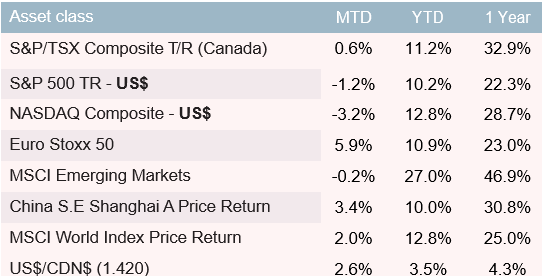
Source: Bloomberg