Navigating the 2026 IPO Wave: Demand, Indigestion, and the Power of Patience
Markets are rarely quiet, and this year is proving to be no exception. We entered 2026 watching structural shifts unfold, and now the focus is turning toward a massive wave of private giants finally getting ready to test the public waters.
Markets are rarely quiet, and this year is proving to be no exception. We entered 2026 watching structural shifts unfold, and now the focus is turning toward a massive wave of private giants finally getting ready to test the public waters.

Shawn Mottahedeh
Lead Strategist & Associate Portfolio Manager
June 14, 2026
SpaceX was the first big issuer to come to market with a largely successful IPO day. Including this alongside OpenAI, Anthropic, and others expected to debut or issue stock this year, we are set to see a tremendous amount of new equity supply coming to market.
On one hand, the sheer volume of demand for these companies is a net positive for general market sentiment. It tells us that investor appetite for emerging technologies – particularly AI – remains incredibly robust. But from a portfolio strategy and market mechanics perspective, a supply shock of this size requires a healthy dose of vigilance alongside optimism.
Here is what is on our radar, what the historical data tells us, and how we are approaching it.
The Reality of Supply: Where Do the Dollars Come From?
When a massive influx of new companies enters the public arena, it creates a simple mechanical challenge: all of this incoming equity supply needs to be met with dollars sourced from elsewhere.
Unless fresh capital floods into the global financial ecosystem all at once, much of the liquidity required to buy these new tech giants will likely be sourced by trimming existing equities. As the market reshuffles its holdings to make room, it is safe to assume we will see some amplified volatility across the broader market.
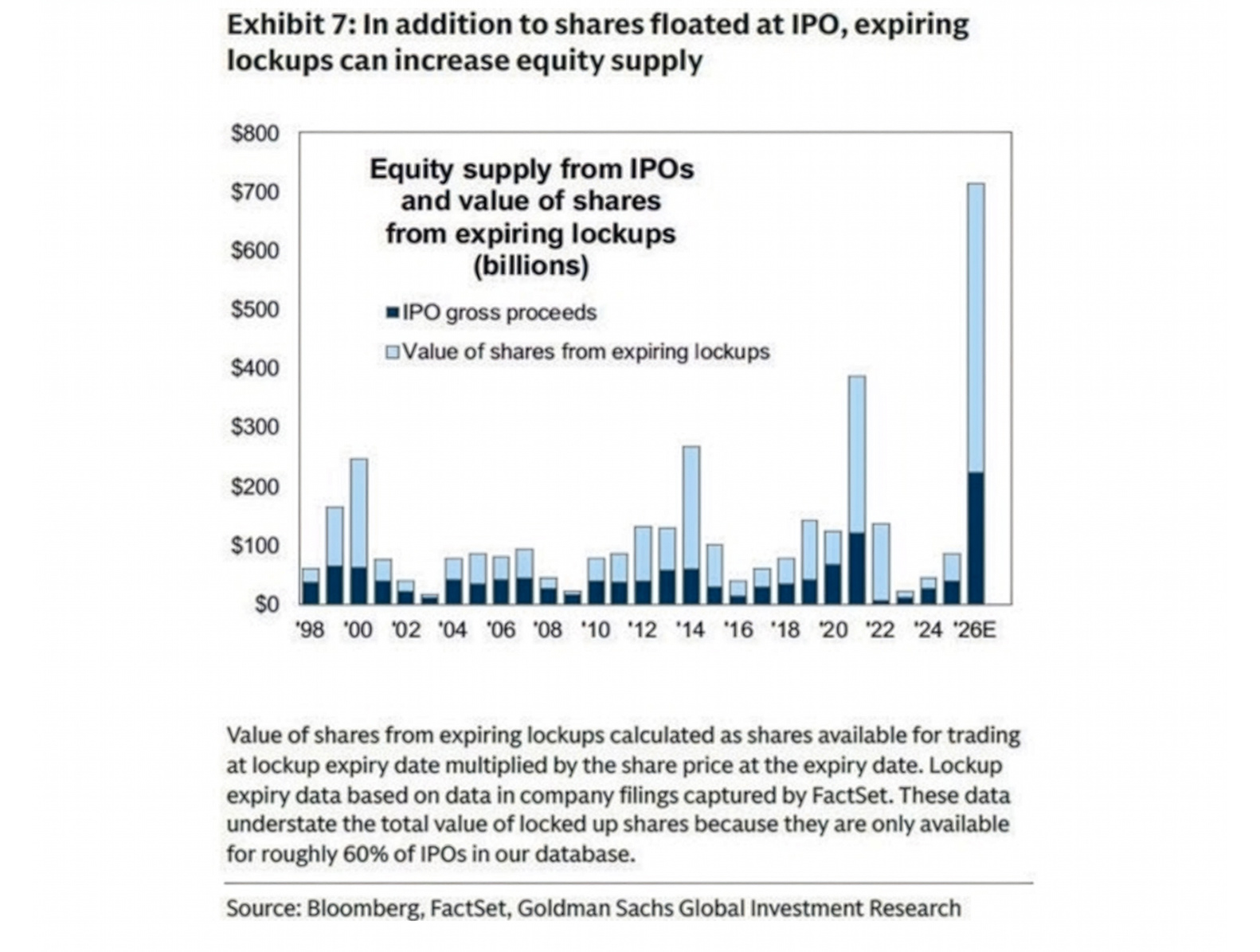
According to data compiled by Goldman Sachs (see chart below), the scale of total supply coming online – including what will eventually hit the market when lockup shares expire – is staggering. We are looking at supply projections substantially higher than at any point since the late 1990s.
Beyond simple supply and demand, two specific market mechanics will likely trigger periods of "indigestion" over the coming months:
- Accelerated Index Inclusion: Major index providers are moving fast. The Nasdaq, for example, has agreed to rush normal timelines for company inclusion. This means large institutional ETFs will be forced to sell down existing positions to mechanically make space for these massive newcomers.
- Staggered Lockup Expiries: Typically, insiders are restricted from selling for a set period post-IPO. However, several of this year's largest issuers are opting for non-traditional, staggered lockup schedules. This will create rolling waves of supply rather than a single, predictable event.
Both of these mechanical issues will require watching. If nothing else, they will be useful context for understanding potential turbulence in the year ahead.
What History Tells Us About the "IPO Hype"
IPOs are inherently attractive. They dominate the headlines, capture investor imagination, and generate immense fear-of-missing-out (FOMO). But the numbers tell a very different story about what happens after the opening bell rings.
Data compiled by Creative Planning looking at major IPOs over the last 15 years highlights a vital structural pattern. While a handful of companies like Palantir or Arm Holdings posted massive one-year gains, they are the exceptions, not the rule.
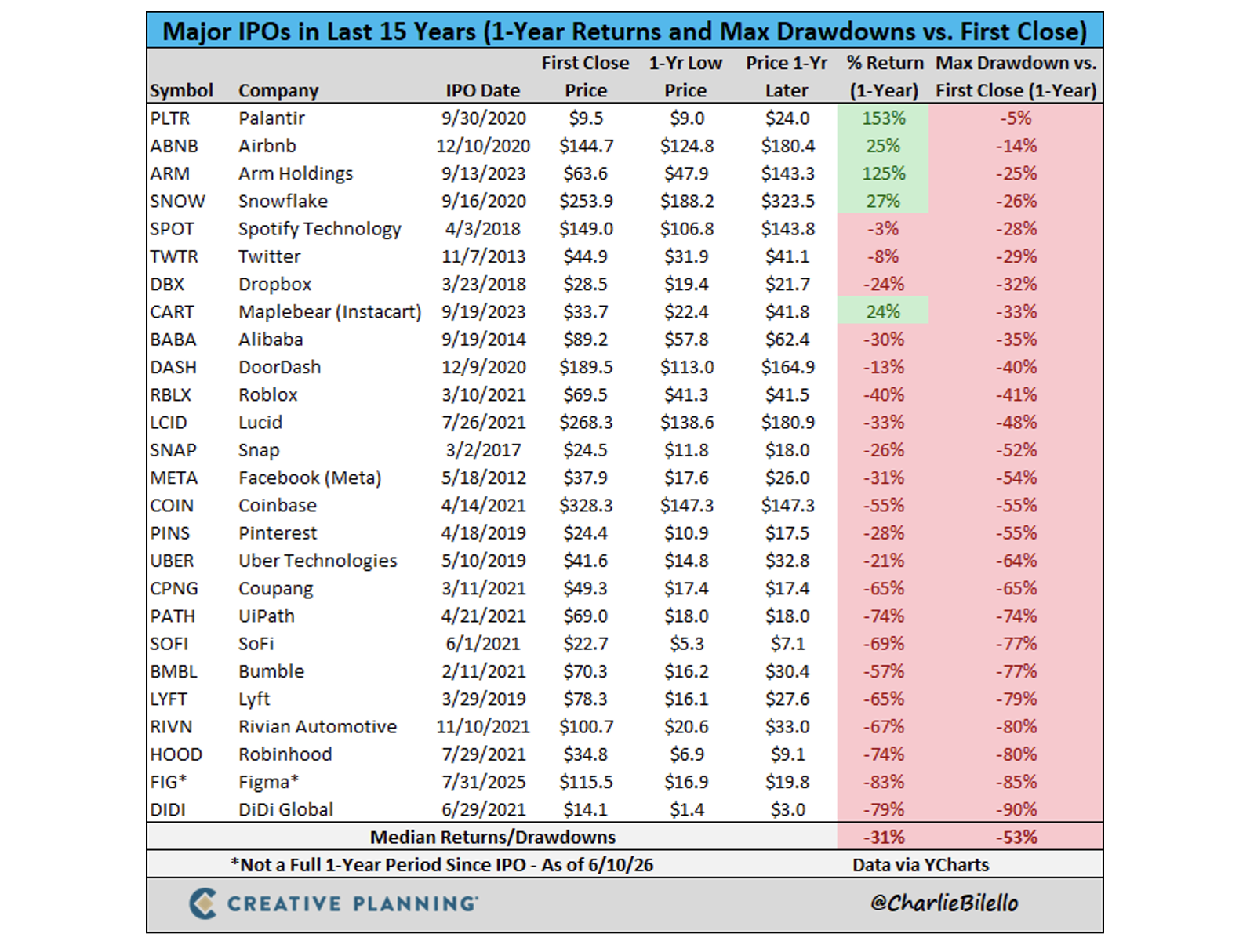
The key takeaway here is the average 1-year return for these major IPOs was -31%, while the median maximum drawdown within the first year was -53%.
This isn't a critique of the operational quality of the businesses debuting this year. Rather, it's a reminder of market physics: hype tends to overshoot reality early on. History shows that if you genuinely love a company and its long-term prospects, you will almost certainly get an opportunity to buy it at a better price than the IPO day price at some point during its first year of trading.
Our Approach: Sticking to the Fundamentals
When the market gets shiny and loud, our responsibility is to stay grounded in execution and risk management.
The companies coming public this year may ultimately prove to be some of the defining businesses of the next decade. That doesn't mean investors need to rush.
History suggests that patience is often rewarded. While others focus on the excitement surrounding an IPO, we'll continue focusing on the same things that have always mattered: business quality, valuation, competitive advantages, and long-term compounding.
Markets may experience some indigestion as they absorb this wave of new supply. For disciplined investors, that may create opportunities rather than obstacles.