
Mike Morgan, CFP, CIM
Portfolio Manager & Wealth Advisor, Financial Planner
September 29, 2026
The question nobody asks you
Here is a question most business owners have never been asked: how much would you like your tax bill at death to be?
It sounds like a trick, and in a sense it is. Nobody gets to pick zero. But if you own an incorporated business, there is a point at which you can pick the ceiling — and most owners pass that point without knowing it was there.
The strategy is called an estate freeze. What follows is what it does, what it costs you, and the part that gets written about least: how to know whether it is too early.
Your tax bill is growing at the same rate as your company
In Canada, you are deemed to have sold everything you own immediately before you die, at fair market value on that day. Your shares in your own company are included. The gain is calculated, and the tax falls due on your final return.
For most couples there is a deferral. Where shares pass to a spouse or to a qualifying spousal trust, the deemed disposition generally rolls over at cost and the tax is postponed until the second death. So the date that matters is usually not the first funeral. It is the second one.
Two things follow from that, and they are the whole reason this strategy exists.
The first is that the liability grows with the business. A company worth five million dollars today carries a smaller deemed disposition than the same company worth twelve million in fifteen years. You are not being taxed on what you took out. You are being taxed on what it became.
The second is that the tax is payable in cash, and the asset that triggered it is a private company that cannot be sold quickly, cannot be sold in pieces, and may not be something anyone wants to buy at the moment the estate needs the money. I have seen families forced into a sale at a bad time for no reason other than that a tax bill arrived and nothing else could fund it.
What a freeze actually does
An estate freeze does what the name suggests. You exchange your common shares for fixed-value, redeemable, retractable preferred shares worth what the company is worth today. New common shares — the ones that will absorb all future growth — are issued for a nominal amount to the next generation, usually through a family trust.
From that day forward your interest in the company is a fixed number. If the business doubles, the doubling belongs to the new common shares. Your eventual deemed disposition is calculated against a value you already know. Structured properly, none of this triggers tax at the time of the exchange.
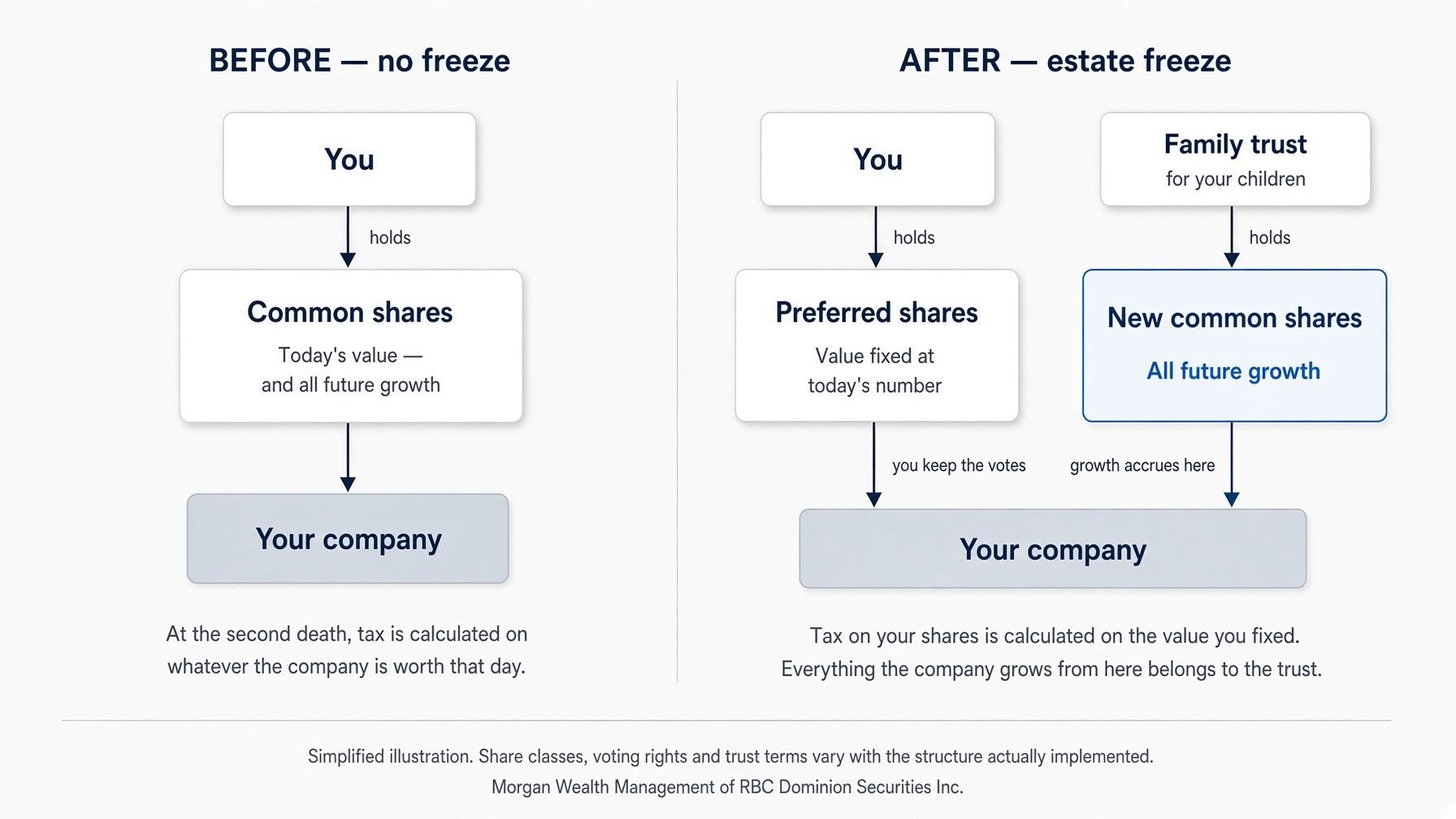
Two features make this tolerable rather than reckless.
You can usually keep control, though it does not happen by itself. Control is retained by giving the preferred shares you take back special voting rights, or by limiting the votes attaching to the growth shares, or by holding those growth shares in a trust of which you are a trustee — often some combination. It is a design decision, and it is the single most common misconception I encounter about freezes: owners assume a freeze hands over the company, and others assume control survives automatically. Neither is right.
You keep income. The frozen preferred shares can be redeemed over time, which is how a great many owners fund their own retirement out of the company after a freeze. You have stopped participating in growth. You have not stopped being paid.
That is the whole mechanism: fix the number you will be taxed on, while you still know what it is.
Why the shares go to a trust — and what the trust costs you
The freeze could put the new common shares directly into your children’s hands. In most cases it should not, and the first reason has very little to do with tax.
A discretionary family trust means you do not have to decide today. At the moment of a freeze, one child may be running the business, another may be finishing school, and a third may have no interest in it at all. Fixing their entitlements now, permanently, based on how things look this year, is a decision most owners are not ready to make and should not be forced into. A trust lets the shares grow for the family as a group, with the allocation decided later by the trustees.
The second reason is the lifetime capital gains exemption. Each individual is entitled to claim their own on a disposition of qualifying small business corporation shares — $1,275,000 for 2026. I wrote about this strategy here in more detail. If your family members are shareholders, directly or through a trust, their exemptions may also be available against a future sale rather than only yours. On a large transaction that is a substantial number. Two cautions: there can be adverse consequences where a beneficiary is a minor and the shares are sold to a non-arm’s-length party, and the shares have to actually qualify at the time of sale, which is not automatic.
The third reason is family law. Shares held in a trust are not in an individual’s hands, which matters if a child’s relationship breaks down. But this cuts both ways and should be thought about deliberately rather than assumed: how growth shares are treated on a relationship breakdown is a question to put to a family lawyer at the design stage, not afterwards.
Now the cost, because it is real and it is usually left out. Holding the growth shares indirectly through a trust can limit your ability to income split with family members who are not actively involved in the business. The tax on split income rules, which since 2018 apply to adult family members and not only to minors, tax split income at the top marginal rate and strip certain personal credits. The exclusions turn largely on whether the family member is meaningfully involved in the business, or owns enough of the votes and value — and a beneficiary of a trust holds neither directly. If income splitting is one of your reasons for freezing, the trust may work against it, and that trade-off belongs in the design conversation.
The other reason Ontario owners do this
Ontario has among the higher probate costs in the country, calculated on the value of the estate. A freeze caps the value of the shares that will sit in yours, so assuming the company keeps growing, it limits what probate is charged on as well. It is rarely the main reason to freeze and it should not be, but for an Ontario business owner it is a real secondary effect.
It is also not the only way to address probate. An alter ego or joint partner trust is available from age 65, and in some provinces a multiple wills strategy can be used for private company shares. Which of these fits is a question for your lawyer, not a reason to choose a freeze.
A hypothetical
A couple in their early sixties own a company worth roughly five million dollars. Two of their adult children work in the business. The parents are not ready to give up control, and they are not ready to stop being paid by it.
They freeze. Their common shares are exchanged for fixed-value preferred shares worth five million, carrying the votes. New common shares are issued to a discretionary family trust whose beneficiaries include both children.
Fifteen years later the company has grown substantially. On the second death, the deemed disposition on the parents’ shares is measured against the five million that was fixed on the day of the freeze — not against whatever the company has since become. The growth in between sits with the common shares held by the trust, and will be taxed in the children’s hands when they eventually realise it, at their rates, on their timetable.
The parents, meanwhile, spent those fifteen years redeeming preferred shares to fund their retirement, and never lost voting control of the business.
Nothing about the tax has been eliminated. What has happened is that an open-ended liability has become a known one, and a second liability that would have landed on the estate has been moved to a generation that has decades to plan for it.
Freeze, do nothing, or give the shares away now
Owners usually frame this as freeze or don’t freeze. There is a third option people rarely put on the table, which is to simply transfer the shares outright now. Setting the three side by side is the clearest way to see what a freeze is actually buying.
| Freeze now | Do nothing | Gift the shares outright now |
Who gets future growth | The next generation, via the new common shares | You — and so does the tax on it | The next generation |
Do you keep control? | Usually — if the preferreds carry the votes, or you are a trustee | Yes | No |
Do you keep income from the company? | Yes — by redeeming preferred shares over time | Yes | Only what the new owners choose to pay you |
What your death tax is measured against | The value fixed on the day you froze | Whatever the company is worth on the second death | Nothing — the shares are already gone |
Immediate tax on the transaction | Generally none, if structured correctly | None | A deemed disposition at fair market value now, with tax payable now |
Can you change your mind? | Partly — the trust gives discretion over who benefits, and a refreeze is possible if value falls | Yes | No |
Cost and complexity | Meaningful: valuation, legal work, trust, ongoing filings | None | Moderate, but the tax cost is usually the objection |
The middle column is the one most owners are in by default. The right-hand column is the one they imagine they are choosing when they say they want to "pass the business on." The left is the one that lets you do it without giving up the two things you are not ready to give up.
The freeze you do too early
This is the part nobody warns you about, and it is the reason I would rather have this conversation twice than once.
A freeze caps your economic interest in the business at whatever it is worth on the day you sign. That is the point of it. It is also the risk.
Freeze at fifty-five, then spend the next fifteen years building the company into something several times larger, and all of that growth belongs to the next generation. You will have succeeded at the tax objective and possibly failed at a more important one, because the value you were counting on to fund your own retirement stopped growing the day you froze it.
Inflation compounds that quietly. Your preferred shares are fixed in nominal dollars, and over a long retirement those dollars buy less each year while the business they came from carries on growing. A number that looked comfortable at fifty-five can be noticeably less comfortable at eighty.
I have seen owners freeze at a valuation that looked comfortable at the time and later discover that comfortable had been calculated against a retirement they had never properly costed.
So the sequence matters more than the structure. Work out what you actually need for yourself, with real numbers and a real plan. Confirm that the frozen value plus everything else you own covers it, with genuine room to spare. Only then decide how much upside to hand forward.
If you are not sure, you do not have to choose all or nothing. A partial freeze issues new growth shares to both you and your family, so you continue to participate in some of the upside — which is also the standard answer to the inflation problem. And where a company’s value falls after a freeze, it is often possible to refreeze at the lower number, which reduces the eventual tax on death and passes more growth forward.
One more timing point, in the other direction. If a sale of the business is imminent, a freeze has little left to do. There is no future growth to redirect and no deferral worth much. The strategy needs runway to be worth the cost.
Freeze once you know your own number. Not before.
The attribution trap nobody writes about
Here is the part that almost every article on estate freezes leaves out, and it is not a footnote.
The attribution rules exist to stop income being shifted to lower-taxed family members. There is a corporate version: where you transfer or loan property to a corporation and one of the main purposes is to reduce your income and benefit your spouse or a non-arm’s-length minor, an annual amount can be attributed back to you. It is calculated as the value of what you transferred multiplied by the CRA prescribed interest rate, and it is included in your income whether or not anyone was actually paid a dollar.
Why this matters for a freeze: the most common way of doing one is treated as exactly that — a transfer of property to a corporation, one of whose main purposes is to benefit your spouse and children. On its face, the rules are engaged by default rather than by accident.
The saving provision is the important part, and it is worth understanding before you panic. Corporate attribution does not apply to a Canadian-controlled private corporation where substantially all — generally ninety per cent or more — of the fair market value of its assets is used in an active business carried on primarily in Canada. So for a genuine operating company, this is usually a non-issue. It becomes a live problem where the corporation has accumulated passive investments beyond roughly ten per cent of its asset value, which describes a great many mature businesses that have been quietly building a portfolio inside the company for years.
Where it does apply, there are ways to manage it, including taking interest or taxable dividends from the corporation. And separately, to avoid ordinary attribution back to whoever settles the trust, the trust used in a freeze should be irrevocable, with real care taken over who the settlor and trustees are.
None of this is a reason not to freeze. It is a reason to know your corporation’s passive asset ratio before you start, which is a number your accountant can give you this week.
The 21-year clock
Once growth is accumulating inside a family trust, a second date goes in the diary. A trust is generally deemed to dispose of its capital property at fair market value every twenty-one years, whether or not anything has been sold, and must report the accumulated gains as though it had.
Two things soften that. The gains are taxed at the top marginal rate in the trust’s province unless the trust agreement permits that deemed income to be allocated out to the beneficiaries and taxed in their hands — which is a drafting question, decided years before it matters. And the deemed disposition does not wind the trust up; unless the agreement says otherwise, it carries on afterwards as before.
The practical point is about timing. If you expect the freeze to still be in place twenty-one years out, the plan for that date should be made at the outset, not discovered in year twenty. Twenty-one years is long enough that the advisors who set the trust up may not be the ones still involved when the alarm goes off.
What a freeze does not do
It does not create liquidity. Your death-tax liability is smaller and it is known, but it still has to be paid in cash by an estate whose main asset is a private company. That is usually a separate conversation about how the liability gets funded, and for many incorporated owners the answer involves corporate-owned insurance and the capital dividend account. I’ve written about this strategy in more detail here.
It does not make your children capable of running the business. Ownership and management are different things, and a trust deed has never yet turned a beneficiary into a manager.
It does not guarantee the shares will qualify for the lifetime capital gains exemption later. Those tests look at the composition of the company’s assets, and a corporation quietly accumulating investments can fail them without anyone noticing. Worth knowing too: only individuals can claim the exemption. If a holding company ends up owning the operating company and the holdco sells those shares, the exemption is not available on that sale — so if a freeze introduces a holdco, where the operating company shares sit has to be decided with that in mind.
It does not solve the passive income problem, and can interact with it. Where a holding company and an operating company are associated, investment income earned in the holdco can affect the operating company’s access to the small business deduction, even though the income was earned elsewhere.
And it does not work in isolation. A freeze touches your corporate structure, your will, your shareholders’ agreement and your retirement plan at the same time. Done by a lawyer who has not seen the financial plan, or by an accountant who has not seen the will, it can conflict with something else you have already put in place — which is the most expensive kind of mistake, because every individual piece of it was competent work.
The real question
You spent decades building the business. An estate freeze is not really about tax. It is about deciding who benefits from the next chapter of growth, and doing it deliberately rather than by default.
If your company still has significant runway ahead of it, now is the time to work out whether this makes sense for you and your family. The earlier that conversation happens, the more options are still open — and in financial planning, options are worth a great deal.
If you would like to talk it through, reach out to me today to start the conversation.
FAQ
Do I lose control of my company if I freeze?
Not necessarily, but control has to be built in rather than assumed. It is usually retained by attaching special voting rights to the preferred shares you take back, by limiting the votes on the growth shares, or by holding those growth shares in a trust of which you are a trustee. Value and control are separate questions, and a well-designed freeze separates them on purpose.
Can I still take money out of the company afterwards?
Yes. The frozen preferred shares can be redeemed over time, and for many owners that becomes the main way their retirement is funded out of the corporation. What stops is your participation in future growth, not your income.
What if the business is worth less after I freeze?
Your preferred shares stay fixed at the old, higher number while the common shares underneath them may be worth little. In that situation it is often possible to refreeze — implementing a fresh freeze of the preferred shares at the new lower value — which reduces the eventual tax on death and lets more of any subsequent growth pass forward.
Does the freeze have to cover the whole company?
No. A partial freeze issues new growth shares to both you and your family, so you keep participating in some of the upside. If you are uncertain whether you have enough to retire on, or concerned about inflation eroding a fixed number over a long retirement, this is usually the more sensible starting point.
How is the value established, and what if the CRA disagrees?
A proper valuation of the shares being frozen is critical. Freeze too low and you can realize a capital gain equal to the shortfall; freeze too high and you can trigger a taxable benefit. Transfer documents commonly include a price adjustment clause, which lets the parties adjust the price if the CRA later determines a different fair market value.
Who actually does the work?
A valuation professional establishes the value being frozen, a tax lawyer and accountant design and implement the reorganization and the trust, and your financial advisor should be confirming that the number you are freezing at genuinely supports the retirement you are planning. The last of those is the step most often skipped.
DISCLAIMER
This article is for informational purposes only and reflects tax rules in effect as of September 2026. It is not legal, tax, accounting or investment advice, and it is not a recommendation to buy, sell or hold any security or to implement any strategy.
The scenario described is a hypothetical, simplified illustration. It is not based on any actual client, does not represent any particular outcome, and does not reflect all of the costs, fees, professional expenses or tax consequences that would apply in a real transaction.
An estate freeze is a complex corporate reorganization whose tax consequences depend entirely on the specific facts of your corporation, your family and your existing structures, and on rules that are subject to change. The lifetime capital gains exemption is indexed and changes from year to year. A freeze requires legal, tax and valuation work that sits outside the scope of this article. Please consult your own legal, tax and accounting professionals before acting on anything described here.
Mike Morgan is a Portfolio Manager and Wealth Advisor with Morgan Wealth Management of RBC Dominion Securities Inc. The views expressed are those of the author and do not necessarily reflect those of RBC Dominion Securities Inc. RBC Dominion Securities Inc. is a member of the Canadian Investor Protection Fund.