
John Ord and Tim Waller
Ord Private Wealth Management
June 23, 2026
One of the most well-known and time-tested warnings for investors (and chefs!) is as follows: "Don't try to catch a falling knife". In a literal sense, you're very likely to cut your hand open if you try to grab onto a blade that’s falling from the counter. For investors, this advice suggests not to buy a stock as its price is falling sharply downward (often due to recent negative news for that company). It's very difficult to predict when a stock will find its bottom and it's best not to try and jump in too early. Often the downside continues before a recovery can begin.
However, this situation can cut both ways. There is an equally dangerous "Rising Knife" scenario, which involves chasing stocks that are in the middle of a parabolic run higher. When a stock rockets upward, it can seemingly defy gravity for a while, creating a powerful emotional desire to jump in and buy. Yes, that previous sentence might have been inspired by the recent SpaceX IPO (Initial Public Offering), which at this point could be either a great investment story or a quick way to have lost money, depending on the day you invested!
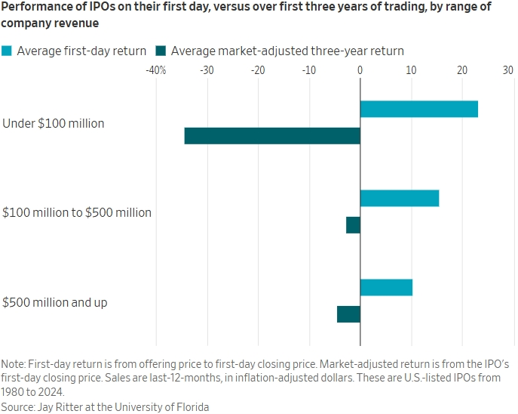
For those that were able to get shares at the IPO price of $135? You’ve done well! However, if you got excited about SpaceX’s price rising for the first 3 days and bought near the top at $225? Well, you’d be down over 30% on your investment while the IPO investors are still up about 15% (based on the roughly $155 share price as of Monday, June 22nd). This result is not that unusual, as stocks are very likely to perform well on the first day of trading post-IPO, averaging double-digit returns. But after that? They underperform the market by a wide margin over the next few years, as seen in the chart above.
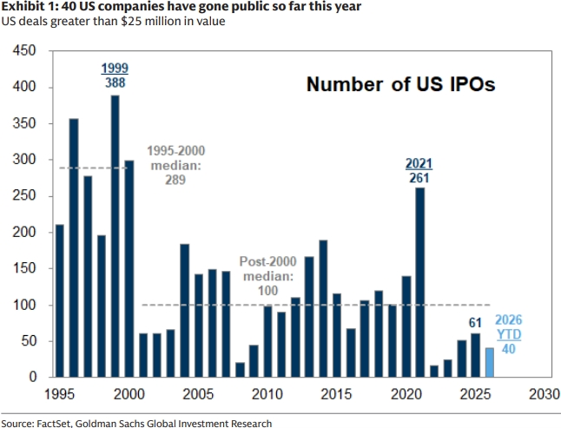
Despite the recent attention that SpaceX brought to the IPO market, we are still not seeing anywhere near the frenzy of 2021, which saw 261 IPOs (and preceded the last 20% correction in the market in 2022). Prior to the tech bubble in 1999? There were 388. There are still some other high-profile IPOs set to come in 2026 (including rival AI companies Anthropic & OpenAI) and there will undoubtedly be a lot of interest in those two. However, there is a long way to go before we can become too concerned about the number of IPOs foreshadowing a problem in markets.
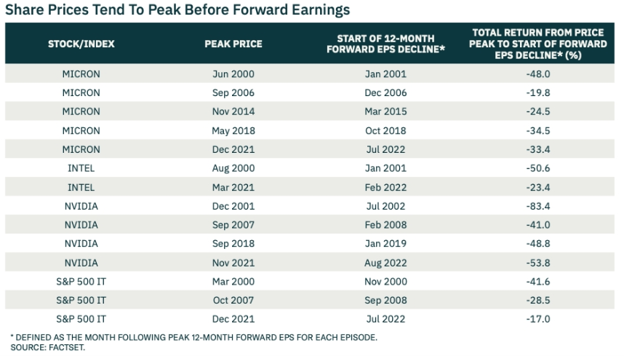
Currently, there are also a few other “high-flying” companies that have caught investors’ attention due to their recent parabolic gains, including Micron; Intel; Sandisk and other companies in the memory chip or semiconductor space. The first two names on that list (Micron and Intel) have been in this position before on multiple occasions, including in 2000 when they were both heavily involved in the technology boom and bust cycle. You might logically think that the peak stock price for these companies would only occur AFTER their earnings projections started to slow down, but as the chart below shows - that is not the case. In prior cycles, Micron (MU) and Intel (INTC) stock started to drop for several months before any decline in forward earnings was visible. This has been the case for Nvidia and the tech sector in general in the past.
The lessons here?
1) You’re not going to be able to time the top without getting VERY lucky
2) Taking profits during the good times is never a bad idea
This phenomenon is not just limited to stocks: Gold, Oil and Bitcoin have also been subject to some “panic buying” at times in the past year, only to see their prices drop significantly after investors (or more accurately - traders) found something else more exciting to buy. If you’ve been paying attention to markets long enough, you’ll understand that even major disruptions to the world’s economy can be reduced to a short news cycle. Sentiment often drives the direction of stock prices in the short term. Eventually, fundamentals matter for the long term. There are plenty of sectors and companies out there trading at much more reasonable valuations that are just not getting investor interest right now. It would not surprise us to see a bit of a rotation in market leadership over the summer, especially if there are any small holes punched into the dominant AI hardware narrative of today.
Remember: the best time to buy a stock is RARELY when everyone is already talking about it. That may work out for you temporarily, but history would suggest you may be arriving late for a party about to end. Sometimes the best plan is not to show up.
You don’t get credit for the gains that already happened.