
Dr. Derek Seely
Investment Advisor
August 2, 2026
Month In Focus: August 2026
--------------------------------------------------------------------
I hope you are finding an opportunity to enjoy some time away this summer. We recently spent a week on Italy’s Amalfi Coast – a beautiful part of the world with breathtaking scenery, incredible food and a way of life seeming disconnected with the stress of modern life.
Travelling with two teenage boys made for an interesting perspective. While they were more than happy to sample pizza, pasta, and gelato, convincing them to appreciate centuries old buildings, museums and historical landmarks was a much tougher sell. It was a good reminder that people can experience exactly the thing yet focus on very different aspects of it.
Markets are often similar. Headlines tend to draw our attention to the most exciting or concerning developments of the day, but successful investing usually comes from looking beyond the obvious and focusing on the factors that are most likely to influence long term outcomes.
Tariffs, the Bank of Canada and Why It Matters
The headlines have been dominated by the White House’s announcement of proposed 50% tariffs on certain Canadian imports under some obscure act passed in 1930 that prohibits discrimination against US commerce. At first glance the announcement appeared significant enough to raise concerns about the outlook for the Canadian economy and financial markets.
However, as the details have emerged, the market reaction has become much more measured.
The Tariff Headlines Were Bigger Than the Reality
The initial announcement created the impression that virtually all Canadian exports could be affected. In reality, the proposed measures are considerably narrower.
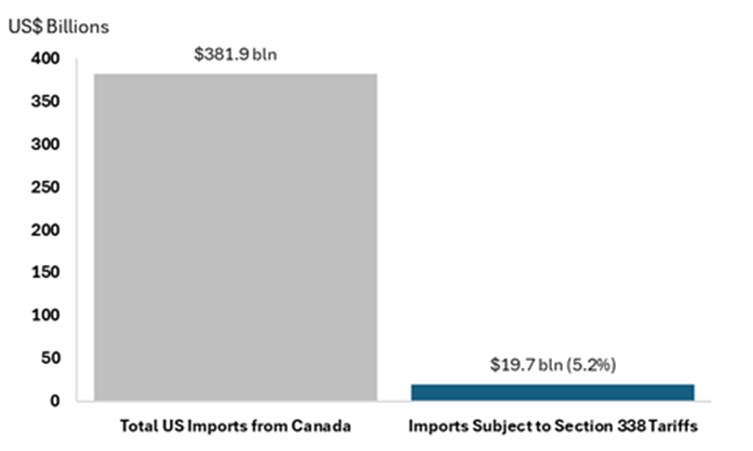
Current estimates suggest that only approximately US$19.7 billion of Canadian exports would be subject to the new tariffs—roughly 5% of total U.S. imports from Canada.
Section 338 Tariffs Cover 5% of the US Imports from Canada
Several important sectors remain excluded, including:
- Energy
- Potash
- Critical Minerals
- Goods already subject to existing Section 232 tariffs (such as steel and aluminum)
- Various strategic products
Equally important, the proposed tariffs are not expected to take effect immediately, leaving approximately 30 days for negotiations. This window has given investors’ confidence that political negotiations may still alter the final outcome.
- Why Markets Are Still Paying Attention
Historically, products meeting USMCA requirements have largely been protected from broad tariff measures. The willingness to move outside that framework introduces additional uncertainty into North American trade policy.
Markets dislike uncertainty, and this helps explain why Canadian assets may continue to trade with a modest risk premium until greater clarity emerges. The Canadian dollar has already reflected some of this uncertainty, and currency volatility could remain elevated while negotiations continue.
Bank of Canada Remains on Hold
Last week, the Bank of Canada left its overnight lending rate unchanged at 2.25%, a decision that was widely expected.
More encouraging than the rate decision itself was the Bank’s assessment of the economy. Policymakers noted that economic activity is becoming both broader and stronger, suggesting that growth is no longer being supported by just a handful of sectors.
Recent manufacturing data reinforced this message. Manufacturing sales increased for a fourth consecutive month, with strength seen across transportation equipment, petroleum products, chemicals and industrial production. Capacity utilization has improved; unfilled orders continue to rise and inventory levels remain healthy.
These are generally positive signs for Canada’s industrial economy and support my view that the domestic economy continues to stabilize despite ongoing trade uncertainty.
Canada Is Slowly Diversifying Its Export Markets
One of the more encouraging longer-term developments has received relatively little attention. Canada recorded a merchandise trade surplus of C$4.2 billion in May—the largest in four years. More importantly, Canadian exporters are becoming less dependent on the United States. At the beginning of 2025, approximately 78% of Canadian goods exports were destined for the U.S.
By May 2026, that figure had fallen to roughly 69%, with exports to Europe, Asia and other international markets increasing meaningfully.
While the United States will remain Canada’s largest trading partner for the foreseeable future, greater export diversification should reduce Canada’s vulnerability to future trade disputes and create a more resilient economy over time.
Putting the AI Rally into Perspective
The extraordinary performance of artificial intelligence-related companies has naturally led many investors to ask whether today’s market resembles the technology bubble of the late 1990s. There are certainly similarities, but there are also important differences. Technology stocks have generated exceptional returns since 2019, yet the cumulative gains remain well below those experienced during the dot-com bubble.
Unlike many internet companies during the late 1990s, today’s largest technology firms are highly profitable and occupy dominant competitive positions. That does not mean valuations cannot become stretched, but it does suggest today’s environment rests on a considerably stronger fundamental foundation than the speculative excesses seen a generation ago.
As always, maintaining diversified exposure remains more important than attempting to predict exactly when market leadership will change.
In Closing
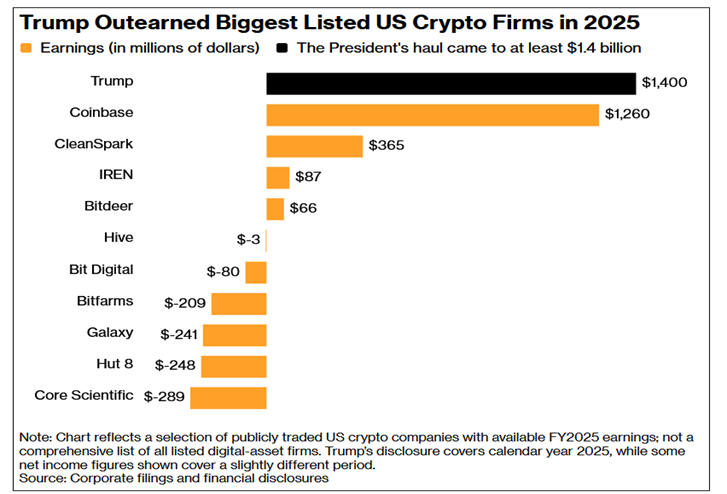
To close this newsletter out, I found it notable that Trump’s portfolio gains from Cryptocurrency trading earned him $1.4 billion 2025. It turns out he earned more from crypto than every publicly traded US crypto company. While this headline is certainly attention-grabbing, it also highlights just how quickly the digital landscape is evolving. Crypto has moved from a niche investment class and is becoming increasingly intertwined with politics.
Conclusion
With so much information competing for our attention every day, it can be difficult to separate the noise from what matters. My role is to do that work on your behalf – continually assessing risks, identifying opportunities, and making thoughtful portfolio decisions before they become obvious to everyone else.
In other words, much of what we have discussed in this newsletter has already been considered in the management of your portfolio. Rather than reacting to headlines, I position portfolios with a disciplined forward-looking approach designed to help protect capital, capture opportunities and keep you on track towards your long-term financial goals.
While markets carry on, we hope you are finding moments to unplug, relax.