
Dr. Derek Seely
Investment Advisor
May 31, 2026
Month In Focus: June 2026
As we move into the second half of the year, investors continue to navigate an environment characterized by competing economic signals. The Canadian economy has officially entered recession, inflation remains more persistent than many had expected, labour markets continue to show resilience, and AI is becoming more important than ever in the productivity of companies. At the same time, housing markets in several countries, including Canada, are adjusting to higher borrowing costs, creating questions about the outlook for consumer spending and economic growth.
In this month’s newsletter, we examine the evolving outlook for interest rates, the implications of softer housing markets, and why current conditions may differ from the environments that preceded some of history’s major stock market downturns. While uncertainty remains a constant in investing, understanding the forces shaping markets today can help investors maintain perspective and stay focused on their long-term objectives.
Canadian Housing: A Potential Headwind for Growth
Housing remains one of the most important sources of wealth for Canadian households. When home values rise, consumers tend to feel more confident and spend more. Conversely, falling home prices can weigh on household confidence and future spending decisions.
Since the end of 2021, Canadian home prices have declined by almost 10%, making Canada one of the weakest-performing housing markets in the developed world.
What makes this particularly interesting is that financial markets still expect the possibility of interest rate increases in Canada before year-end. Investors appear to be placing greater emphasis on persistent inflation and resilient labour markets than on the weakness currently being seen in housing. In addition, the recent increase in commodity prices is laying a strong foundation for a rebound out of recession by the end of this year.
While softer home prices can eventually slow consumer spending and economic growth, that process often unfolds gradually. For now, strong employment conditions and ongoing inflation pressures continue to dominate the economic outlook.
Change in National Home Price Indices Since End-2021
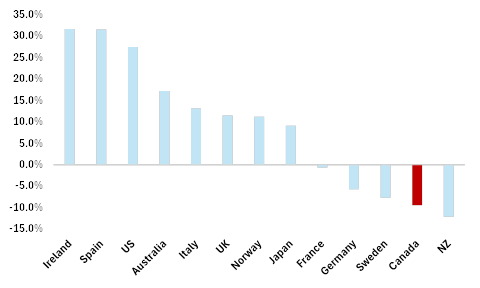
*Change in nominal home prices since end-2021
Source: Dallas Fed
Why the Federal Reserve’s Next Move Could Be a Rate Increase — And Why That May Not Be Bad for Markets
For much of the past year, investors have focused on when the U.S. Federal Reserve would begin cutting interest rates. Increasingly, however, the conversation is shifting toward whether the next move could actually be a rate increase.
Several recent developments suggest that the Fed’s easing cycle may be over.
First, inflation expectations have moved higher. While investors often focus on reported inflation figures, policymakers are equally concerned about where consumers believe inflation is headed. Expectations can become self-fulfilling, influencing spending habits, wage demands, and business pricing decisions. Recent surveys indicate that Americans are becoming less confident that inflation will return to the Fed’s long-term target.
Second, the U.S. labour market remains remarkably resilient. Job creation has continued at a healthy pace and unemployment remains near historically low levels. Despite higher borrowing costs, the economy continues to demonstrate surprising strength.
Third, rising inflation itself can effectively loosen financial conditions. As inflation increases, the gap between nominal interest rates and inflation narrows, reducing the real (inflation-adjusted) interest rate. In practical terms, this can stimulate economic activity in much the same way that an interest rate cut would.
Corporate earnings have also remained strong. Healthy profit growth is generally a sign of a robust economy and supports higher stock prices over time. However, strong earnings can also signal that demand remains firm, which may contribute to ongoing inflation pressures.
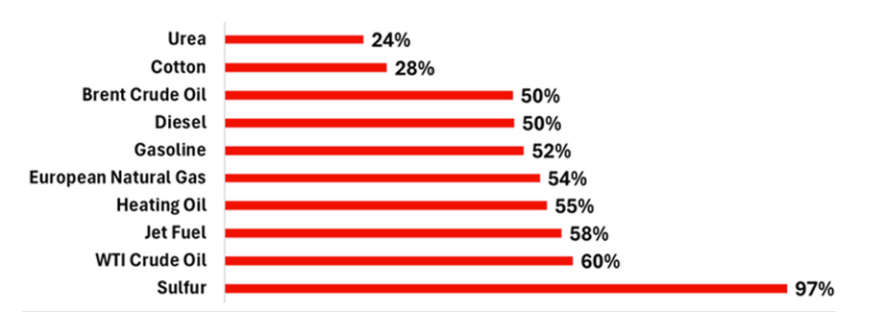
Finally, several Federal Reserve officials have recently emphasized that the war in Iran is becoming more impactful in pricing and that is fueling their inflation concerns. As a result, financial markets have begun reassessing the possibility that rates could remain higher for longer—or potentially move higher still.
Price Increases since the start of the Iran war ( as of 18 May 2026)
 What Does This Mean for Investors?
With artificial intelligence driving excitement and technology stocks posting impressive gains, some investors have started comparing today’s market to previous speculative bubbles.
While caution is always appropriate, one important difference stands out: monetary policy is not nearly as restrictive as it was before some of the market’s most significant declines.
Prior to both the Dot-Com crash in 2000 and the Global Financial Crisis in 2007-08, interest rates were substantially higher than inflation. In other words, central banks were actively working to slow economic activity and cool financial markets.
Today’s environment is different. While interest rates remain elevated, inflation has also remained relatively firm, meaning real interest rates are only modestly restrictive. In fact, inflation-adjusted monetary policy has become gradually less restrictive over the past two years.
This distinction matters because market returns have historically been influenced not simply by the level of interest rates, but by whether monetary policy is becoming more restrictive or more accommodative. Periods of aggressive tightening have often created challenges for both stocks and bonds. Conversely, markets have frequently performed well during periods when economic growth remains healthy and financial conditions are stable.
While volatility should always be expected, the current backdrop does not resemble the highly restrictive environments that preceded many of history’s major market downturns. For long-term investors, that remains an important reason for cautious optimism
Real Fed Policy Rate Over Time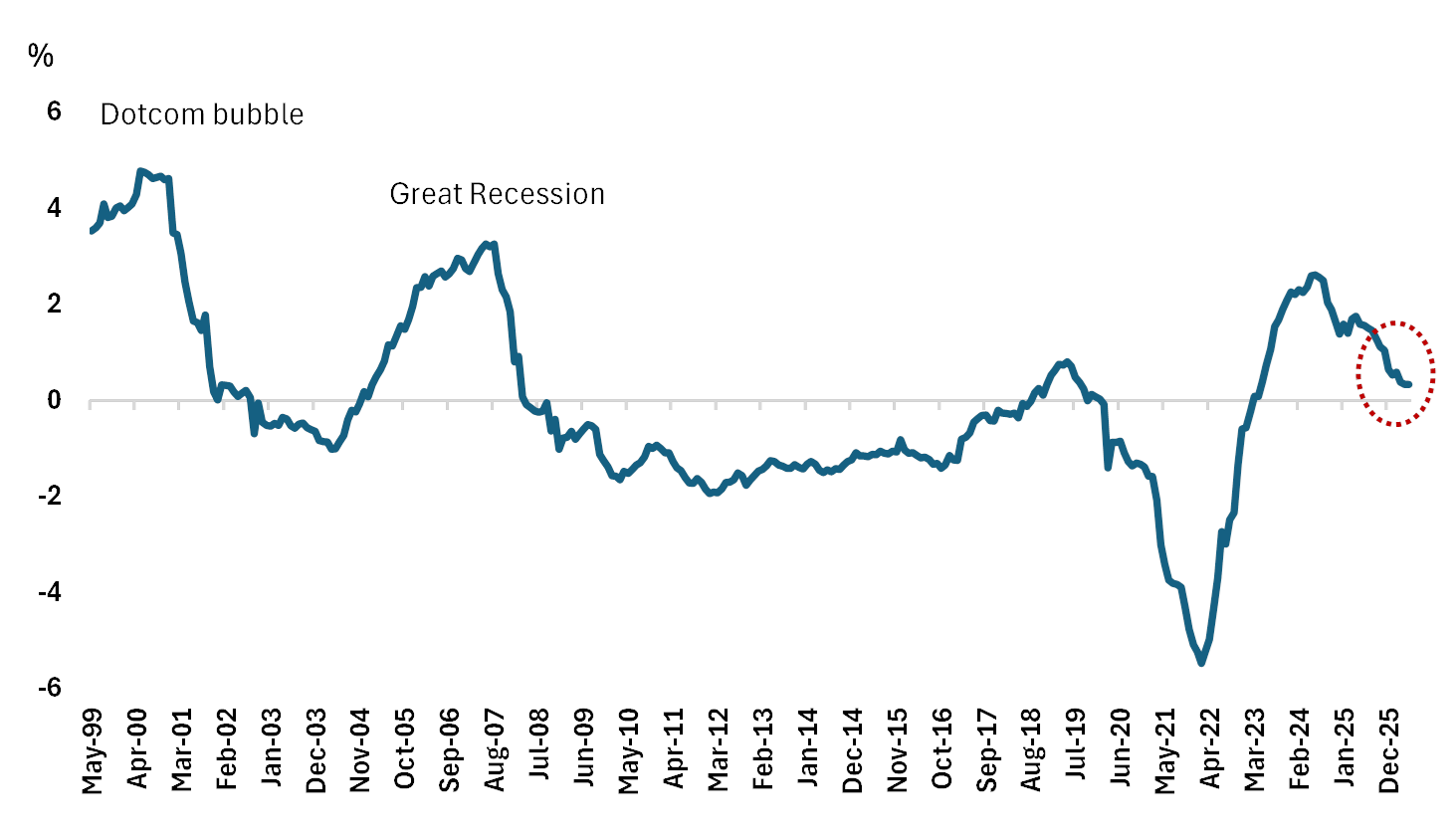 Real Fed Policy Rate = Midpoint of FFR target range – Core PCE (y/y)
Source: BMO GAM
While markets carry on, we hope you are finding moments to unplug, relax