John Vidas
Portfolio Manager
June 4, 2026
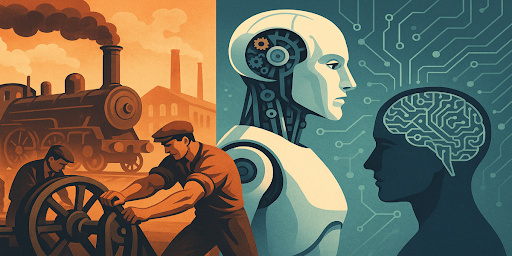
From steam to Silicon: How Three technological Waves Reordered Humanity.
Humankind does not experience technological change as a smooth, linear progression. Instead, our history over the last three centuries is defined by violent disruptions—moments where a breakthrough technology drastically slashes the cost of a fundamental constraint. When the cost of power, information, or cognition collapses, human society is forced to dismantle its existing structures and completely reorganize itself.
To understand where our current AI paradigm is taking us, we must first look backward. By examining the trade-offs of the First, Third, and Fourth Industrial Revolutions, we can map a predictable historical cycle: an initial wave of intense exploitation and systemic friction, followed by an unprecedented leap in human capability, culminating in an entirely new baseline for civilization.
1. The First Industrial Revolution (Late 1700s – Mid 1800s): The Power Shift
"The iron giant, steam, has done more to change the face of the world than all the philosophies and empires of antiquity." |
Before the late eighteenth century, human civilization was trapped in a Malthusian struggle, bound entirely by the biological limits of human and animal muscle power, supplemented only by primitive wind and water mills. The seminal moment came in 1776 when James Watt introduced the commercial, double-acting steam engine. By converting coal into mechanical work, humanity unlocked millions of years of concentrated solar energy stored in fossil fuels.
The Benefits: Affordability and Abundance
The immediate benefit was a radical downward pressure on the cost of physical production. Mechanized spinning jennies and power looms turned textiles from a luxury item into a cheap commodity. According to data compiled by economic historian N.F.R. Crafts, British real income per person rose from roughly $400 in 1760 to $800 by 1860. Mass production democratized basic household goods, improved transportation via steam locomotives, and generated the taxable capital necessary to eventually build modern sanitation and public health infrastructures.
The Downside Impact: Urban Squalor and Human Exploitation
The transition was brutal. The shift from agrarian farming to the factory system concentrated human labor around coal sources, giving birth to poorly planned industrial cities. Early workers faced grueling 14-to-16-hour workdays in highly hazardous environments where child labor was systematically exploited. Urban infrastructure could not keep pace with migration; cities became plagued by open sewers and contaminated water supplies, leading to devastating cholera outbreaks. Furthermore, this era marked the beginning of unchecked carbon emissions, initiating the modern climate crisis.
The second Industrial Revolution --- Period covering 1870-1914 --- an extension of the First Industrial Revolution, experienced transitioning from steam and mechanization to mass production powered by electricity, gas, and oil.
2. The Third Industrial Revolution (Late 1900s): The Digital Blueprint
"The advance of technology is based on making it fit in so that you don't really even notice it, so it's part of everyday life." |
If the First Industrial Revolution mechanized physical labor, the Third Industrial Revolution digitized information. Beginning mid-century with the invention of the silicon transistor at Bell Labs in 1947, this era accelerated through the 1970s with personal computing and peaked in the 1990s with the commercialization of the internet. Humanity transitioned from moving physical mass to manipulating pure data at the speed of light.
The Benefits: The Democratization of Knowledge
The Third Industrial Revolution effectively decoupled communication from geographic location. Complex administrative drudgery, financial tracking, and mathematical computations were absorbed by silicon chips. The internet created a hyper-connected global economy, allowing for real-time international collaboration. For the individual, it democratized human knowledge; an ordinary citizen with an internet connection suddenly possessed greater access to information than any historical monarch or academic institution before them.
The Downside Impact: Deindustrialization and the Surveillance State
The economic reordering proved deeply destabilizing for traditional workforces. As manufacturing automated and supply chains globalized, blue-collar job markets in developed countries collapsed, leaving deep regional economic depressions and socio-political polarization. Additionally, the digitization of daily life gave rise to what Shoshana Zuboff termed 'surveillance capitalism'—an economy where personal data is aggressively mined, commodified, and weaponized via behavioral algorithms to manipulate consumers and fracture public discourse.
3. The Fourth Industrial Revolution (Present Day): Ambient Integration
"AI is more profound than fire or electricity or anything we’ve done in the past... It has the potential to solve some of our biggest problems, but also carries enormous risks." |
We are currently living through the Fourth Industrial Revolution. This era is not defined by faster standalone computers, but by the systemic convergence of the physical, digital, and biological worlds. It is driven by ubiquitous cloud infrastructure, advanced biotechnology (such as CRISPR gene editing), and generalized machine learning algorithms. Technology has ceased to be a tool we sit down at a desk to use; it has become an ambient layer of human reality.
The Benefits: Hyper-Optimization and Precision Medicine
The primary benefit of this era is the ability to navigate complex, multi-variable systems. AI-driven models optimize global supply chains and manage energy grids in real time to reduce waste. In medicine, breakthroughs like DeepMind’s AlphaFold have resolved decades-old biological mysteries by predicting protein structures, accelerating custom therapeutic designs and genetic interventions to combat previously incurable diseases.
The Downside Impact: Synthetic Reality and Existential Vulnerability
The downsides are profoundly systemic. The hyper-optimization of information has eroded the concept of a shared social reality. The proliferation of deepfakes, large-scale automated disinformation, and algorithmic echo chambers have compromised public information ecosystems. Economically, the concentration of massive computing infrastructure (compute) within a handful of mega-corporations has created unprecedented monopolies, while the dual-use nature of advanced biotech and autonomous digital systems introduces catastrophic biosecurity and systemic cyber risks.
4. What is a Reasonable Expectation of Current AI?
Amid the intense cultural discourse surrounding artificial intelligence, it is vital to separate the 'recursive capability' of software from practical economic realities. Commentators frequently predict an immediate, exponential automation of all human labor. However, real-world data paints a much more nuanced picture of what AI can reasonably execute today.
The "Jagged Frontier" of AI Capability
According to the Stanford HAI 2026 AI Index Report, current frontier models display extraordinary capabilities on structured, measurable benchmarks—frequently matching or exceeding human baselines on PhD-level science queries, advanced coding tasks, and competitive mathematics. For instance, task success on benchmarks like SWE-bench (which tests automated software engineering) and OSWorld (which tests AI agents navigating real computer operating systems) saw major leaps over the past year.
Yet, AI operates on a jagged frontier. The exact same model that can achieve a gold medal score on international mathematical olympiad problems can simultaneously fail at basic spatial reasoning, sequential planning, or accurately reading an analog clock.
What AI Can Reasonably Do Right Now
·Structured Automation: AI achieves immediate productivity gains in highly structured, digitally isolated environments. Studies show efficiency increases of 15% in customer support, 26% in software engineering, and up to 50% in synthetic marketing copy generation.
·Cognitive Co-Piloting: AI serves effectively as an analytical accelerator—synthesizing thousands of legal documents, drafting basic code scripts, formatting messy data, and acting as an interactive sounding board for human creators.
·Multilingual and Multimodal Translation: Current models seamlessly bridge communication gaps across text, audio, and video inputs, radically lowering translation barriers globally.
What AI Cannot Do (The Guardrails of Reality)
·Reliable Autonomous Execution: While AI agents are progressing, they still fail roughly 1 in 3 times on complex, unmonitored multi-step tasks. They lack the capacity for reliable, long-horizon planning without human oversight.
·Navigate the Physical World Flexibly: Physical deployment remains bounded by massive engineering and capital constraints. While software updates overnight, building data centers, securing energy grids, and deploying robotics require years of physical infrastructure development.
·Substitute Human Trust and Accountability: Because models lack genuine comprehension and remain prone to logical hallucinations, they cannot assume liability. Relational, supervisory, and regulatory tasks still fundamentally require human judgment.
As economic analysis from Citadel Securities highlights, technology diffusion historically follows a slow S-curve rather than an infinite vertical line. AI is not rendering human labor obsolete; rather, it is rapidly absorbing specific cognitive tasks, shifting human work higher up the chain of oversight, synthesis, and emotional intelligence.
Supporting Documentation and Historical Sources
·Crafts, N. F. R. (1985). British Economic Growth During the Industrial Revolution. Oxford University Press. (Documenting historical per-capita income shifts and real wage trends).
·Zuboff, S. (2019). The Age of Surveillance Capitalism: The Fight for a Human Future at the New Frontier of Power. PublicAffairs. (Analyzing the downside data-monetization models of the Third Industrial Revolution).
·Stanford University Human-Centered Artificial Intelligence (HAI). (2026). The 2026 AI Index Report. Stanford University. (Providing empirical data on model capabilities, the jagged frontier, SWE-bench performance, OSWorld task success metrics, and corporate adoption trends).
·Microsoft AI Economy Institute. (2026). Global AI Diffusion Report (Q1 2026). (Documenting the global adoption rates among the working-age population and the widening digital gap between the Global North and South).
·The World Bank. (2026). World Development Report 2026: Decoding AI for Development. World Bank Group. (Analyzing the potential for AI to bridge public service gaps in developing nations against the risks of global institutional dependency).
·Citadel Securities Macro Research. (2026). The 2026 Global Intelligence Crisis: Productivity Shocks and Labor Substitution Realities. (Providing macroeconomic context on the S-curve of technology adoption and labor market impacts).
John Vidas
May 2026
Investment Disclaimer
This document is for informational purposes only and does not constitute investment advice, a recommendation, or an offer to buy or sell any securities.
The views expressed are those of the author as of the date of publication and are subject to change without notice.
Investing involves risk, including the possible loss of principal. Past performance is not indicative of future results.
Readers should conduct their own due diligence and consult with a qualified financial advisor before making any investment decisions.