Will Your Money Last? A Retirement Readiness Checklist
For most of your working life, the financial question is simple: Am I saving enough? You build the nest egg, watch it grow, and keep going.
Retirement flips that question on its head. It’s no longer about accumulating; it’s about turning what you’ve built into a paycheque that lasts the rest of your life.
For most of your working life, the financial question is simple: Am I saving enough? You build the nest egg, watch it grow, and keep going.
Retirement flips that question on its head. It’s no longer about accumulating; it’s about turning what you’ve built into a paycheque that lasts the rest of your life.

Gage Buchanan
Wealth Advisor & Financial Planner
June 29, 2026
By Gage Buchanan, CFP, CIM - Stathopulos Family Wealth, RBC Dominion Securities, Kelowna, BC
For most of your working life, the financial question is simple: Am I saving enough? You build the nest egg; you watch it grow and keep on going.
Retirement flips that question on its head. It’s no longer about accumulating; it’s about turning what you’ve built into a paycheque that lasts the rest of your life. One that lasts through markets that can be unpredictable and a timeline none of us knows in advance. That’s a genuinely different skill, and it’s one of the biggest financial transitions a person ever makes.
The good news: “Will my money last?” isn’t a question you have to approach blindly. It’s one you can research and see where it might fail. Here's how we think about getting retirement ready, and a checklist you can work through yourself.
1.What it actually costs
Net worth tells you what you have. It doesn't tell you whether it's enough.
The first step is understanding what your life actually costs, as well as what you want it to cost. Separate the needs (housing, food, health, basic living) from the wants (travel, hobbies, helping kids and grandkids) and the one-time goals (renovations, a vehicle, a bucket-list trip).
A good starting point is taking an honest look at what you've been spending. Too often we rely on round numbers or an amount we hope is close to the truth. Start a spreadsheet or journal and enter everything you spend money on for the next three months (regardless of how small or one off it is) - it might surprise you!
A retirement plan built on a realistic number is far sturdier than one built on a guess.
2. Map your income sources and their timing
Most Canadians retire with income coming from several places, each with its own rules and timing decisions
- Government benefits:
- CPP: When you start CPP matters. You can take it as early as 60 or defer it to as late as 70, and the timing meaningfully changes the amount.
- OAS has its own start-date flexibility but may be reduced if you make too much money. These decisions interact with everything else, so they're worth modelling rather than defaulting to "as soon as I can."
- Workplace pensions. Defined - benefit and defined-contribution plans behave very differently - know which you have and what options it gives you.
- Registered savings:
- RRSPs eventually convert to a RRIF (by the end of the year you turn 71), which comes with minimum withdrawals; but you can also convert your RRSP early (say at age 60) and convert back when you start to receive your CPP and OAS at age 65.
- TFSAs: Tax Free Savings Account withdrawals work differently and can be a useful lever.
- Non-registered investments and other assets: This can include investment portfolios, the proceeds of a business sale, inheritance, financial gifts, real estate or other asset sales.
3. Turn assets into an income strategy
Having the pieces isn't the same as having a plan. The order in which you draw from different accounts affects how much tax you pay and how long your money lasts. There's no universal "right" order, it depends on your mix of accounts, your income needs, and your tax situation.
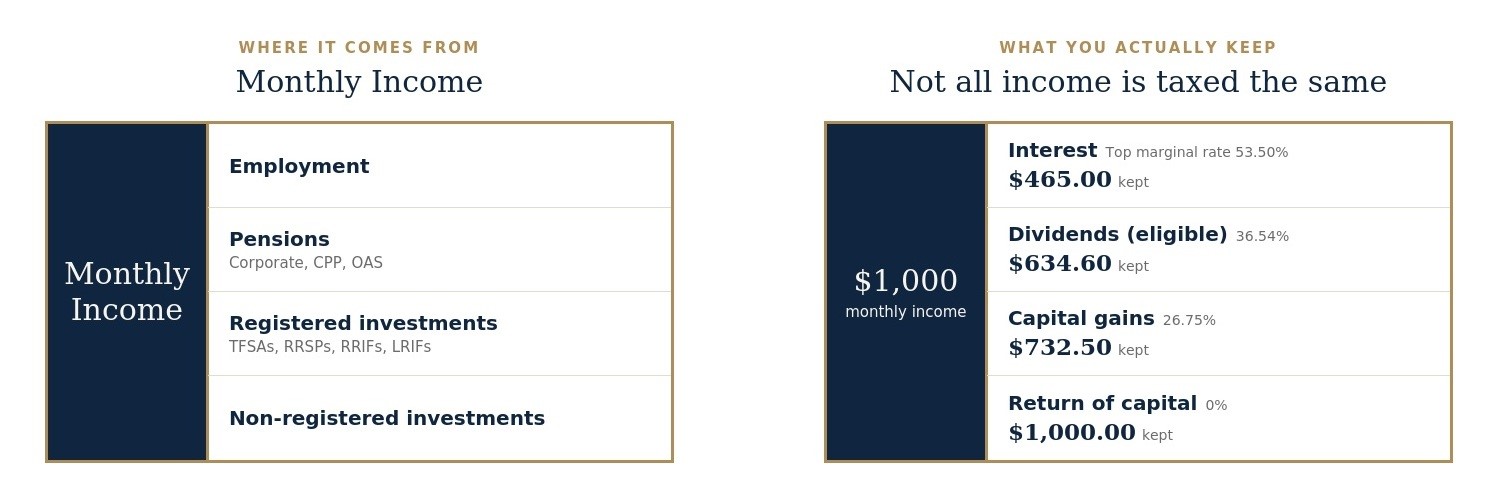
*What $1,000 of each income type leaves you after tax, at British Columbia’s top marginal bracket (taxable income over $265,546). Combined federal and B.C. rates per Ernst & Young, current to January 15, 2026.
It’s also one of the highest-impact decisions in retirement, and it deserves some deliberate thought rather than drawing from whatever's easiest. Reviewing these income sources every year, once your income tax has been filed, is good time to look at different opportunities for income.
4. Stress-testing the plan
A plan that works great on paper can still fail when things don’t happen as expected.
The risks worth testing for are often the obvious ones: living longer than you expect, inflation quietly increasing your costs year after year, or a market downturn early in retirement. You can’t eliminate these, but you can build a plan that holds up better if they happen.
- Longevity: planning to live well into your 90s, not to average life expectancy.
- Inflation: your costs in year 25 won't look like year one.
- Sequence of returns: this is important! A substantial market correction early in your retirement does more damage than the same correction later because you're drawing income while the value of your portfolio is still down.
- Health and care costs: the expense most people underestimate. For many people, their corporate benefit plans end when they retire, replacing these benefits can be costly.
5. Plan for the part that isn't about money
Retirement is a life transition, not just a financial one. The people who navigate it best have thought about what they’re retiring to: purpose, routine, identity, and for couples, whether they actually agree on what the next chapter looks like. It’s surprising how often two partners can have an entirely different picture of retirement yet never talk about it. The financial plan and the life plan should support each other.
6. Get the structure in place
The foundations that make everything else work: an up-to-date will, powers of attorney, and current beneficiary designations. These tend to get postponed - and they're exactly what you don't want to leave unsettled heading into this stage.
The Retirement Readiness Checklist
Work through these. The ones you can't answer confidently are where a conversation is worth having.
- I know, roughly, what my retirement will cost each year - essentials, discretionary, and one-time goals.
- I've listed every income source and when each one starts.
- I've made a deliberate decision about when to start CPP and OAS, rather than defaulting to age 65.
- I understand how and when my RRSP becomes RRIF, and what that means for withdrawals.
- I have a plan for which accounts to draw from, and in what order.
- My plan has been tested against living longer than expected, inflation, and an early market downturn.
- I've accounted for potential health and care costs.
- My will, powers of attorney, and beneficiary designations are current
- My partner and I agree on what this next chapter actually looks like.
- I know what I'm retiring to, not just what I'm retiring from.
Retirement is hopefully a transition you see coming - which means it's one you can prepare for. That’s exactly the kind of conversation we have with people every week.
Gage Buchanan, CFP, CIM, is an advisor with Stathopulos Family Wealth at RBC Dominion Securities in Kelowna, BC. He works with individuals and families navigating major life transitions, business sales, retirement, and personal change.
RBC Dominion Securities Inc.* and Royal Bank of Canada are separate corporate entities which are affiliated. *Member-Canadian Investor Protection Fund. RBC Dominion Securities Inc. is a member company of RBC Wealth Management, a business segment of Royal Bank of Canada. ® / TM Trademark(s) of Royal Bank of Canada. Used under license. © 2026 RBC Dominion Securities Inc. All rights reserved. This information is not intended as nor does it constitute tax or legal advice. Readers should consult their own lawyer, accountant or other professional advisor when planning to implement a strategy.