Surging Profits: Durable or Delusional?
Research analysts in aggregate are very optimistic about a continued surge in corporate profits, driven in part by an unprecedented wave of AI spending. Today’s note takes a deeper look at the history of the relationship between profit expectations and stock market performance, and the risks of veering too far into euphoria at the expense of business fundamentals.
Research analysts in aggregate are very optimistic about a continued surge in corporate profits, driven in part by an unprecedented wave of AI spending. Today’s note takes a deeper look at the history of the relationship between profit expectations and stock market performance, and the risks of veering too far into euphoria at the expense of business fundamentals.

Ryan Harder
Associate Portfolio Manager & Lead Strategist
May 24, 2026
In today’s note:
- Research analysts are projecting an unprecedented mid-cycle surge in corporate profits
- Skyrocketing AI-related capital expenditures are leading the charge
- Looking back at historical data highlights both risks and opportunities to this outlook
- We believe diligent and selective exposure to this AI capex surge is important for investors, but without veering into speculative and overly optimistic parts of the trade
For anyone invested in the stock market, it’s vital to remember what exactly it is you’re doing – becoming an (extremely small) minority owner in a variety of very large businesses. As it is with any business acquisition decision, there are two broad variables to consider: the future profit potential, and the price paid to become entitled to a share in that future profit.
The stock market and financial news media often tempt us to look only at the price paid. When we see a stock market hitting new all-time highs and realizing strong returns, the natural inclination is to feel that stocks are expensive and overextended. This instinct is rational, but only half the picture. With stock markets generally hovering just below their all-time highs, it’s more important than ever to look deeper into the earnings picture to see if this is justified.
If you were to aggregate all the profit growth expectations from equity research analysts (the folks at JP Morgan, RBC Capital Markets, Morgan Stanley et al who do deep research on stocks within their assigned sector), then yes this move has been entirely justified. Since the beginning of 2024, the S&P 500 is up 56%, making it one of the strongest periods in its history (albeit with a great deal of volatility). But if we look at profit expectations, at the beginning of 2024 aggregate analyst expectations for next year’s profit were $215 per share of the S&P 500, and today they are $335, for a total growth of…56%! What this means is that despite the market’s run in the last two years, stocks are sitting at almost exactly the same P/E multiple (price divided by earnings) that they were in January 2024. So if you ask analysts, stocks aren’t expensive, they’re just right. The chart below shows the relationship between stock prices and earnings expectations over that period.
(If you’re wondering why the earnings expectations line jumps so much in Q1 of every year, it’s because that’s when the biggest chunk of annual EPS (earnings per share) revisions are updated, with smaller quarterly adjustments happening throughout the rest of the year.)
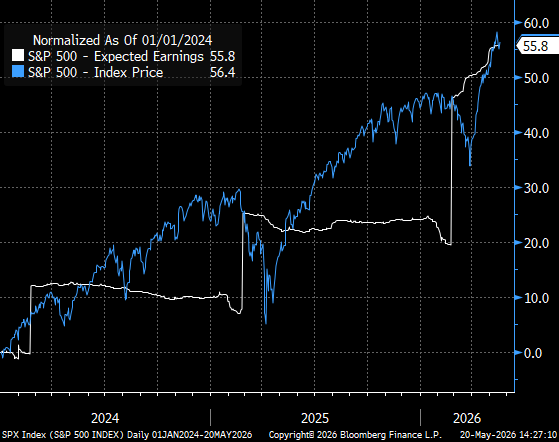
Unfortunately, there’s a problem with the equity research model – as an analyst, you essentially must be structurally bullish. Analyst “BUY” recommendations in aggregate outnumber “SELL” recommendations almost 10 to 1. So while analyst expectations are an extremely valuable tool in creating an investment outlook, we must look at their expectations through a skeptical lens, particularly since analysts tend not to reflect deteriorating conditions in their outlook until after the stock market has already started to do so.
The expected earnings growth in 2026 is nothing short of terrific: analysts expect overall profit to increase by over 20% this year. A highly disproportionate driver of this optimism comes from the hundreds of billions of dollars being poured into the ongoing AI compute build-out every single year. Free cash flow from the world’s largest companies is being directed toward massive datacenters, which are resulting in very real profits today for the many different sectors (utilities, construction, semiconductors, raw materials, etc) that need to come together to create these sprawling complexes of pure computational power.
But is this profit growth sustainable? Is this a continuation of the relatively consistent profit growth we’ve seen in broad stock markets since coming out of the financial crisis in 2009? Or is this a repeat of the dot-com bubble in 2000?
Let’s look at a longer history of stock prices vs earnings. Please note that the y-axis on this next chart is logarithmic, because using a normal y-axis scale completely hides the relationship of an exponential growth series (if you look at a stock market chart going back to 1950, it will look like nothing happened in those early years because the amounts are so close to zero relative to today’s levels). Also please note that this is showing earnings and stock price growth relative to 1927, but I’ve cut off those earlier years because the scale is extremely volatile in the first few decades.
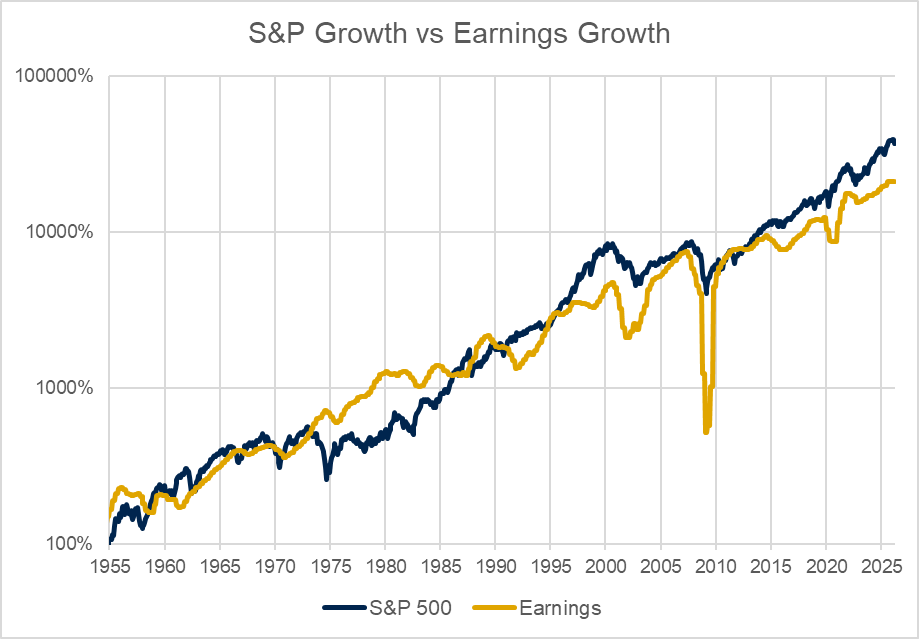
It's no surprise at all that these two time-series exhibit a very strong relationship – after all, shareholders are minority owners in these businesses, and it stands to reason that the value of each company should rise commensurate with profits. But we can also see that it’s not a perfect relationship. Stocks lagged profits in the mid 70’s, which created a wonderful subsequent return (905% cumulative) over the next 15 years as stocks caught up with earnings. Conversely, stocks got ahead of themselves during the dotcom mania and suffered in the proceeding years (which in turn pushed earnings lower as credit growth slowed significantly). If we look at today’s levels, a gap is creeping wider once again.
There are two ways to interpret this gap: either stocks are becoming over-extended, or stocks are pricing in an expectation that earnings growth will be even steeper going forward and will provide some catch-up to stock prices. For our part, we believe it’s a bit of both.
On the bullish side, there has been a persistent society-wide shift away from the power of human labor to the power of capital (computers, robotics, machinery, etc). A hundred years ago the size of a business was more or less a linear function of how many people were on the payroll, whereas today there are multi-trillion-dollar companies that employ fewer people than the population of North Bay Ontario.
What this means is that when compared to historical levels, productivity today relies more on capital than it does labour. We can see one effect of this if we look at average profit margins, which have been moving higher for decades. There are margin downturns in recessions like dotcom, GFC, and COVID, but the trend is clearly toward higher lows and higher highs. These types of long-term trends continue until they don’t (40 years of falling interest rates is one example), but there aren’t many reasons to believe that rising margins will permanently reverse course soon.
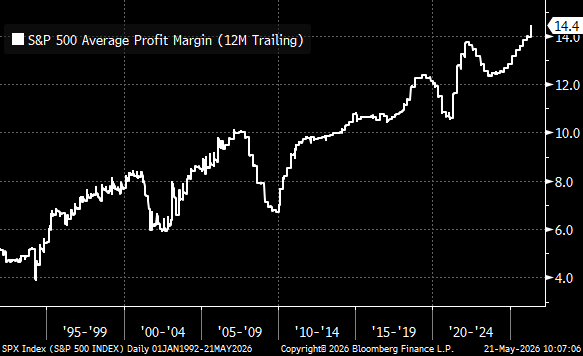
The reason I mention this is to rationalize some of the market’s performance in recent years, and to provide reassurance about why a strong stock market doesn’t necessarily portend a correction in the near future. Markets are clearly pricing in a corporate environment with faster growth and even stronger margins going forward.
On the other hand, this is veering dangerously close to “excuse making” territory. Many of these same arguments could have been made in 1999: margins were rising, analyst growth expectations were optimistic, and an exciting new technology was ushering in a wave of capital expenditures.
It’s important to remember the two most dangerous phrases in the world of investing: 1) this time is different, and 2) this time is never different. Finding the balance between these two doesn’t facilitate the type of clean, easy to digest narratives that both bullish and bearish financial pundits declare with extreme conviction on CNBC and Bloomberg, but it’s our philosophy that the best long-term investment outcomes come from a process of diligent, incremental, and nuanced (often boring) tactical decisions.
With all that said, the analyst community is very firmly in the “this time is different” camp, and to their credit, the first few years of the AI trade have validated that thesis. We do think having thoughtful and measured exposure to AI is important for a well-diversified portfolio.
At the same time, there is clearly some excess euphoria in this space, and not just from the companies slapping AI rebrands onto completely unrelated businesses. It’s for that reason that we continue to focus on business fundamentals like high free cash flow, durable growth, and clean balance sheets, even if those companies tend to be concentrated in less trendy parts of the market. After all, AI may change the world, for better or worse, but that doesn’t change the fact that good long-term investment outcomes will always depend on fundamentals, discipline, and valuation.