To Whom Does the US Government Owe $40T and What is a Bond Anyway?
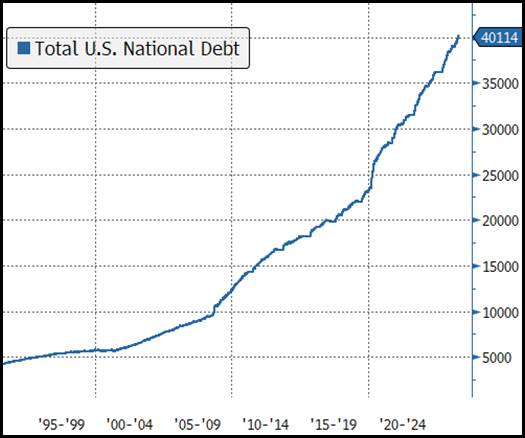
The U.S. Government recently surpassed $40 trillion in total debt, and it may seem as though further growth is unsustainable. In fact the opposite is true: this debt is almost guaranteed to continue growing indefinitely because the global financial system is designed to facilitate an ever-expanding debt and money supply.
The U.S. Government recently surpassed $40 trillion in total debt, and it may seem as though further growth is unsustainable. In fact the opposite is true: this debt is almost guaranteed to continue growing indefinitely because the global financial system is designed to facilitate an ever-expanding debt and money supply.

Ryan Harder
Associate Portfolio Manager & Lead Strategist
September 30, 2026
Given my fixed income upbringing in this industry, I may be biased. But I believe that to understand investing it’s vital to understand money, and to understand money it’s vital to understand bonds. If investing is a home, bonds are the plumbing, electrical, and HVAC. Like those essential components of a home, bonds often don’t make for the most riveting dinner party conversation – but if something goes wrong with the plumbing, it can quickly become an emergency.
A quick word of warning before you proceed – this newsletter is less about a specific market forecast or economic commentary and more about the nature of money and how our financial system is designed to reward risk-takers who invest and punish those who save. If nothing else you may find it the perfect read to ward off insomnia. So let’s get into it.
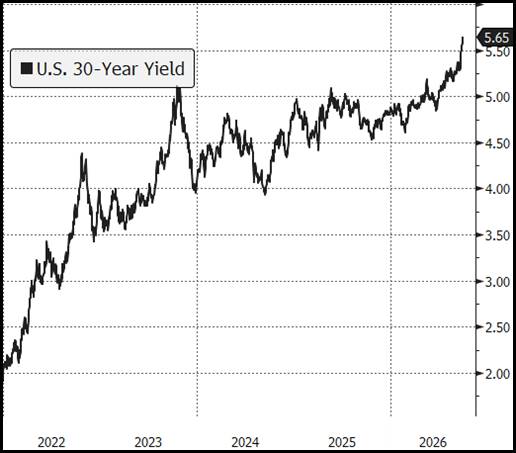
Bonds are enjoying a more prominent role in the financial news media lately for a couple of reasons. The first is that bond yields are rising, and the second is that US national debt recently surpassed $40 trillion. Today we’ll focus on the latter question because the former deserves an investigation on its own, but the very short answer is that rising bond yields are a good thing for most investors in the long run as long as it’s done in a gradual, orderly manner.
Forty-five years ago, the total US national debt surpassed a trillion dollars; this was an unthinkable burden at the time. If we simply match the proportional growth of the past 45 years (and I would argue it’s more likely to exceed that pace), US treasury debt will surpass one quadrillion dollars by the year 2071. Who do they owe all this money to, and how will it ever be repaid?
Before tackling the issue of who owns all this debt, we need to understand what sovereign debt actually is. The temptation for many is to think of government finances like a very large version of household finances; this thinking leads to incorrect conclusions. Indeed, if the US were like a very large household it would have filed for bankruptcy many decades ago.
A more accurate analogy would be a household that creates its own currency out of thin air, and through the threat of violence or forcible detainment is able to compel everyone else in the neighbourhood to use this currency to trade for goods and services. No matter how poorly that household mismanages their finances, they will never default in their own currency. The cost of mismanagement is borne by the rest of the neighbourhood, which sees the value of that currency decline relative to other forms of money (lower FX rates), scarce goods (debasement vs gold, land, etc), or consumer goods and services (inflation).
Ultimately, money is nothing more than an idea – it has no physical or intrinsic value. A dollar only has value because we collectively believe it does. We often think of dollars as a source of innate value and a stable denominator in the valuations of assets. For example we almost always talk about the price of gold going up in dollar terms, rather than talking about the price of dollars declining in gold terms, even though both are equally true. In reality, the value of a dollar is constantly fluctuating, and the direction of that value is lower over time – by design.
Currency is like an IOU, except those IOU’s are so universally accepted that they never have to be repaid directly because the recipient of the IOU can turn around and trade them with someone else. I had my gutters cleaned recently and gave the contractor dollars, since he was not willing to accept my newsletters as payment (even though I fervently argued heभ extract more value out of my newsletters than he would from my dollars).
In this vein, bonds are like an IOU of IOUs. Put in simpler terms, they are loans that the government takes out from the bank, except the bank in this case is the investing public (for the most part…more on that below). They don’t have to do it this way – technically they could just print the money and spend it as they please. In many ways, this is exactly how they do it, but in a more roundabout and clandestine way. This is partly for legitimate reasons but also partly to hide what it is that they’re doing (which is debasing our currency rather than raising taxes).
Bonds are a reflection of this phenomenon. Like dollars, more of them created almost every year. They will never at any point be truly “repaid”. Yes you will always receive your principal on the maturity date of a Canadian or US treasury bond, but that bond will be reissued immediately. The result is perpetual dance of hundreds of billions of dollars of constant maturities and new issuance. This ongoing cycle forms the foundation of our financial system, even though we rarely think about it. Similarly, when I turn on the tap at home, I expect clean water to flow instantly. I don’t think about this on a day-to-day basis, but that certainly doesn’t mean it’s not important.
Globally there is currently over $350 trillion in total debt outstanding. To whom is this owed? Aliens? Of course the extremely oversimplified answer is that it’s owed to ourselves. And to a large extent the same is true of government debt, regardless of country (although there are unique circumstances I won’t cover here, such as debt owed in a currency controlled by another country, which was the case in the European debt crisis of the early 2010’s). If monies are IOUs and bonds are IOUs of IOUs, and those IOUs have no intrinsic value, what really is money? As said before, it’s an idea, and that idea is trust.
A commonly trusted currency allows for trade to take place between parties even when no two parties have a mutually beneficial trade to make. It is the foundation of the division of labour that has made our economy orders of magnitude more efficient than it was during our species’ long history as hunter-gatherers. The factors that make a given currency trustworthy deserve a full-fledged newsletter on its own, but suffice it to say that for most of human history, gold has been the good that has had the strongest claim to all of those “trustworthy” attributes (durable, portable, divisible, fungible, can’t be easily created, hard to counterfeit).
Bonds are just an additional layer of trust on top of currency. In the case of treasury bonds, you are trusting the same entity that you trust when you accept dollars as a form of money in the first place.
As a quick aside, this is ultimately what caused the financial crisis in 2008: a failure of trust. There was no war, pandemic, earthquake, meteorite, or other external catastrophe to cause the collapse of the US housing market and a number of large financial institutions. Instead it was a destruction of trust resulting from over-securitization, fraudulent behavior, and undisclosed risk. As a result, lenders stopped lending and otherwise productive businesses were starved of capital. In this way, the failure of an idea led to fewer real goods and services being produced. But I digress…
So we’ve established that bonds are IOUs of dollars (and dollars in turn are IOUs for goods and services). But who is the “U” that the government owes?
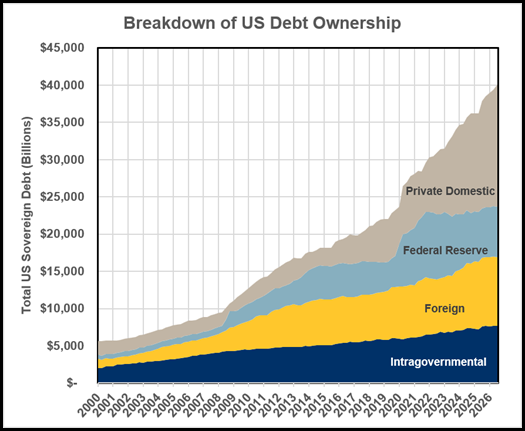
Intragovernmental: Let’s start quickly here. Without getting too deep into the weeds, this is essentially the US government taking money from its left pocket to put in its right pocket. For example, Social Security owns trillions in treasury bonds – it’s an asset of the social security system and a liability of the treasury. But the US government controls both entities, and it’s done more out of an accounting practice than one based in physical reality. Many will argue this should be considered part of the overall debt load, but it’s a bit of a grey area. Ultimately, owing yourself $5 trillion is the same as owing yourself nothing. This isn’t to say there aren’t any issues with social security funding, it’s just that the debt owed to social security and other entitlement programs is more of an accounting exercise meant to represent future spending requirements.
Foreign Ownership: This is the piece that typically generates the most hang-wringing from financial pundits and in my opinion is also the most misrepresented. Many will point to the hundreds of billions of dollars in treasury bonds held by China or Japan or other countries as evidence that the U.S. is somehow beholden to those countries. And while there is some truth to that (it would cause problems if China dumped all of their treasuries in a short period of time), for the most part it’s the opposite that’s true.
If you owe the bank $100, that's your problem. If you owe the bank $100 million, that's the bank's problem. – J. Paul Getty
Now change the above quote to read “if you owe the bank $9 trillion of a currency you can create in unlimited quantities out of thin air, that’s the bank’s problem.” Remember that treasury bonds are an IOU of dollars (which themselves are an IOU that is constantly being debased over time). Foreign sovereign investment in treasuries does not confer control to those foreign entities – it confers control to the U.S. government, because it is a byproduct of their complete authority over the most universally accepted currency in the world. It’s for this reason that so many international central banks – particularly China – have been selling treasuries in favor of gold.
Federal Reserve: Just like intragovernmental, this is another form of the US government owing money to itself. Fed ownership of treasury debt started in earnest after the Global Financial Crisis with a process called Quantitative Easing (QE). The idea behind QE was that buying hundreds of billions in bonds would increase the price of bonds and drive yields down. If you’re wondering why they didn’t just cut rates instead of implementing QE, the short answer is that they did this as well, and the much longer answer will have to wait for another time. Nonetheless, the bonds held by the Fed are almost certainly never going to be fully returned to the open market. Other than brief periods of Quantitative Tightening (QT), where the Fed sells its bonds, the Fed always reinvests the maturities as they come due. In my opinion, we should consider the nearly $7 trillion held by the Fed as "cancelled” debt. Fun fact: the Federal Reserve could eliminate the entire $40T debt load overnight by printing the dollars and purchasing then cancelling the bonds. But doing so would cause inflation to skyrocket, it would destroy the plumbing of the international finance system, and it would severely hurt confidence in the dollar. So instead they have “secretly cancelled” a portion of the debt by just buying those bonds and never putting them back into the broader system.
Private Domestic: This is the biggest component of the debt picture, and also the most complicated. The private domestic bucket includes investors who have as little as $100 in a government bond ETF to investors as large as pension or insurance funds who hold tens of billions in bonds. It is the private domestic investor that has absorbed the majority of the recent increase in treasury debt, and it’s quite impressive that the trillions in new bond supply has resulted in fairly gradual yield increases. However, this is the layer whose opinion matters most, and right now rising bond yields are an indication that this group of investors is running out of capacity to continue lending to the U.S. government.
So does this mean we’re headed for a bond crisis? The answer is that all this debt issuance needs to be absorbed either by investors or by the Fed (paid for by inflation and money printing). If the private domestic layer simply can’t buy the bonds fast enough, yields will continue rising. At a certain point if they rise enough, the Federal Reserve will almost certainly step in (as it has multiple times in the past), to monetize that debt through new money supply. This is why I think inflation is much more likely to bear the brunt of the US debt load than yields are. The path to a true bond crisis is one where yields are rising rapidly and the Fed refuses to help – with Fed Chair Kevin Warsh, this is unlikely, despite his relatively hawkish comments on the Fed balance sheet.
If you’ve made it this far, I commend you. Typically, my desire to talk about fixed income markets exceeds the demand to read about it. But I do think it’s an extremely important and overlooked topic, since it’s the foundation for the entire global financial system. Once you understand the ever-expanding nature of money and bonds, a few things become clear:
- Dollars are fluctuating assets, and the direction of that asset is structurally lower – this is called debasement (or its better-known cousin inflation)
- Productive assets like stocks and scarce assets like gold expand along with the money supply over the long run, which is why it’s so difficult to increase your wealth by stuffing savings under the mattress
- There is no level of sovereign debt in one’s own currency where default or bankruptcy will be necessary – instead, the cost will be borne by a faster pace of debasement and inflation, which is what we’re seeing today and expect will continue into the future
- Debasement hurts savers at the expense of investors who hold real assets like stocks, real estate, and precious metals
- Rising bond yields are a headwind for stock markets, but there is no risk of US government insolvency at any level of debt denominated in USD
There are many other related topics that we haven’t touched on here – how the banks do the vast majority of money printing, why rising bond yields are positive for long term returns but negative in the short term, or how the nature of monetary policy is changing as government debt loads rise. But those will have to wait for another month – until then, remember that the money supply universe is designed to expand forever, and the only way to truly grow your wealth in this type of system is to own productive or scarce assets that grow alongside the money supply.