
Robin Gullason
Associate Portfolio Manager, Lead Strategist
October 29, 2026
Executive Summary
- The Bank of Canada and the Federal Reserve had interest rate decisions on the same day this week.
- Despite Canada’s weaker growth trajectory, the Bank of Canada raised rates for the first time in three years while the Federal Reserve stood pat with healthy growth and sustained inflation south of the border.
- The net effect is that over the past few months, bond yields have increased to levels that are getting more attractive.
- While elevated inflation necessitates higher yields, historically these levels of rates have typically led to rates of return over and above the coupon rate.
- In other words, yields today are high enough that there is substantial room for them to fall if inflation abates or the economy weakens, which could lead to a combination of income plus capital gains.
- It is early days, but as volatility has ticked upward in recent weeks we have seen “bonds acting like bonds” again, i.e. posting positive performance when stocks sell off.
- This relationship is key to the value proposition of holding a balanced portfolio and reducing volatility in returns.
Bank of Canada delivers a hike…
The Bank of Canada and the Federal Reserve delivered a study in contrasts this week. The Bank of Canada opted to raise its benchmark interest rate by 25 basis points to 2.50%, marking its first rate hike in three years despite the challenges facing the economy. The BoC hiked rates as a precaution against rising energy prices, and revised up its inflation forecast and growth outlook. Governor Macklem signaled openness to further tightening but emphasized a meeting-by-meeting approach. The market is pricing in another full rate hike by January.
…while the Fed takes a pass
Meanwhile, south of the border, the Federal Reserve chose to stand pat, maintaining its target rate range following an earlier rate increase this year amidst healthy economic growth and elevated inflation. After raising rates at its last meeting, the Fed is taking a “wait and see” approach, and though it will deny it, they likely didn’t want to change rates ahead of an election unless the need for change was acute. We would note that markets have priced in a 79% chance of a hike at the next meeting in December, so it seems this rate hiking cycle is not done quite yet.
Recent developments have led to higher bond yields regardless of central bank actions
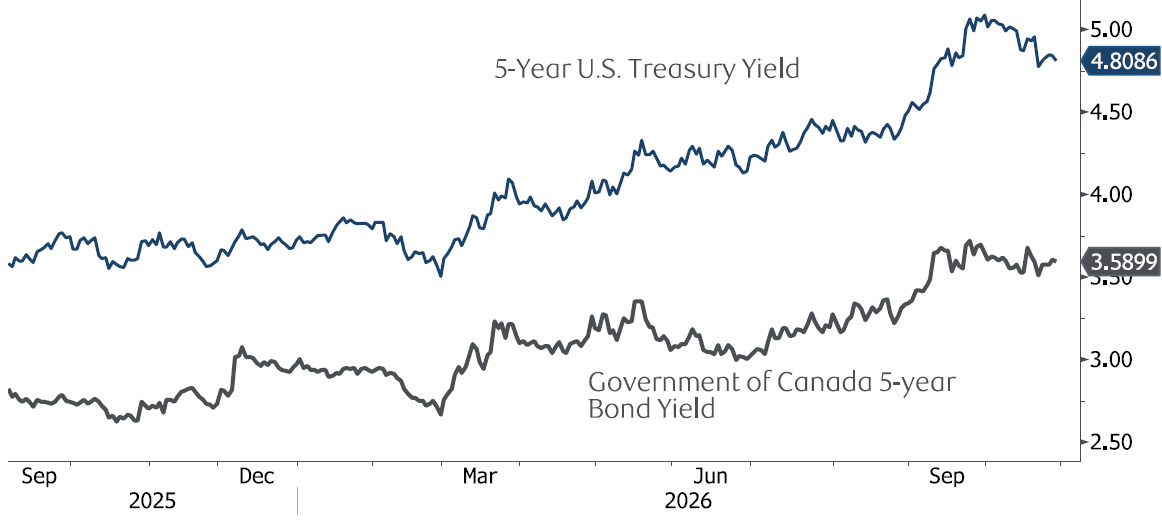
As oil prices have remained elevated and technology companies compete with governments for investor capital, bond yields have moved steadily higher throughout 2026, with U.S. yields going above the 5% level briefly.
Source: Bloomberg
Yield is no longer as scarce as it once was
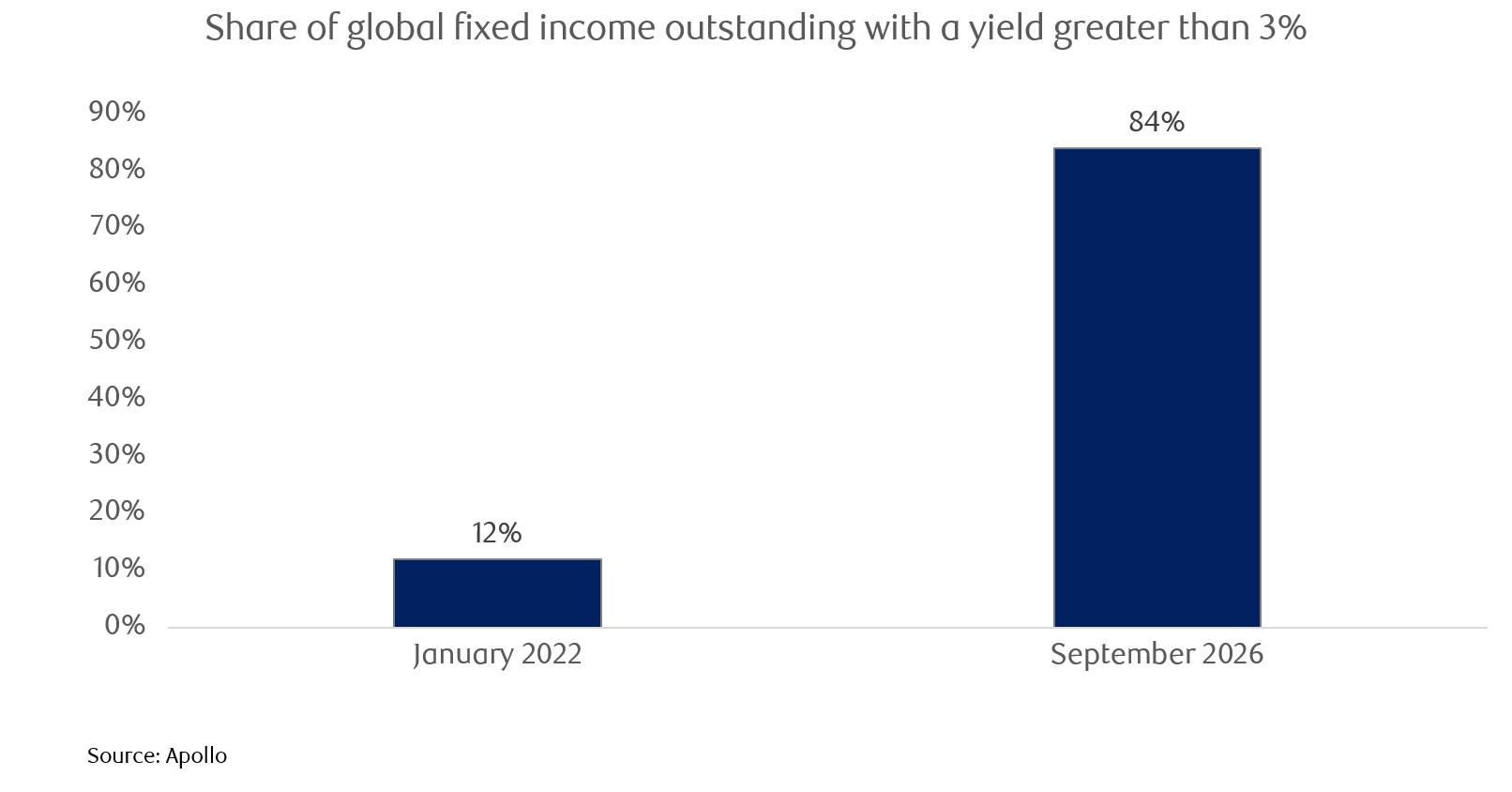
The post-COVID reckoning in bond markets has brought about a profound shift in the structure of the market. In January 2022, only 12% of bonds globally had a yield above 3%, while today 84% of fixed income outstanding has a yield above that level. 3% just happens to be roughly the rate of inflation in Canada and the U.S., so while the 3% level does not represent a high “real” yield over and above inflation, there are many opportunities to earn yields in excess of 3%.
Potential for healthy returns in bonds grows meaningfully when U.S. yields eclipse 4.5%
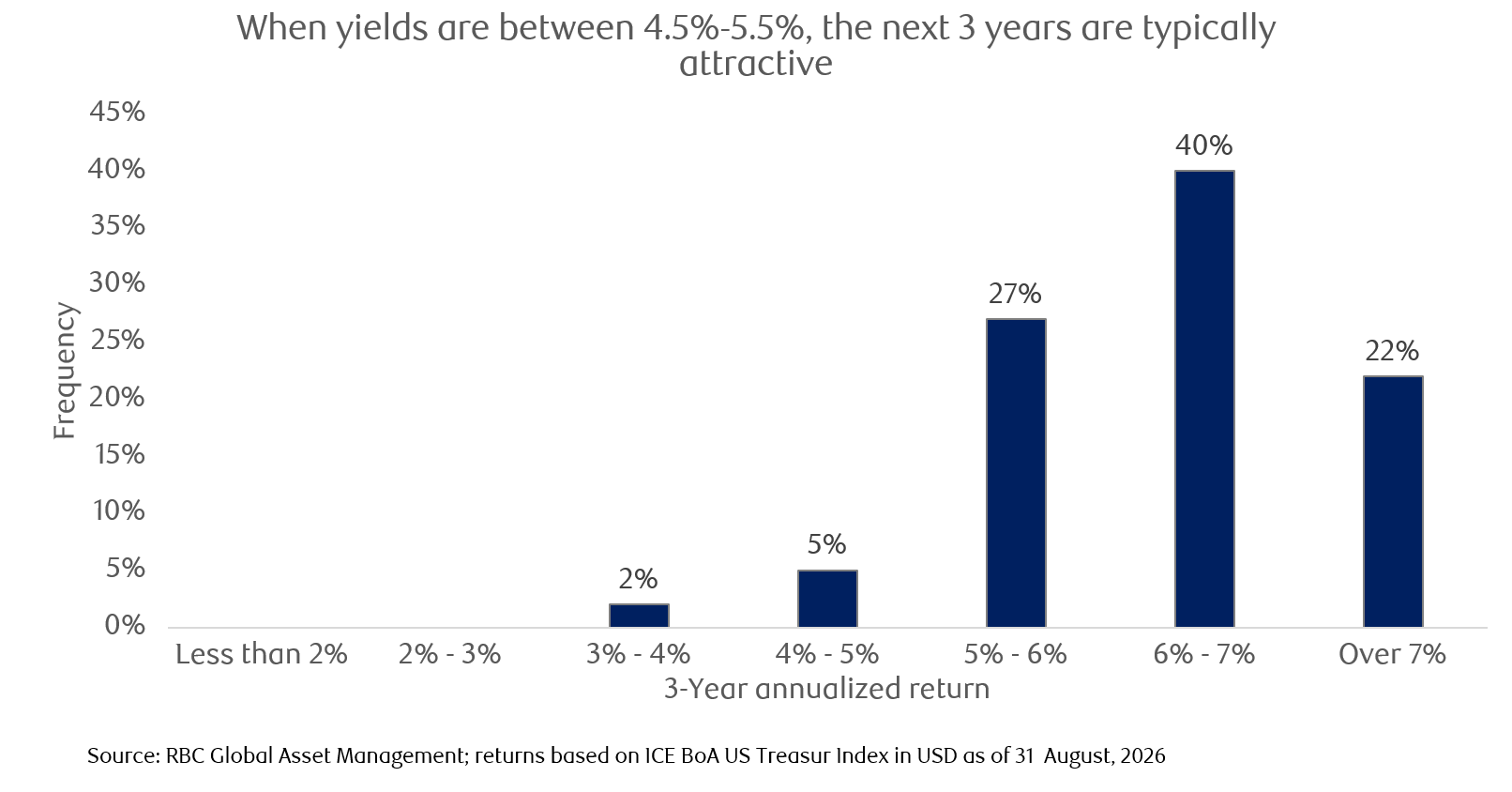
Historically, when U.S. Treasury yields are between 4.5% and 5.5% the forward returns have been attractive, with the U.S. Treasury index posting returns greater than 5% annualized for the next three years 89% of the time. While this is U.S. data, we would note that the Canadian and U.S. bond indices have seen remarkably similar returns over time, with the long term rate of return differing by less than 0.2% annualized going back 20 years.
Are “bonds behaving like bonds” again?
While the last five years have been a challenge for bonds investors faced with rising yields eroding returns, we are now in a position where bonds have the potential to deliver returns over and above their coupon income. Yields are high enough that there is room for them to fall in the event that inflation wanes or the economy weakens. When yields fall, bond prices rise, augmenting the income return that investors receive regardless of what happens to price in the short term. Further, in the past month we have seen bonds reclaim their role as portfolio diversifier. For the first time in a while, we have seen bonds putting up positive returns on days when stocks trade lower. This is the opposite of the phenomenon seen earlier in the year where a weaker bond market would infect stocks. It is very early days, but we are optimistic that the benefits of a balanced portfolio are set to reassert themselves after a difficult period.
The Harbour Group - 416-842-2300
Putting you first, every time, to help you navigate the complexities of managing your wealth. All of our team members, all of our resources, all of our collective insight: ALL FOR ONE: YOU™.
The information contained herein has been obtained from sources believed to be reliable at the time obtained but neither RBC Dominion Securities Inc. nor its employees, agents, or information suppliers can guarantee its accuracy or completeness. This report is not and under no circumstances is to be construed as an offer to sell or the solicitation of an offer to buy any securities. This report is furnished on the basis and understanding that neither RBC Dominion Securities Inc. nor its employees, agents, or information suppliers is to be under any responsibility or liability whatsoever in respect thereof. The inventories of RBC Dominion Securities Inc. may from time to time include securities mentioned herein. RBC Dominion Securities Inc. and its affiliates may have an investment banking or other relationship with some or all of the issuers mentioned herein and may trade in any of the securities mentioned herein either for their own account or the accounts of their customers. RBC Dominion Securities Inc. and its affiliates also may issue options on securities mentioned herein and may trade in options issued by others. Accordingly, RBC Dominion Securities Inc. or its affiliates may at any time have a long or short position in any such security or option thereon. Mutual funds are sold by RBC Dominion Securities Inc. There may be commissions, trailing commissions, management fees and expenses associated with mutual fund investments. Read the prospectus before investing. Mutual funds are not guaranteed, their values change frequently and past performance may not be repeated. RBC Dominion Securities Inc.* and Royal Bank of Canada are separate corporate entities which are affiliated. *Member CIPF. ®Registered Trademark of Royal Bank of Canada. Used under licence. RBC Dominion Securities is a registered trademark of Royal Bank of Canada. Used under licence. ©Copyright 2026. All rights reserved.