
Robin Gullason
Associate Portfolio Manager & Lead Strategist
July 7, 2026
Executive Summary
- Despite strong stock markets around the world, the Canadian dollar has been weak in 2026.
- There have been multiple culprits, from the “flight to safety” surrounding middle east hostilities, lower oil prices and the USMCA review.
- The largest impact has come from shifting interest rate expectations, with the U.S. shifting starkly from expected rate cuts to expected rate hikes.
- We would not be surprised to see no change from either central bank this year but markets trade off expectations.
- Speculators have taken notice, and their bets against the Canadian dollar are hitting levels that have in the past led to a bottoming process.
- Markets often bottom when so much bad new is priced in that a small change can have a big impact – we may be near this point with the Canadian dollar.
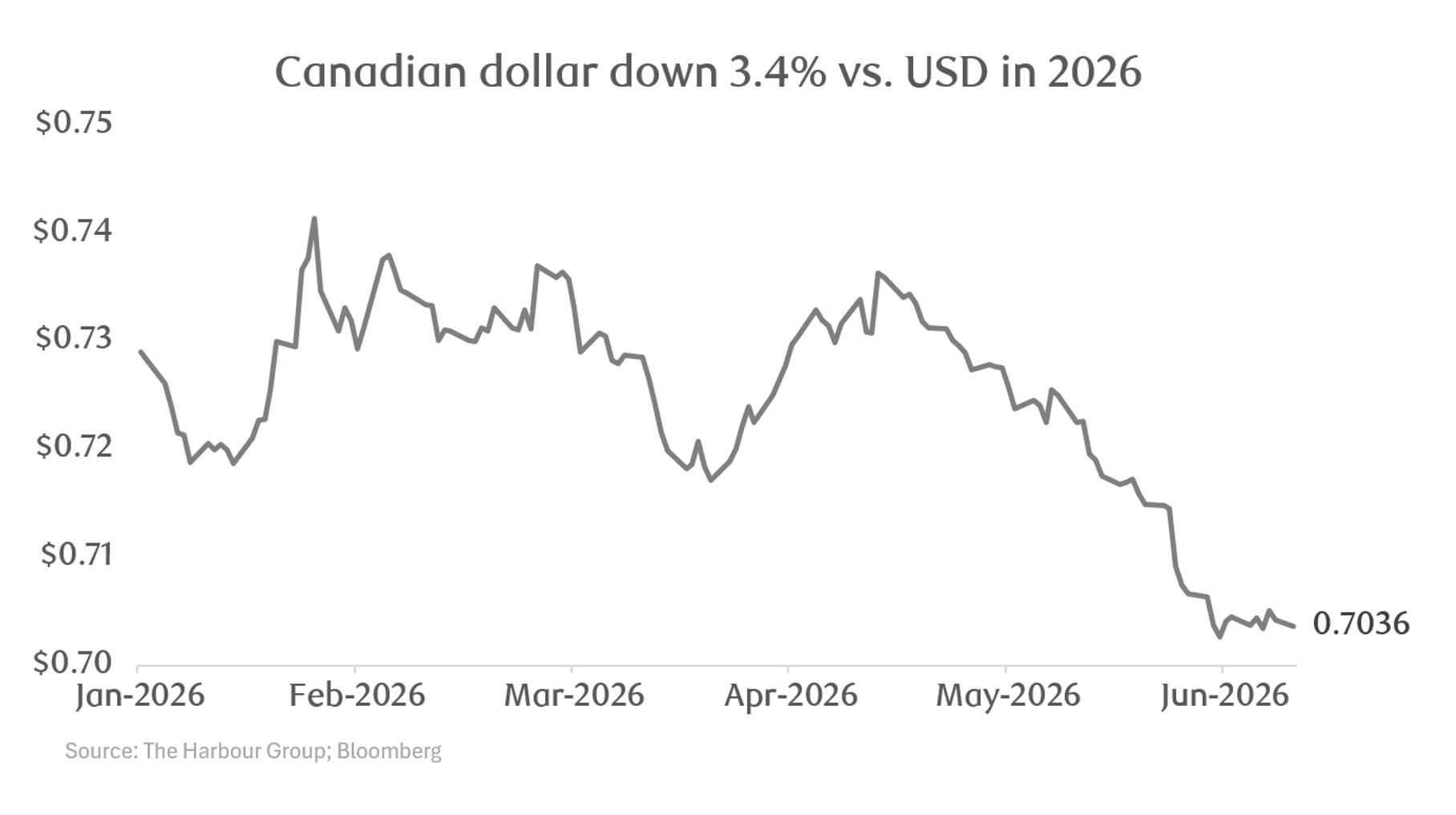
If someone said on January 1 of this year that by the mid-point of 2026 the major equity indices would be up high single digits, the Straight of Hormuz had been closed and oil hit over $100 a barrel, few would expect the Canadian dollar to be at its lowest point in over a year, but that’s where we are. There is plenty of blame to go around – a strong U.S. dollar, a “flight to safety” during the most recent middle east hostilities and the ongoing USMCA review. As we mentioned in May, surging oil prices are not the boost they once were for the Loonie, and it feels like the only time the loonie moves reliably with oil is when prices are going down! Add it all up, and we are looking at a Canadian dollar down over 3% so far this year.
Interest rates: the silent driver of exchange rates…
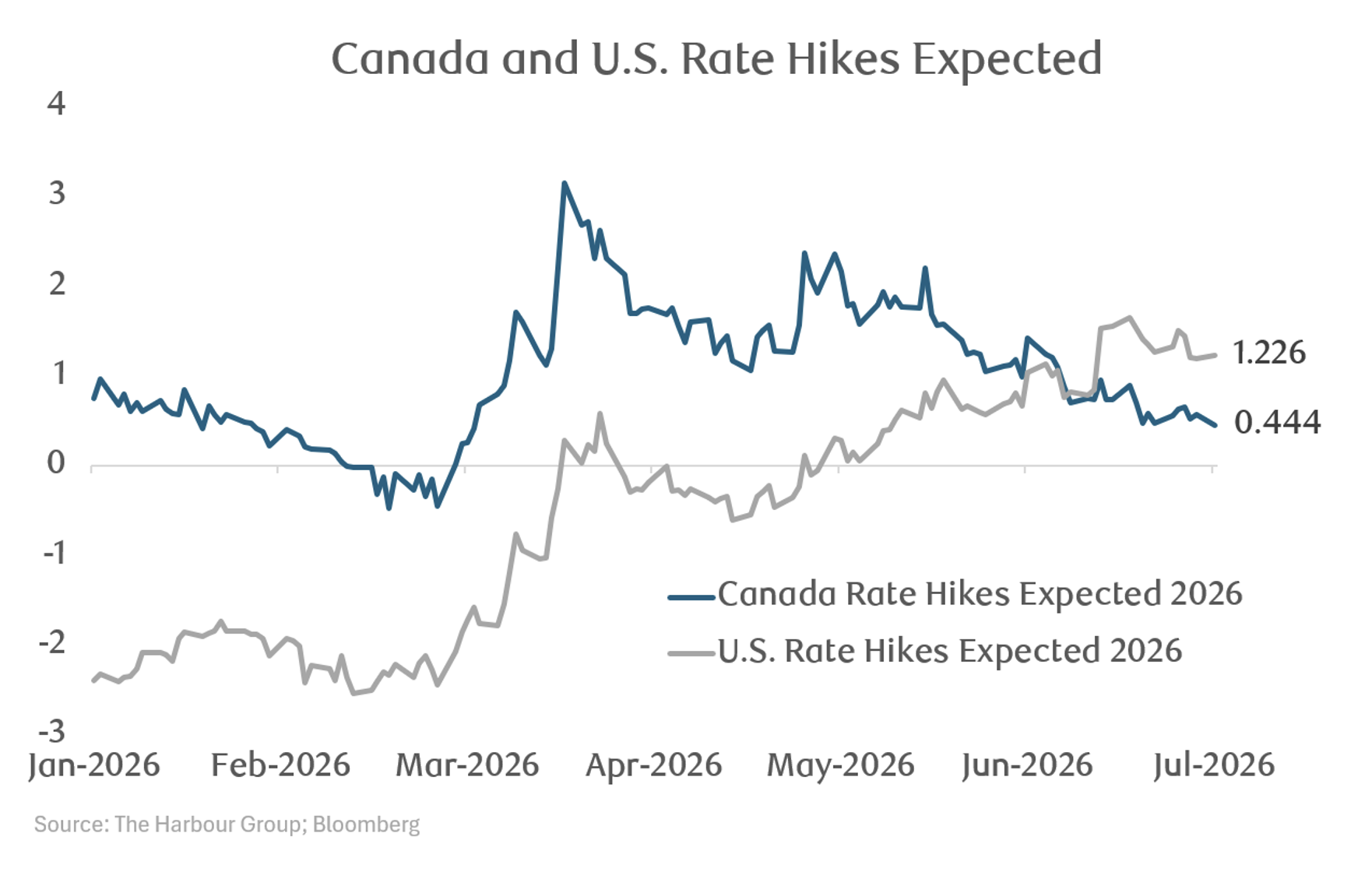
While tariffs, trade deals and Tehran make all of the headlines, something much further below the radar has been the primary driver of currencies over the long term. Current and expected interest rates have an enormous impact on the exchange rate between two countries, particularly when their economic growth and inflation rates are similar (i.e. the U.S. and Canada). The most straightforward way to think of it is someone is straddling the Canada/U.S. border with a bag of cash, and they are going to deposit that money where they will earn (or expect to earn in the near future) a higher rate of interest, all else equal. While the actual interest rates paid by the Bank of Canada and the Federal Reserve have not changed this year, the expectations have shifted meaningfully. As seen below, the market has been expecting between zero and three rate hikes from the Bank of Canada this year, settling in on a 44% chance of a hike as of today. The U.S. has seen a much greater swing, with more than two rate cuts expected in January to a full rate hike and then some expected today. On January first, markets expected one rate hike out of Canada and more than two cuts out of the U.S. and now they see the U.S. raising rate more than us. This shift in expectations tends to boost the U.S. dollar versus the Canadian dollar.
… but a very powerful one
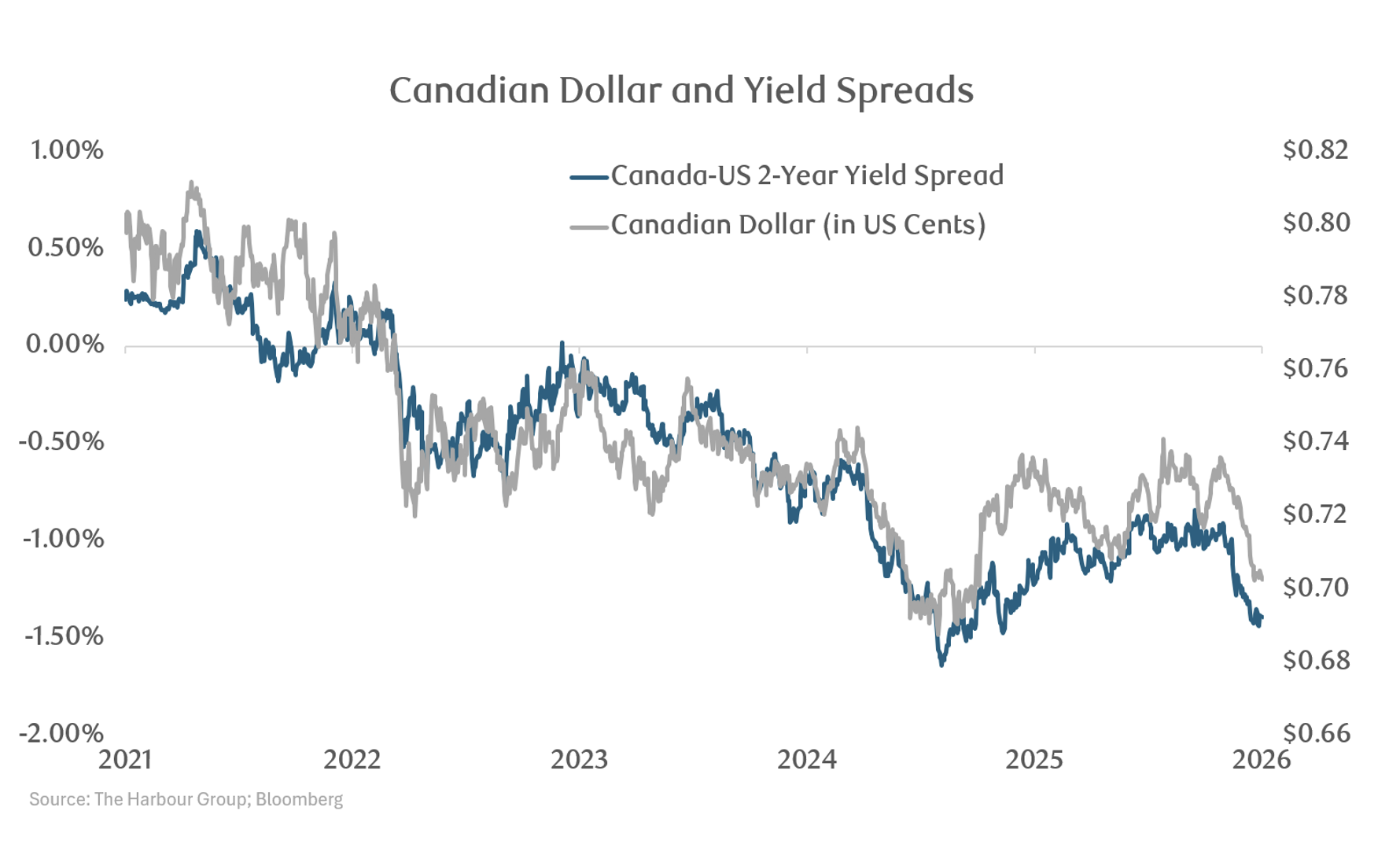
The entire exercise above can be simplified by looking at the difference between Canadian and U.S. 2-year bond yields. These yields are short-term enough that the current central bank interest rate has a strong influence, but also encompass enough term to be driven by what is expected in the near future. The difference between the 2-year bond yield in each country has historically been a strong driver of exchange rates. If we look over the past five years the correlation is not perfect but this so-called “yield differential” has been directionally correct the majority of the time and in 2026 it has moved sharply in the U.S.’s favour.
Speculators piling on – nothing attracts a crowd like a crowd
The final piece of the puzzle on the weakness in the Canadian dollar is what is called “positioning”, i.e. how many investors are betting on or against the currency. This is most visible in the futures market, where investors can use substantial leverage to amplify their bets. If we look at the chart below, the size of the grey bars shows how much investors are betting for or against the loonie. Speculators’ positioning today is nearly as largely negative as it has been in the past five years. We use this data as a contrarian indicator. When everyone is betting heavily in one direction, it often doesn’t take much to cause market direction to shift. As we discussed in April, we only need news that is “less bad” than feared to spark a rally, and we do wonder if we are reaching that point for the Canadian dollar.
What could cause the loonie to take flight once again?
Right now it feels like everything that can be going wrong for the Canadian dollar is. The U.S. dollar has been broadly stronger, USMCA uncertainty is high, oil prices are falling and the new Federal Reserve chair seems much less likely to cut interest rates than was recently assumed. The other side of this is how much worse can sentiment get? Worse is always possible, but in our view the probability of any of the above turning slightly for the better is higher than adding another negative to the pile. The weaker Canadian dollar has been a headache for travelers but has boosted portfolio returns in the first half of 2026. We don’t need a lot to go right in order for this not to be repeated in the back half of the year.
The Harbour Group - 416-842-2300
Putting you first, every time, to help you navigate the complexities of managing your wealth. All of our team members, all of our resources, all of our collective insight: ALL FOR ONE: YOU™.
The information contained herein has been obtained from sources believed to be reliable at the time obtained but neither RBC Dominion Securities Inc. nor its employees, agents, or information suppliers can guarantee its accuracy or completeness. This report is not and under no circumstances is to be construed as an offer to sell or the solicitation of an offer to buy any securities. This report is furnished on the basis and understanding that neither RBC Dominion Securities Inc. nor its employees, agents, or information suppliers is to be under any responsibility or liability whatsoever in respect thereof. The inventories of RBC Dominion Securities Inc. may from time to time include securities mentioned herein. RBC Dominion Securities Inc. and its affiliates may have an investment banking or other relationship with some or all of the issuers mentioned herein and may trade in any of the securities mentioned herein either for their own account or the accounts of their customers. RBC Dominion Securities Inc. and its affiliates also may issue options on securities mentioned herein and may trade in options issued by others. Accordingly, RBC Dominion Securities Inc. or its affiliates may at any time have a long or short position in any such security or option thereon. Mutual funds are sold by RBC Dominion Securities Inc. There may be commissions, trailing commissions, management fees and expenses associated with mutual fund investments. Read the prospectus before investing. Mutual funds are not guaranteed, their values change frequently and past performance may not be repeated. RBC Dominion Securities Inc.* and Royal Bank of Canada are separate corporate entities which are affiliated. *Member CIPF. ®Registered Trademark of Royal Bank of Canada. Used under licence. RBC Dominion Securities is a registered trademark of Royal Bank of Canada. Used under licence. ©Copyright 2019. All rights reserved.