
Jaxson Khan
RBC Thought Leadership
September 29, 2026
Data centres are at the core of the AI boom. Tech companies are committing trillions of dollars, much of it to the data centres that power their AI applications and services. And Canada is a natural destination for data centre buildouts, given its clean energy, cooler climate, and abundant land.
The scale of the opportunity is immense. In Canada’s New Capital Playbook, co-written with McKinsey & Company, we found that global data centre demand—as measured by energy requirements—is expected to roughly triple by 2030, with AI accounting for about 70% of that growth. Cumulative investment in data centre facilities alone could exceed US$2 trillion to US$2.5 trillion through 2030.
As the report outlines, pairing investment in data centres with commercialization steps can allow Canada to be a participant in shaping the global AI economy. Data centres could potentially provide significant economic benefit, generating revenue and improving productivity through AI-enabled solutions. Domestic data centres could also strengthen Canada’s AI and data sovereignty.
However, public sentiment has soured on data centres amid environmental and noise concerns, as well as growing anxiety about AI. Data centre construction has become deeply politicized, particularly in the U.S., where it has emerged as a key mid-term election issue.
Closer to home, a framework to guide data centre development in Canada has started to take shape, with the federal government and six provinces each releasing principles, frameworks or rules aimed at setting clear expectations for data centre projects. As Canada pursues a build out of the infrastructure powering AI, the frameworks that have been unveiled so far boil down to three key requirements:
- Power: bring your own generation or win an allocation, without loading the grid or offloading costs on Canadians.
- Price: pay the full cost without relying on public money and leave lasting benefits.
- Permission: earn the approval of the local community, Indigenous rights holders, and relevant regulators.
Power
Power is often the most significant challenge with data centre development and has the longest lead time. Addressing power requires grid studies and connection agreements, or self-supplied generation with the utility regulator’s approval, plus the transmission, substation, and transformer work that must start early. In some cases, large substation transformers can take more than three years to arrive.
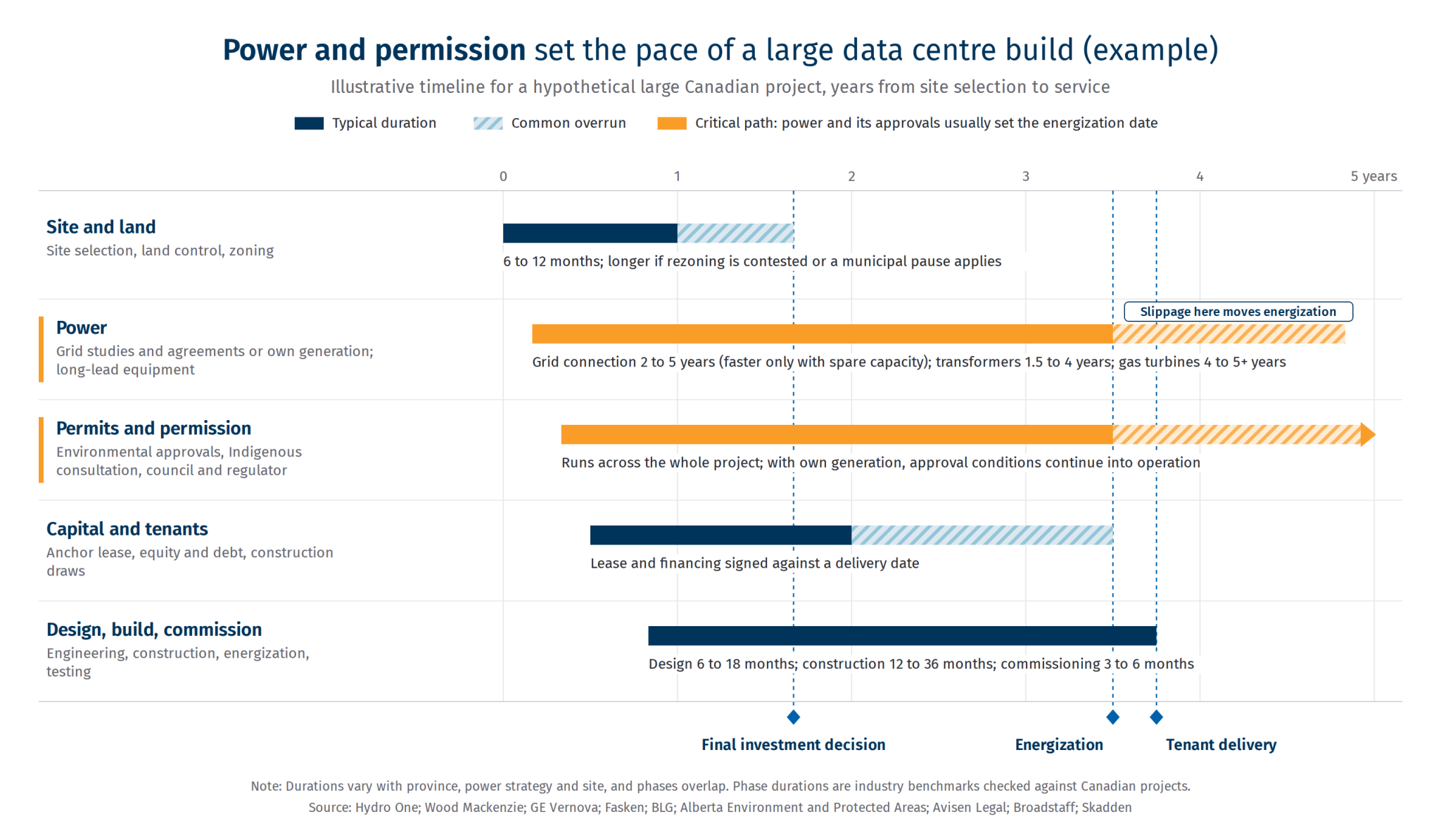
Figure 1. Five overlapping workstreams for a hypothetical large Canadian data centre project, with illustrative timing. Timelines draw on information from Hydro One, Wood Mackenzie, GE Vernova,Fasken, BLG, Alberta Environment and Protected Areas, Avisen Legal, Broadstaff and Skadden. Every project differs.
Power often determines where projects land. Alberta holds roughly 3% of Canada’s active data centre capacity but about 90% of proposed capacity, in part because it is where a developer can often most easily build its own power generation, rather than wait for the grid. The provincial government has also actively sought to be a major hub for data centres. Meta broke ground in the summer on a $13 billion, 1 GW facility, its largest outside the United States, to be fed in 2030 by a $4.6 billion, 932 MW natural gas plant being built beside it in Sturgeon County near Edmonton.
Even so, Alberta’s interim grid allocation of 1,200 MW is fully subscribed against a queue near 19,565 MW. Ontario estimates proposals there could exceed 10,000 MW. Even those that want to supply power themselves face obstacles, as demand has stretched delivery times for gas turbines and other equipment. For a fraction of the proposed projects to proceed, Canada needs new supply: the Alberta and Ontario queues alone are roughly 18 times the 1.6 GW of data centre capacity operating in the country today.
Prime Minister Mark Carney has put forward a plan to double the capacity of the electricity grid by 2050, “supplying clean, reliable and affordable power over the next coming decades.” As part of the forthcoming national electricity strategy, there could be an opportunity for clean energy to play a bigger role in powering data centre demand. Currently, natural gas is often filling the energy gap. But low emission nuclear energy may also be an opportunity, particularly in Ontario, where more reactors are being built. Nuclear-powered data centre development is already happening in the U.S. For example, Microsoft struck a 20-year agreement with Constellation to restart the Three Mile Island Unit 1 reactor. Now renamed as the Crane Clean Energy Center, it is expected to go back online in 2027.
Price
Who pays and who benefits is the second test. Alberta won’t offer subsidies or discounted electricity. Ontario, Saskatchewan, and New Brunswick have each moved to make new data centres pay their own way, rather than rely on public money, and Hydro-Québec has proposed a data centre rate that’s about double its large industrial rate. The federal principles also state that data centres must create lasting local benefits and not shift electricity costs to Canadians.
Data centres can bring construction spending, property tax and utility revenue, and compute that local firms can use. For Canada, longer-term benefits could include building the grid connection, power generation, and local economic benefits.
In some cases, revenue from AI data centres can potentially lower costs for residents. In the U.S., utility provider Indiana Michigan Power proposed cutting about US$59 million from 2027 bills, roughly US$100 a year for a typical household, and freezing Indiana residential rates for three years, citing revenue from data centres and other large power loads.
Permission
Permission remains a key challenge, even when power is available and economic benefits are clear. Getting data centres built requires environmental approvals, Indigenous consultations, municipal, provincial or territorial permits, as well as regulatory decisions.
Addressing water usage is also key, something that is reiterated in the federal government’s framework. For example, interim by-laws in Mississauga and Oakville, Ont., pausing data centre development were passed to study local impacts including water, and the Sturgeon Lake Cree Nation is in court challenging the water permit for the Wonder Valley development on its Treaty 8 territory. Water is usually a local approval question in Canada and can sometimes be where permission is granted or rejected.
Indigenous partnership is critical. Many potential data centre sites sit on or near traditional territories, so consultation is a legal requirement. Indigenous equity stakes have also become an important component of advancing Canadian infrastructure projects. For example:
- Woodland Cree First Nation holds 51% of a 650 MW Alberta project that would repurpose a partially built power plant, billed as an Indigenous-led data centre.
- Prophet River First Nation has signed a letter of intent for a majority stake in a project near Fort St. John.
- Upper Nicola Band members voted in 2025 to open lease negotiations with Bell for a proposed $500 million facility.
Bell’s Regina-area campus sits on land owned by George Gordon First Nation, under a partnership focused on Indigenous procurement and workforce development, with waste heat under discussion for a George Gordon Developments project next door and nearby university campuses.
How Canada stacks up globally
Jurisdiction | Approach | What it means for Canada |
|---|---|---|
United States | Speed over process. Interconnection queues hold about 1,300 GW of generation and 750 GW of storage, and a new plant waits a median of more than five years (LBNL); the EPA has proposed letting states drop federal public-notice requirements for “minor source” air permits, a class that covers many data centre backup generators; more than 30 candidates for Congress, governor and state legislatures have signed a pledge that backs a ban on data centre tax breaks; and Pennsylvania’s governor has, by executive order, made state permits contingent on local approvals, barred NDAs, and directed the state to press regulators to make developers pay full grid costs. | Volatile rules and long waits for data centres in America are Canada’s opening, and the trap to avoid. |
China | State-directed scale. About 32 GW installed at the end of 2025, heading for 60 GW by 2030, with eight national computing hubs under “East Data West Computing,” an 80% renewable requirement for new hub projects, and PUE caps of 1.25 (1.2 in the hubs). | Canada may not be able to match the scale. However, we may be able to match some of the conditions. No Canadian province sets a renewable-share rule for data centres, though the hydro grids in Quebec and B.C. already exceed China’s 80% in practice. |
European Union, France, Germany | Sovereignty through subsidy. The EU is aiming to invest €10B and unlock €20 billion more from the private sector for up to seven “AI gigafactories” of more than 100,000 processors each, with 76 expressions of interest from 16 EU Member States. France has identified at least 35 sites suitable for data centres, 16 available immediately, cut its authorization time from nine months to six, and attracted a UAE-backed 1 GW campus. | Europe is competing on pre-cleared sites and public money. Canada similarly has many sites and likely higher potential for clean power generation. |
Nordics | Conditions tightening. Finland moved data centres to the higher electricity tax class on July 1, 2026, and is debating a proposal that large facilities bring matching new generation before connecting; Sweden is expected to attach heat-recovery conditions to new permits; Norway’s January 2026 strategy requires renewable-powered, energy-efficient facilities. | Like Canadian provinces, Nordic governments are tightening terms as demand grows, with higher electricity taxes, requiring new generation, and heat-recovery and renewable conditions. |
Ireland | The cautionary case. A de facto moratorium on new grid connections around Dublin from 2022, with data centres using nearly a quarter of national electricity, was lifted by the regulator in December 2025 but only on strict conditions: on-site or nearby generation or storage must cover maximum demand and at least 80% of annual electricity must be from new renewables. | Unmanaged growth resulted in a moratorium, so it’s critical to plan growth with better management of power demands. |
Gulf states | State capital and speed, with sovereign AI partnerships recruited aggressively. Stargate UAE is aiming for a 5GW campus and Saudi Arabia is aiming for 1.5GW investment. | It’s unlikely that Canada will be able to match or outspend them. Canada’s counter is what money cannot buy quickly: a clean grid, political stability, rule of law, and proximity to U.S. customers and networks |
Southeast Asia | Singapore has provisionally allocated 200 MW under its call for applications with colocation occupancy above 95%; Johor, Malaysia has 1,110 MW operating, 602 MW under construction and 2,486 MW planned, with vacancy at 0.7% and Malaysian authorities tightening power, water, and renewable requirements. | Even the fastest-growing market in Asia is adding conditions as it grows |
Key considerations for policymakers
Power
- Provinces could publish and hold energy operators accountable to a grid connection timeline. The American interconnection wait is a competitive opening for Canada.
- Canada’s forthcoming national electricity strategy could include data centres as anchor demand to get major energy projects built, including nuclear, hydro and gas.
Price
- Governments should carry some of the public education burden regarding electricity costs and require transparency in return. That could include a plain explainer of what a data centre draws, pays and returns (which the federal transparency principle already calls for).
Permission
- Provinces could offer data centre-ready sites with pre-cleared permits and clear bring-your-own power rules.
- Turn the emerging consensus into a common floor: include a shared definition of Canadian ownership and control, and shared expectations so that different frameworks can read as one to a developer.
Lead Author
Jaxson Khan, CEO, Aperture
Contributors:
Nora Bieberstein, Director Strategic Programs, RBC Thought Leadership
Sabreena Shukul, Research Associate, RBC Thought Leadership
Alicja Siekierska, Editor, RBC Thought Leadership
Lavanya Kaleeswaran, Director, Digital Marketing
Disclaimer
This article is intended as general information only and is not to be relied upon as constituting legal, financial or other professional advice. The reader is solely liable for any use of the information contained in this document and Royal Bank of Canada (“RBC”) nor any of its affiliates nor any of their respective directors, officers, employees or agents shall be held responsible for any direct or indirect damages arising from the use of this document by the reader. A professional advisor should be consulted regarding your specific situation. Information presented is believed to be factual and up-to-date but we do not guarantee its accuracy and it should not be regarded as a complete analysis of the subjects discussed. All expressions of opinion reflect the judgment of the authors as of the date of publication and are subject to change. No endorsement of any third parties or their advice, opinions, information, products or services is expressly given or implied by Royal Bank of Canada or any of its affiliates. This document may contain forward-looking statements within the meaning of certain securities laws, which are subject to RBC’s caution regarding forward-looking statements. ESG (including climate) metrics, data and other information contained on this website are or may be based on assumptions, estimates and judgements. For cautionary statements relating to the information on this website, refer to the “Caution regarding forward-looking statements” and the “Important notice regarding this document” sections in our latest climate report or sustainability report, available at: https://www.rbc.com/our-impact/sustainability-reporting/index.html. Except as required by law, none of RBC nor any of its affiliates undertake to update any information in this document.