
Robin Gullason
Associate Portfolio Manager, Lead Strategist
September 17, 2026
Executive Summary
- Bond market news is usually found in the back half of the newspaper, but lately it has migrated to the front.
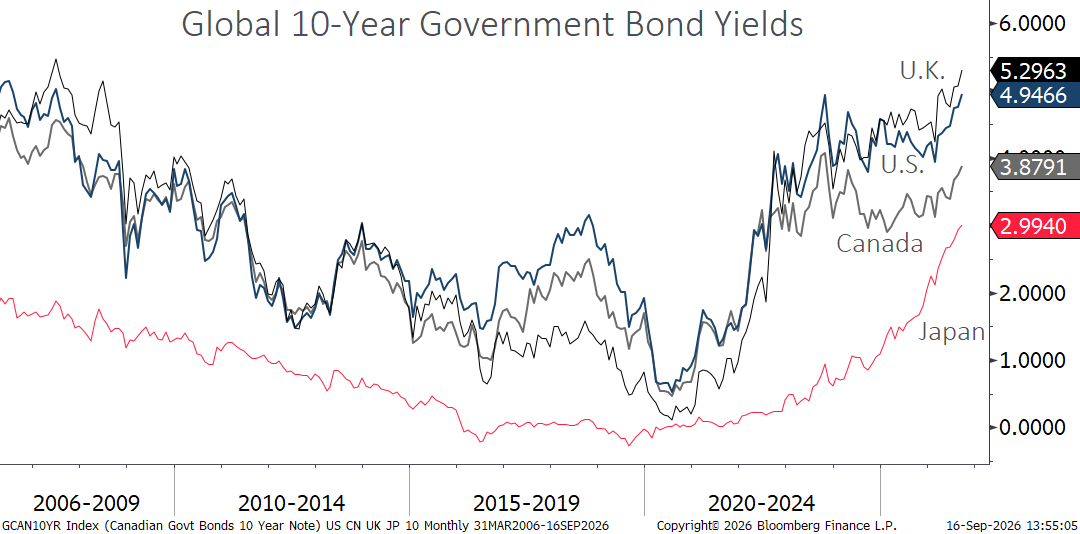
- 10-year bond yields are hitting levels not seen in nearly two decades in the U.S., U.K., and Japan, which is seeing yields on par with 1996.
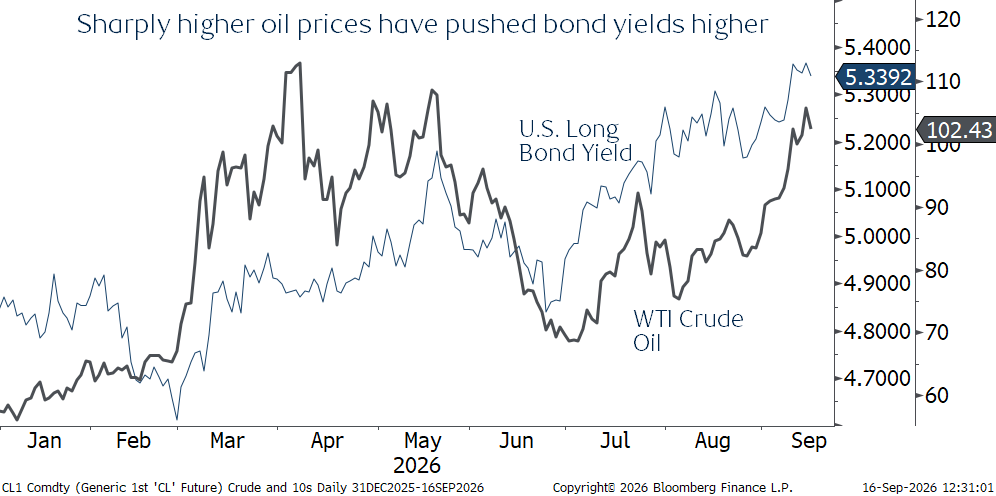
- Rising yields reflect a combination of higher inflation, surging oil prices, persistent government deficits and competition from highly-rated corporate issuers flooding the markets with their own bonds.
- What does this mean for investors? Aside from the ability to lock in attractive yields, particularly in discounted bonds, current levels don’t seem to be giving stocks too much trouble.
- The risk is the sell off on bonds becomes disorderly and spooks equity investors, something that would likely be met with a strong response from policy makers.
- In the near term, relief on oil prices is the surest path to lower yields. In the longer term, it will take a more sustainable path of government finances to calm the “bond vigilantes” and there are no quick fixes there.
- While rising yields can led to investor trepidation as the cost of borrowing rises, the one thing rising yields typically do not forecast is economic weakness – that is almost always accompanied by sharply falling yields.
Investors are used to bonds being boring, and for the most part they like it that way. What is typically relegated to the financial back pages has become front page news, and boring no longer. Yields on longer-dated government debt have climbed to levels we haven't seen in nearly two decades across major developed markets. In the United States, United Kingdom, and Japan, 10-year bond yields are approaching peaks set almost 20 years ago (and 30 years ago in Japan). Canada has managed to avoid breaking through the recent highs from 2023, but the trajectory this year has been upward as well, stifling returns on fixed income.
Why now?
Issues like high government debt levels have been on investor worry-lists for a generation. Why are we seeing yields jump now? Several forces are conspiring to push yields skyward. Higher inflation remains a persistent headwind, requiring bond investors to demand greater compensation for lending money over long periods. Surging oil prices have generated concern about future levels of inflation, and government budget deficits are not getting any smaller, requiring substantial bond issuance to fund spending. An interesting wrinkle in 2026 is added competition from high quality corporate issuers. Anyone who studied undergraduate economics is likely familiar with the concept of “crowding out”, where increased government borrowing competes with the private sector for capital, raising interest rates. We are currently seeing the opposite of this play out, with highly rated technology companies issuing long-dated debt to fund the data centre buildout and effectively competing with the government for capital. The outcome is the same in both instances – a higher supply of long-term bonds leads to higher interest rates all else equal.
Portfolio implications
For investors, there's actually a silver lining amid the headlines. The ability to lock in attractive yields has returned, something that felt like a distant memory during years of near-zero rates. Even earlier this year, yields for Canadian 5-year bonds were a full percentage point below where they are now. For those with cash to deploy or portfolios rebalancing into fixed income, current yield levels present healthy rates of return versus recent history. This is doubly true for taxable investors investing in discounted bonds, which have a tax advantaged return stream (due to capital gains treatment of part of the return) which is the most attractive it has been in a while.
The bigger pictures for portfolios is the implication for stock market performance. Despite the odd wobble on the bond market’s most volatile days, the trend of rising yields this year hasn’t dampened the stock market’s enthusiasm over healthy earnings growth and a U.S. economy that continues to perform well. The primary concern is that a disorderly sell-off in bonds could spook equity investors and trigger a broader market pullback. Should such a scenario unfold, history suggests it would likely prompt a swift and strong response from policymakers, who have demonstrated their willingness to intervene when financial stability is at stake. Bond market routs also tend to be self-limiting, as the higher yields go, the more people start to worry about the economy, leading them to increase their exposure to bonds in portfolios.
Triggers of reprieve
In the near term, relief on oil prices represents the most straightforward path to lower yields. Since rising oil prices are a key driver of both inflation expectations and yield pressures, a denouement in the middle east would be welcome. How likely this might be is difficult to say, but we continue to watch developments closely.
Over the longer term, a more sustainable approach to government finances would be necessary to truly calm the so-called "bond vigilantes", those investors who aggressively sell government bonds when they perceive a loss of fiscal discipline. Unfortunately, there are no quick fixes here. Addressing persistent government deficits requires difficult political choices and structural reforms that typically unfold over years, not quarters. In the interim, we should expect bond yields to remain elevated and potentially volatile as markets digest fiscal outlooks and monetary policy decisions.
U.S. Federal debt has crossed $40 Trillion
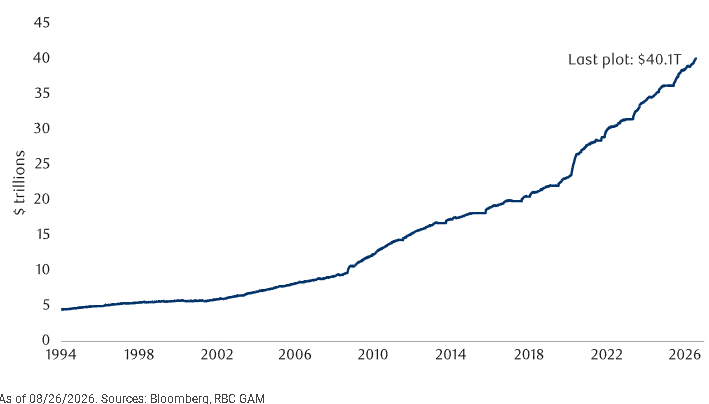
This week’s Federal Reserve interest rate increase has paradoxically been a positive. It may seem strange that raising short-term interest rates helps bring down longer-term interest rates, but each term of the bond market has different primary influences. Short-term bonds 2-years and under are heavily influenced by the Fed, but 10 and 30-year yields are more driven by expectations surrounding economic growth and inflation. This week’s rate hike suggested the Fed remains committed to keep inflation in check regardless of political pressure, something long-term bond investors take some comfort in.
A Reassuring Reality
Here's something worth keeping in mind as we navigate these headlines: rising bond yields typically do not forecast economic weakness. It’s usually the opposite. Economic downturns are almost universally accompanied by sharply falling yields, as investors flee to the safety of bonds and central banks cut interest rates to stimulate growth. The current environment, with elevated yields and resilient equities, actually suggests that markets are pricing in steady economic activity rather than recession concerns. As always, the most important principle remains unchanged: a well-constructed, diversified portfolio positioned for your specific goals and objectives is the best defense against market noise, regardless of whether that noise originates in bond markets or elsewhere.
The Harbour Group - 416-842-2300
Putting you first, every time, to help you navigate the complexities of managing your wealth. All of our team members, all of our resources, all of our collective insight: ALL FOR ONE: YOU™.
The information contained herein has been obtained from sources believed to be reliable at the time obtained but neither RBC Dominion Securities Inc. nor its employees, agents, or information suppliers can guarantee its accuracy or completeness. This report is not and under no circumstances is to be construed as an offer to sell or the solicitation of an offer to buy any securities. This report is furnished on the basis and understanding that neither RBC Dominion Securities Inc. nor its employees, agents, or information suppliers is to be under any responsibility or liability whatsoever in respect thereof. The inventories of RBC Dominion Securities Inc. may from time to time include securities mentioned herein. RBC Dominion Securities Inc. and its affiliates may have an investment banking or other relationship with some or all of the issuers mentioned herein and may trade in any of the securities mentioned herein either for their own account or the accounts of their customers. RBC Dominion Securities Inc. and its affiliates also may issue options on securities mentioned herein and may trade in options issued by others. Accordingly, RBC Dominion Securities Inc. or its affiliates may at any time have a long or short position in any such security or option thereon. Mutual funds are sold by RBC Dominion Securities Inc. There may be commissions, trailing commissions, management fees and expenses associated with mutual fund investments. Read the prospectus before investing. Mutual funds are not guaranteed, their values change frequently and past performance may not be repeated. RBC Dominion Securities Inc.* and Royal Bank of Canada are separate corporate entities which are affiliated. *Member CIPF. ®Registered Trademark of Royal Bank of Canada. Used under licence. RBC Dominion Securities is a registered trademark of Royal Bank of Canada. Used under licence. ©Copyright 2026. All rights reserved.