
Robin Gullason
Associate Portfolio Manager, Lead Strategist
August 13, 2026
Executive Summary
- The media does a great job of fostering a “fear of missing out” among investors.
- The best investment strategy is one we can stick through in thick and thin, but this is one of the biggest challenges for investors.
- At any given time various strategies or countries are in or out of favour, and investors naturally always want to be in a winning strategy.
- To do this requires an ability to successfully time the market, a skill that almost all investors find elusive.
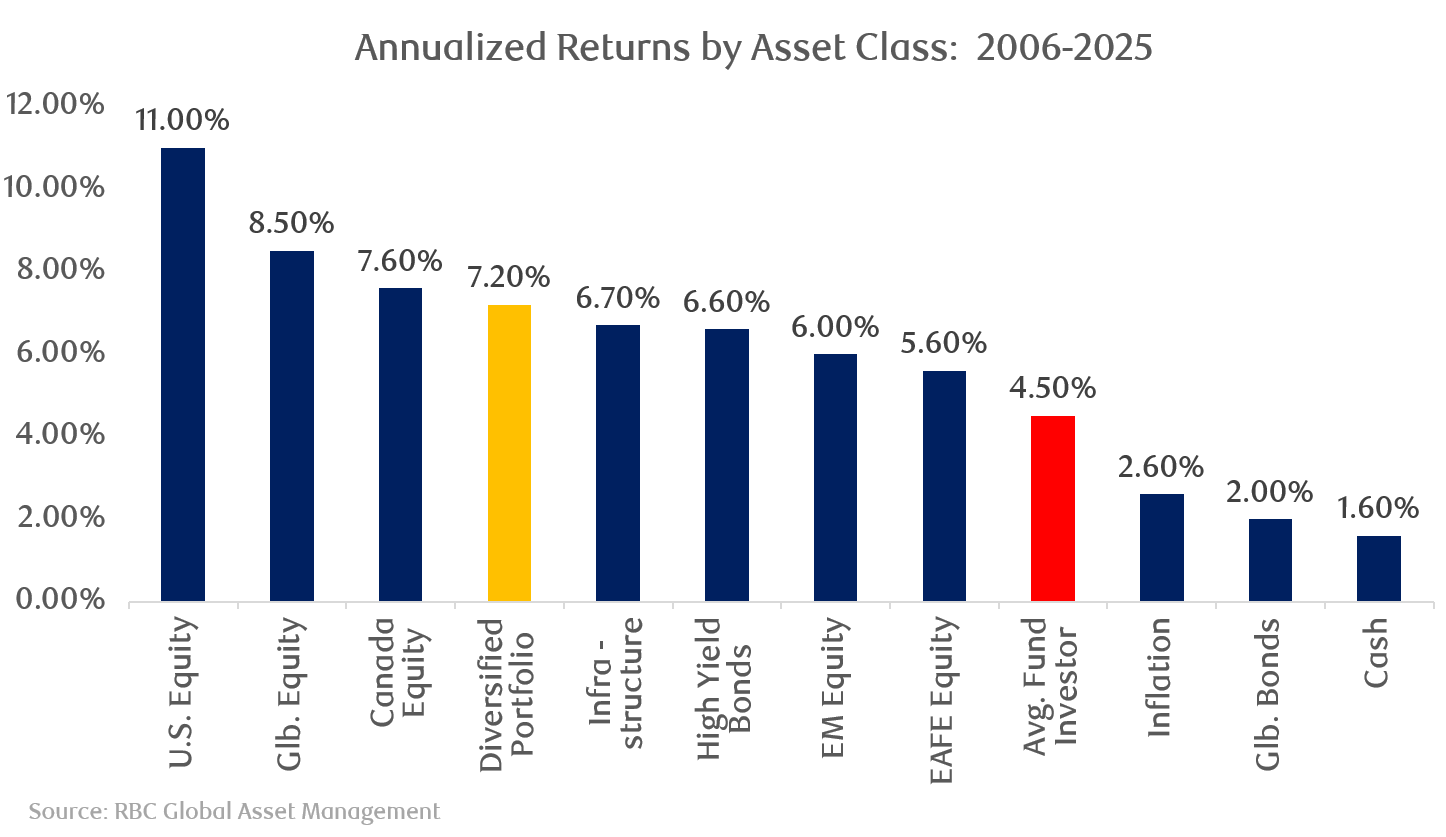
- This is borne out in hard data – the “average” investor has underperformed a balanced portfolio by over nearly 3% per annum over the last 20 years.
- Financial plans are built to withstand inevitable market volatility, but their durability can come under pressure if constant shifts in strategy lead to sub-optimal returns.
“FOMO” may be real…
The media is really good at one thing: making investors feel like they are missing out. Every cycle there's something new. Tech stocks are on fire, crypto is the future, real estate is where the money is. The noise can grow so loud you feel like if you are not in the “new thing”, you are putting your financial future at risk.
… but acting on it is not a real way to grow wealth
Here's what history says: most investors who chase these trends end up worse off than people who just stick to a plan. The best investment strategy isn't necessarily the one with the highest returns in any given year. It's the one an investor can actually live with when things get messy, and that's where most people struggle. At any given time, something is working. Some countries are up, some strategies are hot, and naturally we all want to be in what is winning right now. The challenge is doing this successfully requires timing the market, over and over again, a skill that very few people possess.
The proof is in the numbers
The numbers bear this out. Over the last 20 years, the average investor in funds has actually underperformed a balanced portfolio by close to 3% a year. This isn’t because they are paying exorbitant fees compared to the benchmark – it is the result of chasing trends, buying high, and selling low. A market-timing tax, if you will, and the cost is almost as bad as anything CRA can throw at us!
The impact of compounding
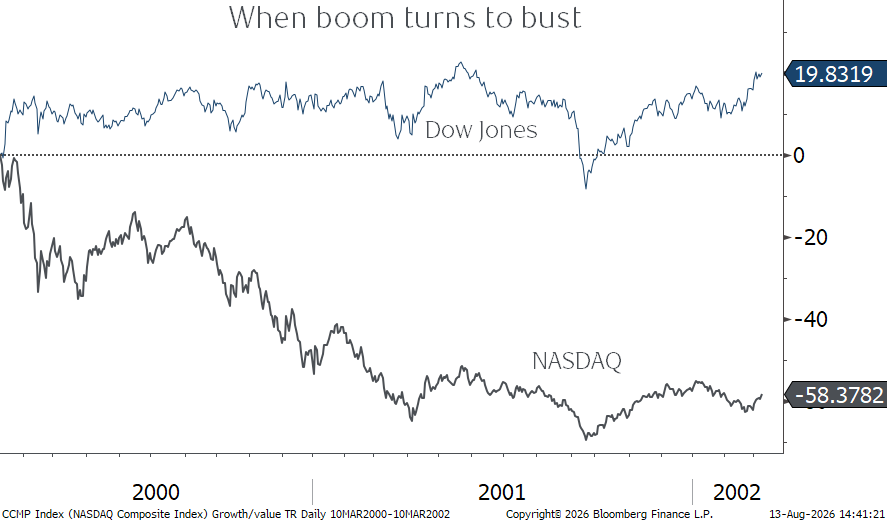
Look at global equities from 2006 to 2025: 8.5% compounded return annually. A diversified portfolio: 7.2%. The average fund investor, furiously chasing strategies that worked last year, made 4.5% a year. When we compound that out over 20 years, the diversified portfolio delivered a 302% total return versus 141% for the average investor, or less than half the gains. Does this mean “never change strategy”? Of course not. What it does mean is that investments should be made with more analytical rigour than looking at last year’s performance tables. There is a long history of last year’s winners being this year’s losers and vice versa, with one of the most extreme examples being in 2000. Heading into the NASDAQ peak on March 10, 2000, the Dow was down 13.5% year to date, with the NASDAQ up 24%. What took place over the next two years is one for the history books, with a near-80% underperformance for the NASDAQ.
Stick to the plan
When the time horizon is 20 or 30 years plus, chasing trends stops making sense. Diversifying across different asset classes ensures the whole portfolio shouldn't depend on any one market outcome, and tends to avoid panic-selling at the worst possible time. Financial plans are built to handle volatility, but they fall apart quickly when one is constantly shifting strategies. We have seen it time and again - markets reward patience.
The Harbour Group - 416-842-2300
Putting you first, every time, to help you navigate the complexities of managing your wealth. All of our team members, all of our resources, all of our collective insight: ALL FOR ONE: YOU™.
The information contained herein has been obtained from sources believed to be reliable at the time obtained but neither RBC Dominion Securities Inc. nor its employees, agents, or information suppliers can guarantee its accuracy or completeness. This report is not and under no circumstances is to be construed as an offer to sell or the solicitation of an offer to buy any securities. This report is furnished on the basis and understanding that neither RBC Dominion Securities Inc. nor its employees, agents, or information suppliers is to be under any responsibility or liability whatsoever in respect thereof. The inventories of RBC Dominion Securities Inc. may from time to time include securities mentioned herein. RBC Dominion Securities Inc. and its affiliates may have an investment banking or other relationship with some or all of the issuers mentioned herein and may trade in any of the securities mentioned herein either for their own account or the accounts of their customers. RBC Dominion Securities Inc. and its affiliates also may issue options on securities mentioned herein and may trade in options issued by others. Accordingly, RBC Dominion Securities Inc. or its affiliates may at any time have a long or short position in any such security or option thereon. Mutual funds are sold by RBC Dominion Securities Inc. There may be commissions, trailing commissions, management fees and expenses associated with mutual fund investments. Read the prospectus before investing. Mutual funds are not guaranteed, their values change frequently and past performance may not be repeated. RBC Dominion Securities Inc.* and Royal Bank of Canada are separate corporate entities which are affiliated. *Member CIPF. ®Registered Trademark of Royal Bank of Canada. Used under licence. RBC Dominion Securities is a registered trademark of Royal Bank of Canada. Used under licence. ©Copyright 2026. All rights reserved.