
Robin Gullason
Associate Portfolio Manager, Lead Strategist
October 8, 2026
Executive Summary:
- Midterm elections trigger pre-election market volatility as investors face uncertainty around tax policy, regulation, trade, and spending priorities, with October typically showing a dip ahead of the November vote.
- Post-election resolution historically produces outsized returns, with the S&P 500 averaging 15.4% in the rolling year following midterms compared to 7.8% in other periods since 1950.
- Congressional gridlock, where opposing parties control the House and Senate, generates the most attractive market returns by restoring predictability and allowing businesses to plan and execute.
- Short-term investors risk being shaken by election uncertainty, while patient long-term investors who remain invested are better positioned to capitalize on post-election relief rallies that have been common for over half a century.
- The current 2026 midterm cycle may follow historical patterns with soft pre-election performance followed by seasonal strength in November and December, though earnings reports and geopolitical factors add complexity.
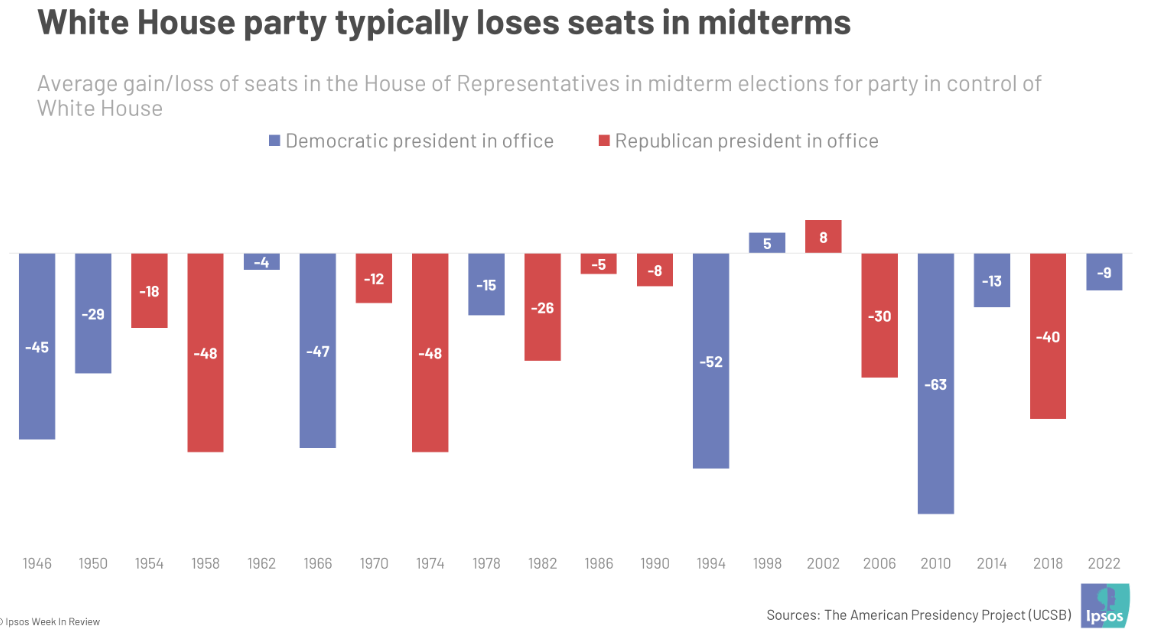
Two years after each presidential election, American voters head to the polls for the so-called midterm elections. All seats in the house of representatives are up for grabs, as is 1/3 of the senate and multiple governorships. These elections often act as a referendum on the sitting president, with their party typically losing ground.
Election uncertainty drives volatility…
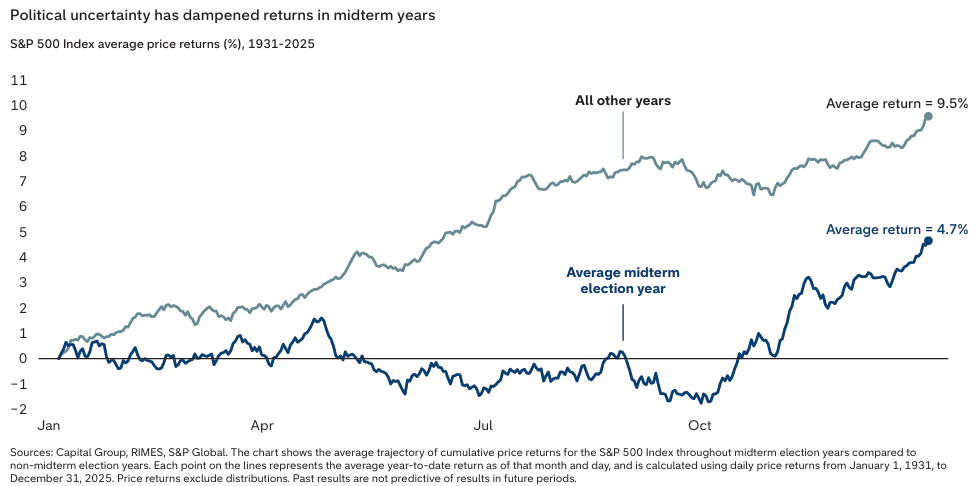
Even though the historical statistics show a pretty clear likely outcome, the stock market seems to stumble right on schedule anyway. Markets prefer certainty, and if we have learned anything in the past decade, the polls do not provide a crystal ball. When Congress is in flux and voters are reshuffling power, the future becomes cloudier. Companies don't know what tax rates they'll face next year. Regulators might shift priorities. Trade policies could change. Spending could swing. This uncertainty seems to peak in the month or so before the election, with markets on average dipping in October in the chart below.
… but the eventual resolution has historically boosted stocks
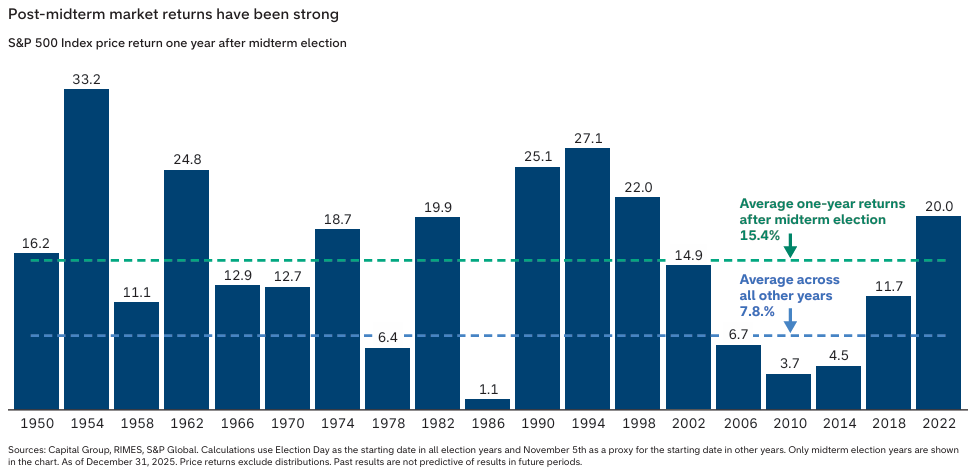
What we find more interesting is what happens next. Once the votes are counted and the dust settles, returns have been universally positive going back to 1950. In the year (rolling year from election date, not calendar year) following midterm elections, the S&P 500 has averaged 15.4% returns. That's nearly double the 7.8% average we see in other rolling years.
Markets love gridlock
As always, markets reward the patient investor. Those with short time horizons can be shaken out of their seat by midterm uncertainty. Long-term investors who stay invested typically come out ahead, particularly if historical performance after these elections is any guide. The 2026 midterms may bring their own version of this familiar pattern of a soft run-up to the election, with a relief rally afterward which lines up well with strong historical returns in November and December. Of course there is more than just an election going on. We are about to embark on third quarter earnings reports, the Iran conflict is nowhere near resolved, interest rates are rising but so far the equity market has largely taken these issues in stride.
Interestingly, investors should be cheering for gridlock in Washington, i.e. the House and Senate controlled by different parties where few contentious laws are likely to be passed. Historically, a split congress has produced the most attractive returns, proving out the thesis. Investors move off the sidelines. Companies follow through on expansion plans that were previously on the shelf. The market has in the past generously rewarded the return to predictability, and we like those odds as we look forward.
The Harbour Group - 416-842-2300
Putting you first, every time, to help you navigate the complexities of managing your wealth. All of our team members, all of our resources, all of our collective insight: ALL FOR ONE: YOU™.
The information contained herein has been obtained from sources believed to be reliable at the time obtained but neither RBC Dominion Securities Inc. nor its employees, agents, or information suppliers can guarantee its accuracy or completeness. This report is not and under no circumstances is to be construed as an offer to sell or the solicitation of an offer to buy any securities. This report is furnished on the basis and understanding that neither RBC Dominion Securities Inc. nor its employees, agents, or information suppliers is to be under any responsibility or liability whatsoever in respect thereof. The inventories of RBC Dominion Securities Inc. may from time to time include securities mentioned herein. RBC Dominion Securities Inc. and its affiliates may have an investment banking or other relationship with some or all of the issuers mentioned herein and may trade in any of the securities mentioned herein either for their own account or the accounts of their customers. RBC Dominion Securities Inc. and its affiliates also may issue options on securities mentioned herein and may trade in options issued by others. Accordingly, RBC Dominion Securities Inc. or its affiliates may at any time have a long or short position in any such security or option thereon. Mutual funds are sold by RBC Dominion Securities Inc. There may be commissions, trailing commissions, management fees and expenses associated with mutual fund investments. Read the prospectus before investing. Mutual funds are not guaranteed, their values change frequently and past performance may not be repeated. RBC Dominion Securities Inc.* and Royal Bank of Canada are separate corporate entities which are affiliated. *Member CIPF. ®Registered Trademark of Royal Bank of Canada. Used under licence. RBC Dominion Securities is a registered trademark of Royal Bank of Canada. Used under licence. ©Copyright 2026. All rights reserved.