December 2024 Market Commentary
Financial markets demonstrated extraordinary resilience in 2024. Mounting geopolitical tension mixed with economic and earnings uncertainty was not enough to deter investors from equities. The artificial intelligence (AI)-heavy Nasdaq composite performed remarkably well (+28.6%), followed by the S&P 500 (+25.0%) and S&P TSX (+21.7%).
Financial markets demonstrated extraordinary resilience in 2024. Mounting geopolitical tension mixed with economic and earnings uncertainty was not enough to deter investors from equities. The artificial intelligence (AI)-heavy Nasdaq composite performed remarkably well (+28.6%), followed by the S&P 500 (+25.0%) and S&P TSX (+21.7%).

Troy Private Wealth Partners
December 30, 2024
Financial markets demonstrated extraordinary resilience in 2024. Mounting geopolitical tension mixed with economic and earnings uncertainty was not enough to deter investors from equities. The artificial intelligence (AI)-heavy Nasdaq composite performed remarkably well (+28.6%), followed by the S&P 500 (+25.0%) and S&P TSX (+21.7%). Major equity indices such as the S&P 500 have now returned greater than +20% in back-to-back years. Is this outstanding performance sustainable? Are we in a market bubble? Should equity investors in 2025 expect a drawdown or three-peat of market gains? Let’s examine the year ahead.
Index | December | 3-Month Trailing | 2024 Return |
|---|---|---|---|
S&P TSX | -3.3% | 3.8% | 21.7% |
S&P 500 | -2.4% | 2.4% | 25.0% |
Nasdaq | 0.5% | 6.2% | 28.6% |
WTI Oil | 6.1% | 5.4% | 0.8% |
Natural Gas | 8.0% | 24.3% | 44.5% |
10-Year US Treasury Bond | -2.8% | -5.3% | -1.5% |
USD/CAD FX | 2.7% | 6.3% | 8.6% |
Source: FactSet
The January effect is a theory where stock markets typically experience favourable performance in the first month of the year. This phenomenon is often attributed to several factors which includes the reinvestment of year-end tax-loss selling. In December, many investors sell their underperforming stocks to offset capital gains taxes which can push stock prices lower. As the new year begins, there is often a rebound in January as investors buy back those stocks they previously sold, driving prices higher.
Further, there is a strong likelihood of new capital inflows in January. Many institutions and individuals begin the year with fresh capital to invest. For individuals, this could be through employee bonuses or raises. This influx of cash can create an increase in the demand for stocks, particularly in the first few weeks of January, leading to upward price movement. Cash could also be sitting on the sidelines in December for investment in registered accounts.
Lastly, the start of a new year often brings renewed optimism and confidence in financial markets. Investors do tend to be more bullish in January fueled by the potential for strong economic growth and positive earnings expectations for the upcoming year.
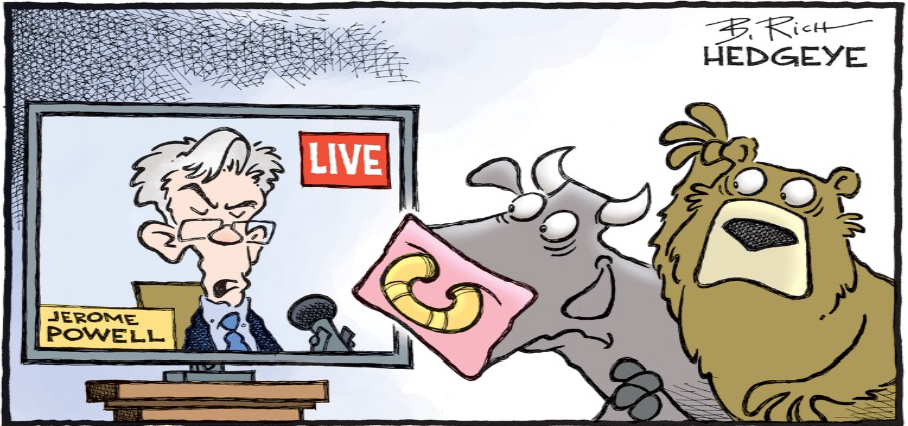
Another stock market theory is the January barometer, which suggests the performance in the first five trading days of the year is directionally predictive of the full calendar year’s return. Since 1928, if the S&P 500 is positive in the first five trading days of the year, then there is a 77% probability that its calendar year performance will also be positive. The S&P 500 posted a gain in the first five trading days of 2025 – investors welcome history repeating itself. According to the January barometer, there is a strong possibility that the S&P 500 will be directionally positive this year. However, keep in mind that the federal reserve plays an enormous role in the direction of equity markets – there are two interest rate cuts expected by the end of the year.
Chart 1: Whimsical cartoon depicting the stock market’s reliance on the U.S. Federal Reserve
Each year for a few days at the beginning of January, RBC Dominion Securities hosts a portfolio management conference. The forum features a range of thought-provoking industry leading analysts, portfolio managers, strategists, and business executives.
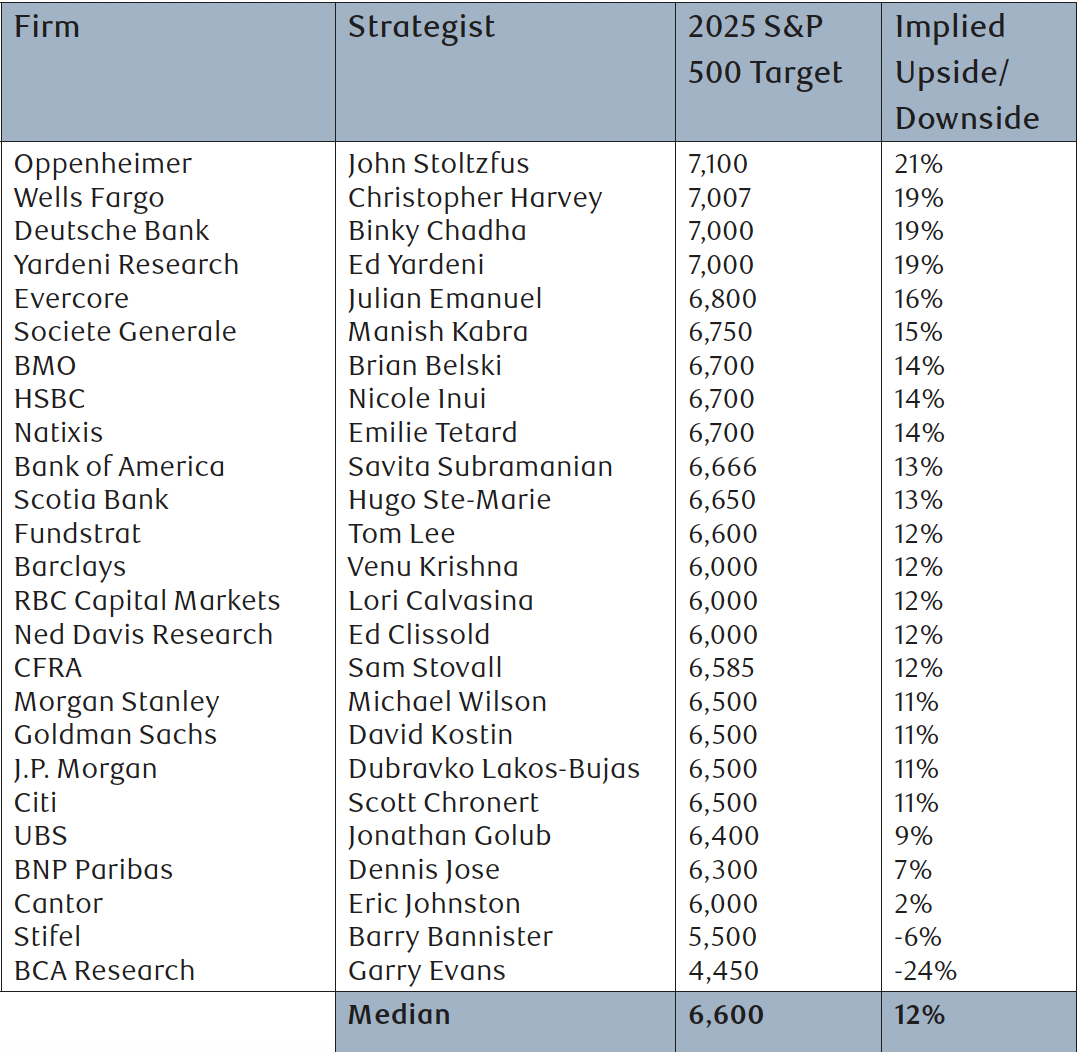
A contested topic at the conference each year is the outlook for stocks in the year ahead. Market strategists and investment firms often have diverse price targets for the S&P 500, reflecting differing outlooks on economic conditions, corporate earnings, and broader market trends. Chart 2 demonstrates the current projections on the index which spans quite a wide range. From a bearish low of $4,450 to an optimistic high of $7,100, you can see that these firms also have contrasting views on expectations for inflation, interest rates, and geopolitical stability to name a few. This divergence in opinions reminds us to take a longer-term approach to investing as predicting stock market performance on a year-to-year basis is very difficult. A median price target of $6,600 among all market strategists suggests a generally bullish sentiment, implying 12% upside to the 2024 year-end closing price.
Chart 2: The median forecast for the S&P 500 is +12% in 2025
Source: Bloomberg
With the S&P 500 posting a return greater than or equal to +20% in back-to-back years, are we due for a pullback? Tom Lee suggests otherwise. Mr. Lee is the Co-Founder, Chief Investment Officer, and Head of Research at Fundstrat Capital. He presented at the portfolio management conference and gave quite a bullish outlook for stocks in 2025 with +12% implied upside. Fundstrat has an outstanding reputation, and Mr. Lee is a highly regarded strategist.
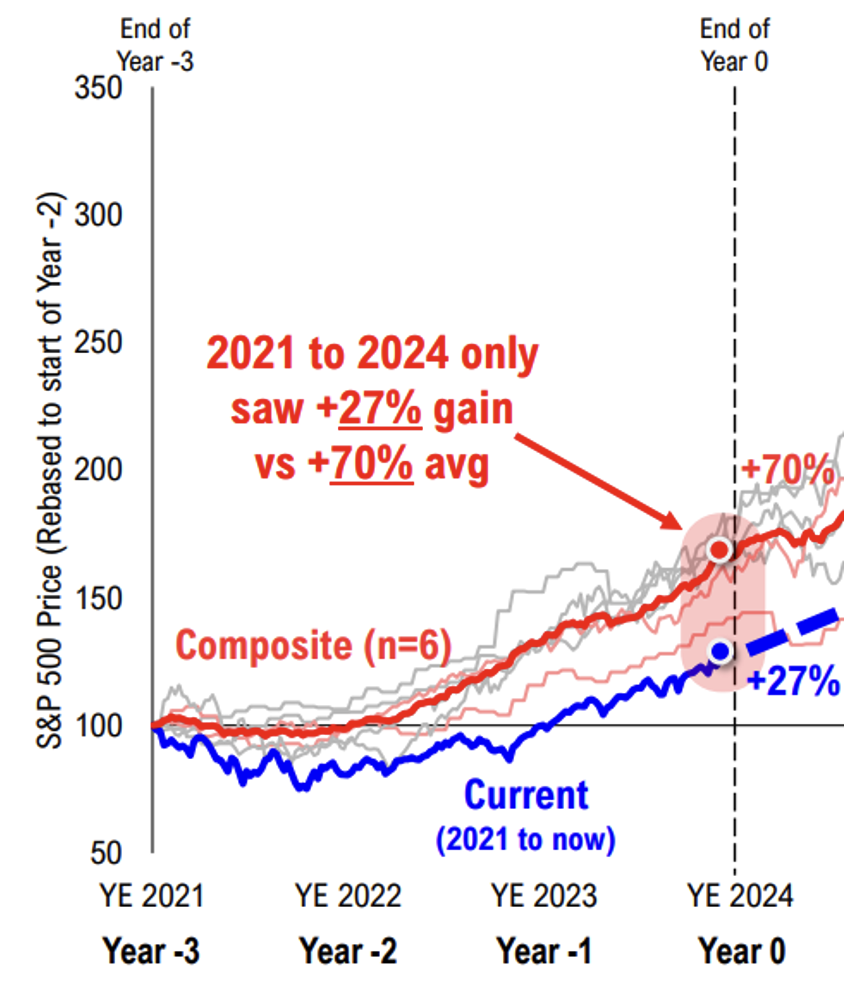
Since 1871 the S&P 500 has posted calendar year back-to-back closing gains of +20% or more just six times. Of those six instances, in only one instance did you have a +20% gain in the following year. The rest of the time, markets had a lackluster year. Following year returns in five of the six instances fall into the range of +/- 5%, implying high odds that we will have a mediocre year this year. Mr. Lee agreed that two consecutive years of +20% or more in gains is a bearish indicator, but that there is a substantial caveat - investors need to look at the prior year. In 2022 the S&P 500 fell -19% and in all of those six instances, you did not have a double-digit decline before the two years of double-digit gains. The average three-year cumulative return of the six instances is approximately +70%, and we’re up just +27% over the same period (Chart 3). This implies the S&P 500 has only compounded at roughly +9% per year since 2022, versus an annualized rate of return closer to +20% which is the average of the six other instances. According to Mr. Lee, after analyzing those back-to-back years of +20% or more return, we could certainly have another great year based on his research.
Chart 3: The 2021-2024 cumulative return of +27% trails its six precedents
***Instances where the S&P 500 return was greater than or equal to +20% in back-to-back years
Source: Fundstrat, Bloomberg
Irene Nattel of RBC Capital Markets specializes in the Canadian consumer. She presented at the portfolio management conference and gave her 2025 outlook. She expects the national unemployment rate to reach 7.0% by the middle of the year, driven by cautious consumer spending. Why does she expect the consumer to be timid in spending? The household debt service ratio is at all-time highs, debt service payments are expected to increase +20% this year, real wage growth is lagging, and GDP per capita metrics remain sobering. Further, inflation across key spending buckets (food, energy, debt service, shelter) has far exceeded income growth. Also, RBC Capital Markets just released the share of total income a household would need to cover home ownership costs in Canada and the statistics are staggering. Nearly 60% of a household’s total income is spent to cover home ownership costs (Chart 4). Housing affordability has been extremely challenging in Canada which has weighed on the consumer. In Vancouver, nearly 100% of a household’s total income is spent on home ownership costs. She expects quality Canadian companies to continue weathering the storm well, given a weak Canadian consumer will likely persist this year.
Chart 4: Canadian home ownership costs as a percentage of total household income

Source: RBC Capital Markets
Company Highlight

Our investment team recently heard from the CEO of Suncor Energy (Richard Kruger) and GFL Environmental (Patrick Dovigi). What stood out amongst the two meetings? Strong cybersecurity is an absolute necessity. Both companies experienced serious cyber-attacks in recent years, and Mr. Dovigi highlighted cybersecurity as the single greatest threat to his business - both CEOs mentioned that they deal with cyber warfare on a daily basis.
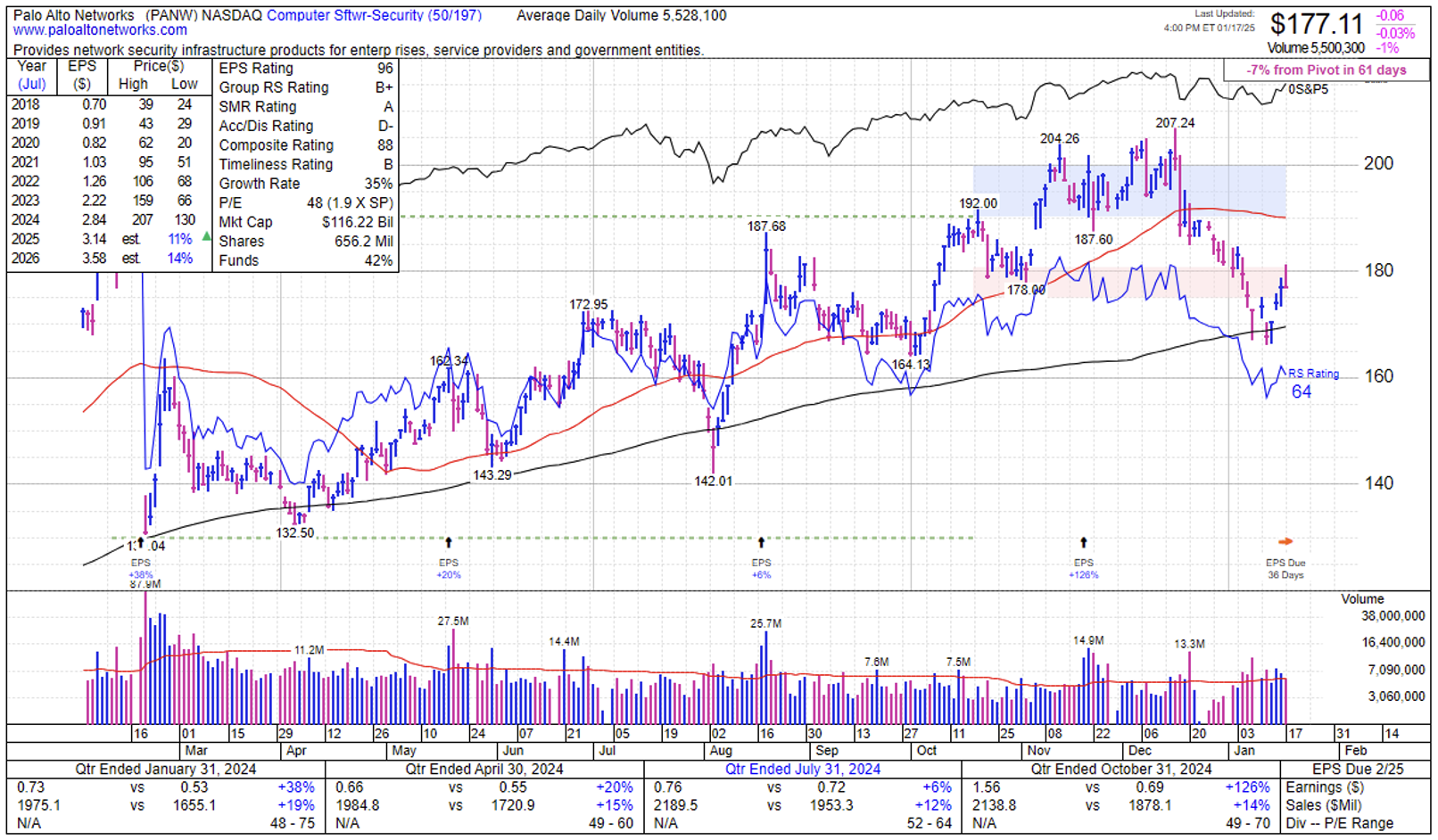
Palo Alto Networks is a platform-based cybersecurity vendor with product offerings covering comprehensive network security, cloud security, and security operations. This includes advanced firewalls and AI-driven threat detection. They protect enterprises, governments, and service provider networks. The business was founded in 2005 and is currently the largest pure play cybersecurity company in the world.
We recently added Palo Alto Networks (PANW) to client portfolios. The cybersecurity sub-sector is growing rapidly, and we view PANW as one of the highest quality cybersecurity companies globally. The business has high margins, a fantastic balance sheet, and a solid long-term operating outlook.
Chart 5: We view the recent weakness in Palo Alto Networks as an opportunity for investors
Source: RBC Capital Markets
As we embark on 2025, it is natural to feel some uncertainty with the ongoing headlines and political discussions dominating the airwaves. Whether it is the noise surrounding political developments or speculation about potential headwinds, it is important to remember that markets have weathered similar storms before. Over time, they have consistently rewarded patience, discipline, and a long-term focus.
Our commitment remains steadfast: to guide you through both the opportunities and challenges that the year may bring. By staying focused on your financial goals and adhering to a well-constructed strategy, we can ensure that short-term volatility doesn’t distract from your longer-term success.
As always we are here to listen, provide clarity, and support in this ever-evolving world. If you have any questions, concerns, or simply want to discuss the outlook for 2025, we are just a call or meeting away.
Here is to a year of steady progress, informed decision-making, and continued growth – no matter the noise. Thank you for your continued trust and partnership.
Warm Regards,
Andrew Troy