
Michael Wilkie
August 27, 2026
A word from Mike
Hello,
From Shadowing to Success: Wrapping Up an Incredible Summer Internship
Over the past three months, I’ve had the absolute pleasure of welcoming a very special intern to our team: my son, Aidan! Watching him dive headfirst into the fast-paced world of wealth management and investment has been nothing short of inspiring.
From day one, he brought incredible energy and curiosity to the office. He shadowed meetings with professionals from a variety of different positions, mastered essential administrative workflows, and gained a comprehensive, hands-on understanding of how the investment industry operates behind the scenes.
Beyond the technical skills and industry insights, this summer was all about growth. He built meaningful professional connections, forged lasting friendships, and proved himself to be a natural fit in our office culture.
As he heads into his next chapter, I couldn’t be prouder of everything he has accomplished. Thank you for an unforgettable summer, and we wish you the absolute best in all your future endeavors!

Now back to business!
Canada-U.S. trade tensions have escalated, adding to domestic economic uncertainty. Below, we assess the latest developments and their potential implications for the Canadian economy and financial markets.
Trade Talks Break Down
Canada-U.S. trade negotiations broke down last week, despite earlier signs of meaningful progress. The two sides reportedly failed to agree on auto sector tariffs, while U.S. demands around Canada’s ability to pursue trade agreements with other countries and protections around Canadian culture and sovereignty also proved difficult to reconcile. As a result, the U.S. imposed a new 50% tariff on roughly $28 billion of Canadian goods, with Canada announcing retaliatory tariffs effective September 8.
At first glance, the economic impact looks reasonably contained. The newly tariffed goods account for around 5% of Canadian exports to the U.S., while more than 80% of exports should continue to flow tariff-free under CUSMA. Meanwhile, RBC Economics estimates that these duties affect approximately 0.4% of Canadian GDP and employment, adding that the latest developments have not materially changed their annualized economic growth forecast of 1.3% to 1.8% over the next four quarters.
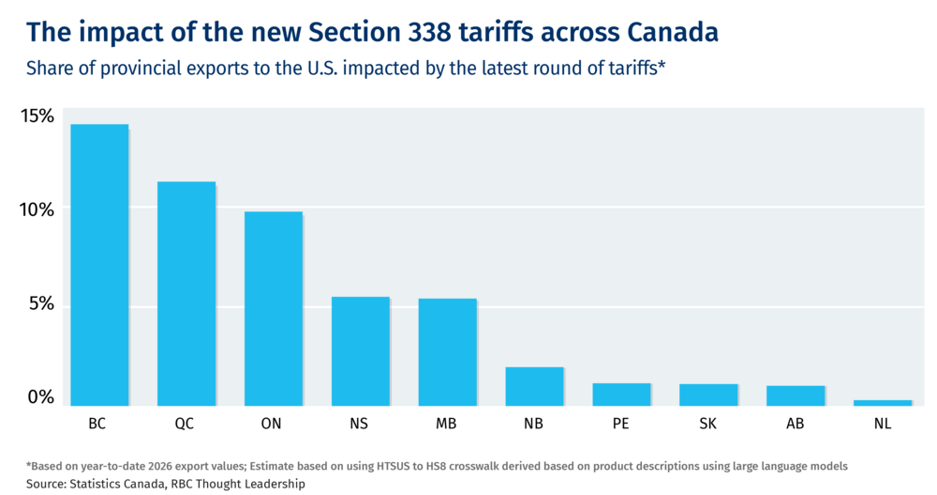
The aggregate numbers, however, mask considerable challenges for affected industries and regions. Electrical equipment, plastics, furniture and wood products are among the more exposed sectors, with the impact concentrated in Quebec, British Columbia and Ontario.
To help cushion the initial impact, the federal government has announced $7.5 billion in support for affected workers and businesses, on top of nearly $25 billion introduced since the trade dispute began in early 2025. Canada’s relatively modest government debt level compared to other developed economies should provide policymakers with some flexibility to support the economy if needed.
Over the past year, the Canadian economy has also demonstrated some ability to adapt to changing trade conditions. In 2025, exports to the U.S. fell by roughly $35 billion, but a $29 billion increase in exports to other countries provided a substantial offset. Much of that increase, however, reflected higher gold prices rather than a broad-based expansion into new markets, highlighting that diversifying Canada’s trade relationships remains a longer-term process.
Looking ahead, public support may also give the federal government some latitude to remain patient in negotiations. Recent surveys suggest most Canadians supported walking away from the table rather than accepting an unfavourable deal. Although this could strengthen Canada’s position over the coming months, entrenched positions on both sides may complicate the path toward an eventual agreement.
For the economy, the most relevant questions are how long the tariffs will remain in place and whether current tariff measures will broaden further. The longer tariffs persist, the greater the risk of a potential drag on household spending, business investment and hiring.
The Economy is Not the Equity Market
Financial market reactions have so far been relatively muted. The Canadian dollar edged lower following the breakdown, while government bond yields declined as investors assessed somewhat greater downside risks to growth and pared back expectations for Bank of Canada rate hikes in the quarters ahead.
Canadian equities, meanwhile, are slightly higher this week—a reminder that Canada’s stock market may be more insulated from the impact of tariffs than the economy. The Financials, Energy, and Materials sectors together account for close to 70% of the S&P/TSX Composite. Slower domestic growth could pressure Financials through household and business sentiment channels, but the sector has limited direct exposure to tariffs. Energy and Materials, meanwhile, are influenced more heavily by global commodity prices, particularly energy and precious metals.
Recent Canadian bank results have also offered a reasonably constructive read on the economy. Management teams acknowledged both the fluid trade environment and some of the progress Canada has made diversifying trade. More importantly, bank earnings generally exceeded expectations, with solid domestic business results and strong capital-markets activity providing an important contribution to growth. The broader fundamental outlook is similarly encouraging. S&P/TSX Composite profits are expected to grow by roughly 25% this year and another 10% in 2027.
Takeaway
The current environment is a useful reminder that uncertainty is an inevitable part of investing. Today’s “wall of worry” includes greater scrutiny of the durability of the AI investment cycle, higher long-term bond yields, volatile energy prices amid an unresolved Middle East conflict and, specific to Canada, renewed trade frictions with the U.S. that has increased downside economic risks. At the same time, the global economy remains on a firm footing, keeping corporate earnings on an upward trajectory. This doesn’t mean markets will avoid bouts of volatility, but it underscores the importance of keeping short-term uncertainty in perspective and maintaining disciplined portfolio diversification to navigate a range of economic outcomes.
Highlights
AI: Valuation signals
The segment of the equity market more directly tied to AI has undergone a notable valuation adjustment amid sharper scrutiny of AI capex durability, monetization timelines, and lingering disruption risks.
Regional developments: Canada announced and the U.S. implemented reciprocal 50% tariffs following failed trade negotiations; AI token costs are falling rapidly; Continued economic resilience in Europe; Asian semiconductor stocks are rebounding.
Please take some time to review the Global Insight Weekly.
U.S. imposes 50% tariffs on a broad range of Canadian exports as trade talks break down
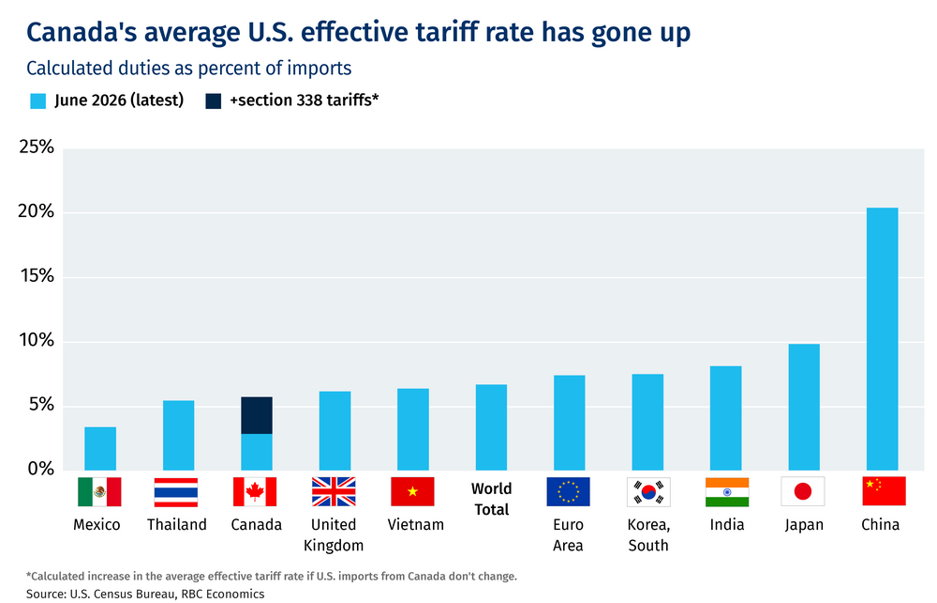
Trade talks broke down between the U.S. and Canada last weekend, ending with President Donald Trump implementing a new 50% tariff on a broad range of Canadian exports, with plastic goods, electrical machinery, furniture, and wood products some of the most impacted areas. Region-wise, Quebec, Ontario, and B.C. will feel the brunt of the new duties. As RBC Economics pointed out, much of what will determine the significance of these tariffs on Canada's economy is so far unknown. Overall, the affected products account for roughly 5% of U.S. imports from Canada, and under the Canada-United States-Mexico Agreement (CUSMA), more than 80% of Canadian goods continue to flow to the U.S. tariff-free. This suggests only a modest increase in the overall tariff burden, with Canada's average effective tariff rate rising from 3% to 6%, though the true increase is likely to be less as the tariffs cause less of the affected goods to be traded.
Prime Minister Mark Carney has pledged to support Canadian businesses hurt by the levies and to respond with dollar-for-dollar retaliatory tariffs post-Labour Day. So far, Ottawa has announced C$7.5 billion in support for affected workers and businesses, including interest-free Business Development Bank of Canada loans of $2.5 million to $5 million with repayments deferred for 36 months.
Inflation in Canada rose 3% in July thanks to higher gas and tour prices
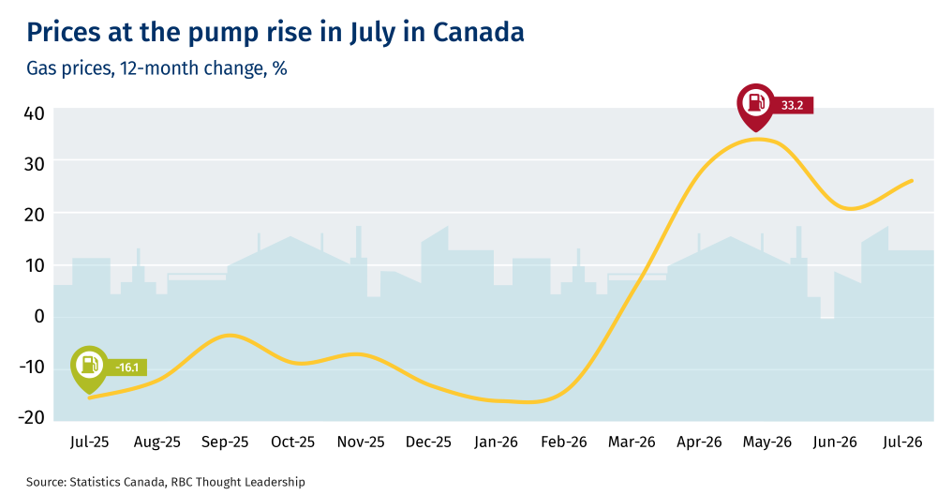
Gas prices increased 25.7% annually, as the conflict in the Middle East continued to push up energy costs. Travel tour costs rose 15.2% annually due to pricier hotels and flights to U.S. destinations hosting World Cup games. While grocery price growth moderated, it was higher than headline inflation for the 18th consecutive month. Still, with underlying inflation close to target, RBC Economics expects the Bank of Canada will keep interest rates unchanged for the rest of 2026.
Demand for Canadian citizenship certificates has surged
Ottawa is currently processing 121,800 applications, from 56,000 in April, while estimated wait times have doubled to 25 months. Demand for the certificates-roughly half from American citizens-jumped after Parliament adopted the "Lost Canadian" legislation last year, which allows citizenship for those who can prove they're descended from a Canadian ancestor, even if that person had left the country. Around 6,000 have already received the certificate, allowing them to apply for Canadian passports and live and work in the country.
Vancouver housing starts dropped 42% in July year-on-year
It signals the worst downturn in three decades in one of Canada’s most expensive housing markets. Other major housing markets such as Toronto saw a more muted 10% drop, while Montreal experienced a 3% increase. Analysts say the decline is driven by high costs of building new homes. National housing starts are expected to decline through 2026-2028 amid high costs, softer demand and elevated inventories, according to the Canada Mortgage and Housing Corporation.
IMF head said the AI boom will be a global growth engine
International Monetary Fund managing director Kristalina Georgieva said on Tuesday that global economic growth will be strong as AI investments spread outside the United States, and countries weather the Iran war better than initially feared. The IMF head said lower demand for energy, drawdowns of emergency supply and more renewable capacity helped cushion the oil price shock resulting from the U.S.-Iran conflict. The IMF expects the world’s economy will expand 3% this year.
Canada likely to withstand tariff shock, though escalation risks persist
Canada’s economy appears capable of weathering the new 50% tariff the U.S. has imposed on roughly $28 billion of Canadian goods, according to economists, including some from Canada’s largest banks, who met with Finance Minister François-Philippe Champagne. While some forecasters have reduced growth estimates, recession risk wasn’t focused on as a concern, with broad agreement that the damage should remain concentrated in tariff-exposed industries. RBC Economics maintains their base case outlook for national growth, though the team acknowledges somewhat greater downside risks. The key risk is further escalation and Ottawa is readying itself for a potentially prolonged dispute. President Trump has threatened 50% tariffs on Canadian vehicles and new measures on auto parts beginning Jan. 1, which could create substantially greater disruption due to the sector’s integrated supply chains. Meanwhile, economists surveyed by Bloomberg expect Q2 GDP to have expanded at a 3.4% annualized pace, rebounding after nearly a year of sluggish growth.
Charts of the day
Interesting tidbits
100. The number of never-before-seen reels that were used for a new documentary on athlete and cancer research advocate Terry Fox’s 1980 Marathon of Hope. Run Terry Run will premiere at the Toronto International Film Festival next month.
Pet owners are hoping dog years last a bit longer. The Dog Aging Project, a partnership between Texas A&M University and the University of Washington, has 580 dogs enrolled in a clinical trial aimed at boosting longevity. Many pet owners are also splurging on supplements, with sales over a six-year period surging 56% for dog owners and 70% for cat owners, according to the American Pet Products Association. This is all part of a surging US$165-billion pet sector in the U.S.
Chinese robot makers want to deploy humanoids for wide commercial use. This year’s World Robot Conference in Beijing featured humanoid robots sorting parcels, packing mobile phones and helping with household chores. There’s been a surge of investor interest in humanoid robots, a sector that is shaping up to be another area of competition between China and the United States.
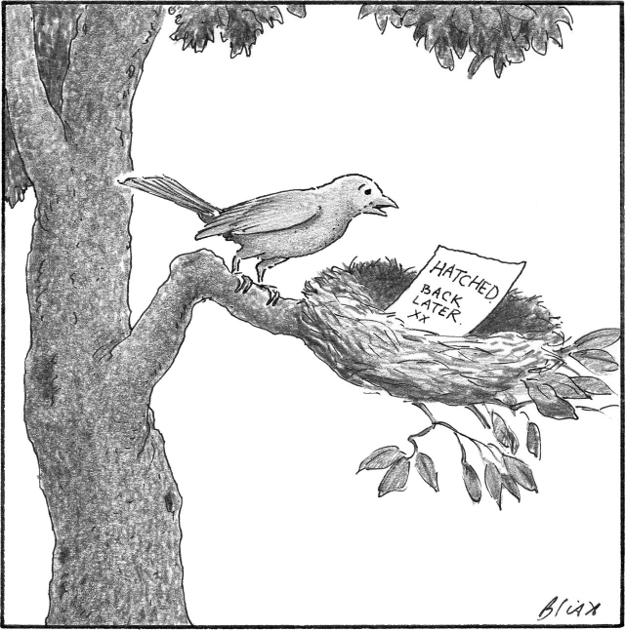
Today’s funny
REMINDER: Most of my new clients come to me via word of mouth as I don’t advertise or engage in marketing programs. Please keep my team in mind if you hear of anyone with over $1 million in investable assets who is in need of wealth management services.
This information is not investment advice and should be used only in conjunction with a discussion with your RBC Dominion Securities Inc. Investment Advisor. This will ensure that your own circumstances have been considered properly and that any action is taken based upon the latest available information. The strategies and advice in this report are provided for general guidance. Readers should consult their own Investment Advisor when planning to implement a strategy. Interest rates, market conditions, special offers, tax rulings, and other investment factors are subject to change. The information contained herein has been obtained from sources believed to be reliable at the time obtained but neither RBC Dominion Securities Inc. nor its employees, agents, or information suppliers can guarantee its accuracy or completeness. This report is not and under no circumstances is to be construed as an offer to sell or the solicitation of an offer to buy any securities. This report is furnished on the basis and understanding that neither RBC Dominion Securities Inc. nor its employees, agents, or information suppliers is to be under any responsibility or liability whatsoever in respect thereof. The inventories of RBC Dominion Securities Inc. may from time to time include securities mentioned herein.