
Mike Wilkie
November 5, 2026
A Word from Mike
Hello,
What do the U.S. midterm elections mean for markets, and can the AI investment theme withstand political risk? I explore these questions, which remain top of mind for investors, in more detail below.
Earnings Strength: Market Churn
Nearly 90% of S&P 500 companies have reported third-quarter results, with the proportion exceeding analyst estimates running above the five-year average. With the index tracking earnings growth above 25% for the third straight quarter, corporate profits continue to point to a broadly constructive fundamental backdrop.
Despite this underlying strength, market volatility has picked up as investors question Big Tech’s elevated AI-related spending plans and the structural uncertainty associated with the timing of returns on these investments. Most notably, the market is applying much greater scrutiny on companies with outsized capital expenditures relative to internally generated cash flows, demanding clearer evidence of monetization and quantifiable benefits from AI adoption.
This has, in turn, driven the tech-heavy Nasdaq Index lower recently and weighed on the broader S&P 500 Index. Meanwhile, valuations for Information Technology stocks have fallen to roughly 18x forward earnings from around 26x at the start of 2026, suggesting investors are adjusting risk expectations and discounting a wider range of potential outcomes.
But weakness in one prominent investment theme doesn’t necessarily imply broader market stress. For instance, the equal-weighted S&P 500 was up approximately 5% in October, aided by strength across several sectors including Consumer Staples, Health Care and Energy. This broader participation has helped offset some of the weakness in AI-related segments.
Although demand for compute continues to outpace supply, I believe questions about return on AI investments are likely to linger. Periods of skepticism and uneven performance are not unusual in major investment cycles, when capital deployment often precedes the realization of economic benefits. They do, however, heighten the importance of future earnings delivery to justify continued investment. As a result, I expect markets to remain particularly sensitive to quarterly earnings reporting seasons over the coming year.
U.S. Midterm Elections: Power Shift Implications
The Democratic Party secured majorities in both the House of Representatives and Senate, shifting the Congressional balance of power as the cost of living, among other issues, topped voter concerns. The magnitude of the Democrats’ win was larger than expected, especially in some traditionally Republican strongholds, but the overall direction of the result had been telegraphed in polling data.
In RBC GAM’s view, the outcome could present a mild headwind for economic growth prospects if a divided government makes it more difficult to deliver more fiscal stimulus. That said, I would generally caution against overemphasizing the influence of political developments on financial markets. Historically, equity markets have tended to perform reasonably well following U.S. midterm elections as a key source of uncertainty abates.
An inherent feature of divided governments is policy gridlock. While majorities in the House and Senate provide the Democrats scope to pursue legislative goals, presidential veto power is likely to limit some initiatives. This can potentially restrain major regulatory initiatives and scope for fiscal stimulus. Nevertheless, Congressional majorities provide the Democrats with greater influence over the President’s domestic policy agenda.
For AI, the election may not materially alter the outlook in the near term. While regulation could feature more prominently in political debate, much of the current policy framework rests at the state and local levels. Across other industries, a divided government potentially reduces the likelihood of significant policy shifts, though I am cognizant that headlines can still have an impact on investor sentiment and uncertainty.
Turning to Canada, the Trump administration’s ability to pursue changes in trade policy likely remains intact. Encouragingly, constructive comments from both nations in recent days point to some incremental progress toward restarting negotiations.
Takeaway
With the U.S. midterm election uncertainty behind us, this could allow markets to refocus on economic and corporate fundamentals. Most indicators continue to point to a reasonably solid pace of economic expansion, reinforcing my confidence in a constructive outlook for corporate earnings growth over the next six to twelve months.
For fixed income investors, I would also note that the upward move in bond yields this year has meaningfully improved the potential for bonds to contribute to portfolio total returns.
More broadly, I believe the recent sharp volatility in AI-related stocks serves as a reminder of the importance of prudent risk management and maintaining balanced exposure across asset classes, sectors, and investment themes.
Highlights
Election reflections: The midterms and what really matters for markets
The midterm elections upended American politics, but when it comes to the stock market, it’s important to remember that elections come and go. We look at what could change and what may not for the investment landscape, and four factors that we believe matter more to the U.S. equity market’s medium- and long-term performance than elections.
Regional developments: Canada’s GDP remained unchanged in August; Divided U.S. government a boon for bonds?; The Bank of England delivers a hawkish hike, with a jumbo hike dissent; Asian equities diverge as investors reassess AI valuations following U.S. midterm elections.
Please take some time to review the Global Insight Weekly.
Global Insight Monthly
November 2026 edition
I am pleased to share the latest investment strategy report from RBC Wealth Management—Global Insight, which provides our current thoughts on asset classes, the economy, and timely issues that impact investment strategy.
Full report: Global Insight
This month’s highlights:
Executive summary: Robotics comes of age
Is the era of R2-D2 and C-3PO, the two Star Wars robots, upon us? This summary of our recently released Special Report explores the innovations transforming robotics and focuses on the intriguing world of humanoid robots. It foresees how the workplace and the home might change with these machines, before exploring investment opportunities.
Global equity: More new highs likely ahead—along a bumpier path
New highs could be on the horizon for equity markets in 2027. However, concerns about CPI, Middle East hostilities, and any further policy uncertainty could produce meaningful corrections along the way to those highs.
Global fixed income: The French disconnection
Rising French bond yields have heightened market turbulence, but contagion risks appear limited, in our view. We explore why higher yields may persist, but at a more moderate trajectory.
Ottawa unveils budget with focus on investment and infrastructure
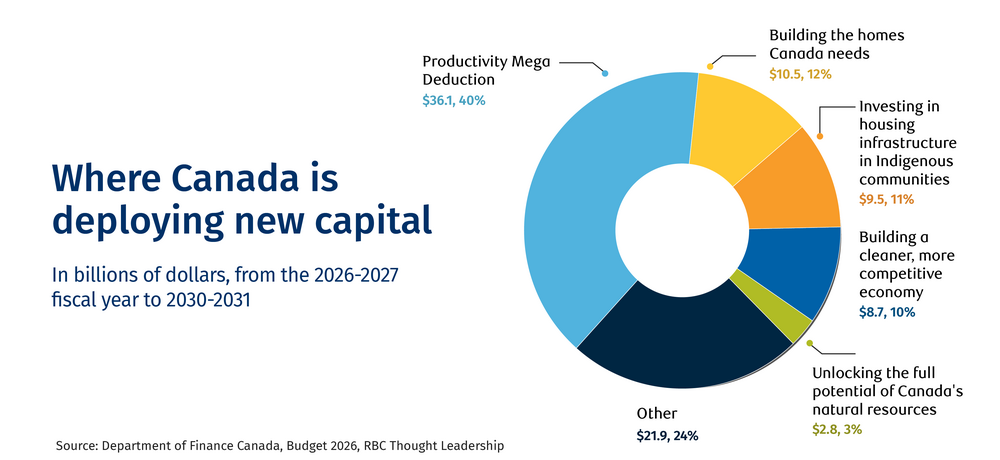
The Canadian federal government unveiled its 2026 budget, outlining C$151.5 billion in new spending over five years, with a focus on encouraging business investment, expanding infrastructure and improving affordability. Key measures include a C$36 billion tax incentive to support business investment, C$8.7 billion to expand electricity infrastructure and C$45 billion over 10 years for housing programs. Additional support will go toward industries affected by trade tensions, First Nations infrastructure and households facing higher living costs. Stronger-than-expected revenues, partly driven by higher oil prices, have given Ottawa more room to spend, although much of the windfall will go toward funding new initiatives. The federal deficit is projected to reach C$62.3 billion in 2026–27, with annual deficits expected to remain between C$50 billion and C$60 billion over the next five years. Meanwhile, the debt-to-GDP ratio is expected to hold relatively steady near 40%, although debt-servicing costs are projected to rise. Overall, the budget aims to support longer-term economic growth and productivity, although persistent deficits and rising debt-servicing costs remain key challenges to the government’s fiscal outlook.
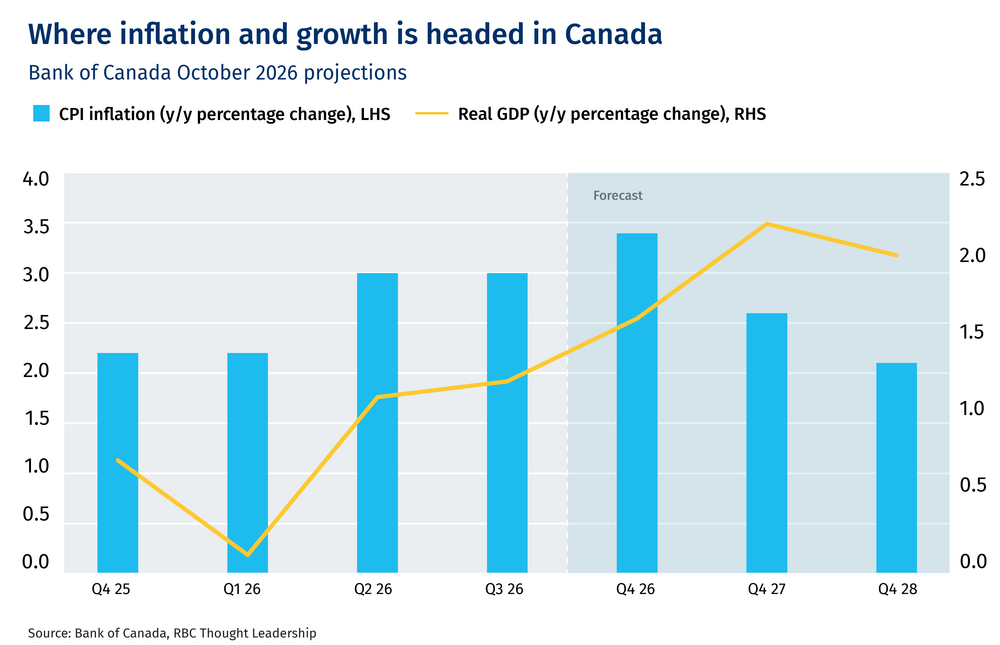
The Bank of Canada raised its key interest rate for the first time since 2023
Governor Tiff Macklem said the 25-basis-point hike, which brings the rate to 2.5%, was needed to reduce the risk that higher energy prices spill over and become generalized inflation. The bank also signalled that additional hikes may be needed. Meanwhile, U.S. Federal Reserve officials voted 10-2 to hold the key interest rate steady at between 3.75% and 4%. Inflation as measured by the Fed’s preferred gauge was 3.4% in August—above the bank’s 2% target.
Canadians hoping blue wave will bring tariff relief
The Canadian auto industry, which has been hit hard by U.S. President Donald Trump’s protectionist policies, is expecting a Congressional push against tariffs and possible resurrection of EV-friendly policies. Democrats signalled a willingness to try to end the trade war, although their options may be limited given Trump’s veto powers. House Minority Leader Hakeen Jeffries said that Democrats would pass a bill to “stop the stupid Trump tariffs jacking up prices on Americans,” while Senator-Elect Abdul El-Sayed called the Canada-U.S. trade war “insane.” For more on what the U.S. power shift means for Canada, read our latest briefing.
Loonie gains ground amid stronger trade figures and U.S. political shifts
Canada's merchandise trade surplus widened to C$5.35 billion in September, above consensus expectations and its highest level since May 2022. The improvement was largely driven by stronger gold and energy exports, which rose 16.8% and 8.2%, respectively, while imports edged down 0.3%. However, underlying trade activity remained weak, as exports excluding gold and energy fell 5.6%, reflecting the impact of U.S. tariffs on Canadian goods. Export volumes also declined 4%, suggesting that the headline surplus may overstate the strength of external demand. Meanwhile, the Canadian dollar strengthened to a seven-week high against the greenback, reaching about US$0.72. The Loonie likely benefited from the stronger trade figures and broad U.S. dollar weakness following the Democrats' sweeping victory in the U.S. midterm elections, which raised expectations of political gridlock in Washington. While the trade surplus data provides some encouragement, weakness across several export categories, ongoing trade uncertainty, and softer economic activity indicators suggests that Canada's economic growth outlook remains challenging.
The U.S. economy grew at the fastest pace in a year
GDP increased 3.4% annualized in the third quarter, driven by resilient consumer spending and increased business investment related to the AI buildout. While household spending—which makes up more than two-thirds of the U.S. economy—has been strong, economists expect it to moderate amid higher gas prices. The GDP release is the last economic report before next week’s midterm elections, which has been largely focused on affordability and high prices.
U.S. manufacturing gains momentum as Canadian activity weakens
Manufacturing activity in the U.S. and Canada diverged in October, highlighting different economic conditions on both sides of the border. In the U.S., ISM Manufacturing PMI rose to 55.5 from 54.5 in September, exceeding expectations and signaling continued expansion. Strong domestic demand, supported by consumer spending and investment in AI, helped lift factory production to its highest level since November 2021. However, manufacturers remained cautious as elevated input costs, supply shortages and trade uncertainty continue to weigh on sentiment. The prices paid index eased but remains high, reinforcing concerns about inflation. In contrast, Canada's manufacturing sector contracted for the first time in 2026, with the S&P Global Manufacturing PMI falling to 49.6 from 51.5. Both production and new orders declined as tariffs, geopolitical uncertainty, and supply chain disruptions weighed on activity. Moreover, input costs and selling prices also climbed to their highest level in more than four years. Overall, the reports highlight stronger U.S. manufacturing momentum alongside growing pressures on Canadian factories, with inflation remaining a shared concern.
Charts of the day
Interesting tidbits
- $1 million. The funding University of Waterloo battery researcher Dr. Linda Nazar was awarded as part of the Gerhard Herzberg Canada Gold Medal for Science and Engineering—the country’s top science prize.
- Alexander MacDonald is set to lead the Canadian Space Agency. His two decades of experience in the space sector includes serving as NASA’s first chief economist. MacDonald helped establish the U.S. space agency’s Moon to Mars strategy, including the Artemis program that oversaw Canadian astronaut Jeremy Hansen’s travel around the moon. The appointment comes at a pivotal moment as Canada focuses on strengthening its domestic space capabilities in an increasingly competitive global space race. For more on Canada’s space ambitions, read Mission Critical: Why Canada’s race to space is of national urgency.
- 53. The number of Olympic pools Quebec’s strategic maple syrup reserve could fill. However, the industry is warning that the reserves, spread across three Quebec warehouses, could deplete by February on rising global demand.
Today’s funny

REMINDER: Most of my new clients come to me via word of mouth as I don’t advertise or engage in marketing programs. Please keep my team in mind if you hear of anyone with over $1 million in investable assets who is in need of wealth management services.
This information is not investment advice and should be used only in conjunction with a discussion with your RBC Dominion Securities Inc. Investment Advisor. This will ensure that your own circumstances have been considered properly and that any action is taken based upon the latest available information. The strategies and advice in this report are provided for general guidance. Readers should consult their own Investment Advisor when planning to implement a strategy. Interest rates, market conditions, special offers, tax rulings, and other investment factors are subject to change. The information contained herein has been obtained from sources believed to be reliable at the time obtained but neither RBC Dominion Securities Inc. nor its employees, agents, or information suppliers can guarantee its accuracy or completeness. This report is not and under no circumstances is to be construed as an offer to sell or the solicitation of an offer to buy any securities. This report is furnished on the basis and understanding that neither RBC Dominion Securities Inc. nor its employees, agents, or information suppliers is to be under any responsibility or liability whatsoever in respect thereof. The inventories of RBC Dominion Securities Inc. may from time to time include securities mentioned herein.