Mike's Musings - Oct 9, 2026
Elevated bond yields and geopolitical tensions have challenged the resilience of markets, but so far neither has been sufficient to durably undermine economic growth and corporate earnings momentum. I discuss the key factors shaping today’s risks and opportunities in this issue.
Elevated bond yields and geopolitical tensions have challenged the resilience of markets, but so far neither has been sufficient to durably undermine economic growth and corporate earnings momentum. I discuss the key factors shaping today’s risks and opportunities in this issue.

Michael Wilkie
October 8, 2026
A word from Mike
Hello,
Elevated bond yields and geopolitical tensions have challenged the resilience of markets, but so far neither has been sufficient to durably undermine economic growth and corporate earnings momentum. I discuss the key factors shaping today’s risks and opportunities in more detail below.
Macro Strength Tested
The world economy continues to expand at a reasonable pace despite numerous crosscurrents. In the U.S., a stable labour market and rising household wealth have helped reinforce consumer spending, while AI-related investments have supported business activity. Global economic indicators remain at healthy levels, and data has generally been surprising to the upside, providing a constructive foundation for continued corporate profit growth.
I continue to monitor simmering risks that could weigh on economic momentum and contribute to volatility. Namely, geopolitical developments and the rise in global bond yields. Oil prices remain meaningfully above pre-war levels, and further disruption to commodity flows or energy infrastructure in the Middle East could prolong price pressures. However, I am reasonably encouraged by reports that energy shipments are beginning to normalize, though recent attacks on tankers in the region underscore lingering risks to energy supply.
Higher Bond Yields: Headwind & Opportunities
In my view, higher yields are not necessarily negative in isolation. While the recent uptrend partly reflects greater inflation and monetary policy uncertainty related to an energy shock, it is also a function of a constructive outlook for global growth.
For fixed income investors, rising yields are initially accompanied by lower prices for existing bonds, which has dampened returns recently. However, with a higher starting point for yields today, the forward-looking return outlook for a diversified fixed income portfolio has become more attractive, allowing investors to collect higher coupon payments while also providing more cushion against further increases in yields.
Economically, persistently higher yields can raise borrowing costs for businesses and consumers. This can soften economic momentum on the margin, but the impact varies across economies. The U.S. economy appears relatively well positioned to absorb higher rates given its lower sensitivity to interest-rate fluctuations compared to other major economies. More broadly, higher rates also increase the income households and businesses earn on cash and other interest-bearing assets, which can partially offset the effects of higher borrowing costs.
For equity markets, higher yields can create performance variances across sectors. More rate-sensitive sectors—such as utilities, real estate, consumer staples—have recently underperformed the broader market. A stabilization in bond yields would, in my view, help improve the prospects of these market segments. At the same time, with fixed income markets now offering more attractive return potential, this will likely raise the importance of earnings delivery as a driver of equity market returns in the quarters ahead.
Solid Earnings Fundamentals
While bond yields and interest rates have dominated headlines, I expect market attention to increasingly shift toward the start of Q3 corporate reporting season.
The outlook for earnings growth remains strong. S&P 500 earnings are forecast to increase by more than 20% year-over-year for the third consecutive quarter. While technology companies are expected to remain an outsized contributor, all eleven S&P 500 sectors are projected to deliver profit growth. If realized, this broadening participation in profit expansion could provide additional support for the ongoing equity market uptrend.
The Canadian corporate sector is showing similar strength, with the S&P/TSX Composite also projected to deliver earnings growth exceeding 20% in the third quarter.
Takeaway
While markets can always be surprised by unforeseen developments, most economic indicators continue to support my baseline view that the economy and corporate fundamentals retain positive momentum. I am nevertheless monitoring several potential speed bumps, including signs that higher borrowing costs are beginning to weigh more meaningfully on growth and any disappointments around AI investment or monetization.
Against this backdrop, I believe portfolios should balance participation in a durable expansion cycle with awareness of market concentration. Maintaining exposure to AI-linked companies remains important given their structural growth potential, but this exposure should be complemented by sectors and regions that are less dependent on the AI investment theme. I remain focused on disciplined portfolio management, with an appropriate mix of growth and defensive exposures aligned with long-term objectives.
Highlights
Global Insight Weekly
Equity bull cycle intact but rising rates and deteriorating breadth are a concern
The S&P 500’s trend remains positive, but rising long-term interest rates remain a concern that has led to deteriorating breadth as measured by the NYSE Advance-Decline line. While interest rates have yet to reverse, the silver lining is that the decline in many sectors through Q3 has moved some technical indicators toward oversold levels that often support a multi-month rebound.
Regional developments: Pacific Link project is expected to create over 140,000 jobs and generate over CA$20 billion in GDP per year; Funding for orbital data centers in focus; Fiscal worries weigh on European bonds; China starts trade talks with European Union.
Please take some time to review the Global Insight Weekly.
Global Insight Monthly
October 2026
I am pleased to share the latest investment strategy report from RBC Wealth Management—Global Insight, which provides our current thoughts on asset classes, the economy, and timely issues that impact investment strategy.
Full report: Global Insight
This month’s highlights:
Global fixed income: Long bonds light a short fuse
Global bond yields have hit fresh multidecade highs, but is this a warning sign or a healthy market recalibration? We explore the structural forces reshaping interest rates worldwide.
Global equity: The great determinant
There are plenty of valid concerns facing the nearly four-year-old bull market. But, at the end of the day, equity markets tend to move in the same direction as earnings. We argue today’s longish list of investor concerns has limited ability to materially alter the earnings outlook for 2026–27.
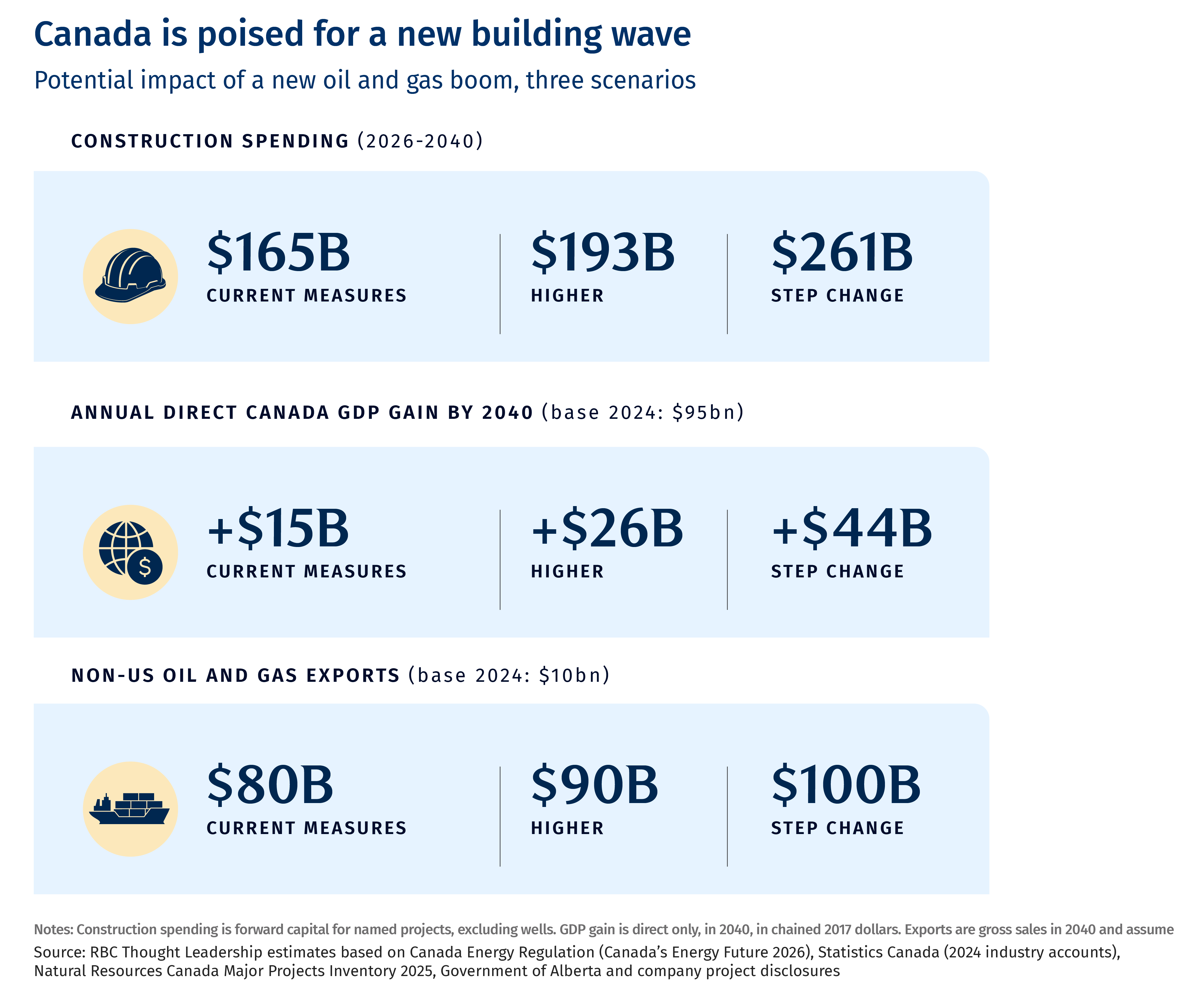
Ottawa fast-tracked regulatory approval of the Alberta-to-B.C. oil pipeline
The government listed the joint project with Alberta in the "national interest," effectively shifting the regulatory process from approval to setting conditions around its construction by Sept. 1, 2027. Indigenous groups will be offered a minimum of 10% in the Pacific Link (formerly the West Coast Oil Pipeline). It's the first project approved under the newly legislated Building Canada Act. The one-million-barrel-per-day pipeline is part of Prime Minister Mark Carney's strategy to double non-U.S. exports in 10 years.
New U.S. import ban on select Canadian products
New U.S. trade restrictions on Canada took effect last week , with Washington banning imports of many Canadian alcoholic beverages, certain dairy products including whey, molasses, and some motorcycles. The measures replace the 50% tariffs previously applied to these products and follow Canada’s retaliatory tariffs on U.S. goods earlier this month, marking another escalation in the trade dispute.
American consumers continue to power the economy
Household spending rose 6.1% in the 12 months through August, up from an annual growth rate of 4.3%. While consumer prices increased 3.6% over the period, inflation-adjusted spending is also up. A cooling labour market and high gas prices are weighing on consumer sentiment, but a bump in stock market and home prices have allowed many to continue spending. And the trend appears across different income groups, with those earning under US$50,000 raising spending by 4.7%, compared to 4.4% for those above US$100,000.
Hormuz Crude Flows Recover, but Diesel Supply Remains Tight
Crude oil shipments through the Strait of Hormuz are recovering but supplies of diesel and other refined products remain depressed. The 7-day average for oil traversing the strait reached 10.3 million barrels a day, or roughly three-quarters of prewar levels. Flows of refined products such as diesel and gasoline, however, are at only 1.3 million barrels per day, representing 11% of total oil flows versus 20% before the war. Importantly, diesel prices show up in transportation and distribution costs, including for everyday items like groceries. In the U.S., diesel recently reached a record national average of US$6.53 a gallon. Refineries across the Gulf have been damaged or disrupted during hostilities, limiting the capacity to turn recovering crude supplies into usable fuels. The G7 has agreed to release 100 million barrels of crude and fuel from emergency reserves, while the U.S. temporarily eased restrictions on tax-exempt dyed diesel. Analysts estimate that a full supply recovery could into late 2027 due to timelines requires to bring refineries back online and replenish oil stocks.
Arctic sea routes are busy as the Strait of Hormuz remains fraught with risks
Voyages through the Northern Sea Route were up 46% in September compared to August, and are up 133% compared to 2022, according to Llyod’s, which tracks shipping routes. The passage is also more accessible due to global warming, with northern sea ice suffering the largest single-year winter decline in 2025 on record. Several shipowners are using that route for containers and bulk cargo to avoid the Strait of Hormuz and the Panama Canal, which suffered drought conditions this year.
The world is facing a liquefied natural gas crunch
Qatar, one of the world’s top LNG producers, has shipped only 98 cargoes of the gas through the Strait of Hormuz, 536 fewer than the same period last year, since the U.S.-Iran war began. LNG prices in Asia have surged 140% as the Strait became a flashpoint in the Washington-Tehran standoff. A severe winter could exacerbate challenges, as Europe—with its gas stocks at record lows for this time of the year—starts competing with Asia for limited supplies.
Global debt levels are set to top 100% of GDP
That’s the warning of Kristalina Georgieva, head of the International Monetary Fund, ahead of the IMF-World Bank meetings with finance ministers and central bank governors in Bangkok next week. High energy prices have pushed 10-year borrowing costs for the U.S., Germany and Japan to multi-decade highs. While the global economy remains resilient, inflationary pressures persist from tariffs, AI investments, and energy and food shocks. This demands central banks to be “prudently hawkish” and politicians to make tough choices.
Charts of the Day
Interesting tidbits
- 11. The age of British child chess prodigy Bodhana Sivanandan, who became the youngest player ever to earn the woman grandmaster (WGM) title.
- New York is the world’s best city. That’s according to the 2026 Global Cities Index, which ranks 1,000 cities across governance, economics, human capital, environment, and quality of life. London, Paris, Seattle, and San Francisco made up the top five. Toronto emerged as the top Canadian city, ranked 20th, scoring high on economics and human capital, but weighed down by high cost of housing and “volatile” winters. The report by Oxford Economics noted that the city is expected to be a "strong contender in the rankings for years to come."
- 32%. The percentage of Canadian real estate markets perceived to favour buyers, up from 15.2% last year, according to a RE/Max survey.
- 180,000. The number of free-roaming tortoises—once considered endangered—that were discovered on a Seychelles island. Fewer than 1,000 were left by the 19th century.
Today's Funny

REMINDER: Most of my new clients come to me via word of mouth as I don’t advertise or engage in marketing programs. Please keep my team in mind if you hear of anyone with over $1 million in investable assets who is in need of wealth management services.
This information is not investment advice and should be used only in conjunction with a discussion with your RBC Dominion Securities Inc. Investment Advisor. This will ensure that your own circumstances have been considered properly and that any action is taken based upon the latest available information. The strategies and advice in this report are provided for general guidance. Readers should consult their own Investment Advisor when planning to implement a strategy. Interest rates, market conditions, special offers, tax rulings, and other investment factors are subject to change. The information contained herein has been obtained from sources believed to be reliable at the time obtained but neither RBC Dominion Securities Inc. nor its employees, agents, or information suppliers can guarantee its accuracy or completeness. This report is not and under no circumstances is to be construed as an offer to sell or the solicitation of an offer to buy any securities. This report is furnished on the basis and understanding that neither RBC Dominion Securities Inc. nor its employees, agents, or information suppliers is to be under any responsibility or liability whatsoever in respect thereof. The inventories of RBC Dominion Securities Inc. may from time to time include securities mentioned herein.