Mike's Musings - Sept 25, 2026
Canada continues to face a familiar economic challenge: turning its considerable advantages into stronger investment and productivity growth. Below, I discuss Canada’s renewed efforts to attract more capital and deepen relationships abroad, as well as the domestic growth and inflation picture.
Canada continues to face a familiar economic challenge: turning its considerable advantages into stronger investment and productivity growth. Below, I discuss Canada’s renewed efforts to attract more capital and deepen relationships abroad, as well as the domestic growth and inflation picture.

Michael Wilkie
September 24, 2026
A word from Mike
Hello,
Canada continues to face a familiar economic challenge: turning its considerable advantages into stronger investment and productivity growth. Below, I discuss Canada’s renewed efforts to attract more capital and deepen relationships abroad, as well as the domestic growth and inflation picture.
Canada Investment Summit
Canada has many qualities that should make it attractive to investors, including abundant natural resources, a highly educated workforce, and credible institutions. The first Canada Investment Summit sought to showcase these advantages and potential investment opportunities to global investors. Over the next five years, the objective is to attract more than $1 trillion of new capital to Canada.
So far, the federal government has reported nearly $500 billion in investment and financing commitments, including almost $100 billion from institutional investors and roughly $325 billion made available by Canadian banks. Rather than generating an immediate spending impulse, some commitments will be deployed over several years, while bank financing depends on sourcing suitable projects and borrowers. The economic payoff will ultimately rest on how much of the announced capital translates into tangible projects and whether it helps attract additional foreign investment inflows.
The summit also unveiled measures aimed at improving the economics of investing in Canada. Most notably, the new Productivity Mega Deduction gives businesses a larger tax benefit upfront when they invest in machinery, technology, infrastructure and other assets. Accelerating those deductions improves cash flow and raises an investment’s expected after-tax return, potentially making more projects economically viable.
The government estimates the changes will cut Canada’s marginal effective tax rate on new business investment from 13% to 6.4%, the lowest amongst major economies. Separately, the Building Canada Strong Act (Bill C-39), proposed on Monday, would make project approvals faster and more predictable by mandating a one-year review timeline for completed applications. Together, these measures are intended to make major projects more financially attractive while shortening the path from proposal to construction.
Shoring Up Alliances
While the summit was hosted in Canada, policymakers also continued their roadshow to broaden strategic and economic ties across the Atlantic. Recent discussions with European leaders have included the possibility of Canada becoming the European Union’s first “associate member,” alongside deeper cooperation in areas such as critical minerals, defence, energy and advanced technology.
These efforts have taken on more importance as Canada-U.S. trade tensions have re-escalated. I acknowledge that geographic proximity and deeply integrated supply chains mean the U.S. is likely to remain central to Canada’s economy. But expanding overseas markets should improve resilience and create new opportunities, even if strong economic incentives remain for both countries to reach a mutually beneficial trade agreement.
The Canadian Economy: A Different Starting Point
In a speech this week, Bank of Canada (BoC) Governor Tiff Macklem highlighted the competing forces shaping the outlook. If the latest U.S. tariffs remain in place, he estimated that economic growth could slow to an annualized pace below 1% in the fourth quarter, roughly half the central bank’s previous expectation.
At the same time, headline inflation remains around 3%, largely reflecting higher energy prices, while measures of underlying inflation are closer to 2%. This suggests broader price pressures remain relatively contained beneath the headline number. So far, the central bank has seen limited evidence that higher energy costs are spreading more broadly, although that risk increases the longer oil prices remain elevated. This differs from the U.S., where economic momentum remains relatively firm and inflation has been running above target for several years, leading the Federal Reserve to raise interest rates last week.
Canada’s softer growth backdrop does not necessarily rule out a rate hike. Markets still see a meaningful chance of an increase at the BoC’s October meeting, as policymakers weigh muted growth against the risk that elevated energy costs become more persistent. The policy rate also sits at the bottom of the BoC’s estimated “neutral range,” the level expected to neither stimulate nor restrain the economy. A modest increase could therefore move policy toward a more neutral setting that reduces some current monetary support while guarding against broader inflation pressures.
Takeaway
After decades of incrementalism and heavy reliance on the U.S., recent trade tensions have served as a much-needed catalyst for Canada to pursue a more ambitious economic agenda. Many of the federal government’s proposals will take time to implement and deliver results, but with strong follow-through, I believe the initiatives will help address longstanding economic challenges by unlocking the considerable strengths and potential of our economy. Over the medium to long term, I believe stronger investment and productivity should help lift Canada's growth trajectory. For investors, that matters because it potentially points to a more constructive environment for the earnings prospects of Canadian companies.
Highlights
Europe: Filtering out the noise
The European economy has proven surprisingly resilient so far, though the European Central Bank (ECB) remains alert to the risk of rising natural gas prices. The region faces a crowded political agenda with plenty to watch over the next six to 12 months. We explore where political noise could create opportunities.
Regional developments: Bank of Canada warns new U.S. tariffs could cut Q4 growth below 1%; U.S. diesel prices reach record highs; Euro area activity indexes underscore the region's resilience.
Please take some time to review the Global Insight Weekly.
The Bank of Canada said tariffs may set back recent economic progress
Governor Tiff Macklem said fourth quarter growth could fall to below 1% as a new wave of uncertainty brought on by fresh U.S. tariffs threatens to hit investment and hiring. Canada’s economy had rebounded in the second quarter, posting an annualized growth of 3.3%, as investment picked up. But the recent trade escalation, plus the ongoing conflict in the Middle East, has increased uncertainty, which could again delay investment, hiring and stall growth.
Canada made progress on a trade deal with India
Indian Prime Minister Narendra Modi is expected to visit Canada in December to sign the new agreement, which is still being negotiated. Canada’s International Trade Minister Maninder Sidhu was in India for trade talks this week, and said the country is looking to Canada for its energy needs, as its refiners look for alternatives to Russian crude, as well as for nuclear capacity, liquified natural gas and potash. Canada is seeking to double two-way trade with India to $70 billion by 2030.
Canadian home prices posted their eighth decline in nine months
Average prices are now down 4.2% in August from their November 2025 peak, the Teranet-National Bank Composite House Price Index data shows. Six of the 11 markets included in the index saw average home prices fall in the month. Vancouver led the way with a 6.5% year-over-year price decline, followed by Hamilton (-6.2%) and Toronto (-6.1%). A sharp rise in U.S. bond yields is pushing Canadian bond yields higher that could lead to higher financing mortgage costs.
Employment at Canadian data centres jumped amid the AI boom
A new report found that the number of people working in data centres and computing infrastructure in Canada increased 23%— or by about 8,000 jobs— between June 2025 and this June. Canada has been late to the AI boom compared to the U.S., where the AI build out is on track to become the biggest economic bet in history. AI-related infrastructure in the U.S. is expected to total $10.3 trillion from 2025 to 2032, amounting to 3.6% of U.S. GDP.
The U.S. Federal Reserve raised rates for the first time since 2023
Chairman Kevin Warsh’s first hike pushes the rate to 4% from 3.75% and is expected to support a return to the Fed’s 2% goal. Geopolitics was among the reasons cited for the hike, with Fed policymakers indicating another increase this year.
U.S. business activity gains momentum; keeps inflation in focus
U.S. business activity accelerated sharply in September to its highest level since July 2021, consistent with annualized economic growth of around 5%. Strength was broad-based across manufacturing and services, while new orders climbed to their highest level since March 2022. The stronger demand backdrop, however, is also creating capacity strains. Work backlogs rose to their highest level since May 2022, supplier delivery times lengthened, and companies reported difficulty finding suitable workers. Inflation pressures also intensified, with the input-price index jumping to 66.4, its highest since October 2022, as supply shortages and higher raw-material costs pushed expenses higher. Altogether, the report points to a U.S. economy that remains resilient, but one where strong demand and supply constraints are increasingly reinforcing inflation, adding to the case for the Federal Reserve to keep policy rates elevated and potentially deliver further rate hikes in the coming months if price pressures remain persistent.
The U.S. and China extended their trade truce. U.S. President Donald Trump rolled out the red carpet for President Xi Jinping in Washington, as the two sides sought common ground over the Iran war, artificial intelligence and trade. Xi told Trump that both countries would “lose in a confrontation.” The trade truce now extends to Jan. 10, with Treasury Secretary Scott Bessent suggesting a “bigger deal” was possible down the road.
China is clamping down on travel of its skilled workforce
The rules, which came into force Tuesday, restrict foreign trips for mid-to-senior-level civil servants, Communist Party officials, and state-owned enterprise employees, but also private citizens working in sensitive areas like advanced technology. It’s seen as one of China’s most significant travel restrictions and comes as Beijing battles with the U.S. for technological dominance. Immigration agencies also said a government order to report public officials, military personnel and others who are exiting the country is also affecting family members.
Europe’s central bank raised interest rates a second time this year
The ECB lifted key deposits rates by 25 basis points to 2.5% to tame inflation that hit a three-year high to 3.3% in August. The surge is driven by natural gas that has jumped to a three-year high as the Middle East conflict disrupts energy markets.
Charts of the day
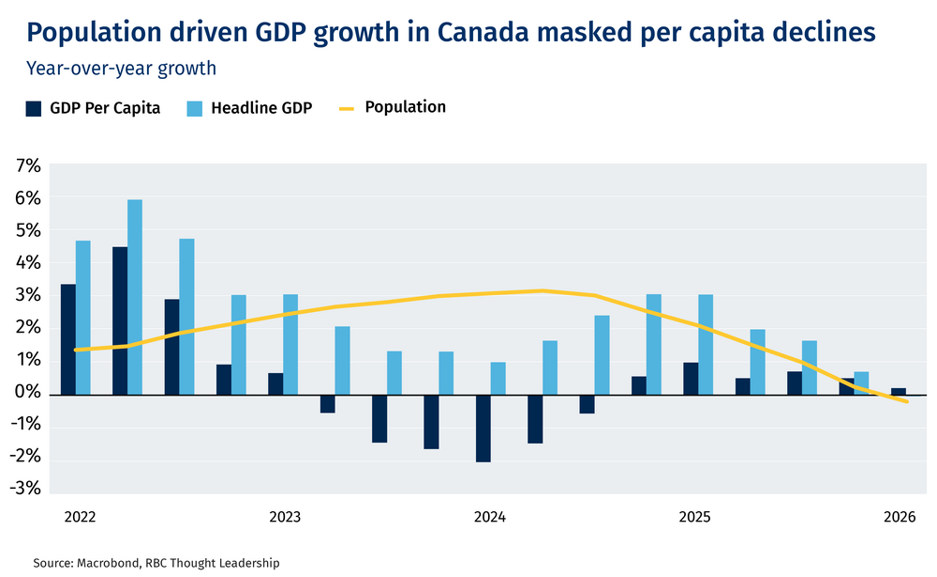
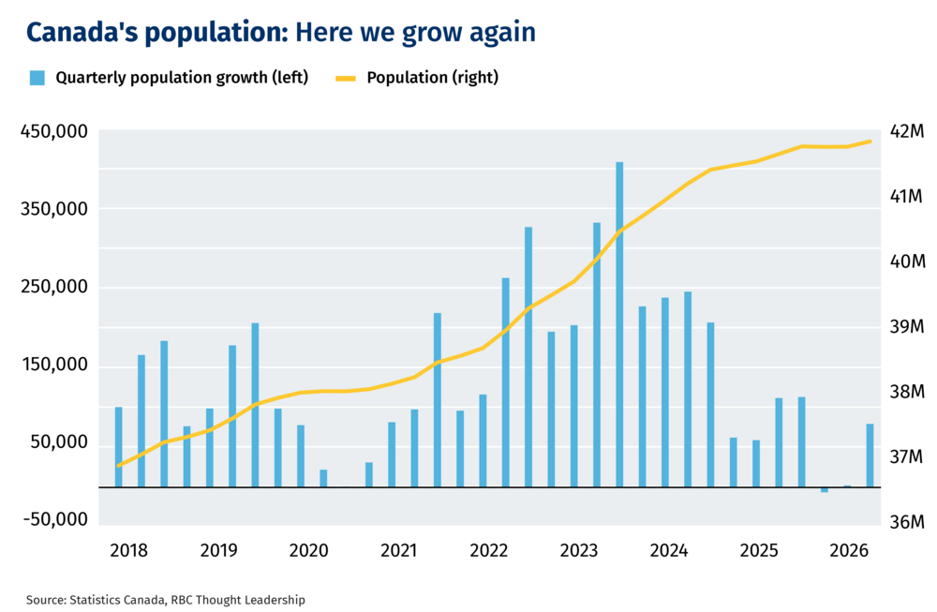
For more on Canada's demographics challenge, read A Smarter Immigration Strategy
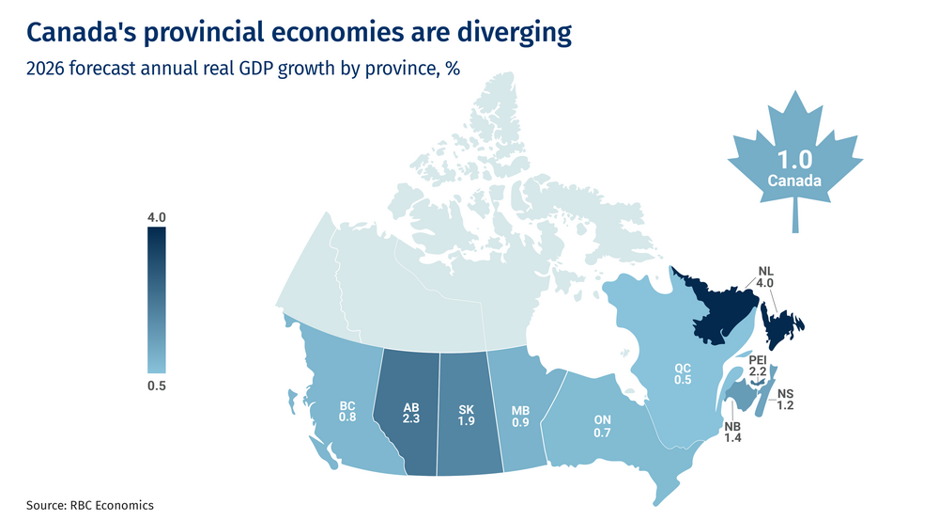
Read more from RBC Economics
Interesting tidbits
- 1,400. The number of new words added to the Merriam-Webster dictionary. It includes "glow-up," and "looksmaxxing," and new tech-inspired words such as "vibecoding," "meme coins," and compute as a noun.
- 9th. St. Catharines downtown’s rank in Time Out’s 40 coolest neighbourhoods. Apart from the Ontario city, Vancouver’s Mount Pleasant (35th) also made the global list.
- US$16 million. How much money you would have today if you invested US$1,000 on the day of Home Depot's IPO in 1981. That's a greater total return than any other stock in the S&P 500 since then.
- 4.27. The average time in seconds it took six-year-old Lian Yunzhi of China to solve a 3x3 Rubik’s Cube at a recent competition, breaking a world record.
Today’s funny
REMINDER: Most of my new clients come to me via word of mouth as I don’t advertise or engage in marketing programs. Please keep my team in mind if you hear of anyone with over $1 million in investable assets who is in need of wealth management services.
This information is not investment advice and should be used only in conjunction with a discussion with your RBC Dominion Securities Inc. Investment Advisor. This will ensure that your own circumstances have been considered properly and that any action is taken based upon the latest available information. The strategies and advice in this report are provided for general guidance. Readers should consult their own Investment Advisor when planning to implement a strategy. Interest rates, market conditions, special offers, tax rulings, and other investment factors are subject to change. The information contained herein has been obtained from sources believed to be reliable at the time obtained but neither RBC Dominion Securities Inc. nor its employees, agents, or information suppliers can guarantee its accuracy or completeness. This report is not and under no circumstances is to be construed as an offer to sell or the solicitation of an offer to buy any securities. This report is furnished on the basis and understanding that neither RBC Dominion Securities Inc. nor its employees, agents, or information suppliers is to be under any responsibility or liability whatsoever in respect thereof. The inventories of RBC Dominion Securities Inc. may from time to time include securities mentioned herein.