Bond Taxation
This article provides an overview of the tax treatment of interest-bearing bonds held in a non-registered account. It discusses how the adjusted cost base (ACB) is determined, explains premiums and discounts, and discusses how to calculate and report a capital gain or loss on the sale or maturity of a bond. This article also includes common transactions with bonds such as early redemptions and how convertible bonds are treated.
This article provides an overview of the tax treatment of interest-bearing bonds held in a non-registered account. It discusses how the adjusted cost base (ACB) is determined, explains premiums and discounts, and discusses how to calculate and report a capital gain or loss on the sale or maturity of a bond. This article also includes common transactions with bonds such as early redemptions and how convertible bonds are treated.
Family Office Services
November 14, 2025
Bond Taxation
This article provides an overview of the tax treatment of interest-bearing bonds held in a non-registered account. It discusses how the adjusted cost base (ACB) is determined, explains premiums and discounts, and discusses how to calculate and report a capital gain or loss on the sale or maturity of a bond. This article also includes common transactions with bonds such as early redemptions and how convertible bonds are treated.
Bonds that Pay Regular Interest
A bond is a debt instrument that pays interest at a set rate at regular intervals such as monthly, semi-annually or annually. The stated interest rate, when a bond is issued, is usually close to the interest rate in the market at that time. The principal amount of the bond is also known as the face value or par value; this is the amount the issuer promises to pay you when your bond matures. Most bonds trade on an active secondary market where the price of the bond is mainly influenced by the debtor's credit risk and the difference between the stated interest rate on the bond and the current market interest rate for a bond with a similar time to maturity.
Normally, when you purchase a bond from the issuer and hold it to maturity, this doesn't result in a capital gain or loss. Interest paid annually needs to be reported as income on your annual tax return.
Guaranteed Investment Certificates (GICs)
While a GIC is not a bond, it's taxed like a regular bond when purchased or sold on a secondary market. Normally, when purchased from the issuer and held to maturity, GICs don't result in capital gains or losses, unless they're in a foreign currency. However, if you buy and sell GICs on the secondary market, you won't necessarily be buying or selling them at the principal amount and you may incur a capital gain or loss. This capital gain or loss would be calculated the same way as a regular bond as described later.
A simple interest GIC pays interest annually and needs to be reported as income on your annual tax return. If the GIC doesn't pay interest annually (a compound GIC), you'll need to accrue interest to the anniversary of the issue date and report it on your tax return each year. For example, if a GIC was issued on March 7, 2024, the first anniversary date would be March 6, 2025. The first time that interest would be reported is on your 2025 tax return. Although the remainder of the article doesn't specifically refer to GICs, the discussion on buying and selling bonds also applies to GICs purchased and sold on the secondary market.
Buying a Bond
When you buy a bond on its issue date, there's no accrued interest on the bond. You typically pay the bond's stated face value. Generally, your ACB is your original purchase price for the bond. If you buy a bond on the secondary market, the price you may include accrued interest. Your ACB will be the price you paid less the accrued interest. This calculation is outlined in the examples that follow.
The Effect of Accrued Interest on the Price You Pay
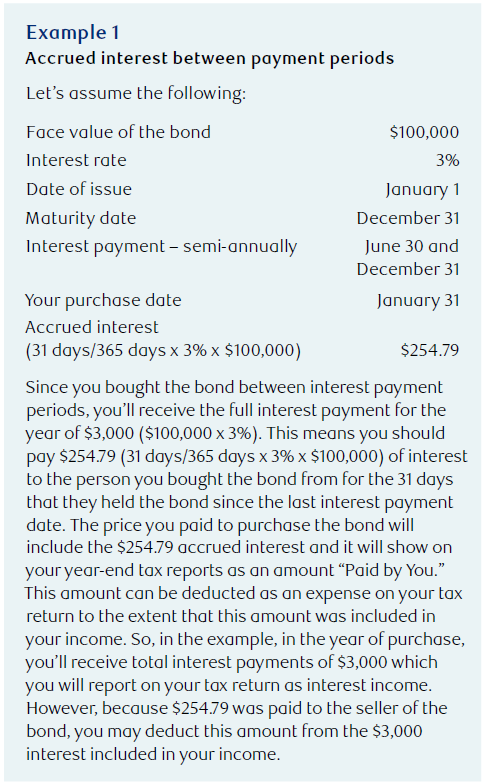
If you buy a bond on the secondary market on a date other than the issue date or between interest payment dates, the amount you pay will include the price of the bond plus accrued interest.
How Do Interest Rates Affect the Price You Pay for a Bond?
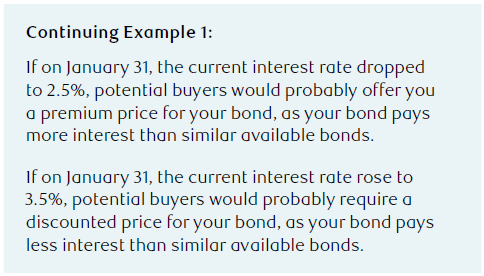
Bond prices move in the opposite (inverse) direction to interest rates. If the market interest rate drops after issue, you may find that your bond is trading on the secondary market for more than you paid for it. The drop of the interest rate makes your bond more valuable, causing it to trade at a premium (i.e. higher than face value). Conversely, if interest rates rise after issue, you may end up holding a bond that's paying interest at less than the current rate, and potential purchasers will only buy your bond on the secondary market at a discount (i.e. less than face value).
Holding Your Bond Until It Matures at Face Value
When you hold a bond that pays regular interest and it matures at face value, the difference between your proceeds of disposition (POD) and your ACB is considered a capital gain or capital loss for tax purposes.
Generally, your ACB is your original purchase price for the bond and your POD will be the face value of the bond at time of maturity. If you originally purchased the bond between coupon dates, your original purchase price may have included an amount for the accrued interest which you had to pay to the seller of the bond. This amount does not form part of your ACB.
Continuing with the facts in Example 1, the following tables illustrate how to calculate the capital gain or loss and interest income earned on a bond when purchased at a discount or a premium.
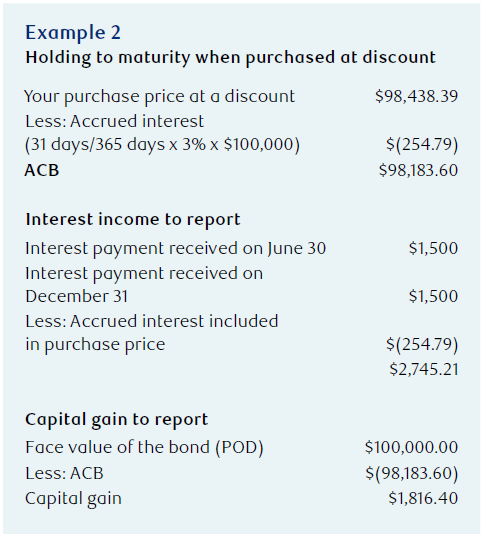
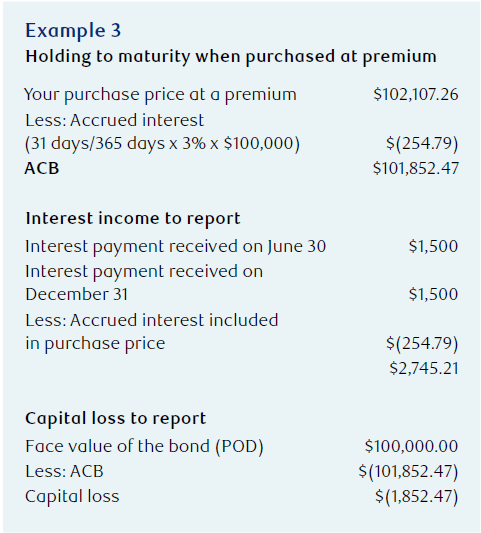
If you purchase a bond at a discount and hold it until maturity, you'll have a capital gain. If you purchase a bond at a premium and hold it until maturity, you'll have a capital loss. This may not be the case when you purchase bonds in a foreign currency, which is discussed later.
Selling Your Bond Prior to Maturity
When you sell a bond that pays regular interest between payment dates, the amount you receive from the purchaser will include accrued interest you earned on the bond, which hasn't yet been paid by the issuer. The remaining amount you received is your POD for purposes of calculating your capital gain or loss on the sale of the bond.
Continuing with the facts in Example 1, the following examples illustrate how to calculate the capital gain or loss and interest income on a bond when sold prior to maturity.
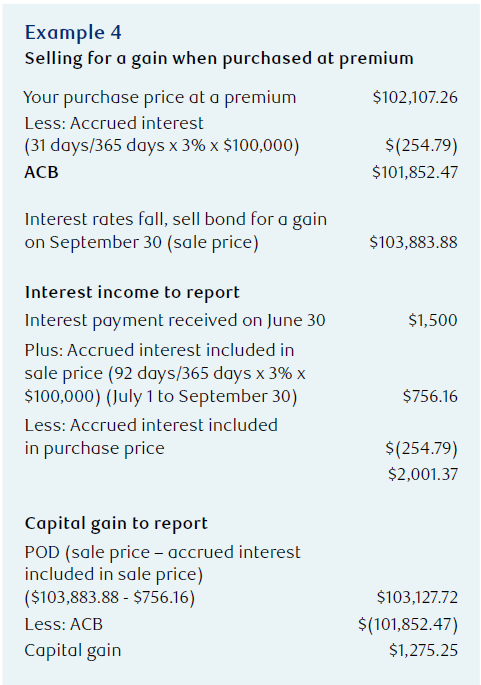
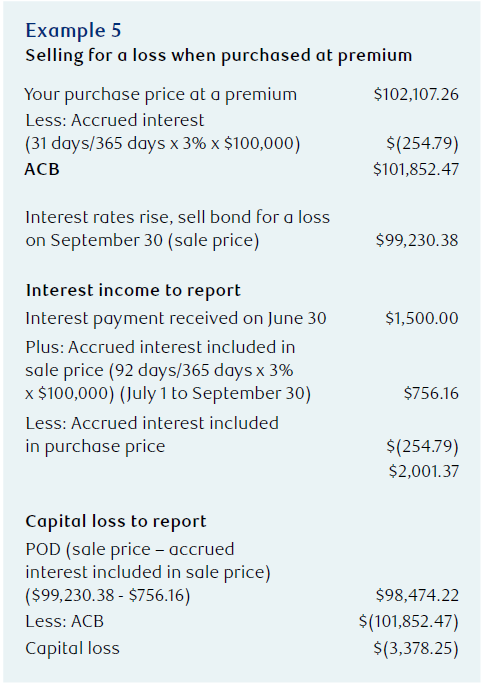
Depending on the circumstances, you may have a capital gain or loss when purchasing a bond at a premium and selling prior to maturity.
Similarly, you can have a capital gain or loss when the bond is purchased at a discount and sold prior to maturity. The same calculations as demonstrated in Examples 4 and 5 would need to be performed.
Whether you hold your bond to maturity or sell it prior to maturity, the disposition should be reported on your statement of security transactions in your tax reporting package.
Foreign Currency Bonds Held to Maturity
If you invest in bonds in a foreign currency, you'll need to convert the interest on the bond to Canadian dollars (CAD) using the foreign exchange rate on the date the income was received for the purpose of reporting this income on your Canadian tax return. For practical reasons, the Canada Revenue Agency (CRA) may also accept the use of an average of exchange rates over a period of time to convert certain income items (e.g. interest income). However, if exchange rates fluctuate significantly, the use of the average exchange rate for a period will not generally be accepted. It's important to note that using the average exchange rate is not acceptable for reporting capital gain or loss transactions.
Foreign currency fluctuations can have a significant effect on the taxation of bonds in a foreign currency. A gain in a foreign currency can turn into a loss when reported in CAD, or vice versa. The following examples show the effects foreign currency can have on foreign denominated bonds. In the following examples, the foreign exchange rate on the date of the transaction is used.
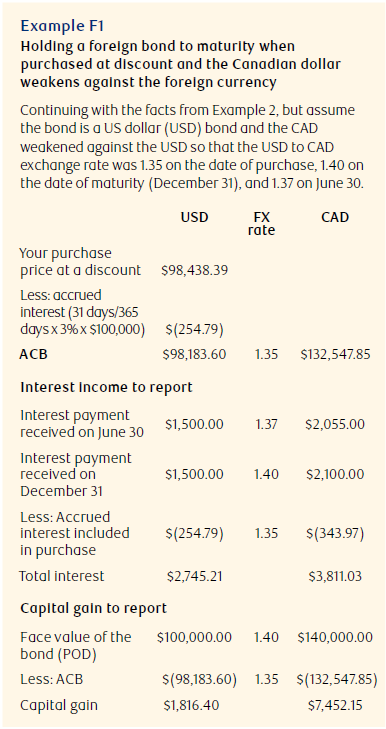
In Example F1, the gain for Canadian tax purposes is even greater than the gain calculated in the foreign currency.
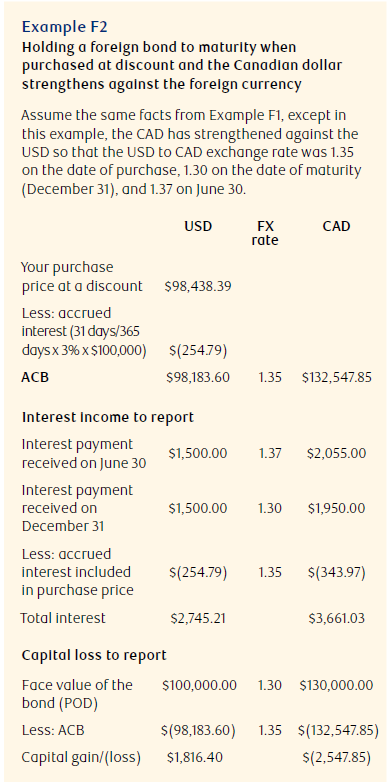
In Example F2, notice how a capital gain in the foreign currency becomes a capital loss for Canadian tax purposes.
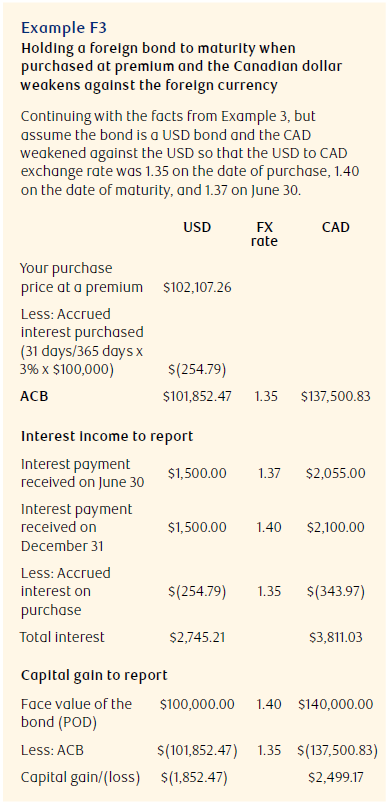
In Example F3, notice how a capital loss in the foreign currency becomes a sizeable capital gain for Canadian tax purposes.
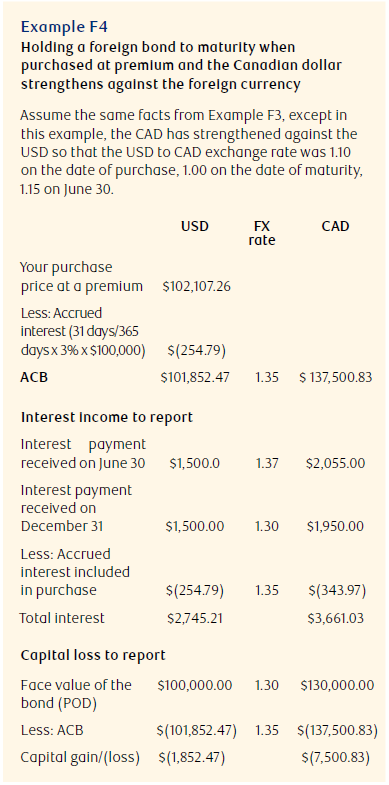
In Example F4, notice how the capital loss for Canadian tax purposes is even greater than the loss calculated in the foreign currency.
Yield to Maturity (YTM)
YTM for a bond is the total return (including interest and capital gain or loss) obtained from a bond held to maturity. When comparing bonds with the same YTM, the bond with the highest discount may be a more tax-efficient vehicle for you to buy. Example 6 demonstrates this concept.
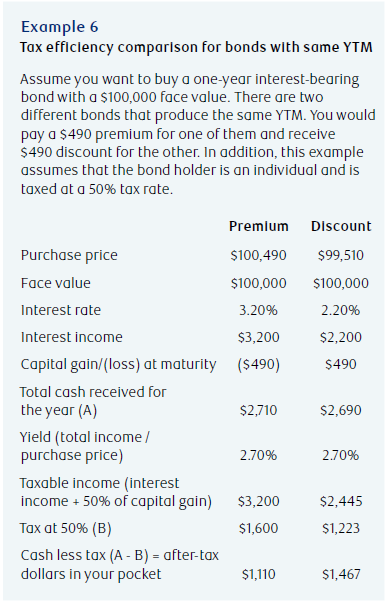
Although the two bonds produce the same YTM, the taxable income is higher with the bond purchased at a premium. With the bond purchased at a premium, the calculation assumes you don't have capital gains to offset the capital loss against and therefore just the interest income is taxable. With the bond purchased at a discount, the calculation assumes you don't have capital losses to offset the capital gain, therefore 50% of the realized gain on the bond is taxable in addition to the interest income.
Notice how, despite the two bonds having the same YTM, the one bought for $980 less only produces $20 less cash but also produces $755 less in taxable income, $337 less of taxes and therefore $337 more cash in your pocket overall. Because interest income is fully taxable at your marginal tax rate while only 50% of capital gains are taxable, discount bonds would appear to be a more tax-efficient investment vehicle when comparing bonds with the same YTM.
Early Redemption of a Bond by Issuer
You may own a bond that's redeemed by the issuer prior to the maturity date. The issuer may offer a premium or prepayment penalty above the face value when redeeming your bond. The premium will be taxable in one of two ways.
• If the premium paid can reasonably be considered to relate to the interest you would have received if you were allowed to continue holding the bond, some or all of the premium is deemed to be received in the year as interest income. Only the amount of the premium equal to the present value of the interest payments that would have been paid on the bond between the redemption date and the original maturity date would need to be reported as interest. If the premium exceeds the value of the forgone interest, this excess would be treated as POD resulting in a capital gain or loss.
• If the premium can't reasonably be considered to relate to the forgone interest, the premium is considered to be part of your POD of the bond.
To determine the proper reporting for you, a qualified tax advisor will need to review the redemption notice and the bond's prospectus.
If you sell your bond before the early redemption date, the amount received, net of accrued interest up to the date of sale, should be considered POD in determining your capital gain or loss on the sale of the bond.
Convertible Bonds
A convertible bond has a special feature that allows the holder to exchange it for one or more shares of the same company. A bond may also have features that allow the holder to exchange it for a new debt obligation, which includes a bond, debenture or note, of the same company.
Bond for Share
The exchange of a company's bond for its shares may not be taxable if the terms of the bond provide the holder with the right to make the conversion, only shares are received and certain other conditions are met. The CRA's administrative position still allows for a tax-free rollover where cash, up to a maximum of $200, is paid in lieu of fractional shares being issued on a conversion. Where the conversion of your bond to a share of the same corporation is non-taxable, you're deemed to have disposed of your bond for POD equal to your ACB of the bond; the ACB of your bond will become the ACB of the shares you receive in the exchange.
If the exchange includes cash, greater than an amount paid in lieu of fractional shares, or if the other required conditions for a tax-free rollover are not met, the conversion will be fully taxable. You'll be considered to have sold your bond for POD equal to the FMV of the shares plus cash you received.
Bond for Bond
An exchange of a bond for a new debt obligation of the same debtor may also be a tax-free rollover if the terms of the bond being exchanged provide the holder with the right to make the conversion, and the principal amount of the new debt obligation is equal to the principal amount of the original bond. When you exchange the bond for a new debt obligation of the same issuer, you'll be considered to have disposed of the original bond at its ACB and acquired the new debt at the same ACB.
Summary
In many cases, bonds are not purchased when issued and held to maturity. Instead, they're bought and sold between these periods. Since interest rates fluctuate constantly and seldom match the stated interest rate on the bond, you'll generally buy and sell bonds at a discount or a premium. For these reasons, you'll probably have to report interest income and a capital gain or loss when you sell the bond, or it matures. It's important to understand the components that make up the amount you pay or receive for a bond. It's also important to understand the tax implications if you own a bond that can be redeemed early by the issuer or has a conversion feature.
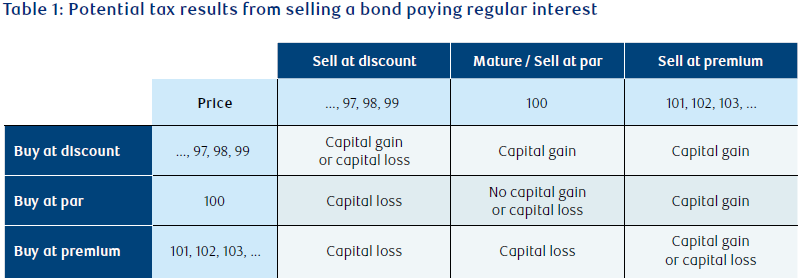
The following table summarizes the different possible capital gain or loss outcomes you could have from selling a bond. The table does not reflect interest or foreign currency bonds.
This article may contain strategies, not all of which will apply to your particular financial circumstances. The information in this article is not intended to provide legal, tax or insurance advice. To ensure that your own circumstances have been properly considered and that action is taken based on the latest information available, you should obtain professional advice from a qualified tax, legal and/or insurance advisor before acting on any of the information in this article.
If you would like to schedule some time to discuss the items outlined in this article, please click here to access our meeting scheduler.