Canadians investing in publicly traded U.S. securities
Explains U.S. and Canadian tax implications for Canadian resident individuals investing in publicly traded U.S. securities, including withholding tax rates, treaty provisions, registered account exemptions, and taxation of specific investment types (REITs, ETFs, MLPs, ADRs).
Explains U.S. and Canadian tax implications for Canadian resident individuals investing in publicly traded U.S. securities, including withholding tax rates, treaty provisions, registered account exemptions, and taxation of specific investment types (REITs, ETFs, MLPs, ADRs).

Family Office Services
September 14, 2021
Canadians investing in publicly traded U.S. securities
Understanding the U.S. and Canadian income tax considerations
Since Canada represents only a small percentage of the world's economy, many Canadians invest in the U.S. stock market to diversify their portfolios. As a result, it's important to have a general understanding of the tax issues associated with such investments, which, in some cases, may include the requirement to file a U.S. income tax return. This article discusses the Canadian and U.S. tax implications for Canadian resident individuals who are non-U.S. persons (i.e. not U.S. citizens, U.S. green card holders or U.S. residents) earning income and gains from common types of publicly traded U.S. securities.
This article does not address investments made by a corporation, a non-taxable entity or a trust. It does not include a discussion of U.S. estate tax issues that may apply to Canadians due to ownership of U.S. investments, which is the topic of a separate article that you may obtain from your RBC advisor.
Taxation of foreign income and minimizing double taxation
As a Canadian resident, you are required to report your worldwide income for tax purposes, which includes the gross amount of any foreign income you earn, even if it was already taxed in the foreign country. When you earn foreign source income, the country where you earn the income generally has the first right to tax the income under their domestic tax law. This means the foreign income you earn may be subject to tax twice. Canada has signed tax treaties with many countries, including the U.S. A treaty determines, among other things, who gets to tax various types of income and the maximum withholding tax rate that applies to the income. The foreign taxes paid include both foreign withholding tax and any foreign income taxes you pay if you have to file a foreign tax return. You may claim a foreign tax credit on your Canadian income tax return for taxes paid in the foreign jurisdiction. By claiming a foreign tax credit, you'll generally reduce your Canadian taxes payable. Canada generally only allows a foreign tax credit for taxes paid up to the reduced treaty rate, if applicable, even if a higher rate of withholding tax was paid. If this occurs, you may have to try to recover the excess foreign tax from the foreign tax jurisdiction.
U.S. tax implications
A Canadian who's a non-U.S. person is generally only subject to U.S. income tax on U.S. source income. U.S. source income is generally derived from activities performed in the U.S. or income derived from a U.S. corporation, a U.S. person, or other entities formed under U.S. federal or state laws and from U.S. real property. Some of the common types of U.S. source income you may earn in your securities portfolio includes, interest, dividend income and certain gains.
The U.S. tax treatment depends on whether the U.S. source income falls into one of the following two categories:
- U.S. source income that is fixed, determinable, annual or periodical (FDAP)
- Income that is "effectively connected with a trade or business in the U.S."
Most U.S. source income earned in your portfolio will likely be FDAP where a flat 30% U.S. withholding tax rate is applied at source unless the U.S. tax laws or the U.S.-Canada tax treaty (the "Treaty") provides for a reduced rate (usually 15%) or an exemption from U.S. taxation. To get the benefit of a reduced withholding rate under the Treaty, you must complete an Internal Revenue Service (IRS) Form W-8BEN, Certificate of Foreign Status of Beneficial Owner for United States Tax Withholding and Reporting.
Some U.S. source income and gains earned in your portfolio could be classified as income effectively connected with a trade or business in the U.S. Although this type of income is generally subject to U.S. withholding tax, you may also be required to file a U.S. non-resident income tax return to calculate your ultimate U.S. tax liability, which may be based on graduated tax rates or long-term capital gains rates. In such cases, you may deduct the U.S. withholding tax paid from the tax liability calculated on your U.S. income tax return.
U.S. withholding tax exemption on interest and dividends earned in certain registered accounts
Under the Treaty, if you receive interest and dividend income from a U.S. investment, there's an exemption from U.S. withholding tax if the investment is held in "registered retirement plans". Registered retirement plans include registered retirement savings plans (RRSPs), registered retirement income funds (RRIFs), locked-in retirement accounts (LIRAs), locked-in RRSPs or restricted locked-in RRSPs (RLSPs), life income funds (LIFs) or restricted LIFs (RLIFs), locked-in retirement income funds (LRIFs), and prescribed registered retirement income funds (prescribed RRIFs).
The exemption does not apply to investments held in registered education savings plans (RESPs), tax-free savings accounts (TFSAs) and registered disability savings plans (RDSPs). For U.S. tax purposes, RESPs, TFSAs and RDSPs will be treated the same as a non-registered account.
The exemption from U.S. withholding tax for registered retirement plans does not apply to other types of U.S. source income earned in these plans, only interest and dividends.
Where foreign withholding tax is paid within your Canadian registered plan, you cannot claim a foreign tax credit on your Canadian income tax return. This may result in double tax — first, the foreign withholding tax and then Canadian income tax when funds are withdrawn from your registered plan. Therefore, in assessing whether a particular investment is appropriate for your registered accounts, you need to consider the total after-tax return, factoring in both foreign and Canadian tax.
Registered plans earning U.S. interest and dividends through Canadian mutual funds and exchange traded funds (ETFs)
If within your registered plans you invest in Canadian mutual funds or ETFs (listed on a Canadian stock exchange) that earn U.S. interest and dividends, the exemption from U.S. withholding tax will not apply. In addition, you will not be able to claim a foreign tax credit on your Canadian income tax return for the U.S. withholding tax. This results in double taxation as previously discussed. This double tax issue occurs if you invest in Canadian mutual funds or ETFs inside your registered plans and these funds make investments in any foreign countries that apply withholding tax. The point is, you need to look at the total after-tax return, taking into consideration both foreign and Canadian tax before investing in a Canadian mutual fund or ETF with foreign exposure within your registered plans.
Taxation of some common types of publicly traded U.S. securities and investment income
The following sections discuss the U.S. and Canadian tax treatment of some common types of income from U.S. investments. In most cases, the income is FDAP unless otherwise specified.
It's important to read the prospectus or offering document discussing the type of U.S. entity you're investing in to determine the related Canadian and U.S. tax consequences. You may also want to consult with your qualified tax advisor.
U.S. interest income
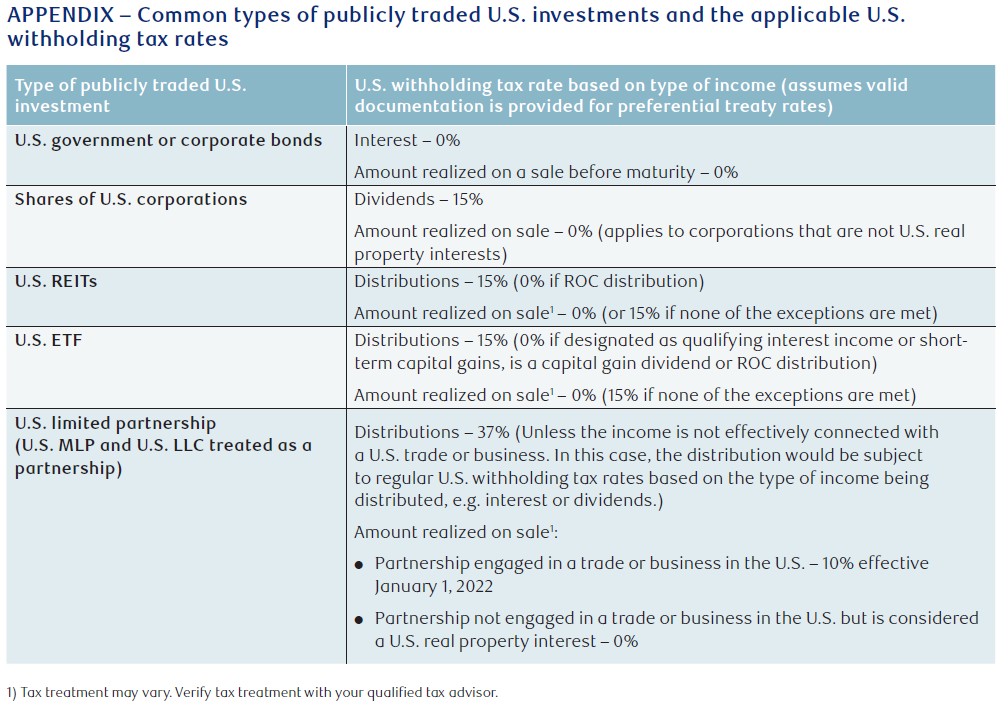
Under U.S. domestic tax laws, there's a general exemption from U.S. withholding tax on "portfolio interest" earned from your U.S. investments. Generally, any interest from U.S. federal and corporate debt obligations (e.g. U.S. government or corporate bonds) issued after July 18, 1984, qualifies. Tax-exempt interest also includes interest from U.S. state and municipal bonds. Another provision exempts interest on bank or savings institution deposits in the U.S. and interest on amounts held by an insurance company.
If the U.S. interest income does not qualify for exemption under U.S. tax law, the Treaty provides relief with an exemption from U.S. withholding tax on most other types of U.S. interest income for a tax resident of Canada. Where interest does not qualify for exemption under domestic law or for an exemption under the Treaty, the Treaty generally reduces the amount of U.S. withholding tax to 15% if received by a resident of Canada.
If you earn interest on U.S. currency held in a bank or brokerage account located in Canada, you are generally not subject to U.S. tax.
For Canadian tax purposes, as a resident of Canada, you are subject to taxation on your worldwide income; therefore, interest income earned from U.S. sources is taxable at your Canadian marginal tax rates.
U.S. dividend income
Under the Treaty, a reduced U.S. withholding tax rate of 15% generally applies to dividend income received from U.S. corporations.
U.S. corporations are corporations that are incorporated in the U.S. This does not include Canadian public corporations that trade on a U.S. stock exchange. For example, although RBC also trades on the New York Stock Exchange in U.S. dollars, it's a Canadian corporation and the dividends paid are not subject to U.S. withholding tax.
You are taxable in Canada on the gross amount of U.S. dividends received at your marginal tax rate. U.S. dividends do not qualify for preferential Canadian dividend tax rates that apply to taxable Canadian dividends.
Return of capital (ROC)
For U.S. tax purposes, ROC is not subject to U.S. taxation. However, for Canadian tax purposes, ROC from a U.S. investment is generally treated as foreign income, unless under Canadian corporate law it qualifies as ROC. Therefore, generally you will be subject to Canadian tax on ROC distributions at your Canadian marginal tax rate.
Capital gains and losses on the sale of U.S. securities
Capital gains and losses realized on the sale of U.S. portfolio investments, such as the sale of shares of a U.S. corporation, are generally not subject to U.S. taxation. However, this rule does not apply to the sale or transfer of investments that are considered effectively connected with a trade or business in the U.S. In addition, gains and losses from the sale or transfer of U.S. real property interests are taxed as if you are engaged in a trade or business in the U.S.
In these cases, special rules apply. This is a consideration if your investment portfolio includes U.S. real estate investment trusts (REITs), U.S. ETFs or U.S. publicly traded limited partnerships. The rules on the sale or disposition of these types of investments are discussed in greater detail in their related sections that follow.
You are taxable in Canada on capital gains and losses that result from the sale of shares of a U.S. corporation or other U.S. investments. As with other capital gains and losses, 50% of the capital gains or losses are subject to Canadian tax at your marginal tax rate.
U.S. REITs
A U.S. REIT is a type of U.S. corporation that owns (and may also operate) or finances income-producing real estate. Many U.S. REITs are publicly traded on a stock exchange. U.S. REITs pay dividends which can be allocated as ordinary income, capital gain distributions and ROC distributions.
Ordinary income
Where the U.S. REIT distributes ordinary income, a 15% U.S. withholding tax rate applies under the Treaty if any one of the following conditions apply:
- You hold an interest of not more than 10% of the REIT
- The dividends are paid with respect to a class of stock that's publicly traded and you hold an interest of not more than 5% in any class of the REIT's stock
- You hold not more than 10% of the REIT and the REIT is diversified (i.e. no property of the REIT is worth more than 10% of the REIT's real estate holdings)
Therefore, if you own 10% or less of a REIT, the 15% withholding tax will apply to distributions of ordinary income from the REIT. Where you do not fall into any one of the situations just mentioned, you will be subject to U.S. withholding tax at 30% on distributions of ordinary income.
Capital gain distributions
Where a publicly traded U.S. REIT pays capital gain distributions, a 15% U.S. withholding tax rate applies if you do not own more than 10% of the REIT at any time during the 1-year period ending on the date you receive the distribution. In other cases, the U.S. withholding tax rate on capital gain distributions from a REIT will be equal to the highest U.S. federal corporate tax rate.
ROC distributions
ROC distributions that do not exceed your cost basis in the REIT stock are not subject to U.S. taxation. However, where the distribution exceeds your basis, U.S. taxation may apply and the treatment is similar to the taxation on a sale of a U.S. REIT.
Sale of a U.S. REIT
As mentioned in the section, "Capital gains and losses on the sale of U.S. securities," the sale or transfer of a U.S. real property interest may be subject to special rules. An interest in a REIT would generally be a U.S. real property interest. However, there is an exception for publicly traded REITs. If, at any time during the calendar year, any class of stock of a U.S. REIT is regularly traded on an established securities market, an interest in the REIT will not be treated as a U.S. real property interest if:
- You did not own more than 10% of the total fair market value (FMV) of that class of interests at any time during the shorter of the following: the period during which your interest was held or the 5-year period ending on the date of disposition.
There is also an exemption from U.S. withholding tax and U.S. tax return filing requirements on the sale of your REIT units if the REIT is a domestically controlled REIT. A REIT is domestically controlled if at all times during the shorter of the 5-year period ending on the date of disposition or the period during which the REIT was in existence, less than 50% of the value of its stock was held, directly or indirectly, by foreign persons.
If none of these exemptions apply, you will be subject to 15% U.S. withholding tax on the total amount realized on the disposition of your REIT units. In addition, you will be required to file a U.S. non-resident income tax return. To the extent the gain is treated as a long-term capital gain, you may be subject to U.S. long-term capital gains tax rates; otherwise, the gain is treated as ordinary income subject to graduated U.S. tax rates.
U.S. REITs held in Canadian registered retirement plans
If you hold a U.S. REIT in a Canadian registered retirement plan, there's generally no U.S. withholding tax on distributions of ordinary income and capital gains received in these accounts. (For more information, refer to the earlier section, "U.S. withholding tax exemption on interest and dividends earned in certain registered accounts".) As noted previously, this U.S. withholding tax exemption does not apply to all Canadian registered accounts (i.e. RESPs, TFSAs and RDSPs). For U.S. tax purposes, RESPs, TFSAs and RDSPs are not Canadian registered retirement plans and will be treated the same as a non-registered account.
U.S. withholding tax should not apply to any gain realized on the sale of your REIT units within these registered retirement plans, provided one of the exceptions previously discussed are met (i.e. the publicly traded exception or the domestically controlled exception). If none of the exceptions apply, you will be subject to U.S. withholding tax and technically, under U.S. domestic tax laws, a U.S. tax return would need to be filed. However, it is uncertain, because of the Treaty, whether a U.S. return would need to be filed where the REIT is held in a registered retirement plan. Therefore, you should speak to a qualified cross-border tax advisor about your U.S. filing obligation.
Canadian taxation in non-registered accounts
The gross amount of distributions, including capital gain distributions and ROC distributions, received from U.S. REITs will be taxable as foreign income on your Canadian tax return and is subject to tax at your marginal tax rate. Capital gain distributions are not eligible for the 50% capital gain inclusion rate. However, any capital gain or loss that results on the disposition of your U.S. REIT shares or units is eligible for the 50% inclusion rate in determining your taxable income.
U.S. ETFs
U.S. ETFs are investment companies registered with the Securities and Exchange Commission (SEC) and that trade on a U.S. stock exchange. They invest in stocks, bonds and other assets or some combination of these investments (this does not include exchange-traded commodity funds or exchange-traded notes, which are beyond the scope of this article). For U.S. tax purposes, they generally qualify as regulated investment corporations (RICs), which means they flow through their income, in the form of distributions, to investors rather than being subject to corporate tax. ETFs may pay the following types of distributions to investors:
- Qualified dividend income
- Ordinary income (may include qualifying interest income and short-term capital gains)
- Capital gain dividends (long-term capital gains — investments held by the RIC for more than 12 months)
- ROC
Distributions from U.S. ETFs are generally subject to a 15% withholding tax rate, unless the distribution is a capital gain dividend or ROC. Capital gain dividends and ROC distributions from U.S. ETFs are not subject to U.S. withholding tax. In addition, any portion of a distribution that the ETF designates in writing as qualifying interest income or short-term capital gains is also exempt from U.S. withholding tax. However, the exemption on qualifying interest income or short-term capital gains will not apply to you if you're present in the U.S. for 183 days or more during the tax year.
Sale of a U.S. ETF
As mentioned in the section, "Capital gains and losses on the sale of U.S. securities," the sale or transfer of a U.S. real property interest may be subject to special rules. An interest in a U.S. ETF may or may not be considered a U.S. real property interest. Where an ETF is considered a U.S. real property interest, there is an exception for publicly traded ETFs. This exception applies if you did not own more than 5% of the total FMV of that class of stock of the ETF at any time during the shorter of the following: the period you held the ETF or the 5-year period ending on the date of disposition.
As with U.S. REITs, there's also an exemption from U.S. withholding tax and the requirement to file a U.S. tax return on the sale of your ETF units if the ETF is domestically controlled. An ETF is domestically controlled if at all times during the shorter of the 5-year period ending on the date of disposition or the period during which the EFT was in existence, less than 50% of the value of its stock was held, directly or indirectly, by foreign persons.
If you don't fall within these exemptions and your ETF is considered a U.S. real property interest, you will be subject to 15% U.S. withholding tax on the total amount realized on the disposition of your ETF. In addition, you will be required to file a U.S. non-resident income tax return. To the extent the gain is treated as a long-term capital gain, you may be subject to U.S. long-term capital gains tax rates; otherwise, the gain is treated as ordinary income and is generally subject to graduated U.S. tax rates.
U.S. ETFs held in Canadian registered retirement plans
If you hold a U.S. ETF in a Canadian registered retirement plan, there's generally an exemption from U.S. withholding tax on distributions of income received from the ETF. (For more information, refer to the earlier section, "U.S. withholding tax exemption on interest and dividends earned in certain registered accounts".) As noted previously, this U.S. withholding tax exemption does not apply to all Canadian registered accounts (i.e. RESPs, TFSAs and RDSPs). For U.S. tax purposes, RESPs, TFSAs and RDSPs are not Canadian registered retirement plans and will be treated the same as a non-registered account.
It's important to note, however, that although U.S. withholding tax may not apply to distributions of income from the U.S. ETF, if you invest in a U.S. ETF that earns investment income from sources outside the U.S., the ETF may incur withholding tax in those foreign countries. This may result in two levels of tax; first, the ETF pays withholding tax in the foreign country, and then you pay Canadian tax when you withdraw funds from the registered retirement plan. You need to consider this when investing in a U.S. ETF that invests globally.
In addition, U.S. withholding tax should not apply to any gain realized on the sale of your ETFs within these registered retirement plans, provided they're not U.S. real property interests. If your ETF is a U.S. real property interest and you don't meet the exceptions previously discussed (i.e. the publicly traded exception or the domestically controlled exception), you will be subject to U.S. withholding tax that cannot be recovered. This may result in double tax where withdrawals from your registered retirement plans are also subject to Canadian tax. Technically, under U.S. domestic tax laws, a U.S. tax return would need to be filed. However, it is uncertain, because of the Treaty, whether a U.S. return would need to be filed where the ETF is held in a registered retirement plan. Therefore, you should speak to a qualified cross-border tax advisor about your U.S. filing obligation.
Canadian taxation in non-registered accounts
For Canadian tax purposes, all U.S. ETF distributions (including capital gain distributions and ROC distributions) are considered fully taxable foreign income, and the gross amount of distributions will be subject to tax at your marginal tax rate. If you dispose of a U.S. ETF held as capital property, 50% of any resulting gain or loss will be included in your taxable income and taxed at your marginal tax rate.
If you invest in a U.S. ETF that earns investment income from sources outside the U.S., the ETF may incur withholding tax in those foreign countries. This may result in two levels of tax, first in the foreign country and then U.S. withholding tax. Generally, you will not be able to claim a foreign tax credit for the foreign withholding tax paid by the U.S. ETF. If you want exposure to foreign markets outside of the U.S. and Canada, it may be better, purely from a tax efficiency perspective, to invest in an ETF listed on a Canadian stock exchange that invests in global markets. This way, you may be able to claim a foreign tax credit for any foreign withholding tax incurred by the Canadian ETF that you hold in a non-registered account.
U.S. publicly traded limited partnerships
A U.S. publicly traded limited partnership is generally a partnership that regularly trades on an established U.S. stock exchange or secondary market. For U.S. tax purposes, they are generally taxed as corporations unless they meet certain conditions. If the partnership is taxed as a corporation, any distributions will be dividends and treated as discussed in the section on U.S. dividend income. However, if 90% or more of the partnership's gross income is certain types of qualifying income (some examples are interest, dividends, real property rents, and any gain from the sales and disposition of real property), the partnership is generally treated as a partnership and is not subject to U.S. corporate income tax.
Publicly traded limited partnerships that are treated as partnerships for tax purposes are generally master limited partnerships (MLPs), but they may also be a publicly traded limited liability company (LLC) that has chosen to be taxed as a partnership. It's important to read the prospectus or offering document to determine the type of entity you're investing in and to understand your tax consequences.
The remainder of this section discusses U.S. publicly traded limited partnerships that are treated as a partnership for U.S. tax purposes, including an LLC that has chosen to be taxed as a partnership. As mentioned before, such partnerships are not subject to corporate tax. Instead, they flow their income, expenses, credits, etc. out to each partner who would be personally taxed on the income of the partnership. This information is provided to you on a Schedule K-1 (IRS Form 1065). Generally, if the partnership has income that's effectively connected with a U.S. trade or business, you are required to file a U.S. non-resident income tax return and pay U.S. tax on such income at graduated tax rates.
In addition, the partnership income distributed to you that's effectively connected with a U.S. trade or business is generally subject to U.S. withholding tax equal to the top U.S. marginal tax rate. Income distributed to you that's not effectively connected with a U.S. trade or business would be subject to regular U.S. withholding tax rates based on the type of U.S. income. However, at the time a distribution is made, it's often not known whether or not the income is effectively connected with a U.S. trade or business; therefore, the withholding may be at the highest U.S. marginal tax rate. You may generally recover any excess U.S. withholding tax when you file a U.S. non-resident income tax return.
Sale of a publicly traded limited partnership
The tax treatment of the sale or disposition of a publicly traded limited partnership is very complex. As discussed previously, capital gains and losses realized on the sale of U.S. portfolio investments are generally not subject to U.S. taxation, unless that investment is a U.S. real property interest or is property that's effectively connected with a trade or business in the U.S.
Effectively connected with a trade or business in the U.S.
If the partnership is engaged in a trade or business in the U.S., all or a portion of the gain on the sale or disposition of your interest may be treated as effectively connected with a U.S. trade or business. The amount of effectively connected gain or loss is determined by reference to the amount of effectively connected gain or loss that you would have been allocated had the partnership sold all of its assets at FMV as of the date of the sale or exchange of your partnership interest. The calculation of your effectively connected gain or loss can be extremely complicated and may require the assistance of a qualified tax advisor.
In addition, starting on January 1, 2022, a withholding tax equal to 10% of the total amount realized on your sale or transfer will generally be required.
If you sell or transfer an interest in a partnership that's engaged in a trade or business in the U.S. and the partnership owns one or more U.S. real property interests, you would determine your effectively connected gain and effectively connected loss under these rules and not under the rules related to disposing of a U.S. real property interest.
U.S. real property interest
Where the partnership is not engaged in a trade or business in the U.S., it is still possible for your interest to be considered a U.S. real property interest if it meets certain conditions. A discussion of when a publicly traded partnership would be considered a U.S. real property interest is beyond the scope of this article; it generally would require the partnership to hold at least 50% of the FMV of their real property interests in U.S. real property interests.
Where a publicly traded limited partnership would otherwise be considered a U.S. real property interest, it will not be treated as a U.S. real property interest if you did not own more than 5% of the total FMV of that class of interests at any time during the 5-year period ending on the date of disposition. If you do not meet this exception, you may be required to file a U.S. income tax return and pay tax on the gain realized on the sale of your partnership interest. However, there is no U.S. withholding tax requirement on the disposition in this case.
U.S. tax obligations
If the publicly traded partnership is engaged in a trade or business in the U.S. or is treated as a U.S. real property interest, you will have U.S. tax obligations when you dispose of the investment. To the extent there is a long-term capital gain, you may be subject to U.S. long-term capital gains tax rates; otherwise, the income and gains are treated as ordinary income and are subject to graduated U.S. tax rates.
You will be required to file a U.S. income tax return and can apply the tax withheld on the sale, if any, to reduce your final U.S. tax liability. You may also have to file U.S. state tax returns and pay tax to a state where the partnership carried on its trade or business.
If the gain or a portion of the gain is not considered a U.S. real property interest and is not otherwise income effectively connected with a U.S. trade or business, there is no U.S. tax on the gain or withholding tax.
U.S. publicly traded limited partnership held in Canadian registered retirement plans
Investing in U.S. publicly traded limited partnerships through Canadian registered accounts is not recommended. Even if you hold this type of investment in a Canadian registered retirement plan, you are generally not exempt from U.S. withholding tax discussed earlier, and technically, under U.S. domestic tax laws, a U.S. tax return would need to be filed. However, it is uncertain, because of the Treaty, whether a U.S. return would need to be filed where the U.S. publicly traded limited partnership is held in a registered retirement plan. (As a reminder, for U.S. tax purposes, RESPs, TFSAs and RDSPs are not Canadian registered retirement plans and will be treated the same as a non-registered account.) Therefore, you should speak to a qualified cross-border tax advisor about your U.S. filing obligation. In addition, you will not be able to claim a foreign tax credit for the withholding tax paid or the U.S. tax paid on filing a U.S. non-resident tax return, if required. This generally results in double taxation.
Canadian taxation in non-registered accounts
For Canadian tax purposes, a publicly traded limited partnership is treated differently if it's an MLP versus an LLC that's treated as a partnership for U.S. tax purposes.
You must report your partnership income from an MLP on your Canadian tax return. The calculation of partnership income should be based on Canadian tax rules; however, unless the partnership publishes specific information for Canadian investors, it may be difficult to obtain adequate information to properly file a Canadian tax return. The information provided on the Schedule K-1 is calculated using U.S. tax rules and generally lacks sufficient detail to allow you to convert the information using Canadian tax rules. As a result, holding a U.S. publicly traded limited partnership will typically increase the complexity and cost of your tax reporting, both in Canada and the U.S. You can generally claim a foreign tax credit for U.S. taxes paid to reduce or eliminate double tax.
Publicly traded LLCs, that are partnerships for U.S. tax purposes, are generally treated as a corporation for Canadian tax purposes, regardless of the U.S. tax treatment. This means you are generally not taxable in Canada unless you receive a distribution from the LLC or dispose of the shares.
The different tax treatment of an LLC in the U.S. versus Canada may result in double tax. For example, you may be subject to U.S. tax in the year income is earned; however, you may not be subject to Canadian tax until the income is paid out from the LLC. If this payout occurs in a subsequent year, the U.S. tax paid in a previous year might not be creditable against your Canadian tax. Even if the reporting for U.S. and Canadian tax purposes occurs in the same year, the amount of the U.S. tax that can be claimed as a foreign tax credit on your Canadian return is generally limited to 15% of the U.S. income reported on your Canadian return. This amount may be lower than the actual U.S. tax paid. Although you may be able to claim a deduction on your Canadian return for any excess U.S. tax paid, this may not result in you fully recouping the U.S. tax. So, the overall income tax you pay may end up being greater than it would have been if you invested in a partnership that is not an LLC.
Before investing in U.S. publicly traded limited partnerships, you should consider the U.S. and Canadian tax impact, as well as the costs associated with filing a U.S. non-resident income tax return. You should consult with your qualified tax advisor.
American depository receipts (ADRs)
ADRs, also known as ADSs — American depository shares, or GDRs — global depository receipts, are negotiable certificates issued by a U.S. commercial bank. These certificates represent ownership in a stated number of underlying non-U.S. equity securities. ADRs are registered with the U.S. SEC, are quoted in U.S. dollars and income is paid in U.S. dollars by the depository. However, the income from these investments is not U.S. source income and is not subject to U.S. tax reporting or withholding tax. Tax withholding on ADRs is based on the country of residence of the issuer of the underlying security. For information on the taxation of income from ADRs, ask your RBC advisor for the article on this topic.
Corporate actions
Certain corporate actions (e.g. takeovers, mergers, spin-offs) involving U.S. corporations are sometimes considered taxable in Canada even though they may not be taxable in the U.S. Every corporate action is unique and must be reviewed in order to understand the U.S. and Canadian tax consequences that apply to you. You should seek advice from a qualified tax advisor regarding the tax treatment of these corporate actions both in the U.S. and Canada.
Converting U.S. dollar income, gains and losses to Canadian dollars for tax reporting
Under Canadian tax rules, you generally need to report all income, capital gains and losses in Canadian dollars on your income tax return. As a general rule, you would typically use the foreign exchange rate on the date of each transaction to convert from U.S. dollars to Canadian dollars. For the disposition of securities and calculating your capital gain or loss, you would typically convert the proceeds of disposition using the foreign exchange rate on the sale date and use the foreign exchange rate on the purchase date to determine your adjusted cost base. The rules regarding foreign currency translations for tax reporting purposes are discussed in much greater detail in a separate article that you can obtain from your RBC advisor.
Canadian information reporting of foreign property
If the total cumulative cost amount of certain foreign property you hold exceeds C$100,000 at any time during the year, you may be required to disclose information about the foreign property to the Canada Revenue Agency by filing Form T1135 – Foreign Income Verification Statement. Even where you hold your U.S. or other foreign securities in a Canadian non-registered investment account, these securities will be considered foreign property for this purpose. For more information, please ask your RBC advisor for the article on this topic.
Conclusion
When determining the merits of investing in the U.S., there are many factors to consider in addition to the investment merits and the effect of fluctuations in currency exchange rates. To determine the overall after-tax return, you need to consider the Canadian and U.S. tax implications including the ability to claim foreign tax credits to minimize or eliminate double tax, as well as whether a U.S. tax return or other reporting is required and the related cost. It's very important to review the prospectus or other offering document before investing so that you understand the investment and their tax consequences on both sides of the border.
Speak with your RBC advisor and your qualified tax advisor for assistance in evaluating a particular investment before investing.
This article may contain strategies, not all of which will apply to your particular financial circumstances. The information in this article is not intended to provide legal, tax or insurance advice. To ensure that your own circumstances have been properly considered and that action is taken based on the latest information available, you should obtain professional advice from a qualified tax, legal and/or insurance advisor before acting on any of the information in this article.
If you would like to schedule some time to discuss the items outlined in this article, please click here to access our meeting scheduler.
If you would like to schedule some time to discuss the items outlined in this article, please click here to access our meeting scheduler.