Decision tree for addressing surplus cash in a corporation
As a business owner, you most likely rely on the income generated by your corporation's business to fund your lifestyle. You may also hope that your business accumulates sufficient capital to meet your income needs in retirement. In the meantime, what should you do with any surplus cash accumulating in your corporation? This article introduces some options you can consider if you have surplus cash in your corporation and provides a decision tree to help you address your personal and corporate needs.
As a business owner, you most likely rely on the income generated by your corporation's business to fund your lifestyle. You may also hope that your business accumulates sufficient capital to meet your income needs in retirement. In the meantime, what should you do with any surplus cash accumulating in your corporation? This article introduces some options you can consider if you have surplus cash in your corporation and provides a decision tree to help you address your personal and corporate needs.

Family Office Services
January 14, 2026
Decision tree for addressing surplus cash in a corporation
As a business owner, you most likely rely on the income generated by your corporation's business to fund your lifestyle. You may also hope that your business accumulates sufficient capital to meet your income needs in retirement. In the meantime, what should you do with any surplus cash accumulating in your corporation? Is there a business need for the cash? If so, could you invest the funds within the corporation? Or do you need the funds personally and want to withdraw them from your corporation? Are there tax-efficient ways to withdraw funds out of your corporation?
This article introduces some options you can consider if you have surplus cash in your corporation and provides a decision tree to help you address your personal and corporate needs.
The terms "corporation" and "company" are used interchangeably to refer to a Canadian-controlled private corporation (CCPC) in this article. In simple terms, a CCPC is a Canadian corporation that's not controlled by a non-resident of Canada or a public corporation or a combination of both. In addition, no class of shares of the CCPC can be listed on a prescribed stock exchange. This article doesn't apply to public corporations or to businesses operating as a partnership or a sole proprietorship.
The decisions
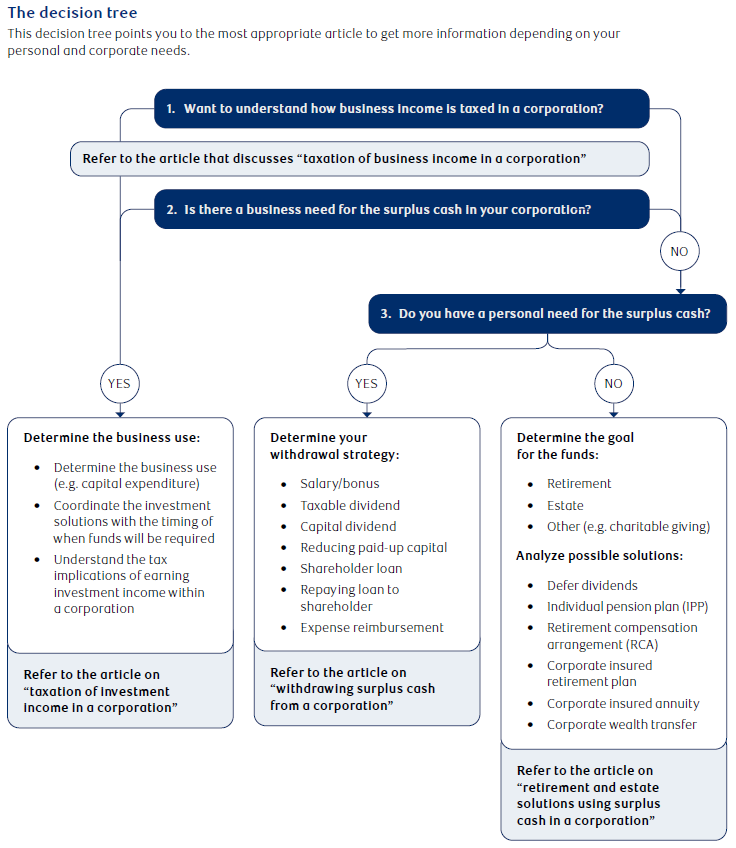
As a starting point, you may want to be familiar with the rules governing the taxation of business income inside your corporation. Understanding how business income is taxed will provide you with insight for making informed decisions about what to do with any surplus cash in your corporation. For more information, please ask your RBC advisor for an article discussing the taxation of business income in a corporation. This article provides an overview of the benefits of operating a business inside a corporate structure, describes the various facets of business income and explains how business income is taxed in a corporation.
Once the business income has been taxed in your corporation, you need to determine if there's a business need for any surplus after-tax cash. For example, does your corporation need the cash to pay income tax instalments or to make a major capital expenditure? If there's no immediate business need, you might want to consider investing the excess funds within your corporation in order maximize the value of your surplus cash in the meantime. However, keep in mind that if you need the funds in the short- or medium-term, you'll want to ensure the investments you make can be easily liquidated when the time comes. For more information, please ask your RBC advisor for an article discussing the taxation of investment income in a corporation.
If there's no business need for the excess cash within your corporation, consider whether you have a personal need for the funds, such as paying down personal debt or funding lifestyle expenses. If you decide you have a personal need for the surplus cash in your corporation, the next step is to determine the best way to withdraw the money, paying special attention to the tax consequences. For more information, please ask your RBC advisor for an article discussing withdrawing surplus cash from a corporation. This article discusses various methods of withdrawing cash from your corporation as well as the consequential tax issues and incentives that might apply with each method.
Lastly, if you don't have a short- or medium-term business or personal need for the cash, you may want to consider your long-term objectives, whether they involve boosting your retirement savings or enhancing the value of your estate. For more information, please ask your RBC advisor for an article discussing the use of surplus in a corporation for potential solutions for retirement and your estate.
This article may contain strategies, not all of which will apply to your particular financial circumstances. The information in this article is not intended to provide legal, tax or insurance advice. To ensure that your own circumstances have been properly considered and that action is taken based on the latest information available, you should obtain professional advice from a qualified tax, legal and/or insurance advisor before acting on any of the information in this article.
If you would like to schedule some time to discuss the items outlined in this article, please click here to access our meeting scheduler.