Financial and legal considerations on relationship breakdown
If you find yourself going through a relationship breakdown, coping with the emotional aspects is just one step in a complicated process. This article reviews the legal, financial and family issues you need to consider whether you're contemplating a separation or in the final stages of a divorce.
If you find yourself going through a relationship breakdown, coping with the emotional aspects is just one step in a complicated process. This article reviews the legal, financial and family issues you need to consider whether you're contemplating a separation or in the final stages of a divorce.

Family Office Services
April 14, 2024
Financial and legal considerations on relationship breakdown
If you find yourself going through a relationship breakdown, coping with the emotional aspects is just one step in a complicated process. There are many legal, financial and family issues that need to be addressed regardless of whether you're married, in a civil union or domestic partnership, or in a common-law relationship. Managing your finances can be challenging even at the best of times. However, it's often the decisions you make, or don't make, during transitional periods in your life that have the most impact on your overall financial picture. This article reviews the issues you need to consider whether you're currently contemplating a separation from your spouse, or you're in the final stages of a divorce. Even if you remain with your spouse, or reconcile at a later date, it's a good idea to know where you're at and where you're going financially. Any reference to a spouse in this article also includes a common-law partner.
Getting organized
The first step you should take, regardless of what stage in the relationship breakdown you may be in, is to organize your financial affairs. This involves finding out exactly what assets you and your spouse own and what liabilities the two of you may have. By knowing the financial positions of both you and your spouse, you can gain some insight into your net worth, should you formally end your relationship. This can also help protect you from the possibility of your spouse disposing of assets without your knowledge, or simply not disclosing them to you.
In addition, you'll need to provide information to the professional advisors who are helping you get your financial life back on track. Some examples of documents you should gather include:
• Will and Power of Attorney documents
• Marriage contracts/domestic agreements
• Home ownership documents, including title deed and mortgage statement
• Current bank and investment account statements
• Tax returns for the past three to five years or longer, if possible
• Business financial statements and tax returns
• Shareholder/partnership agreements
• Company pension and/or employee compensation statements
• Registered account statements
• CPP/QPP information statements
• Current statements of all outstanding debts, including credit card statements
• Trust deeds and any associated loan documents
• All insurance policies (such as home, auto and life)
Figure out your sources of income
Except in the most amicable cases, separation or divorce proceedings can often carry on for an unknown length of time, which can result in a period of financial uncertainty. During this period, you will need to know what sources of income you'll receive to support yourself and any dependants.
Sources of income can include employment income, interim spousal and/or child support, income from your investments and income from registered plans, such as your registered retirement savings plan (RRSP) or registered retirement income fund (RRIF).
Establish your own credit
It's important to establish your own credit record so that you'll have the ability to get credit if needed. If you've never had a credit card in your own name, consider applying for one. You may want to do this even before deciding whether to separate. Once you've established your own credit, you should think about when you should close all joint credit card accounts.
You should also contemplate getting a line of credit in case you have a temporary need for cash while your financial affairs are being settled. The interest charges associated with a line of credit are generally much lower than credit card rates. In addition, you should notify all other known creditors (such as your mortgage representative or bank loan officer) of your change in status. If possible, make sure your spouse can't further bind you to any new debt.
Open your own bank account
If you do not have a bank account in your own name, you may want to open one. Once you have your own bank account, consider closing any joint bank accounts shared with your spouse. If any joint accounts need to remain open, ask that both signatures be required before any transactions are made. You should also think about revoking any Powers of Attorney/Protection Mandate in Quebec that you've given authority in favour of your spouse.
Notify your investment professionals of your status
If you hold any investment accounts in joint names with your spouse, make sure you notify your investment professionals of your relationship status. You may want to rescind any trading authorization granted to your spouse.
Finding the professional help you need
You should seek professional assistance to guide you through the separation and divorce process. Qualified professionals such as lawyers, accountants and financial advisors can help you address the various legal and financial issues that arise during a relationship breakdown. If you're unsure where to get the professional assistance you need, your RBC advisor can refer you to qualified professionals. If you already work with professional advisors like lawyers and accountants, your RBC advisor can work with them to ensure all aspects are considered in helping you stay on track financially.
A lawyer
There are many legal issues that must be sorted out on a relationship breakdown. To help you through this process, it's important to seek the assistance of a qualified family lawyer. Your lawyer can advise you in deciding how best to resolve the outstanding matters between you and your spouse. There are ways to resolve disputes with your spouse outside of the court system that you may wish to consider. These include mediation, collaborative processes, arbitration and negotiation.
Even if you and your spouse are able to agree on issues related to property division, support and child custody, it's still worthwhile to consult a family lawyer to ensure you're fully aware of your rights and responsibilities.
You may also want to speak to a lawyer regarding updating your estate planning documents, such as your Will and Power of Attorney/Protection Mandate.
Support payments
If you're married (or for most provinces and territories if you're in a common-law relationship) you may be entitled to receive spousal support from your former spouse. The amount and duration of any spousal support awarded will generally depend on the needs, means and other circumstances of each spouse. Spousal support advisory guidelines may also be utilized to help in determining the appropriate amount of spousal support to be paid. Spousal support can be awarded on an interim, lump sum or fixed-term basis. It can also be varied if there is a change in circumstances.
Federal, provincial and territorial family law legislation includes support guidelines that set out the amount of child support to be awarded. This amount is generally fixed according to the annual income of the person providing the support, as well as the number of children involved. The guidelines may not apply in cases where a child is over the provincial age of majority or the person providing support earns in excess of a certain amount of income. In addition, there may be other special circumstances where the guideline table amount is varied with consideration given to other special expenses.
For a more detailed discussion of the taxation of support payments, ask your RBC advisor for an article on this topic.
Parenting arrangements for children
A lawyer will help you negotiate the terms and conditions around custody and access to your children, if you have any. Custody and access matters are generally resolved by considering the best interests of the children, taking into account their physical, emotional, intellectual and moral well-being.
Division of family property
Married and civil union spouses are generally entitled to an equal division of property accumulated during the marriage, subject to certain exceptions. For example, gifts or inheritances received during the marriage may be excluded from the division of property. In some provinces and territories, common-law spouses are also entitled to a division of property. A lawyer will be able to help you understand and determine what kind of property is subject to division, how the property is valued and how the sharing of property will be achieved.
An accountant
You should consider seeking out an accountant to help you work through the various tax implications associated with separation and divorce. An accountant may also be able to help you determine the current value of your or your spouse's pension plan or the fair market value of any jointly owned business. In addition, an accountant can help you prepare long-term personal financial projections that can be used by your lawyer in settlement negotiations or to determine the viability of any proposed settlement option.
As you would a lawyer, choose a qualified accountant who's experienced in family law matters and who you feel comfortable with.
For a more detailed discussion of the tax considerations during a relationship breakdown, ask your RBC advisor for an article on this topic.
A financial advisor
In addition to a lawyer and accountant, you should also seek the assistance of a qualified financial advisor. By knowing the details of your personal financial situation and understanding your goals and objectives, this person will be able to work closely with your chosen lawyer and accountant to achieve a financially equitable settlement that's right for you.
You may wish to explore the possibility of creating a financial plan with your RBC advisor. A financial plan will address questions such as: Can you afford to keep the house? Do you have enough money to retire? What kind of lifestyle can you afford?
The following are some of the other services your RBC advisor can help you with:
• Analyzing your cash flow
• Determining your interim and long-term needs
• Estimating the education costs for your children
• Facilitating the transfer of investment or retirement assets from your former spouse
• In conjunction with other professional advisors, your RBC advisor can assist with the preparation of your net-worth statement and budget
Determine your net worth
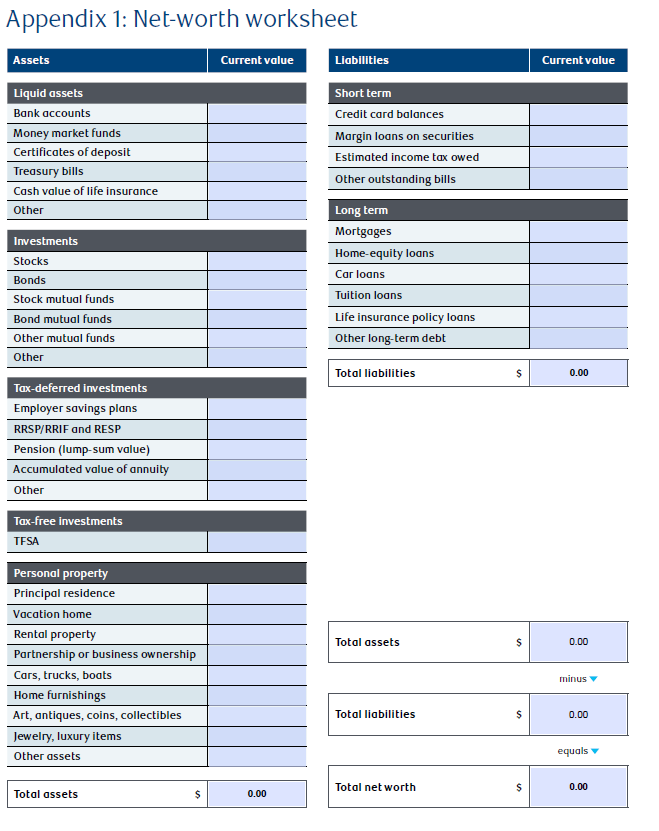
Your RBC advisor will be able to help you determine and update your net-worth statement periodically over the course of the divorce. A sample net-worth worksheet (Appendix I) is enclosed to help you determine your current net worth. You can get an idea of what you have to work with by subtracting your total liabilities from your total assets. Don't forget to include the value of a family business or any shared property, such as your home, in your calculation.
Set your goals and priorities
Once you've determined your net worth, you should set your financial goals and priorities, both for the immediate future and the long term. The immediate priorities would be to secure a sufficient cash flow, interim support payments or line of credit to cover necessary expenses and to maintain an adequate standard of living for yourself and your dependants until your financial matters have been resolved. Ensuring adequate insurance coverage is in place should also be a priority to protect your dependants in case of unexpected events.
Your long-term goals and priorities could also include retirement planning, provisions for dependants and developing an estate plan. These planning objectives would be made clearer once the separation is finalized and the division of property and support payments are confirmed.
Develop a budget
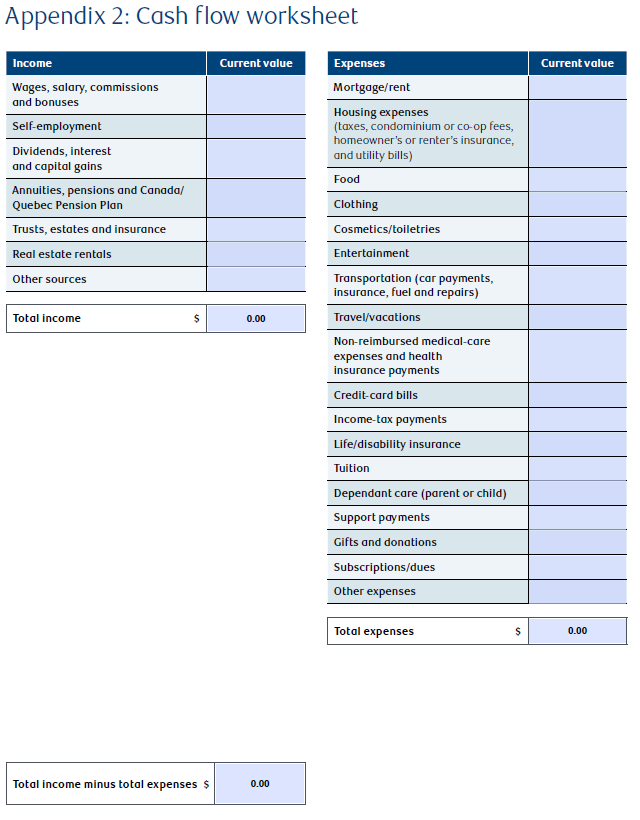
To achieve your goals and objectives, you may have to limit the amount of money you spend. Considering that many costs which were previously shared will now be your responsibility, your RBC advisor can help you develop a cash-flow analysis that details your income and expenses, as well as a personal budget that will help you determine what you can safely spend to achieve your goals and objectives.
You can use the sample cash-flow worksheet in Appendix II to help you get started on developing your own budget.
Investment solutions
Once you've figured out your net worth and established a budget, it's time to decide how to manage your assets. Depending on your situation, you may require professional assistance with your investments. A qualified investment professional can help you clarify your investment objectives and create a plan to achieve them.
Develop an investment plan
Your RBC advisor's first, and most important, job is to listen to you and understand your personal situation and investment needs. Based on this information, your RBC advisor can help you establish your investment objectives and create your investment plan. If you receive a settlement on your relationship breakdown, you may want to set aside the proceeds in safe, liquid investments until your investment plan is developed. If you've made a payment to your former spouse on your relationship breakdown, you may want to consider rebalancing your investment portfolio.
Once your investment plan has been agreed upon, your RBC advisor can recommend an appropriate blend of investments that can help turn your objectives into achievements. Your goal is to have a mix of investments that's suitable for your life stage and risk tolerance.
Helping you during times of transition
During times of transition in your life, such as separation and divorce, it's important you have all the support and guidance you need. There are many issues to consider during a relationship breakdown, and surrounding yourself with a team of qualified legal, tax and financial advisors can help you navigate through this difficult process. Taking the right steps to get your finances organized will go a long way in establishing your independence and help put you on the right path for future financial stability.
This article may contain strategies, not all of which will apply to your particular financial circumstances. The information in this article is not intended to provide legal, tax or insurance advice. To ensure that your own circumstances have been properly considered and that action is taken based on the latest information available, you should obtain professional advice from a qualified tax, legal and/or insurance advisor before acting on any of the information in this article.
If you would like to schedule some time to discuss the items outlined in this article, please click here to access our meeting scheduler.