Foreign currency tax reporting
Under Canadian tax rules, you need to report all income and capital gains or losses in Canadian dollars. When you're dealing with foreign currencies or securities denominated in foreign currencies, you may have foreign exchange gains or losses due to exchange rate fluctuations. This article provides an overview of how foreign exchange gains or losses are determined when you purchase or sell securities or convert cash into a different currency.
Under Canadian tax rules, you need to report all income and capital gains or losses in Canadian dollars. When you're dealing with foreign currencies or securities denominated in foreign currencies, you may have foreign exchange gains or losses due to exchange rate fluctuations. This article provides an overview of how foreign exchange gains or losses are determined when you purchase or sell securities or convert cash into a different currency.

Family Office Services
February 14, 2025
Foreign currency tax reporting
Under Canadian tax rules, you need to report all income and capital gains or losses in Canadian dollars. When you're dealing with foreign currencies or securities denominated in foreign currencies, you may have foreign exchange gains or losses due to exchange rate fluctuations. This article provides an overview of how foreign exchange gains or losses are determined when you purchase or sell securities or convert cash into a different currency.
Income versus capital
When you realize a gain or a loss on the disposition of property, you must determine whether the gain or loss is on account of income (business income or loss) or capital (capital gain or loss). A gain or loss on account of income is fully included in or deducted from your taxable income. Whereas a gain or loss on account of capital is only partially taxable or deductible.
A detailed discussion of how to characterize a foreign exchange transaction is beyond the scope of this article. Generally, you need to examine the character of the underlying transaction to make such a determination. For most investors, foreign exchange gains and losses will likely be capital in nature. However, it's a question of fact in each particular situation, therefore, you should speak to a qualified tax advisor to discuss the tax treatment that applies to you. This article focuses on foreign exchange gains or losses that are on account of capital.
What is a foreign currency gain or loss?
You may recognize a capital gain or loss at the time you dispose of capital property or settle a capital liability. If the transaction is taking place in a foreign currency, you may also realize a foreign exchange gain or loss. Here are some examples of transactions that may result in a foreign exchange gain or loss:
- You convert funds in a foreign currency into another foreign currency or into Canadian dollars;
- You use a foreign currency to make a purchase or a payment;
- You make a repayment of part or all of a capital debt obligation; and
- You sell a security denominated in a foreign currency.
What type of investments are impacted by currency fluctuations?
Publicly traded shares and Canadian mutual funds
If you own publicly traded shares or mutual funds that are denominated in a foreign currency, you may realize a foreign exchange gain or loss when you dispose of these investments. You must convert the adjusted cost base (ACB) and sale proceeds of the security into Canadian dollars to calculate your capital gain or loss. For Canadian tax purposes, the foreign exchange rate that was in effect on the date of the transaction (e.g. the settlement date of the purchase and the settlement date of the sale) should be used to calculate the capital gain or loss in Canadian dollars. The reporting of the capital gain or loss in Canadian dollars captures both the change in the fair market value (FMV) of the security, as well as the gain or loss due to currency fluctuations. You do not report these amounts separately.
Generally, the weighted-average cost method must be used to determine the ACB per share or unit of all identical property you hold in a non-registered account. If you purchase the same security on several different dates, you would use the foreign exchange rate on the settlement date of each of the purchases to calculate the ACB of each group of the security you purchased. You would then take the total ACB of all of the identical security you hold and divide by the number of shares or units of the identical security to arrive at the ACB per share or unit of the security.
Here are some examples of the gain or loss you may realize on the sale of a security:
Assume you purchase 100 shares of America Corp for US$115 with a settlement date of Jan. 2 in Year One. You sell the shares in Year Two with a settlement date of March 26 when they're trading at US$120 each. The capital gain in Canadian dollars is calculated as follows:
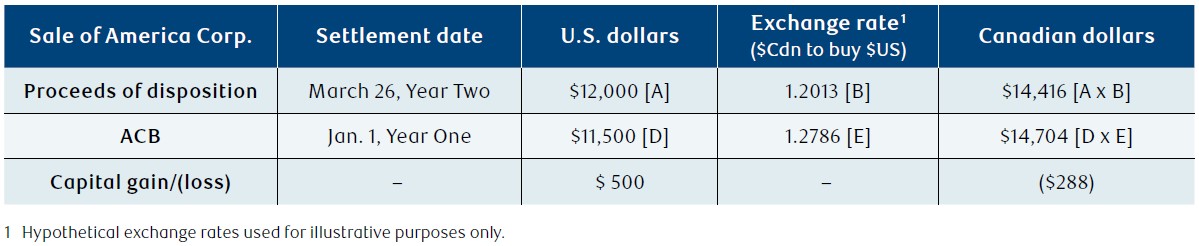
Notice that your gain denominated in U.S. dollars (i.e. US$500), which reflects the growth of the shares, can actually be a loss for Canadian tax purposes. The capital loss of C$288 is the amount you would report on your Canadian tax return. It would be incorrect to simply net the proceeds received in U.S. dollars with the U.S. dollar ACB and convert the gain of US$500 to Canadian dollars.
Due to fluctuations in the foreign exchange rates, it's possible to incur a capital gain or loss even if the FMV of the security hasn't changed. Let's assume you purchase a U.S. money market fund for US$11,500 on Jan. 1, Year One. You then redeem the fund on March 26, Year Two for US$11,500.
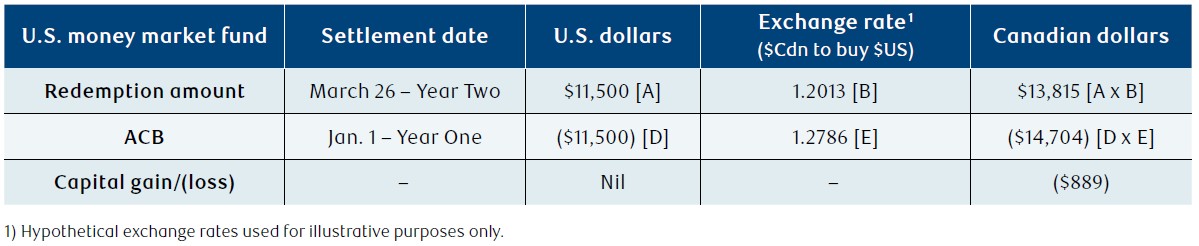
In this example, you realize a capital loss of C$889 even though the redemption amount and the ACB of the fund in U.S. dollars are the same. This capital loss can be attributed to the strength of the Canadian dollar in Year Two.
Income distributions from investments
You may hold securities that pay income in a foreign currency. You will generally need to convert this income to Canadian dollars using the foreign exchange rate on the date the income was received for the purposes of reporting this income on your Canadian tax return. If you're receiving income distributions throughout the year, the Canada Revenue Agency (CRA) has stated that it's acceptable to use the average exchange rate for the tax year, when reporting the income on your income tax return. It's important to note that using the average exchange rate is not acceptable for reporting capital gain/loss transactions.
Negotiable instruments
You may invest or have already invested in negotiable instruments such as notes, bonds, mortgages, debentures, government treasury bills and notes, and commercial paper. When these securities are denominated in a foreign currency, there may be a foreign exchange gain or loss at time of maturity or disposition of the security due to currency fluctuations. You may realize the gain or loss even if you keep the proceeds in the same currency or roll over the proceeds into similar securities. In addition to reporting the capital gain or loss, you must also report the income distributions you received during the year on your tax return. If this income is denominated in a foreign currency, you must convert this income to Canadian dollars using the foreign exchange rate on the date the income was received or the annual average exchange rate if you received income distributions throughout the year.
Here's an example:
Let's assume you purchase a 6% US$100,000 par value corporate bond with a settlement date of March 1 in Year One. Interest is paid semi-annually each March and September. On the purchase date, you paid C$117,130 to buy the bond. You sell the bond at a discount price of 0.98 before maturity, with a settlement date of Nov. 6 in Year Three.
The hypothetical Canada-U.S. currency conversion rates on the relevant days are as follows:
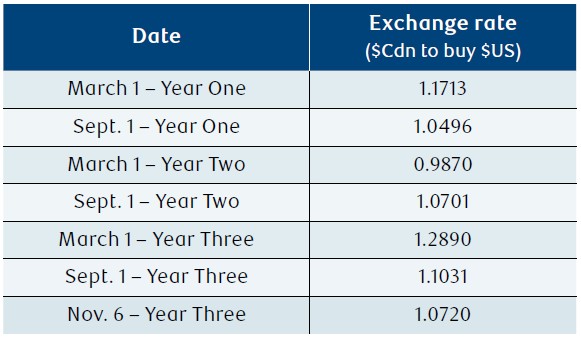
For non-compound interest paying investments, you report the interest you receive on your tax return for the year it's received. You would report the following for each year in this example:
In Year One, you would only receive one interest payment on Sept. 1. Year One income is calculated as follows:
US$100,000 x 6% ÷ 2 = US$3,000 x 1.0496 = C$3,148.80
In Year Two, you would receive the March 1 and Sept. 1 interest payments which need to be converted to Canadian dollars separately, calculated as follows:
March 1: US$100,000 x 6% ÷ 2 = US$3,000 x 0.9870 = C$2,961.00
Sept. 1: US$100,000 x 6% ÷ 2 = US$3,000 x 1.0701 = C$3,210.30
For Year Two, you would report total interest of C$6,171.30.
In Year Three, you would receive interest in March and September and interest from the buyer of the bond for the interest that had accrued from the last regular interest payment date to the date the bond was sold on Nov. 6. The calculation is as follows:
March 1: US$100,000 x 6% ÷ 2 = US$3,000 x 1.2890 = C$3,867.00
Sept. 1: US$100,000 x 6% ÷ 2 = US$3,000 x 1.1031 = C$3,309.30
Nov. 6: US$100,000 x 6% x (66 ÷ 365 days) = US$1,084.93 x 1.0720 = C$1,163.05
For Year Three, you would report the total interest of C$8,339.35.
In addition to the interest income that you must report, you may also realize a capital gain or loss on the sale of the bond, which could be impacted by foreign currency fluctuations. You would report the gain or loss on your tax return for the year of sale. The gain or loss is calculated as follows:

In this example, the $2,000 capital loss is actually a $12,074 capital loss for Canadian tax purposes. Calculating the gain or loss, first in U.S. dollars and then converting it to Canadian dollars, does not give the same result and is not the correct method for calculating gains and losses for Canadian tax purposes.
Discount instruments
A discount instrument, such as a strip bond, Banker's Acceptance (BA) or T-bill, also produces interest income and/or capital gains or losses upon sale or maturity. In order to calculate the capital gain or loss (including the foreign currency gain or loss), you must first determine the amount of interest income you have to report.
Here's an example:
Assume you purchase a U.S. denominated T-bill for US$9,900 on June 1 with a yield of 4.07%. The T-bill matures on Sept. 1 (91 days) and its maturity value is US$10,000. You decide to sell the T-bill on Aug. 10 for US$9,980. Let's assume that the exchange rate on June 1 is 1.2 ($Cdn/$US) and on Aug. 10 it is 1.1 and remained at that rate until maturity.
First, you would calculate the interest income from June 1 to Aug. 10:
Total interest = Purchase price x Effective yield rate x (Number of days T-bill held ÷ Number of days in year of sale)
Total interest = $9,900 x 4.07% x (71 ÷ 365) = US$78
For Canadian tax purposes, you must report the interest income of C$85.80 (US$78 x 1.1) on your income tax return. Alternatively, you can use the average U.S. exchange rate for the year if this method of determining income in Canadian dollars is applied consistently.
Once the interest is known, the gain or loss is calculated. In this example, you would have a small gain on disposition if we were only looking at the transaction in U.S. dollars.
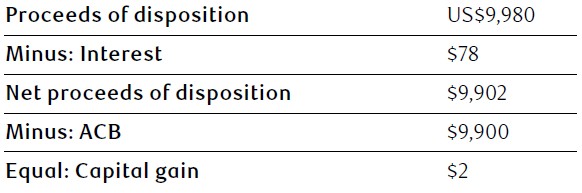
However, the capital gain or loss should be calculated as follows:

The capital loss in Canadian dollars is affected by the foreign exchange rate fluctuations over the holding period of the discount instrument. Also, you need to report the interest income and the capital gain or loss separately on your tax return.
Non-negotiable instruments – Funds on deposit
You may invest in or have been invested in term deposits, non-negotiable GICs and other investments that are not negotiable. These investments are considered to be on deposit. They are not considered to be disposed of until they are converted to another currency or used to purchase negotiable investments or other assets. The CRA's administrative position is that the rollover of one term deposit into another term deposit of the same foreign currency will generally not be considered a disposition.
Here's an example:
Assume you purchase a one-month US$20,000 term deposit on May 1 with a 5% interest rate. It matures on June 1 and the principal and interest is rolled over to another one-month U.S. dollar term deposit with a 6% interest rate and matures on July 1.
The hypothetical Canada-U.S. currency conversion rates on the relevant days are as follows:
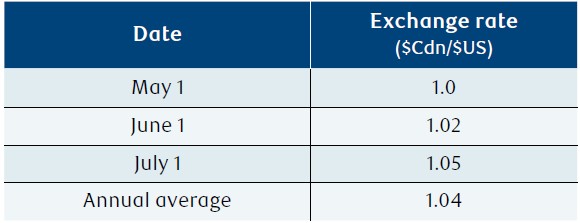
Here is a summary of the transactions:
May 1 conversion C$20,000 is converted to US$20,000
May 1 purchase US$20,000 GIC
June 1 maturity Principal returned: US$20,000 Interest earned: US$84.93 ($20,000 x 5% x 31/365)
June 1 purchase US$20,084.93 GIC
July 1 maturity Principal returned: US$20,084.93 Interest earned: US$99.05 ($20,084.93 x 6% x 30/365) Balance: US$20,183.98
July 1 conversion US$20,183.98 is used to purchase a negotiable instrument, such as a common share of a company.
You must report the interest you receive in the year or when the tax rules require accrued interest to be reported. For the previous example, you would convert the interest received at maturity on June 1 of US$84.93 to C$86.63 (exchange rate of 1.02) and report it on your tax return. Similarly, you would convert the interest of US$99.05 received at maturity on July 1 to C$104.00 (exchange rate of 1.05) and report it on your annual tax return.
Alternatively, you may be able to use the average exchange for the year to convert the interest you receive during the year. You may find that using the average annual foreign exchange rate option is especially handy when there are numerous foreign currency income transactions in the year.
You must report a foreign exchange gain or loss when there is an actual conversion of currency or if the principal balance is used to purchase a negotiable investment or other asset. In the previous example, when you purchased the common share, the July 1 balance will include the interest already reported on your tax return and reinvested in a U.S. dollar GIC. The total US$20,183.98 is converted to Canadian dollars at the foreign exchange rate on the date the funds are converted to Canadian dollars to purchase the common share, in this example at 1.05. The capital gain or loss is calculated as follows:
Proceeds of disposition
US$20,183.98 x 1.05 = C$21,193.18
ACB
C$20,000 + $86.63 + $104.00 = C$20,190.63
Capital gain/(loss)
C$21,193.18 – C$20,190.63 = C$1,002.55
On your tax return you would report a capital gain of C$1,002.55.
Cash
The cash you hold in a foreign currency whether it's in a safety deposit box, as a traveller's cheque, in a bank account or in a high interest savings account (HISA) is a form of funds on deposit. As such, you may realize a capital gain or loss when you dispose of the cash by converting the cash to another currency or using the funds to purchase negotiable investments or other assets.
Gifting of cash in a foreign currency
You may incur a capital gain or loss when you dispose of your foreign currency via a gift. For example, let's assume you give US$100,000 to a friend. If you acquired the US$100,000 when the Canada–U.S. exchange rate was at par and now the U.S. dollar is worth C$1.20, you would be making a gift that is the equivalent to C$120,000. You would realize a C$20,000 capital gain for Canadian tax purposes.
You would calculate the capital gain or loss as follows:
Proceeds of disposition
US$100,000 x 1.20 = C$120,000
ACB
US$100,000 x 1.00 = C$100,000
Capital gain/(loss)
C$120,000 – C$100,000 = C$20,000
$200 exemption for individuals
For individuals, only an amount in excess of $200 of net gain or loss on the disposition of foreign currency (cash or other assets that are considered on deposit) is deemed to be taxable as a capital gain or deductible as a capital loss. This $200 exemption does not apply to the gain or loss realized on the sale of negotiable assets such as securities.
For example, assume you deposit C$100,000 in a U.S. dollar HISA when the Canada-U.S. exchange rate is par. You keep the funds there until the Canadian dollar strengthens, at which time you withdraw the funds from the HISA to purchase a publicly traded stock. At the time you purchase the stock, you have realized a foreign exchange gain. You must report this gain, less the $200 exemption on your Canadian tax return. If instead you withdrew the cash in U.S. dollars and placed the cash in your safety deposit box, you would not realize a capital gain.
Repayment of a debt
You may realize a foreign gain or loss in the year you repay a loan in full or in part if the loan was denominated in a foreign currency. For example, if you borrowed US$100,000 when the Canadian dollar was trading at par and then repaid the loan when the U.S. exchange rate was 1.10, it would cost you C$110,000 to make the repayment. In this transaction, you would have a C$10,000 capital loss. You use this capital loss to offset your realized capital gains.
Conclusion
For Canadian tax purposes, you generally must report all amounts in Canadian dollars. As such, when you engage in a reportable transaction that is denominated in a foreign currency, you should be mindful of the possible foreign currency gain or loss that you may have to report. Speak with a qualified tax advisor to ensure that you are properly reporting your foreign currency gains or losses as well as any foreign income you may receive.
This article may contain strategies, not all of which will apply to your particular financial circumstances. The information in this article is not intended to provide legal, tax or insurance advice. To ensure that your own circumstances have been properly considered and that action is taken based on the latest information available, you should obtain professional advice from a qualified tax, legal and/or insurance advisor before acting on any of the information in this article.
If you would like to schedule some time to discuss the items outlined in this article, please click here to access our meeting scheduler.