How the alternative minimum tax (AMT) rules may impact trusts
Historically, AMT applied in relatively narrow scenarios, such as when a trust earned tax-preferred income, like capital gains or taxable Canadian dividends, and it was kept in the trust. Since 2023, the government has introduced a number of changes to AMT that may now affect or have a bigger impact on certain trusts commonly used for tax and estate planning.
Historically, AMT applied in relatively narrow scenarios, such as when a trust earned tax-preferred income, like capital gains or taxable Canadian dividends, and it was kept in the trust. Since 2023, the government has introduced a number of changes to AMT that may now affect or have a bigger impact on certain trusts commonly used for tax and estate planning.

Family Office Services
June 14, 2026
How the alternative minimum tax (AMT) rules may impact trusts
Historically, AMT applied in relatively narrow scenarios, such as when a trust earned tax-preferred income, like capital gains or taxable Canadian dividends, and it was kept in the trust. Since 2023, the government has introduced a number of changes to AMT that may now affect or have a bigger impact on certain trusts commonly used for tax and estate planning. If AMT is triggered, trusts could face an unexpected tax liability, so it's important to understand when AMT may apply. This article explains what AMT is, summarizes the recent changes that have become effective for tax years after 2023, and discusses the potential effect it may have on different types of trusts.
What is AMT?
AMT has been in effect since 1986, and because trusts are taxed like individuals, AMT applies to certain trusts and is intended to prevent them from significantly lowering their taxes by using certain tax preferences and incentives. Tax preferences are specific items that reduce a trust's taxable income or tax liability, such as claiming certain tax deductions or earning tax-preferred income. AMT is a mechanism to ensure most trusts pay at least a minimum amount of tax every year on income kept in the trust.
Consequently, trusts are required to compute their tax liability by calculating their regular tax and AMT. Trusts pay either the regular tax or AMT, whichever is higher. The AMT calculation allows fewer deductions, exemptions and tax credits than the regular income tax rules. The trust's taxable income for calculating its regular tax is different from the adjusted taxable income (ATI) when calculating its AMT. If the trust is required to pay AMT, it may be recoverable over the next seven years.
Trusts may also be subject to provincial/territorial AMT. For many provinces/territories, their AMT is calculated as a percentage of federal AMT. This article focuses on federal AMT.
AMT carry-forwards
If a trust is subject to AMT, it can carry forward the difference between the AMT paid and its regular income tax liability as a tax credit for seven years, or until it's used up — whichever is sooner. This AMT tax credit can be used to offset future regular taxes, to the extent the trust's regular tax liability exceeds its AMT liability in future years. If this is the case, AMT is like a prepayment of tax. However, if the trust will be subject to AMT each year or won't have sufficient regular taxes payable in the next seven years, the AMT credit will expire, and the AMT paid becomes a permanent tax. The trust may not be able to fully recover the AMT credit if the trust claims the same types of exemptions, deductions and credits or has the same type of tax preferential income every year.
What are the changes that may affect trusts?
Certain types of trusts, such as graduated rate estates (GREs), employee life and health trusts, and employee ownership trusts (EOTs), are exempt from AMT. However, for trusts that aren't exempt, AMT may be a concern under the new rules, especially since most trusts don't get the AMT basic exemption. The AMT basic exemption is only available to individuals and qualified disability trusts (QDTs) where, if their income is less than the threshold, AMT will not be triggered. The government has increased the AMT basic exemption from $40,000 to the amount that is the start of the fourth federal tax bracket. This amount increases annually, as it's indexed to inflation.
The government has also raised the AMT rate from 15% to 20.5% and limited certain tax preferences when calculating the AMT (such as certain exemptions, deductions and credits).
Here are a few examples of particular importance, for the purposes of calculating AMT:
- 100% of capital gains and losses realized in the trust are now included or deducted in ATI for AMT purposes (as opposed to 50% for calculating regular income tax).
- 50% of the capital loss carry-forward is allowed as a deduction when calculating ATI (the same as for calculating regular income tax).
- 50% of non-capital losses and limited partnership losses of other years is allowed as a deduction when calculating ATI (as opposed to 100% for calculating regular income tax).
- 50% of interest and financing expenses on money borrowed to earn income from property are allowed as a deduction (as opposed to 100% for calculating regular income tax).
- 50% of certain fees paid to investment counsel is allowed (as opposed to 100% for calculating regular income tax). Deductible fees paid to investment counsel include only fees paid to investment counsel for advice as to the advisability of purchasing or selling a specific security, or services in respect of the administration or management of securities.
Which trusts may be affected?
The following sections outline some common examples of when AMT may be triggered in a trust.
A trust borrows to invest and deducts interest
Consider the common situation of a prescribed rate loan to a family trust. This structure is often used to achieve income splitting with lower-income family members. In prior years, these types of trusts likely never owed much tax, if any. Instead, income would be earned in the trust, allocated to the beneficiaries, and the beneficiaries would then pay tax at their presumably lower marginal tax rates.
Where the trust earns investment income and incurs interest charges, which it deducts, AMT may now apply given the rules disallow 50% of the interest charges when calculating ATI, especially since the trust won't get the AMT basic exemption.
To illustrate, assume you loaned $2,000,000 to a family trust at the CRA's prescribed interest rate, which was 1% at the time. The trustee invested the funds and generated $100,000 of interest income. The trustee must pay you the annual interest of $20,000 and claims the interest paid as a deduction, leaving $80,000 in the trust. Any income retained in the trust is taxed at the top personal marginal federal rate of 33%.
Under the new AMT rules, 50% of the interest deduction, or $10,000, would be disallowed in calculating ATI, resulting in $10,000 of income subject to AMT (as opposed to NIL for regular income tax purposes). Even if the trust allocates all $80,000 of net investment income to the beneficiaries and has the income taxed in their hands, the disallowed portion of the interest deduction would still be subject to AMT when determining the trust's taxes. In this case, AMT won't be avoided even if the trust allocates all of its net income to beneficiaries.
A trust incurs investment counsel fees
Continuing with the same facts from the previous section, the trust also incurs $10,000 of investment counsel fees, resulting in $70,000 net investment income in the trust after deducting the fees and interest expense. To avoid the income being taxed at the top personal marginal federal rate of 33% in the trust, the net income is paid out to the beneficiaries, resulting in no taxable income in the trust.
Under the new AMT rules, 50% of the investment counsel fees, or $5,000, would be disallowed in calculating ATI, resulting in $15,000 of income ($10,000 disallowed interest expense plus $5,000 disallowed investment counsel fees) subject to AMT (as opposed to NIL for regular income tax purposes). Even where the trust allocates all $70,000 of net investment income to the beneficiaries and has no taxable income, the disallowed portion of the investment counsel fees and interest expense would still result in AMT for the trust. Again, AMT won't be avoided even if the trust allocates all of its net income to the beneficiaries.
One of the main issues with triggering AMT in the trust is the potential for double tax on the investment income earned. The beneficiaries may be required to pay personal tax on the income that's been allocated to them from the trust. The trust will also be required to pay AMT, which might not be recoverable in the future.
Another issue with allocating out all of the trust income to beneficiaries and triggering AMT in the trust is that the trust may need to dip into the capital to pay the AMT liability or receive additional loans. This would not only reduce the amount of funds invested in the trust but also potentially affect the trust's ability to repay the loan in the future.
As a planning consideration, if the trust allows for it, it may make sense to retain some income in the trust to trigger regular tax to eliminate AMT. The income retained in the trust should be sufficient to pay the trust's tax liability, so the trust doesn't need to use the capital.
Let's compare the estimated federal tax liability with the estimated AMT liability under the previous and new rules when:
1. The trust allocates all income to the beneficiaries to be taxed in their hands before 2024.
2. The trust allocates all income to the beneficiaries to be taxed in their hands after 2023.
3. The trust retains the necessary amount of income in the trust to avoid triggering AMT after 2023.
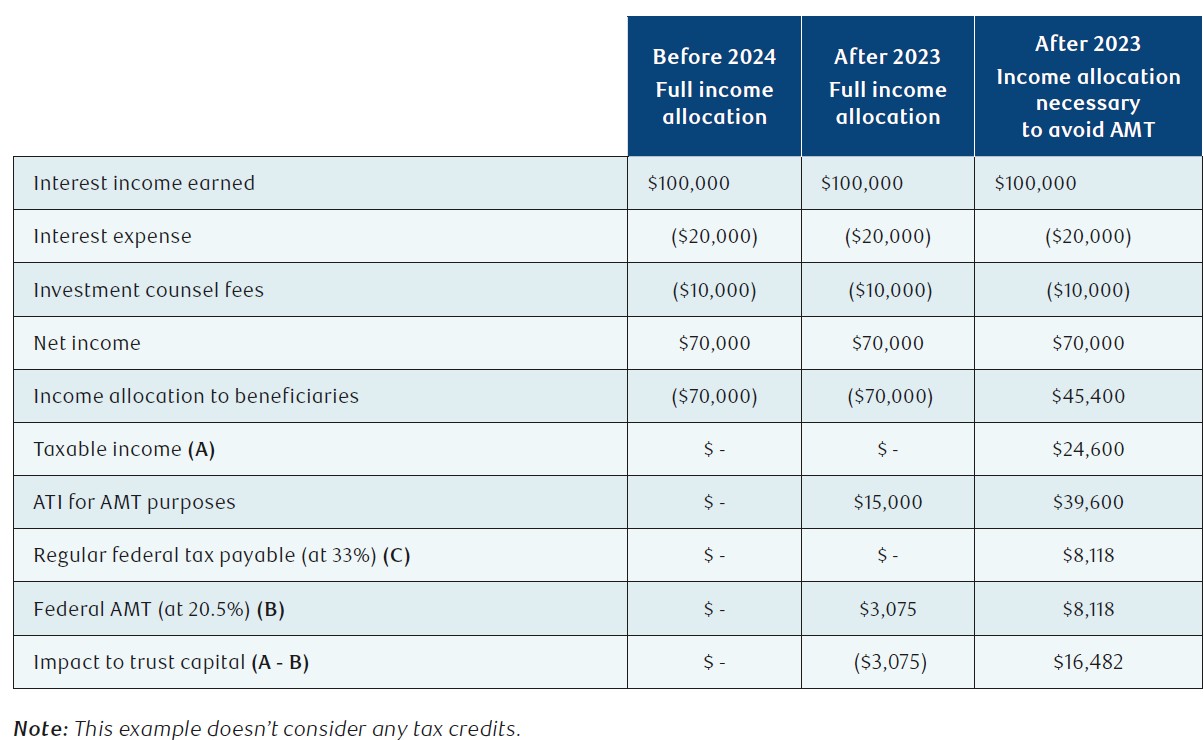
From this illustration, it's evident that if the income retained in the trust is sufficient to create a federal tax liability at least equal to or greater than the AMT liability, the trust eliminates AMT and simply pays the federal tax liability. Although the trust may be paying tax on the investment income at a higher tax rate than if the income was allocated out to the beneficiaries and taxed in their hands, there's no double taxation of the investment income.
As such, if you have a prescribed rate loan to a family trust where the trust earns investment income, incurs interest charges and pays investment counsel fees, please consult with your qualified tax advisor about whether the trust is still beneficial in your situation. Although the effectiveness of using a prescribed rate loan to a trust may not be as great as it once was, there may still be a benefit to maintaining these types of trusts as income splitting vehicles to reduce your family's overall tax bill.
If AMT is a concern for your trust, speak with a qualified tax advisor about ways to mitigate the effects of AMT. Possible solutions could include repaying the loan to reduce the interest expense in the trust, retaining taxable income in the trust or forgoing expense deductions in the trust to avoid triggering AMT. Another option may be to look at investments with embedded fees such as mutual funds and ETFs. However, where these investments are themselves structured as trusts, keep in mind this could lead to other issues related to getting the annual tax reporting slips before the tax filing deadline of the trust.
A trust that realizes mostly capital gains
Certain types of income, such as capital gains, are taxed preferentially under regular income tax rules, as they're only 50% taxable. As such, a trust that realized mostly capital gains may already have been subject to AMT under the old rules. However, given that under the new AMT rules, 100% of capital gains realized in the trust will be included in ATI for AMT purposes (as opposed to 80% previously), AMT will likely have a larger effect on trusts that earn mostly this type of tax-preferred income. Further, if a trust continues to earn mostly tax-preferred income each year, there may be no way to recover the AMT paid.
A trustee could consider distributing all of the taxable capital gains to beneficiaries to eliminate the impact of AMT if this is within the trust's terms.
A trust doesn't distribute all of its income or capital gains to beneficiaries
In planning for blended families, a spousal trust is often established where the spouse or common-law partner is entitled to receive all of the income of the trust during their lifetime; on their death, any remaining capital will then be distributed to the children from a previous marriage or relationship. In these cases, the trust document may restrict the distribution of capital gains to the spouse or common-law partner to protect the children's residual interest in the capital of the trust. As such, while the spouse or common-law partner is alive, all of the capital gains are taxed in the trust. Since 100% of capital gains realized in the trust will now be included in ATI for AMT purposes (as opposed to 50% for calculating regular income tax), the trust will be subject to AMT each year on the capital gains, with no possibility to recover it in the following seven years.
There are other situations where a trustee may not be able to distribute all of the trust's income or capital gains to the beneficiaries. For example, a trust may be established to provide for a family member such as an adult child, a child with a disability or an elderly parent, who can't manage their own financial affairs. If tax-preferred types of income are retained and taxed in the trust, the trust may be subject to AMT.
Please note that spousal trusts, joint partner trusts and alter ego trusts are exempt from AMT for the year in which a deemed disposition occurs due to the death of a beneficiary.
A trust with capital loss carry-forwards
A trust can incur a capital loss if it disposes of capital property, such as securities, for proceeds less than its cost. If a trust realizes a capital loss in a particular year, the trust must first apply that loss against capital gains realized in the same year. If it can't use the loss in that year, the loss can be carried back to any of the three preceding years or carried forward indefinitely to any future year to offset capital gains in those years. A trust can't apply capital losses against capital gains that have been allocated out to a beneficiary. If a trust uses the capital loss carried forward in a future year, only 50% of it can be applied to reduce capital gains for AMT purposes (as opposed to 100% for calculating regular income tax). However, 100% of any capital gains in the year are included in ATI for AMT purposes. This needs to be considered when the trustee is determining the timing of the sale of securities in the future and whether to distribute capital gains to beneficiaries.
A trust with non-capital loss carry-forwards
A non-capital loss includes a loss from employment, business or property. Assume a trust owns a rental property which incurs a rental loss in a particular year. The rental loss becomes a non-capital loss which can generally be carried back three years or forward for 20 years. A trust can't apply non-capital losses against income that's been allocated out to a beneficiary. If the trust earns rental income in a future year, it might consider benefitting from a prior-year non-capital loss, but if it claims the non-capital loss carry-over, 50% of the loss carry-over would be disallowed for AMT purposes.
GREs that exist for longer than 36 months
An estate that designates itself as a GRE will generally be subject to tax at graduated tax rates for the first 36 months of its existence. However, there are often many reasons an executor may need more than 36 months to administer an estate. In such an instance, the estate will no longer be exempt from AMT after 36 months.
Conclusion
If you're a trustee of a trust and suspect the trust may be subject to AMT under the new rules, speak with a qualified tax advisor to determine the trust's AMT exposure, as well as potential approaches that may reduce AMT for the trust. Overall, there are limited options available to effectively manage the new AMT liability. As discussed, you may retain some income in the trust annually so there's no AMT liability for the trust. However, this tax is permanent, and the beneficiaries would receive less distributions, which may not be in line with the intention of the trust.
Consider the timing of transactions that may be impacted by AMT, for example, if the trust is looking to use up non-capital loss carry-forwards. You may now want to try matching gains and losses in the same year to avoid the 50% AMT adjustment for loss carry-overs. To some extent, planning can be conducted when you complete the trust's tax return. You can determine at that time how much of the loss carry-over to apply to avoid triggering AMT.
Also, if the trust has previously paid AMT and has expiring AMT credits, consider making use of these credits or potentially leaving more income to be taxed within the trust. Since the AMT credit can't be carried back to prior years and the carry-forward expires after seven years, it's important the trust has proper planning in place if it's expected to be affected by AMT. A qualified tax advisor can help determine if a trust has an AMT liability for a given year by preparing a draft tax return that factors in all of its relevant tax attributes.
This article may contain strategies, not all of which will apply to your particular financial circumstances. The information in this article is not intended to provide legal, tax or insurance advice. To ensure that your own circumstances have been properly considered and that action is taken based on the latest information available, you should obtain professional advice from a qualified tax, legal and/or insurance advisor before acting on any of the information in this article.
If you would like to schedule some time to discuss the items outlined in this article, please click here to access our meeting scheduler.