
Family Office Services
April 14, 2024
Leverage Strategy: Not for the faint of heart
When borrowing to invest, consider your return and your risk
Borrowing to invest or using a leverage strategy can be a powerful wealth-creation strategy. You may borrow money to invest directly in a portfolio of income-producing assets and deduct the interest expense on your borrowed funds for tax purposes. The tax deductibility of interest may allow you to lower your borrowing cost and increase the after-tax rate of return on your investments. This article describes the leverage strategy and highlights some of the potential issues you should consider before incorporating this borrowing to invest strategy into your overall financial plan.
It's important to note that using borrowed money to finance the purchase of securities involves greater risk than a purchase using cash resources only. Should you borrow money to purchase securities, your responsibility to repay the loan as required by its terms remains the same even if the value of the securities purchased declines. The information in this article is not intended to provide legal or tax advice. To ensure that your own circumstances have been properly considered and that action is taken based on the latest information available, you should obtain professional advice from a qualified tax advisor before acting on any of the information in this article.
The strategy
In a leverage strategy, you would borrow to invest directly in income-producing assets. This strategy will entitle you to deduct the interest on that borrowed money. For more information regarding interest deductibility ask your RBC advisor for an article on this topic.
The ability to deduct interest for tax purposes effectively reduces your borrowing costs. Borrowing to invest will magnify your returns if your investments appreciate in value.
This is due to the larger pool of investment capital that can benefit from investment growth. The downside of this strategy is that your losses will be magnified as well if your investments decrease in value.
An example
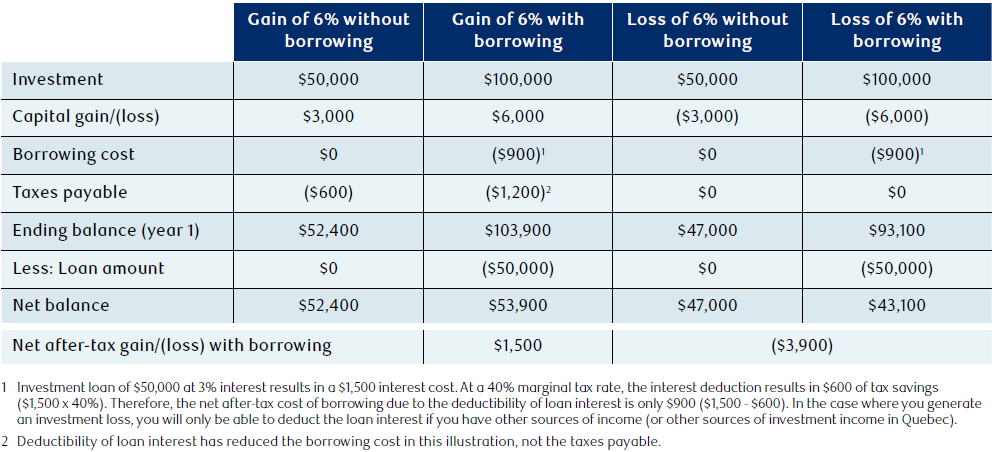
The following simple example may help explain how borrowing to invest can impact your net after-tax gain or loss. It's important to note that capital gains are not considered income for tax purposes, so interest resulting from borrowing to generate capital gains alone will not be deductible. For the purposes of this example, we assume the investments are income-producing.
The illustration assumes that you have capital of $50,000 and decide to borrow an additional $50,000 for a total investment of $100,000. It also assumes your investment gain or loss in the first year will be 6% and that your borrowing cost (interest only) for that year is 3%. Your marginal tax rate is 40%. Please note that capital losses can be used to offset other capital gains, the tax impact of the ability to offset capital gains are not shown in this illustration.
Is this strategy right for you?
Do you have a long investment time horizon?
Generally, a long investment time horizon may increase the possibility of successfully implementing a borrowing to invest strategy. A long investment time horizon provides time for your investment to grow and compound returns, and mitigates the effects of short-term market volatility. This helps to increase the probability that your total investment assets will exceed your loan plus interest costs.
Do you have surplus cash flow?
It's important to review the loan agreement and understand the terms of your investment loan. Some loans require payments that are a combination of interest and principal while other loans require interest-only payments. This will dictate how much interest you can deduct. Further, ensure you have adequate surplus cash flow (i.e. after-tax income less expenses) from sources other than your investment portfolio sufficient to service your debt.
Your source of cash flow should also be sufficient to absorb the effects of a market downturn. A change in economic conditions could result in a potential increase in your borrowing costs and a market downturn could cause a decrease in the value of your investments. If borrowing costs increase, you should have enough cash flow to cover any loan interest payment increases. If the value of the investments you purchased with borrowed money decreases, this could result in significant unrealized losses. In this situation, it's prudent to have enough cash flow to cover any potential demands for repayment. Lastly, if you decide to sell your investments at a loss, you will need to come up with extra cash to pay off the difference between the outstanding loan balance and your investment proceeds.
What is your investment risk tolerance?
Your investment risk tolerance is a measure of how comfortable you're with taking risk in the hopes of earning greater returns on your investments. Most investments have some degree of risk associated with them, and borrowing to invest adds an additional level of risk to your investing. As previously mentioned, borrowing to invest will magnify your returns when your investments are appreciating in value. However, the downside is that if your investments start to decrease in value, your losses will be magnified as well. Diversification of the assets you purchase with your investment loan may help reduce the volatility of the investments.
How can you keep your interest tax-deductible?
To keep your interest deductible, here are some important points you should bear in mind:
What can you invest in?
If you want to deduct your interest expense, the borrowed money must be used for the purpose of earning income from a business or property. Business income includes any activity you carry on for profit or with a reasonable expectation of profit. Property income includes interest income, dividends, rents, and royalties.
If you borrow money to purchase common shares, the interest expense will generally be deductible if there's a reasonable expectation, at the time the shares were acquired, that you will receive dividends.
If a corporation has stated that it doesn't pay dividends and that dividends are not expected to be paid in the foreseeable future, you may not deduct the interest expense because there's no reasonable expectation that you will receive dividends. However, if a corporation is silent with respect to its dividend policy, or its policy is that dividends will be paid when operational circumstances permit, you're likely able to deduct the interest expense. The Canada Revenue Agency's (CRA's) position on interest deductibility is that each situation must be dealt with on the basis of the particular facts involved.
If your investment generates a return of capital (ROC), the ROC must be reinvested to ensure all of the interest continues to be tax-deductible. Otherwise, a pro-rated interest expense calculation is required to determine the amount that may be deductible.
What if the interest expense exceeds the investment income earned?
The amount of income earned (or expected to be earned) does not affect the amount of interest you can deduct. For example, if you borrowed money at 8% to invest in something that earns 5%, you may be able to deduct the full 8%, unless the transaction is a sham.
Please note that if you live in Quebec, the provincial tax laws limit the interest you may deduct in any given year to the investment income you earn in that year. Unused interest expenses can be carried back three years and carried forward indefinitely to be deducted against investment income in other years.
What if you dispose of your investments?
When you dispose of all or a portion of your investments, you will need to identify the current use of borrowed money to determine the extent to which interest remains deductible.
For example, if you invest the proceeds from the sale into a new income source, the entire interest expense should continue to be deductible. If you sell your investments at a loss, it's likely that the proceeds will only cover a replacement investment of lesser value. As long as you can trace the cost of the replacement investment to the entire original borrowed amount, the full amount of the interest expense should be deductible.
If you dispose of a portion of your investments and decide to pay down your investment loan with the proceeds from the sale, then the interest expense on the remaining portion of the loan will generally continue to be deductible. In the case where you dispose of all of your investments at a loss, the proceeds from the sale may not be adequate to pay off the entire outstanding loan balance. In this case, the interest expense on the remaining portion of the loan will generally continue to be deductible as long the original loan was used to purchase income producing assets.
If instead you decide to transfer a portion of your investments to a registered account (such as an RRSP or TFSA), or dispose of your investments and use the sale proceeds for personal purposes (such as travel, renovating your home, or paying down your mortgage), the interest on that portion of borrowed funds would cease to be deductible. Likewise, if you sell your investments at a loss, you will need to identify what portion of the originally purchased investments has been disposed of and the associated pro-rated interest expense to determine the amount that remains deductible.
Alternative minimum tax (AMT)
If you're deducting your interest expense for tax purposes, it's important to consider AMT. This tax aims to ensure that every Canadian individual pays a minimum amount of tax. The calculation of AMT is based on an adjusted taxable income, which seeks to remove the advantages of certain tax-preferential items such as certain deductions and tax credits. The AMT rules limit the deduction of interest and carrying charges. For AMT purposes, you can only deduct 50% of the interest expense you would typically claim as a 100% deduction under regular tax rules. If you're subject to AMT due to the interest expense claimed, you may need to re-evaluate the tax effectiveness of the leverage strategy. For more information regarding AMT, ask your RBC advisor for an article on this topic.
Conclusion
Borrowing to invest is a strategy worth considering in building your long-term wealth. However, it's an aggressive strategy with associated risks. Your RBC advisor along with your qualified tax advisor can help you evaluate whether borrowing to invest makes sense for you.
This article may contain strategies, not all of which will apply to your particular financial circumstances. The information in this article is not intended to provide legal, tax or insurance advice. To ensure that your own actions is taken based on the latest information available, you should obtain professional advice from a qualified tax, legal and/or insurance advisor in this article.
If you would like to schedule some time to discuss the items outlined in this article, please click here to access our meeting scheduler.