
Family Office Services
October 14, 2025
Taxation of investment income in a corporation
As a business owner, you may have surplus cash in your corporation. Perhaps you've been accumulating funds for a large business purchase in the future or perhaps you've received a significant cash inflow from a major sales contract. Either way, you should determine how to maximize the value of this surplus cash. One method to increase the value of this surplus is to invest these funds within your corporation in a passive investment portfolio. This article discusses the taxation of passive investment income earned in a corporation.
The terms "corporation" and "company" are used interchangeably to refer to a Canadian-controlled private corporation (CCPC) in this article. In simple terms, a CCPC is a Canadian corporation that is not controlled by a non-resident of Canada or a public corporation, or a combination of both. In addition, no class of shares of a CCPC can be listed on a prescribed stock exchange. This article does not apply to public corporations or to businesses operating as a partnership or a sole proprietor. The tax rates referenced in this article are current as of July 2025 and are based on federal and provincial legislation.
Taxation of investment income in a corporation
When there is surplus cash in your corporation, the first step is to determine if the business will need the funds in the near future. Perhaps your corporation will need the excess cash to make tax instalments or a major business acquisition. If you decide to invest the surplus cash in your corporation, the income generated might be considered incidental to your business and may be taxed as active business income (ABI). For more information on how ABI is taxed, ask your RBC advisor for an article on this topic.
If the income generated from investing the surplus cash is not incidental to your business, it will be taxed as passive investment income, regardless of whether it's earned in your operating company or holding company. Passive investment income generally includes interest income, foreign dividend income, rental income, royalty income and taxable capital gains.
Although the taxation of passive investment income earned in a corporation may be complex, the following provides an overview of some concepts you may find helpful.
Tax on investment income (excluding Canadian dividends)
When a corporation earns passive investment income (excluding Canadian dividends), it's subject to a federal tax of 28% and an additional refundable tax of 10 2/3% on this investment income for a total federal tax of 38 2/3%. A portion of the tax paid is refundable to the corporation when taxable dividends are paid out to its shareholders. The refundable portion is equal to 30 2/3% of the investment income earned. The refundable portion is reduced if the corporation earns foreign investment income and claims a foreign tax credit for the non-resident withholding tax paid. The mechanism for the refund is explained in greater detail in the dividend refund section.
The purpose of this refundable tax is to achieve an important principle in the Canadian tax system commonly referred to as "integration." When a tax system is perfectly integrated, an individual will be indifferent to earning investment income in a corporation versus earning it personally. Without the refundable tax on investment income, a corporation would pay less tax on investment income earned than an individual in a high marginal tax bracket; this advantage would encourage individuals to earn investment income in a corporation as a way to defer tax.
Tax on Canadian dividends
Canadian dividends earned in a corporation are not subject to regular corporate tax. Instead, they may be subject to a refundable tax. Further, unlike dividends received by individuals, there's no gross-up or dividend tax credit for any dividends received by a corporation.
Dividends received from connected corporations are generally not subject to the refundable tax unless the paying corporation received a refund of its refundable taxes when it paid the dividends.
A payer corporation is connected to the recipient corporation if:
- The recipient corporation owns more than 10% of the voting shares and more than 10% of the fair market value of all the issued shares of the payer corporation; or
- The recipient corporation controls the payer corporation.
For the purposes of determining whether two corporations are connected, the normal concept of control is expanded and provides that one corporation is controlled by another if more than 50% of its shares (that have full voting rights) belongs to the other corporation, persons who do not deal at arm's length with the other corporation, or a combination of the other corporation and persons who do not deal at arm's length with the other corporation.
If the exception to the refundable tax is not available, dividends received from Canadian corporations are generally subject to a refundable tax of 38 1/3%. This tax is refundable to the corporation when taxable dividends are paid out to the shareholders. Speak to your qualified tax advisor for more information about the tax implications of inter-corporate dividends.
Refundable dividend tax on hand (RDTOH) and the dividend refund
The refundable portion of taxes paid by a corporation on passive investment income is either added to the corporation's eligible RDTOH (ERDTOH) or non-eligible RDTOH (NERDTOH) account. The RDTOH accounts are notional accounts that track the refundable taxes paid by a corporation.
The NERDTOH account tracks refundable taxes paid on passive investment income (excluding eligible dividends received by the corporation). It also tracks refundable taxes paid on non-eligible dividends received from non-connected corporations. A corporation is only able to obtain a refund from the non-eligible RDTOH account upon the payment of a non-eligible dividend.
The ERDTOH account tracks refundable taxes paid on eligible Canadian dividends. Any taxable dividend (eligible or non-eligible) paid by a corporation to a shareholder will entitle the corporation to a refund from its ERDTOH account. However, an ordering rule requires that a corporation paying a non-eligible dividend must exhaust its non-eligible RDTOH account before claiming a refund from its eligible RDTOH account.
To the extent there's a positive balance in the applicable RDTOH account, the rate of the refund is 38 1/3% of the eligible or non-eligible dividend paid to shareholders.
Example
The following is an example of how the dividend refund works:
Assume the corporation earned $1,000 each of interest income, dividends from another Canadian corporation and capital gains in the year.
Assuming the prior year's RDTOH accounts have a closing balance of $0, the RDTOH balances at the end of the current year would be a combined total of $843 (which is the total of the refundable taxes paid on all investment income).
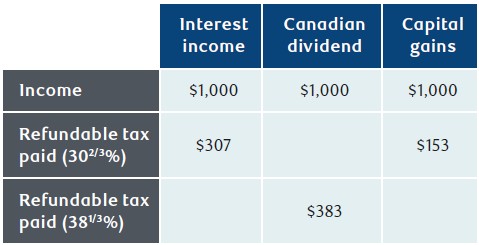
If the corporation pays a non-eligible dividend of $3,000 to its shareholders, the dividend refund is equal to the lesser of:
- The total of both RDTOH balances at the end of the year of $843; or
- 38 1/3% of the taxable non-eligible dividends paid in the year of $1,150 (38 1/3% × $3,000).
In this example, all of the refundable taxes paid, which is $843, would be recovered by the corporation as a dividend refund. The ERDTOH and NERDTOH account balances would then be reduced to nil.
Capital dividend account (CDA)
The CDA is another notional account for private corporations. It keeps track of the non-taxable portion of capital gains and the non-allowable portion of capital losses, as well as other amounts such as capital dividends received or paid by the corporation and certain life insurance proceeds received in excess of the policy's adjusted cost base. It's intended that the tax-free character of these amounts be transferable to the corporation's shareholders. As such, a tax-free capital dividend can be paid out to the company's shareholders when there's a positive balance in the CDA. Once a capital dividend is paid, the CDA balance is reduced accordingly. If you pay a capital dividend that exceeds the corporation's CDA balance, there are negative tax consequences, so it's important to ensure the CDA balance is calculated correctly.
The CDA does not appear on your company's financial statements. However, you should track the balance of the account and closely monitor it to allow you to take advantage of any tax-free capital dividends that can be paid out. As a planning strategy, it may be beneficial to pay a capital dividend when the CDA is positive so that the opportunity is not lost if the corporation realizes a capital loss, as the non-allowable portion of a capital loss immediately reduces the CDA balance.
Tax rates and tax deferrals or prepayments
Tax rates
Investment income earned within a corporation is taxed at two levels — once at the corporate level and again at the personal level when the income is distributed to its shareholders. For the current combined corporate and personal tax rates on investment income, please ask your RBC advisor for a copy of those tax tables. The tables illustrate the following:
- The corporate tax rates on various types of income earned and retained in a corporation;
- The combined corporate and personal tax rates on various types of investment income earned in the corporation that is distributed as an ineligible or eligible dividend to a shareholder; and
- The personal tax rates on various types of investment income earned personally.
These tables assume the shareholder is subject to tax at the top marginal tax rate.
The tables show that integration is not perfect. There could be a tax rate advantage or disadvantage to earning interest income, foreign income and capital gains inside a corporation, depending on the province or territory of residence. Further, if the corporation is subject to non-resident withholding tax and entitled to a foreign tax credit, the amount that's added to the NERDTOH account is reduced. Thus, foreign dividends that are subject to withholding tax may be taxed more heavily when earned through a corporation than foreign dividends earned personally.
There is no tax rate difference between earning Canadian eligible or ineligible dividends personally or through a corporation. The corporate taxes paid on dividends from non-connected corporations are refunded to the corporation when a taxable dividend is paid to its shareholders.
Tax deferrals or prepayments
When investment income earned in a corporation is retained by the corporation and not paid out immediately to shareholders, there is a deferral or prepayment of taxes. This is because corporate tax rates differ from personal tax rates.
For example, in the case where your corporation earns Canadian dividend income but does not pay out that income in the same taxation year, there may be a prepayment or deferral of tax calculated as the difference between the refundable tax of 38 1/3% and your personal marginal tax rate on the dividend income. If your marginal tax rate is less than the corporate tax rate on the dividends, you may want to consider paying out the dividend income earned in the corporation in the same taxation year in which it's earned to avoid the prepayment of tax. Speak with a qualified tax advisor to see if this makes sense in your circumstances.
Other considerations for earning investment income in your corporation
Passive investment income earned by a corporation or any of its associated corporations may impact a corporation's ability to claim the small business deduction (SBD) on its active business income (ABI). The concept of association is defined in the Income Tax Act and is beyond the scope of this article. The SBD lowers the federal tax rate on the first $500,000 of ABI (the "business limit") earned by a CCPC from 15% (the general corporate tax rate on ABI earned by a CCPC) to 9%. All provinces and territories also provide an SBD. Additional criteria must be met in order to qualify for the Quebec SBD. Corporations will only qualify for the Quebec SBD if they operate in the primary or manufacturing sectors or where the corporation's employees worked at least 5,500 hours during the tax year.
The business limit is reduced on a straight-line basis when the CCPC and its associated corporations have between $50,000 and $150,000 of investment income in a year. The business limit is reduced by $5 for every $1 of passive investment income above the $50,000 threshold and is completely eliminated when the CCPC and its associated corporations earn $150,000 or more of passive investment.
For purposes of calculating the reduction to the business limit, investment income earned by a corporation is based on a concept known as "adjusted aggregate investment income" (AAII). AAII generally includes net taxable capital gains, interest income, portfolio dividends, rental income and income from savings in a life insurance policy that is not an exempt policy. AAII excludes certain taxable capital gains (or losses) realized from the disposition of active business assets and shares of certain connected CCPCs. As well, AAII excludes capital losses carried over from other tax years and investment income that pertains to and is incidental to an active business (e.g. interest on short-term deposits held for operational purposes, such as payroll or to purchase inventory).
Any reduction to the business limit will be calculated annually based on passive investment income earned by a CCPC and any of its associated corporations in the taxation year that ended in the preceding calendar year.
The provincial or territorial small business limit may also be reduced for CCPCs that have significant income from passive investments, so it's important to confirm the specific rules for the province or territory of residence of your corporation with a qualified tax advisor.
If you're the owner of a CCPC, consider how these rules will impact your corporation. If you're concerned your corporation, together with any associated corporations, will have passive investment income in excess of $50,000 and impact your corporation's ability to claim the SBD, speak to a qualified tax advisor about any actions you should take as well as any potential investment and asset allocation strategies going forward.
Conclusion
As a business owner with surplus cash accumulating in your corporation, you first need to consider the funding requirements of operating the business and the timing of when certain obligations need to be satisfied. If you decide to invest the surplus cash in your corporation, it's important to understand the tax implications of doing so.
The taxation of investment income in a corporation is fairly complicated but broadly speaking, it's essentially designed to eliminate any tax advantage of earning investment income through a corporation versus earning the income personally. There may be a tax advantage or disadvantage to earning investment income inside a corporation, depending on the province or territory involved (although this may change from year to year depending on the current year's tax rates and your province or territory of residence). As such, it's important for you to review your corporation's situation with a qualified tax advisor.
With these aspects in mind, if you instead decide to withdraw the surplus cash from your corporation and invest it personally, there are different tax implications associated with doing so. These tax implications should be considered in conjunction with the taxation of investment income in your corporation. For more details on the tax implications of withdrawing funds from your corporation, please ask your RBC advisor for a copy of the article on withdrawing surplus cash from a corporation. It's also important that you discuss these decisions with a qualified tax advisor before proceeding with any action.
This article may contain strategies, not all of which will apply to your particular financial circumstances. The information in this article is not intended to provide legal, tax or insurance advice. To ensure that your own circumstances have been properly considered and that action is taken based on the latest information available, you should obtain professional advice from a qualified tax, legal and/or insurance advisor before acting on any of the information in this article.
If you would like to schedule some time to discuss the items outlined in this article, please click here to access our meeting scheduler.