
Family Office Services
December 14, 2025
U.S. estate, gift and generation-skipping transfer tax (GSTT)
Understanding your exposure
This article is intended for both U.S. and non-U.S. persons living in Canada and provides an overview of the U.S. transfer tax system.
The U.S. tax system is composed of an income tax system and a transfer tax system. The U.S. transfer tax system includes gift tax, estate tax and generation-skipping transfer tax (GSTT). These taxes can apply to the value of certain gifts made during your lifetime or on the value of certain property you own when you pass away. This article assumes you are not a "covered expatriate" under U.S. tax law.
The information in this article is based on the U.S. transfer tax laws for U.S. federal purposes and the Canada-U.S. Income Tax Treaty (Treaty). While certain U.S. states may have their own transfer tax laws, they are not addressed in this article.
Overview of the changes made by the One Big Beautiful Bill Act
The H.R.1, budget reconciliation bill known as the "One Big Beautiful Bill Act" (OBBBA) was signed into law on July 4, 2025. The OBBBA permanently increases the unified estate and gift tax exemption amount to US$15 million beginning in 2026 (indexed to inflation). This change also applies to the generation-skipping transfer tax exemption. The existing 40% maximum tax rate remains unchanged.
The increase in the U.S. estate, gift and GSTT exemptions is permanent and is not subject to sunset, however changes to the exemptions can be made by future U.S. governments.
Your exposure to U.S. transfer taxes
The transfer tax system may apply to:
- U.S. persons for U.S. transfer tax purposes (i.e. U.S. citizens and U.S. domiciliaries); and
- non-U.S persons to the extent they own certain U.S. situs property (property that has a U.S. connection or location, such as real estate or shares of a U.S. corporation). These taxes may apply no matter where in the world you reside. A non-U.S. person for U.S. transfer tax purposes is an individual who is neither a U.S. citizen nor a U.S. domiciliary.
An overview of U.S. gift, estate and GSTT for U.S. citizens, U.S. domiciliaries and non-U.S. persons is provided in the following sections.
U.S. gift tax
U.S. gift tax applies to the donor of the gift to the extent a gift made in a particular year is considered a "taxable gift". U.S. gift tax generally doesn't apply to the individual receiving the gift (i.e. the donee). Any direct or indirect gratuitous transfer to an individual where full consideration is not received in return may be considered a gift.
The amount of the gift that's subject to gift tax is equal to the cumulative value of all gifts made in a calendar year, in excess of the annual exclusion for gifts for that year.
The annual exclusion amount is based on the relationship between the donor and the donee, as well as the year the gift is made. The inflation adjusted amounts applicable to 2026 are as follows:
- US$19,000 for gifts to anyone other than a spouse;
- US$194,000 for gifts to a non-U.S. citizen spouse; and
- Unlimited for gifts made to a U.S. citizen spouse.
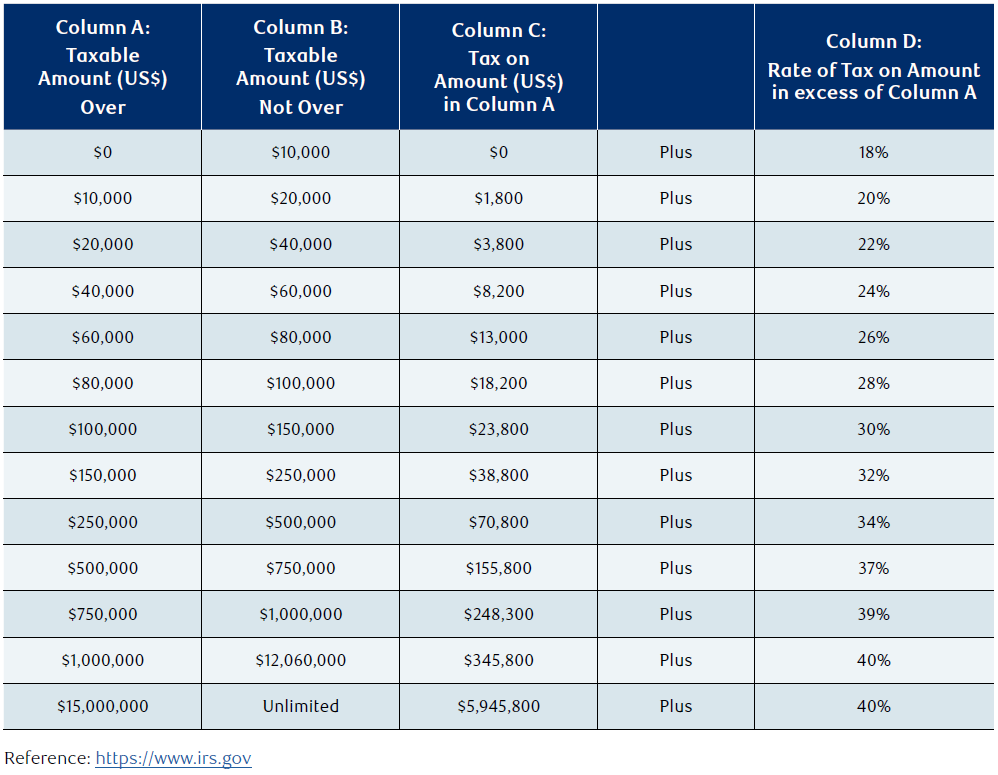
U.S. gift tax is calculated based on a graduated tax rates (refer to the Appendix for a table titled: Graduated U.S. gift and estate tax rates for 2026). The maximum tax rate of 40% is reached when the value of taxable gifts in a calendar year exceeds US$1 million. For example, taxable gifts in the amount of US$1 million are subject to gift tax of US$345,800. If the gift was US$2 million, the first million attracts U.S. gift tax of US$345,800 and the next million is taxed at 40% (US$400,000) for a total gift tax liability of US$745,800.
For U.S. income tax purposes, the donor's cost base of the gifted property becomes the donee's cost base. However, the cost base to the donee will be fair market value (FMV), if the value at the time of the gift is lower than the cost base. Where the donor incurs a U.S. gift tax liability, there may be an increase in the cost base to the donee for all or a portion of the U.S. gift tax incurred.
For Canadian tax purposes, the donor's gift may trigger Canadian income tax, which would step-up the cost base to the donee to its FMV.
Differences in Canadian and U.S. tax treatments may result in double taxation. However, the Treaty does provide the donor the option to elect to treat the gift as a disposition for U.S. income tax purposes. This election may help to minimize double taxation.
What constitutes a gift for U.S. citizens, U.S. domiciliaries and non-U.S. persons is discussed in the following sections.
U.S. gift tax for U.S. citizens or U.S. domiciliary donors
For a donor who's a U.S. citizen or U.S. domiciliary, gifts of any type of property in excess of the annual exclusion thresholds (discussed above) are taxable gifts.
In addition to the annual exclusion thresholds, U.S. citizens and U.S. domiciliaries are entitled to a lifetime gift tax exemption (US$15 million for 2026) to offset U.S. gift tax on taxable gifts until the exemption is exhausted. Note that when any portion of the lifetime gift tax exemption used, this reduces (dollar-for-dollar) the value of the donor's U.S. estate tax exemption (discussed below) that can be used upon their passing.
Additional considerations
For U.S. citizens and U.S. domiciliaries with U.S. citizen or U.S. domiciliary spouses, "gift splitting" may be an option to maximize gifts using the annual exclusion threshold. For example, a U.S. citizen or U.S. domiciliary spouse may make a gift of double the annual exclusion (US$38,000 in 2026) to a child and treat it as a gift of US$19,000 made in 2026 by each U.S. citizen or U.S domiciliary spouse. Keep in mind, however, that gift splitting is not permitted where one spouse is not a U.S. citizen or U.S. domiciliary.
When it comes to gifts made by U.S. citizens and U.S. domiciliaries to U.S. and Canadian charities, these are not subject to U.S. gift tax. Direct payments on behalf of a child or grandchild to educational organizations for tuition expenses (e.g. college tuition) or to a healthcare provider for medical services (e.g. braces for teeth) are also not subject to U.S. gift tax.
In a situation where a U.S. citizen or U.S. domiciliary spouse has passed away, the transfer tax laws include portability provisions that may benefit a surviving spouse. These provisions allow the surviving spouse, who must also be a U.S. citizen or U.S. domiciliary, to utilize any unused U.S. lifetime gift tax or U.S. estate tax exemption of the deceased spouse in addition to their own U.S. lifetime gift and U.S. estate tax exemption. This may minimize U.S. gift tax during the surviving spouse's lifetime or U.S. estate tax upon their death. In order to benefit from the portability provisions, an election must be filed as part of the U.S. estate tax return on the death of the first spouse. However, the portability provisions don't increase the GSTT exemption of the surviving spouse (refer to section below discussing generation-skipping transfer tax).
Filing requirements
A U.S. gift tax return may be filed by U.S. citizens and U.S. domiciliaries on IRS Form 709, United States Gift (and Generation Skipping Transfer) Tax Return, when taxable gifts are made and when couples elect to use gift splitting.
U.S. gift tax for Canadian (non-U.S. citizen or U.S. domiciliary) donors
For donors who are Canadians and non-U.S. persons, only gifts of U.S. situs property that are "U.S. tangible property" are subject to U.S. gift tax, unless they're made to a U.S. citizen spouse.
U.S. tangible property consists of property physically located in the U.S., such as U.S. real estate, cars, boats, jewellery and cash.
U.S. situs intangible property, such as a share of a U.S. corporation, is not subject to U.S. gift tax. However, a gift of U.S. intangible property (or even Canadian property) may be considered to be a "disguised gift" of U.S. tangible property. For example, let's say you want to gift your U.S. vacation property to your child. To avoid U.S. gift tax, you decide to structure the transfer of the property as a sale. However, because your child doesn't have the funds to purchase the property, you make gifts of property not subject to U.S. gift tax to your child (e.g. you gift the child cash in your Canadian bank account) and your child uses the property to purchase the U.S. vacation property from you. In this example, you may be considered to have gifted U.S. tangible property to your child and you may be subject to U.S. gift tax as a result.
When it comes to the U.S. lifetime gift tax exemption and gift splitting, non-U.S. persons aren't entitled to use either of these, as they're not U.S. citizens and are not domiciled in the U.S. Again here, keep in mind that gifts of U.S. tangible property to a qualified U.S. charity are not subject to U.S. gift tax.
Filing requirements
Non-U.S persons file the same IRS form (Form 709) that U.S. citizens and U.S. domiciliaries file to report taxable gifts.
U.S. estate tax
U.S. estate tax is levied on the value of the taxable estate of a deceased individual. It's generally not levied on the beneficiaries receiving the property.
The taxable estate is composed of the value of the taxable property of the estate, net of allowable liabilities and deductions, plus the value of taxable gifts made during the deceased's lifetime. The value of the property may be FMV on the date of death or based on another acceptable valuation method.
U.S. estate tax is calculated on the taxable estate based on the same graduated tax rates used to determine U.S. gift tax (refer to the Appendix for the table titled: Graduated U.S. gift and estate tax rates for 2026).
Certain credits may then be applied to reduce the U.S. estate tax liability.
It's important to note that accrued gains or losses on property in the deceased's taxable estate are not subject to U.S. income tax upon death.
For most types of property transferred to a beneficiary (e.g. stocks, bonds and property), the property receives a step-up in the cost base to FMV. When the property is sold, a U.S. beneficiary is subject to U.S. income tax only on future growth of the property. However, for certain types of property, such as a retirement plan, including a U.S. individual retirement account (IRA) with a named beneficiary and an RRSP or a RRIF (where an election has been made to defer the tax until distribution), while the value is included in the taxable estate, the property does not receive a step-up in cost base. The beneficiary is subject to U.S. income tax when distributions are received from the plan. However, the beneficiary may be able to claim a deduction for U.S. estate tax that was previously levied on the deceased's taxable estate related to the "income in respect of a decedent" (i.e. untaxed income in the plan, which the deceased had earned or had a right to receive during his or her lifetime). In addition, a step-up does not apply to shares of a passive foreign investment company (PFIC) held by a U.S. person at death. For Canadian tax purposes, accrued gains on certain property (e.g. stocks) owned by the deceased are subject to Canadian income tax as if the property had been sold on the date of death. The value of the property in a Canadian registered plan (such as an RRSP) is subject to Canadian tax as if the plan was deregistered. If the property and registered plans are transferred to a surviving spouse, the property and the registered plan may transfer on a tax-deferred basis to the surviving spouse. Alternatively, it is possible for the estate and surviving spouse to elect to transfer the property or registered plan at FMV in order to trigger Canadian income tax.
The taxable estate is determined based on whether the deceased was a U.S. citizen or U.S. domiciliary versus a non-U.S. person living in Canada, which is discussed in the following sections.
U.S. estate tax for U.S. citizens and U.S. domiciliaries
If the deceased is a U.S. citizen or U.S. domiciliary, the property included in their taxable estate includes the value of their worldwide property owned at the time of death. It may also include the value of interests they have in certain property that they don't own. For example, if they're the settlor of a trust and are considered under U.S. transfer tax laws to have a retained interest, or if they're a beneficiary of the trust and they have a general power of appointment, they may be required to include the value of their interest in the trust in their taxable estate.
Also included in the taxable estate is the value of the death benefit of a life insurance policy where the deceased is the insured, provided the deceased owns the policy or is considered to own the policy (referred to as "having incidents of ownership in the policy"). The deceased is considered to have incidents of ownership in the policy where, for example, they have the ability to name or change beneficiaries, borrow against the policy, access the cash value or assign or cancel the policy. They may also be considered to have incidents of ownership in a policy that's owned by a corporation where the deceased is a shareholder. In addition, the value of taxable gifts made by the deceased, during their lifetime, is added to the taxable estate.
Potential deductions, credits and considerations
The taxable estate may be reduced by certain deductions such as mortgage debt and other debts, estate administration expenses, charitable bequests made to both qualified U.S. and non-U.S. charities (e.g. Canadian charities) and, potentially, the "unlimited marital deduction" for property transferred to a surviving spouse.
The unlimited marital deduction applies when the deceased leaves property from their taxable estate to a U.S. citizen spouse. It may also apply when the deceased transfers their property to a spousal trust for the benefit of the surviving U.S. citizen spouse, provided the trust elects for the property to be Qualified Terminal Interest Property (QTIP). This type of trust provides the surviving U.S. citizen spouse with a lifetime income interest in the property. It requires that the annual income of the trust be paid to the surviving spouse annually and that they are the only beneficiary who can access the capital during their lifetime.
Where the surviving spouse is not a U.S. citizen, the unlimited marital deduction may be claimed only if the property is transferred to a qualified domestic trust (QDOT), for the benefit of the surviving spouse. The QDOT provides a deferral of U.S. estate tax on the death of the first spouse on property left to a non-U.S. citizen spouse.
U.S. estate tax is calculated on the taxable estate based on the same graduated tax rates used to determine U.S. gift tax (refer to the Appendix for the table titled: Graduated U.S. gift and estate tax rates for 2026).
The U.S. estate tax may be reduced by certain credits, the most important one being the "unified credit". The unified credit is often expressed in terms of the taxable estate that a U.S. citizen or U.S. domiciliary may receive free of U.S. estate tax or the "U.S. estate tax exemption" amount. For 2026, a U.S. citizen or U.S. domiciliary is entitled to a unified credit of US$5,945,800, which is the equivalent of the U.S. estate tax liability on a taxable estate worth US$15 million.
If the U.S. estate tax liability is in excess of the unified credit, the deceased's estate tax liability may be reduced by a foreign tax credit related to the Canadian tax incurred, as a consequence of their death, on property considered to have a non-U.S. location or connection. For example, a credit for foreign death taxes may be claimed for Canadian tax incurred on death from the deemed disposition of real estate located in Canada or shares of a Canadian corporation.
For property that has a U.S. location or connection, such as shares of a U.S. corporation, the Treaty may provide additional tax relief on the deceased's Canadian income tax return by reducing the Canadian income tax liability on that property due to the deemed disposition rules with a foreign tax credit for U.S. estate tax incurred on that property. However, Canadian provinces and territories generally do not allow foreign tax credits for U.S. estate tax incurred on U.S. situs property.
Other credits that may be claimed include the marital credit. The marital credit may be claimed if the taxable estate decides not to claim the martial deduction and the deceased and spouse meet certain requirements. In addition, credits may also be claimed against the U.S. estate tax for the value of taxable gifts included in the taxable estate.
Filing requirements
U.S. citizens and U.S. domiciliaries determine their U.S. estate tax liability by filing IRS Form 706, United States Estate (and Generation Skipping Transfer) Tax Return, when the value of their taxable estate exceeds the estate tax exemption or the estate wishes to use the benefits of the portability provisions.
There is a separate article that explores common strategies used to minimize U.S. estate tax exposure for U.S. citizens and domiciliaries. Please ask an RBC advisor for a copy of that article.
U.S. estate tax for Canadians (non-U.S. citizen or U.S. domiciliary)
If the deceased is a Canadian who's a non-U.S. person, their taxable estate is calculated in a similar way, but it is based only upon the value of the U.S. situs property owned at death.
As mentioned earlier, U.S. situs property includes property that has a U.S. connection or location and includes both tangible and intangible U.S. property. This is the case whether owned directly or where the deceased has an interest in but does not own the property directly (e.g. U.S. situs property in a trust that the deceased was the settlor of, and has a retained interest in or a trust where the deceased is a beneficiary and has a general power of appointment). Examples of U.S. situs property include shares in a U.S. corporation, U.S. real estate or cash in a U.S. brokerage account. It also includes the value of debt obligations owed to the deceased by U.S. persons and the value of U.S. retirement plans. It also includes deferred compensation (such as stock options) owed to the deceased by a U.S. employer, even if the compensation was earned for services performed outside of the U.S.
Note that U.S. "portfolio" debt obligations, generally issued after July 18, 1984, insurance contracts and deposits in U.S. banks (not connected to a trade or business in the U.S.) are not considered U.S. situs property for U.S. estate tax purposes.
Potential deductions, credits and considerations
Certain liabilities and deductions may be claimed to reduce the value of the taxable estate, such as mortgage debt and estate administration expenses. However, only a portion of these expenses may be deductible. For example, only a portion of a regular mortgage on U.S. real estate owned may be deducted in arriving at the taxable estate value. The deductible portion is calculated by multiplying the outstanding mortgage value at the time of the individual's death by the ratio of the value of their U.S. situs property to value of their worldwide estate.
Their worldwide estate includes the value of the worldwide property they own. If they've transferred property to a trust, it also includes the value of this property if they have a retained interest. If they're a beneficiary of a trust and have a general power of appointment, it also includes the value of property based on their interest in the trust. The worldwide estate also includes the death benefit of a life insurance policy where they're the insured and own the policy or have incidents of ownership in the policy.
An unlimited marital deduction may be claimed when U.S. situs property is transferred to a surviving U.S. citizen spouse directly or to a QTIP spousal trust. Where the surviving spouse is a non-U.S. citizen, an unlimited marital deduction may be claimed when the property transfers to a QDOT. A deduction for charitable bequests is permitted for U.S. situs property donated to qualified U.S. charities.
The value of taxable gifts made by the deceased, during their lifetime, is added to the taxable estate.
U.S. estate tax is calculated on net value of the taxable estate based on the same graduated tax rates that apply to U.S. citizens (refer to the Appendix for the table titled: Graduated U.S. gift and estate tax rates for 2026).
To reduce the U.S. estate tax liability, U.S. transfer tax laws permit non-U.S. citizens or U.S. domiciliaries to claim a U.S. estate tax exemption on the first US$60,000 worth of U.S. situs property, which equates to a unified credit of US$13,000. However, under the Treaty, Canadian residents are entitled to claim an enhanced prorated unified credit.
The enhanced prorated credit is calculated by multiplying the unified credit that applies to U.S. citizens by the ratio composed of the value of the deceased's U.S. situs property to the value of their worldwide estate. In effect, for Canadians, no U.S. estate tax will apply where the value of their U.S. situs property does not exceed US$60,000 or the value of their worldwide estate does not exceed US$15 million (for the year 2026).
Other credits that may be claimed include the marital credit. The marital credit may be claimed if the estate has decided not to claim the martial deduction. In addition, credits may be claimed against the U.S. estate tax for the value of taxable gifts included in the taxable estate.
The Treaty also provides tax relief on the deceased's Canadian income tax return, in the form of a foreign tax credit for U.S. estate tax incurred on U.S. situs property, thereby reducing the Canadian tax liability in respect of this property, which is deemed to be disposed of on death. However, Canadian provinces and territories generally do not allow foreign tax credits for U.S. estate tax incurred on U.S. situs property.
Filing requirements
A non-U.S. citizen or non-U.S. domiciliary files a U.S. estate tax return using IRS Form 706-NA, United States Estate (and Generation Skipping Transfer) Tax Return, if the value of their U.S. situs property exceeds US$60,000 (even if there's no U.S. estate tax liability).
If a U.S. estate tax return is not filed, the cost base of the U.S. situs property may be deemed to be nil, instead of receiving a step-up to FMV. This may result in double tax on tangible U.S. property (such as U.S. real estate), because the accrued gain on this type of property is subject to U.S. income tax when the property is sold by non-U.S. persons.
There are two separate articles that explore U.S. estate tax for Canadians and strategies to minimize your exposure. Please ask an RBC advisor for a copy of these articles.
U.S. generation-skipping transfer tax (GSTT)
For U.S. citizens, U.S. domiciliaries and non-U.S. persons, U.S. GSTT applies to taxable gifts or bequests that are made to a "skip individual" (e.g. a grandchild, a great-grandchild, a more distant descendant or a person who is at least 37½ years younger than the decedent).
GSTT is imposed in addition to U.S. gift or U.S. estate tax to prevent taxpayers from skipping a generation of U.S. gift or U.S. estate tax, which they could otherwise achieve by making a gift or bequest to a skip individual.
GSTT incorporates the same annual exclusions and lifetime exemptions that apply for U.S. gift or U.S. estate tax, with the exception that a non-U.S. person can benefit from a GSTT exemption, unlike under the U.S. gift and U.S. estate tax systems, where only a U.S. person benefits from the lifetime gift and estate tax exemption.
As a result, while a non-U.S. person may incur a U.S. gift or U.S. estate tax liability on gifts or bequests made to a skip individual because they can't access the exemption under U.S. gift or U.S. estate tax systems, they can access a GSTT exemption and potentially avoid GSTT.
With respect to the portability provisions, a deceased U.S. citizen or U.S. domiciliary spouse's unused GSTT exemption may not be used by the surviving U.S. citizen or U.S. domiciliary spouse. The surviving spouse may only use their own GSTT exemption.
GSTT is levied at a flat tax rate as opposed to graduated tax rates. The rate is equal to the highest marginal gift or estate tax rate in the year the gift or bequest is made. The flat tax rate is 40%.
The GSTT may also apply when property is distributed from a trust settled by a U.S. person, unless they've utilized their GSTT exemption for the transfer to the trust.
For GSTT purposes, the same IRS forms used for U.S. gift or estate tax purposes need to be filed.
Summary
The U.S. transfer tax system is more complex for those living in Canada, as your tax liability must take into account both U.S. transfer tax laws as well as Canadian income tax laws. With this in mind, it's important to review your estate planning on a regular basis with a qualified cross-border tax and legal advisor.
This article may contain information and strategies, not all of which will apply to your particular financial circumstances. The information in this article is not intended to provide legal, tax or insurance advice. To ensure that your own circumstances have been properly considered and that action is taken based on the latest information available, you should obtain professional advice from a qualified cross-border tax, legal and/or insurance advisor before acting on any of the information in this article.
If you would like to schedule some time to discuss the items outlined in this article, please click here to access our meeting scheduler.
Appendix: Graduated U.S. gift and estate tax rates for 2026
If you would like to schedule some time to discuss the items outlined in this article, please click here to access our meeting scheduler.