
Family Office Services
February 14, 2025
U.S. estate tax for Canadians
Understanding your exposure
This article is intended for individuals living in Canada (Canadians) who are not U.S. citizens and are not domiciled in the U.S. for U.S. estate tax purposes.
Did you know that Canadians owning U.S. property such as stock of a U.S. corporation, a yacht in Florida or a ski chalet in Colorado may be subject to U.S. estate tax upon their death? If the value of U.S. property you own upon your death exceeds US$60,000, your estate is required to file a U.S. estate tax return regardless of whether you'll actually incur a U.S. estate tax liability.
This article will focus on exposure to U.S. estate tax as a Canadian. Note that only U.S. estate tax at the U.S. federal tax level and the application of Canadian-U.S. Income Tax Treaty (Treaty) will be discussed. It's also important to note that some U.S. states may levy an estate/inheritance tax on Canadians owning property located in such states (which is not covered in this article).
U.S. estate tax system
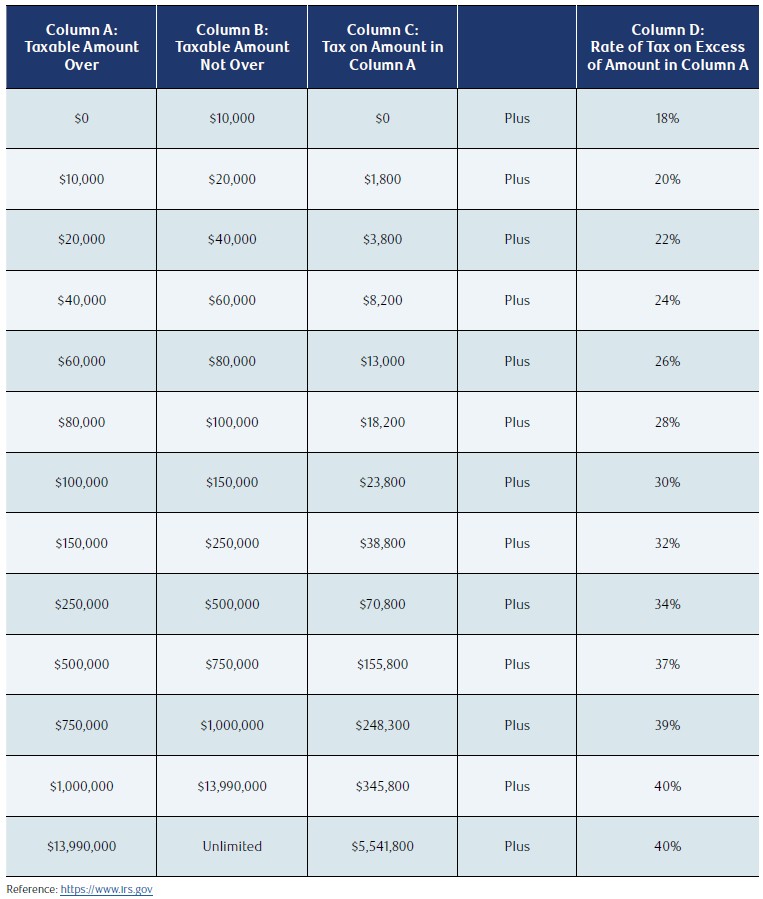
The U.S. tax system includes an inheritance and gift tax system referred to as the "U.S. transfer tax system". This system includes a U.S. estate tax, U.S. gift tax and U.S. generation skipping transfer tax (GSTT). For Canadians, U.S. estate tax only applies on death to the value of your "U.S. situs property" (i.e. property which has a U.S. connection or location). The tax is levied on an individual basis and is calculated based on a graduated tax rate system on the value of your taxable estate beginning at a rate of 18% and quickly moves to a top federal tax rate of 40% on the value that exceeds US$1 million. Canadians are entitled to claim a portion of a U.S. estate tax exemption (which may also be expressed in the form of a unified credit). For example, for 2025, the U.S. estate tax exemption amount is US$13.99 million, which if expressed as a unified credit amounts to US$5,541,800. Note that U.S. situs property transferred to your heirs directly may be subject to U.S. estate tax again when your heirs pass away.
The other two types of transfer tax, U.S. gift tax and GSTT, are not discussed in detail in this article. For more information about these taxes, please ask your RBC advisor for a separate article that provides information about the U.S. transfer tax system.
Overview of the changes to U.S. transfer tax laws for 2018 to 2025
Certain changes were made to the U.S. federal transfer tax laws as part of the other tax changes that were legislated and signed into law on December 22, 2017, otherwise known as the "Tax Cuts and Jobs Act" (P.L. 115-97). While these changes include provisions that substantially reduce exposure to U.S. transfer tax, it is important to note that the laws have a sunset provision. Of particular note:
- Starting January 1, 2018, the U.S. estate, gift and GSTT exemptions increase from US$5 million to US$10 million, subject to a new "chained CPI" inflation-adjustment factor.
- The increased exemptions expire after December 31, 2025.
- Beginning January 1, 2026, the amount of the exemption for U.S. estate, gift and GSTT will revert back to US$5 million (indexed to inflation), unless additional legislation is enacted to extend or change the legislation.
- The existing 40% maximum tax rate remains unchanged for 2018 to 2025.
Assessing whether you have U.S. estate tax exposure
The following quick-reference table will help you determine whether you may have U.S. estate tax exposure should you to pass away in 2025:
U.S. estate tax exposure for 2025
You must satisfy both of these thresholds to potentially have U.S. estate tax exposure:
- More than US$60,000 value of U.S. situs property
- More than US$13.99 million value of worldwide estate
Notes:
- The term "value" generally means the fair market value (FMV) at the date of death but an alternate acceptable valuation method can be chosen using the FMV six months after the date of death. The valuation method that's chosen must be used to value all property included in the worldwide estate. These values are calculated on a per individual basis and not per family or per couple. The terms "U.S. situs property" and "worldwide estate" are defined in the sections that follow.
- If you satisfy both thresholds you may have exposure to U.S. estate tax. You must perform a calculation to estimate your potential estate tax liability as there are certain credits or deductions that you may be able to claim. Your RBC advisor has access to a tool that may be helpful to estimate your potential exposure.
- If the value of your U.S. situs property on death is greater than US$60,000, your estate representative must file a U.S. estate tax return regardless of the value of your worldwide estate and regardless of whether there is an estate tax liability.
Estimating your potential U.S. estate tax liability
To help you assess your exposure, the following sections explain how to calculate an estimate of your estate tax liability if you were to pass away. You first calculate your taxable estate value, apply the graduated estate tax rates to arrive at a tentative U.S. estate tax, claim a prorated unified credit and the marital credit (where applicable) to arrive at your U.S. estate tax liability.
Note that the calculation of U.S. estate tax is complex and the information is presented in a very simplified format. Changes in your net worth and/or the U.S. estate tax laws can significantly impact your exposure. With that in mind, it's recommended that you assess your exposure annually with the assistance of a qualified cross-border tax advisor.
Taxable estate value
You can estimate your taxable estate value using the following formula:
Taxable estate value = U.S. situs gross estate value – non-recourse debt – allowable deductions
When doing this calculation, you should note that:
- The U.S. situs gross estate value is the FMV of all your U.S. situs property (examples of U.S. situs property is provided in another section) on the date of death or based on the alternative acceptable valuation method (discussed earlier).
- Non-recourse debt is a debt obligation collectable only against the U.S. situs property itself and not against any other property of the estate.
- Allowable deductions include the value of U.S. situs property donated to qualified U.S. charities, a prorated portion of regular debts and expenses (including funeral costs, administrative expenses and regular debts) and estate tax paid to a U.S. state. An example of prorated regular debts and expenses is if you have a regular mortgage on a U.S. real estate property, you can deduct only a prorated portion of the value of the mortgage in contrast to a non-recourse mortgage where you can deduct the entire value of the mortgage from the value of your U.S. situs property. The prorated portion of regular debts and expenses that is deductible is calculated by multiplying the amount of the regular debt and expenses by the ratio of your U.S. situs gross estate value (net of non-recourse debt) to your worldwide estate value. The deduction for estate tax paid to a U.S. state is based on the following formula:
Deduction for state death taxes paid = (total value of property in the gross estate subject to state death taxes / gross estate located in the U.S.) × total state death taxes paid
What is U.S. situs property?
U.S. situs property is property that has a U.S. location or connection. Examples of U.S. situs property include (but are not limited to):
- U.S. real estate;
- Property of a trade or business conducted within the U.S. such as shares of a non-publicly traded U.S. private corporation;
- Shares in publicly traded U.S. corporations, whether held in a brokerage account in Canada or outside Canada and whether purchased on a U.S. exchange or foreign exchange;
- Bonds, debentures and other debt obligations issued by U.S. individuals, U.S. corporations and U.S. governments, unless they're specifically exempt under the portfolio interest exemption (generally, the portfolio interest exemption applies to U.S. debt obligations that were issued after July 18, 1984, and are not subject to U.S. non-resident withholding tax on interest payments). An obligation of a U.S. corporation includes stock options and deferred compensation owned by an employee;
- Obligation of U.S. employers to employees or directors, such as deferred compensation, stock options or other awards whether or not the services were performed in the U.S.;
- Tangible property permanently situated in the U.S. (e.g. vehicles, art, boats, jewelry, cash in a safety deposit box located in the U.S.);
- U.S. retirement plans (e.g. Roth and traditional IRAs, Simple and SEP IRAs, 401(k)s, 403(b)s, other qualified retirement plans and annuities);
- Deposits in a U.S. brokerage firm, as they're not considered cash deposits at a bank (note that cash deposits whether denominated in Canadian or U.S. dollars at a U.S. or Canadian bank are not U.S. situs property);
- Gifts of U.S. situs property made during your lifetime if you've retained a life interest in the property or your gift was revocable, i.e. you have a right to income, possession or enjoyment, the right to designate who will enjoy the property or the right to take them back (e.g. U.S. situs property includes U.S. property held in Canadian registered plans such as RRSPs, RRIFs, RESPs, RDSPs or TFSAs, in an alter-ego or joint partner trust, or in a revocable trust);
- Any of the U.S. situs property mentioned above that you've been given a general power of appointment over which is a right that you can exercise to dispose of the U.S. situs property in favour of yourself, your creditors, your estate or your estate's creditors or the power to change the trust (e.g. U.S. situs property includes U.S. property held in a trust where you are the beneficiary and you have the power to have the property in the trust transfer to your estate or to use the trust property to pay your creditors or the creditors of your estate upon your death or the power to change the trust);
- Any of the previously listed types of U.S. situs property held in discretionary managed accounts (whether held in a brokerage account in Canada or outside of Canada and whether purchased on a U.S. exchange or foreign exchange), even though the buy and sell decisions are not made by you; and
- All U.S.-listed Exchange-Traded Funds (ETFs) (e.g. iShares) including those that are legally structured as a Regulated Investment Company (RIC)
Property with U.S. content that is not U.S. situs property
Examples of property with U.S. content that are generally not considered U.S. situs property include:
- Shares of Canadian mutual fund corporations that invest in the U.S. market (even if denominated in U.S. currency);
- Units of Canadian mutual fund trusts (including ETFs) trading on the TSX or another exchange that invest in the U.S. market;
- Canadian-issued notes linked to a U.S. index;
- American Depository Receipts (ADRs), as the underlying share holdings are not U.S. corporations;
- U.S. bank chequing or savings deposits, as long as they're not effectively connected with a U.S. trade or business (this would apply also to U.S. dollars in bank chequing and savings deposits in a Canadian bank that are not connected with a U.S. trade or business);
- U.S. Treasury Bills or U.S. Certificates of Deposit;
- U.S. corporate and government bonds that are subject to the portfolio interest exemption (this means there's no U.S. requirement to withhold tax on the interest paid to a non-resident of the U.S. and the investments are not used in a U.S. trade or business); and
- Canadian-issuer U.S. pay bonds that provide exposure to the U.S. dollar.
What is your worldwide gross estate value?
Your gross worldwide estate value is the FMV of all your property on the date of your death (or other acceptable valuation date). In addition to property you own directly, here are examples of property that's also included in your worldwide estate:
- Proceeds payable to beneficiaries of any life insurance policy you owned upon your death where you had "incidents of ownership" on the policy (this generally means you had the ability to name or change beneficiaries, borrow against the policy, access the cash value or assign or cancel the policy);
- 100% of the value of the property you owned as a joint tenant with the right of survivorship (JTWROS), unless you can prove that the other joint tenant contributed capital;
- Any property you've gifted during your lifetime where you've retained a life interest or where your gift was revocable; and
- All property where you have a general power of appointment over such property.
Tentative U.S. estate tax liability
Once you determine the taxable estate value, the tentative U.S. estate tax liability may be calculated using the graduated tax rates in effect in the year of death. Refer to Appendix A for a table of the graduated U.S. estate tax rates.
U.S. estate tax liability
You may claim a US$13,000 non-refundable credit to reduce your tentative estate tax liability. However, if the credit provided by the Treaty referred to as the "prorated unified credit" is greater, you can claim that credit instead. The Treaty also allows you to claim a "marital credit" when the heir is a surviving spouse.
The prorated unified credit
The prorated unified credit is calculated as follows:
Prorated unified credit = (U.S. situs gross estate value / Worldwide gross estate value) × Unified credit for the year of death
The marital credit:
The marital credit is available when U.S. situs property is transferred to a surviving Canadian or U.S. resident spouse. It's important to note that a spouse for this purpose is considered to be someone you are legally married to, so common-law partners may not qualify for this credit.
The marital credit is calculated as the lesser of:
- The prorated unified credit; and,
- The U.S. estate tax that would otherwise be payable on the particular U.S. situs property transferred to your spouse (i.e. the tentative U.S. estate tax on the taxable estate before transfer, less the tentative U.S. estate tax on the U.S. situs property not transferred to your spouse).
The marital credit may effectively double the prorated unified credit.
Refer to Appendix B for a numerical example that illustrates a calculation of U.S. estate tax for a Canadian resident. An RBC advisor also has access to a tool that may be used to help you estimate your potential liability. You will need to provide an RBC advisor with an estimate of your "taxable estate value" and your "worldwide estate value". You should obtain assistance from a qualified cross-border tax advisor to estimate these values.
Claiming a marital deduction instead of the marital credit
Your estate may choose instead to claim a marital deduction instead of the marital credit if the U.S. situs property is transferred to a Qualified Domestic Trust (QDOT). The marital deduction effectively defers a portion or all of your U.S. estate tax liability. The deferral lasts until distributions of capital are made from the QDOT to your surviving spouse or your surviving spouse passes away. At this point, the U.S. estate tax liability that was deferred and U.S. estate tax on any growth of the property in the trust becomes payable. The U.S. estate tax liability is calculated based on the tax rates that existed in the year of your death when the deferral occurred. Keep in mind that you can't claim both a credit and a deduction and the credit would be claimed over the deduction where the credit is sufficient to minimize or eliminate your U.S. estate tax liability. Additional information regarding claiming the marital deduction with the use of a QDOT is provided in a separate article that discusses strategies to minimize your U.S. estate tax exposure. Please ask an RBC advisor for a copy of that article.
Claiming foreign tax credits for U.S. estate tax
For Canadian tax purposes, when a person passes away, there is no estate tax. However, the Canadian "deemed disposition rules" may trigger Canadian income tax. Only 50% of net capital gains (accrued gains less losses) on property in your non-registered accounts are taxable.
Under the Treaty, a foreign tax credit for U.S. estate tax may be claimed on your Canadian return to reduce federal tax attributable to income, profits or gains on U.S. situs property. However, the maximum foreign tax credit you can claim is limited to your Canadian tax liability, which may be much smaller than your U.S. estate tax liability. In addition, there may be double tax since Canadian provinces and territories generally don't allow you to claim foreign tax credits for U.S. estate tax.
If there are no accrued gains on the property subject to the deemed disposition rules or you transfer the property to your spouse (which transfers at its cost base) there may be no Canadian income tax to claim a foreign tax credit against. Also, for registered plans such as your RRSP/RRIF, the FMV of the plan is subject to Canadian tax; however, there is a tax-deferred rollover if the plan is transferred to a qualifying survivor such as your spouse. When there is no Canadian tax, double tax arises because your estate pays U.S. estate tax but you can't claim a foreign tax credit on your Canadian return to recoup it. In the future, when your spouse or other beneficiary pays Canadian tax on the U.S. situs property, they won't be able to claim an offsetting foreign tax credit based on the U.S. estate tax previously paid by you. Therefore, you may consider transferring U.S. situs property in your registered and non-registered plans to your qualifying survivor at FMV.
Filing requirements and penalties
If the value of your U.S. situs property on death exceeds the US$60,000 threshold, a U.S. estate tax return (IRS Form 706-NA) must be filed within nine months of the date of death. Keep in mind that this filing is required even though you may not have a U.S. estate tax liability.
If a U.S. estate tax return is not filed, the heirs of your estate will have no basis in the U.S. situs property they inherit. This is especially problematic for heirs who wish to sell inherited U.S. real estate. The result may also be a problem for an heir who inherits income-producing property since having no basis in the property means that deductions for tax depreciation may not be claimed.
The IRS may also impose penalties for both late filing and for late payment, unless there's reasonable cause. It may also impose penalties for valuation understatements that cause an underpayment of the tax. In addition, if your estate is trying to transfer U.S. real estate property, many transfer agents may not agree to transfer the property without proof of clearance from the IRS.
Consider your exposure and plan accordingly
Whether you own U.S. property for investment or for enjoyment, understanding your potential exposure to U.S. estate tax and implementing the appropriate strategies to minimize it is key to maximizing the value of the wealth you pass on to your heirs. Please ask an RBC advisor for a separate article discussing strategies that may help you reduce your exposure. Also keep in mind that it's important to review your estate plans on an ongoing basis. An estate plan should be flexible enough to allow for changes to be made when necessary due to shifting circumstances.
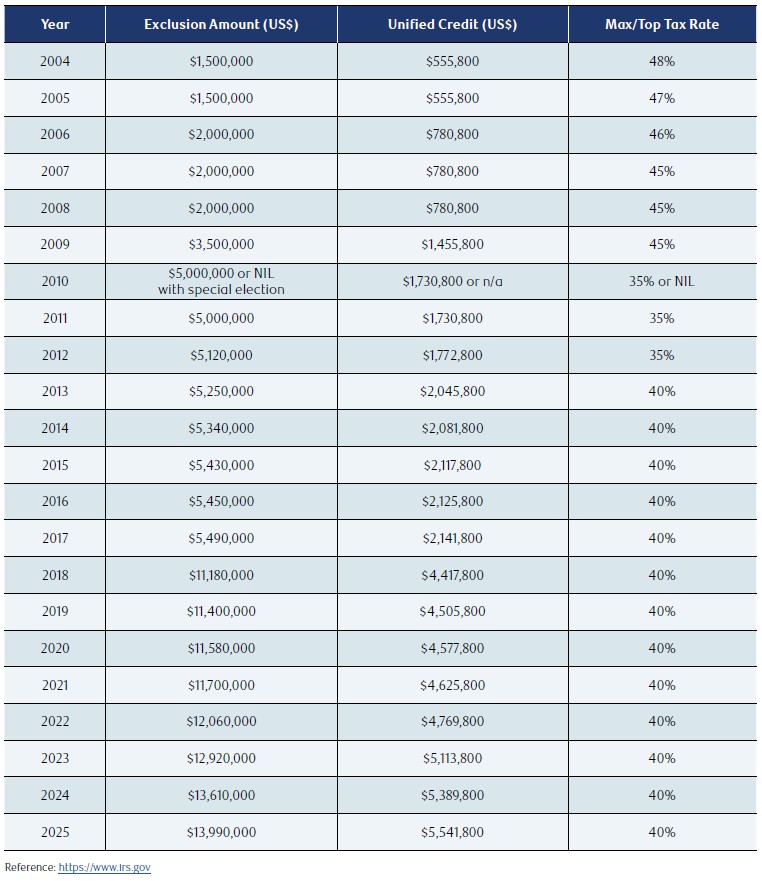
While the new U.S. estate tax laws are more generous, they are set to expire after 2025 and will revert back to the pre-2018 levels. In addition, it is impossible to know whether they'll be extended or if further changes to them will occur. Appendix C illustrates a history of the rates and exemption amounts over many years. With this in mind, you should consider the possibility for changes in tax rates and exemption amounts when reviewing your estate plans.
This article may contain information and strategies, not all of which will apply to your particular financial circumstances. The information in this article is not intended to provide legal, tax or insurance advice. To ensure that your own circumstances have been properly considered and that action is taken based on the latest information available, you should obtain professional advice from a qualified cross-border tax, legal and/or insurance advisor before acting on any of the information in this article.
If you would like to schedule some time to discuss the items outlined in this article, please click here to access our meeting scheduler.
Appendix A - Table of graduated U.S. estate tax rates for 2025
Appendix B - Sample calculation of U.S. estate tax for a Canadian resident in 2025
This calculation applies to Canadian residents (who are not U.S. citizens and not domiciled in the U.S.).
Mrs. C, a Canadian resident, owns U.S. situs property valued at US$4.5 million. Her worldwide estate is valued at US$22.5 million. Does Mrs. C have U.S. estate tax exposure?
STEP 1: Verify whether the value of her U.S. situs property and worldwide estate exceed the U.S. estate tax thresholds
Since the value of Mrs. C's U.S. situs property is greater than US$60,000 and the value of her worldwide estate is greater than US$13.99 million, she may have U.S. estate tax exposure. A calculation is required to estimate her exposure.
STEP 2: Estimate her taxable estate value and calculate the tentative U.S. estate tax using the table in Appendix A
Taxable estate value: US$4.5 million worth of gross U.S. situs property less $0 non-recourse debt less $0 allowable deductions.
Tentative U.S. estate tax: Using Appendix A, the tentative U.S. estate tax on US$4.5 million taxable estate value is US$1,745,800*
* US$345,800 (which is the U.S. estate tax on the first US$1 million in taxable estate value found in column C of the graduated tax rate table in Appendix A), plus US$1.4 million, which is 40% (tax rate in column D in Appendix A) of US$3.5 million (i.e. US$4.5 million less US$1 million from column C).
STEP 3: Estimate the prorated unified credit that can be deducted
The value that may be deducted is calculated by taking the value of your gross U.S. situs estate divided by your worldwide gross estate value and multiplying by the unified credit for the year (i.e. US$5,541,800 for 2025).
Ratio of the value of your gross U.S. situs estate to your worldwide gross estate value:
US$4.5 million ÷ US$22.5 million = 20%
Prorated unified credit:
US$5,541,800 × 20% = US$1,108,360
STEP 4: Subtract the prorated unified credit in step 3 from the tentative U.S. estate tax from step 2
Net U.S. estate tax payable before applying the marital credit (if applicable):
US$1,745,800 − US$1,108,360 = US$637,440
If Mrs. C is not married, US$637,440 will be her U.S. estate tax liability if she passes away in 2025.
Note: Mrs. C's executor/liquidator may be able to recoup some or all of the U.S. estate tax liability by claiming a foreign tax credit on her Canadian tax return to reduce any Canadian tax payable that's attributable to U.S. situs property.
STEP 5: If she's married (common-law partners may not be considered spouses) to a Canadian resident, a Canadian citizen or a U.S. resident and she leaves her property to her spouse, she can deduct an additional non-refundable marital credit
The marital credit is US$1,108,360, calculated as the lesser of:
- the prorated unified credit (i.e. US$1,108,360); and,
- the U.S. estate tax that would otherwise be payable on the U.S. situs property transferred to her Canadian spouse before any credits (i.e. US$1,745,800).
STEP 6: Subtract the marital credit in step 5 from the U.S. estate tax payable from step 4
Mrs. C's U.S. estate tax liability, if all her U.S. situs property are inherited by her spouse, is US$ NIL.*
*(U.S. estate tax before marital credit US$637,440 less marital credit of US$1,108,360 = US$NIL)
Appendix C - Table of U.S. estate tax exclusions, unified credits and top marginal rates from 2004 to 2025
If you would like to schedule some time to discuss the items outlined in this article, please click here to access our meeting scheduler.