U.S. estate tax for Canadians: Non-recourse mortgage strategy
How a non-recourse mortgage may reduce your exposure. This article is intended for Canadian residents who are not a U.S. citizen or U.S. domiciliary for U.S. estate tax purposes. Canadians may be subject to U.S. estate tax upon their death. U.S. estate tax applies only to "U.S. situs" property. This article discusses a strategy involving the use of a non-recourse mortgage (NRM) for Canadians who own U.S. real estate.
How a non-recourse mortgage may reduce your exposure. This article is intended for Canadian residents who are not a U.S. citizen or U.S. domiciliary for U.S. estate tax purposes. Canadians may be subject to U.S. estate tax upon their death. U.S. estate tax applies only to "U.S. situs" property. This article discusses a strategy involving the use of a non-recourse mortgage (NRM) for Canadians who own U.S. real estate.

Family Office Services
January 14, 2026
U.S. estate tax for Canadians: Non-recourse mortgage strategy
How a non-recourse mortgage may reduce your exposure
This article is intended for Canadian residents (Canadians) who are not a U.S. citizen or U.S. domiciliary for U.S. estate tax purposes. Canadians may be subject to U.S. estate tax upon their death. U.S. estate tax applies only to "U.S. situs" property (i.e. property that has a U.S. source or location). Examples of U.S. situs property include U.S. stock held in a registered or non-registered plan and ownership of U.S. real estate. You may have exposure to U.S. estate tax on death if the value of your U.S. situs property exceeds US $60,000 and the value of your worldwide estate exceeds the U.S. estate tax exemption threshold in effect in the year of your death.
There are several planning strategies available to Canadians to reduce their exposure to U.S. estate tax.3 This article discusses a strategy involving the use of a non-recourse mortgage (NRM) for Canadians who own U.S. real estate.
NRM versus conventional mortgage
An NRM is a type of mortgage where the lender's sole recourse in the event of default is to foreclose on the property that's been pledged as collateral to secure the mortgage. Unlike with a conventional mortgage, the lender does not have recourse over other property of the borrower, even if the value of the mortgaged property is insufficient to satisfy the debt.
This distinction is important for purposes of U.S. estate tax. In the calculation of your taxable estate subject to U.S. estate tax, a deduction is permitted related to your outstanding debt on the date of your death. However, not all debt is treated equally. In particular, the amount of the deduction you may claim can greatly differ depending on the type of mortgage you have.
With a conventional mortgage on U.S. real estate, since the lender has recourse over other personal property you own, only a portion of the mortgage (similar to other liabilities) is deductible against the value of your estate subject to U.S. estate tax. The deductible portion is calculated by multiplying the outstanding mortgage balance by the ratio of the value of your U.S. situs property to the value of your worldwide gross estate. With an NRM, since the lender can only foreclose on the U.S. real estate property in the event of default, the entire value of the outstanding NRM balance is deductible against the value of your U.S. taxable estate for U.S. estate tax purposes.
An NRM is generally a type of mortgage product offered by a financial institution in the U.S. However, it may be possible to set one up privately with any party willing to lend funds to you on a non-recourse basis in respect of your U.S. real estate. For U.S. estate tax purposes, the loan must be set up properly and must be a bona-fide loan with commercial terms. If you intend to set up a non-recourse mortgage privately, make sure you consult with a qualified tax and legal advisor.
Evaluating when to consider using an NRM
If you own U.S. real estate or plan to purchase U.S. real estate and you have U.S. estate tax exposure, you may consider an NRM as one of the potential strategies you can use to reduce your exposure. The following points should be considered when evaluating whether to implement an NRM:
- The interest rate on an NRM may be higher than that of a conventional mortgage; however, the additional interest cost may be outweighed by the U.S. estate tax savings.
- The amount of the NRM you can obtain on the property (the loan-to-value ratio) provided by a financial institution is generally limited to 60% of the value of the property, whereas the loan-to-value ratio for a conventional mortgage is usually higher (e.g. 70–80%), allowing for a larger mortgage. However, with an NRM, your U.S. estate tax liability may be lower because you can deduct the entire outstanding balance against the value of your estate, whereas only a portion of the conventional mortgage is deductible.
Your equity in the property (i.e. the fair market value of your interest in the property in excess of the NRM) is still exposed to U.S. estate tax. Any future appreciation of the property in value or repayments of principal on the loan will increase the value of your U.S. taxable estate and therefore your exposure to U.S. estate tax. Should your property appreciate in value, you may consider refinancing to increase the value of the NRM and manage your U.S. estate tax exposure. You would need to consider the loan-to-value limit that applies to the NRM if the NRM is provided by a financial institution, and your tolerance to carry debt. - When determining how much of an NRM you require to reduce your U.S. estate tax exposure on death, you may want to consider your potential Canadian income tax liability with respect to the property on death. If the property has appreciated in value, you may be subject to tax in Canada on 50% of the accrued capital gains on death. If you're also subject to U.S. estate tax on this property, your estate may be able to claim a foreign tax credit (FTC) on your Canadian income tax return for the U.S. estate tax incurred, reducing your overall Canadian tax liability. Note that the FTC may only be used to reduce your Canadian federal taxes payable and not your provincial taxes payable. If there are no accrued capital gains on the property on death, there may be no Canadian income tax against which you can claim an FTC for U.S. estate tax.
- While an NRM strategy may help eliminate your U.S. estate tax liability, you may still have to file a U.S. estate tax return if the value of your property is greater than US$60,000 even though you have no estate tax liability.
- The terms and conditions associated with an NRM should be understood and considered. For example, does the lender have the power to force a sale of the property in the event the property substantially declines in value? You should review the terms of your NRM agreement with a qualified legal advisor.
- The interest on any mortgage used to acquire personal use property may not be deductible for Canadian income tax purposes.
A numerical example to demonstrate the U.S. estate tax savings when an NRM is implemented is provided in the Appendix.
Leverage strategy for property owned free-and-clear
If you own your U.S. real estate free-and-clear or plan on purchasing U.S. real estate outright, there is a leverage strategy involving an NRM that you may consider with the advice from a qualified cross-border tax advisor.
This strategy involves taking out an NRM against the property and using the loan proceeds to invest in a portfolio of securities in a non-registered account that earns interest or dividend income. The NRM reduces your U.S. estate tax exposure by reducing the value of the U.S. property. It may also reduce the cost of financing the mortgage, as the interest paid on the NRM may be deductible on your Canadian income tax return.
When implementing this strategy, consider choosing a portfolio of Canadian investments rather than U.S. investments, since holding U.S. investments would increase the value of your U.S. situs property and thereby your U.S. estate tax exposure.
Keep in mind, a strategy involving the use of loan proceeds to purchase investments that are subject to market fluctuations is not appropriate for everyone. You should consider your tolerance for risk and seek qualified financial advice related to your own personal circumstances before implementing any leverage strategy.
Evaluating your options
Under the right circumstances, an NRM may be a useful strategy for Canadians who own U.S. real estate to reduce or eliminate their exposure to U.S. estate tax and to help enhance their wealth. However, other potential strategies to reduce U.S. estate tax exposure should also be considered. Talk to a qualified cross-border tax or legal advisor, about the potential appropriateness of implementing an NRM strategy.
This article may contain strategies, not all of which will apply to your particular financial circumstances. The information in this article is not intended to provide legal, tax or insurance advice. To ensure that your own circumstances have been properly considered and that action is taken based on the latest information available, you should obtain professional advice from a qualified tax, legal and/or insurance advisor before acting on any of the information in this article.
Appendix: Comparison of U.S. estate tax liability for a Canadian resident who dies in 2026 where there is no mortgage, a conventional mortgage or a non-recourse mortgage (NRM) on U.S. real estate
Bob is married to Janet. Both are Canadian residents who do not have U.S. citizenship or U.S. domicile for U.S. estate tax purposes. Bob's worldwide estate is valued at US $21 million. Included in his worldwide estate is a personally owned vacation property located in Florida worth US $2.5 million (the "Florida Property"), which they own free-and-clear and shares of a U.S. corporation worth US $2 million. Janet owns no property and will inherit all of Bob's assets on his death.
Bob passes away at the beginning of 2026 and Janet passes away a few years later (this example will use the 2026 U.S. estate tax rates for purposes of the illustration). In 2026, the U.S. estate tax exemption is US $15 million (i.e. unified credit of US $5,945,00).
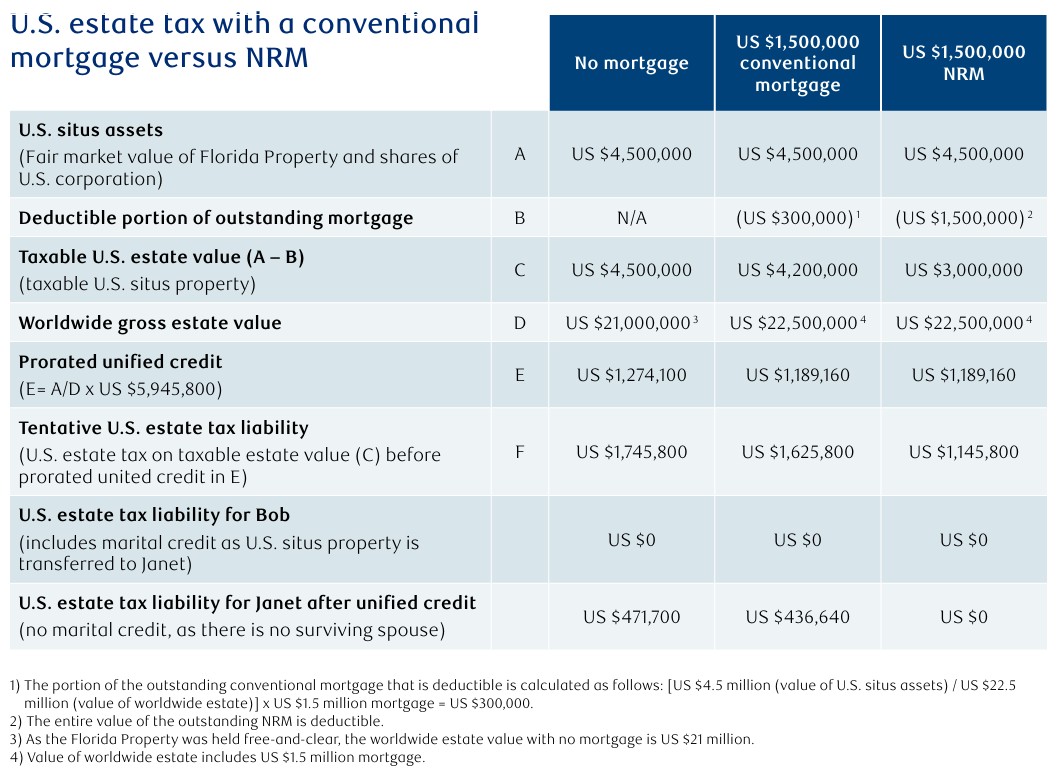
Below is an illustration of Bob and Janet's U.S. estate tax liability in three scenarios: where there is no mortgage on the Florida Property, where there is a conventional mortgage, and where there is an NRM. In the scenarios where there is a mortgage in place on the Florida Property, we have assumed that the mortgage amount is US $1.5 million (i.e. 60% loan-to-value). The value of the mortgage increases Bob's worldwide estate to US $22.5 million.
Bob's U.S. estate tax liability is calculated taking into consideration certain credits, including the marital credit that's available if his U.S. situs property is left to Janet. As a widow, this credit will not be available to Janet when she dies.
As illustrated in the table, due to the current U.S. estate tax exemption threshold and the ability to claim a marital credit, there is no U.S. estate tax payable upon Bob's death whether or not an NRM or conventional mortgage is in place at the time of Bob's death. However, there is U.S. estate tax exposure when Bob's surviving spouse, Janet, passes away. Having an NRM on the U.S. real estate minimizes Janet's U.S. estate tax liability.
It's important to note that in any situation, a cost-benefit analysis needs to be done to evaluate the merits of an NRM versus a conventional mortgage. The analysis would take into consideration the higher interest rate as well as the lower loan-to-value ratio with an NRM as compared to a conventional mortgage. In addition, the terms and conditions of the NRM should be considered.
If you would like to schedule some time to discuss the items outlined in this article, please click here to access our meeting scheduler.