U.S. Income Tax and Other Filing Requirements for U.S. Persons Living in Canada
U.S. persons living outside of the U.S. are required to file U.S. income tax returns on an annual basis, irrespective of their tax status in the country they live in. This article provides information regarding some of the common U.S. income tax and other U.S. filing requirements that apply to U.S. persons living in Canada, including foreign reporting requirements and voluntary disclosure options.
U.S. persons living outside of the U.S. are required to file U.S. income tax returns on an annual basis, irrespective of their tax status in the country they live in. This article provides information regarding some of the common U.S. income tax and other U.S. filing requirements that apply to U.S. persons living in Canada, including foreign reporting requirements and voluntary disclosure options.

Family Office Services
July 14, 2024
U.S. Income Tax and Other Filing Requirements for U.S. Persons Living in Canada
This article assumes you're a U.S. person (i.e., a U.S. citizen or U.S. resident, including a U.S. green card holder) living in Canada. If you're not sure whether you're considered a U.S. person, please ask your RBC advisor for a separate article on that topic.
The U.S. tax system imposes income tax based on both citizenship and residency status. U.S. persons living outside of the U.S. are required to file U.S. income tax returns on an annual basis, irrespective of their tax status in the country they live in. This article provides information regarding some of the common U.S. income tax and other U.S. filing requirements that apply to U.S. persons living in Canada.
Your U.S. income tax liability
U.S. persons who are Canadian residents for tax purposes also have an obligation to file a Canadian income tax return and pay Canadian income taxes. While both countries impose tax on your worldwide income (i.e., income from all sources worldwide), each country's income tax legislation differs, as do their filing requirements. As such, it's important to understand the different filing requirements.
As you're liable for taxes in both countries, you may face double taxation. However, you may be able to claim foreign tax credits (FTCs) to reduce or eliminate double taxation. Further, the Canada-United States Tax Treaty (the Treaty) may allow you to claim additional FTCs or deductions. To benefit from the Treaty, you may be required to file various income tax and information returns in both countries, annually.
Here's an example of when FTCs can help mitigate your exposure to double taxation. Let's assume you earn employment income in Canada (i.e., all your workdays were in Canada). Canada generally has the first right to impose income tax on that income. While you have to include your Canadian sourced employment income on your U.S. income tax return, an FTC related to that employment income may be claimed on your U.S. income tax return. The FTC may reduce or eliminate your U.S. income tax liability by the amount of Canadian income tax paid.
If, on the other hand, the employment income you earn is U.S. sourced (i.e., all your workdays were in the U.S.) and your employer is located in the U.S., the U.S. generally has the right to tax the income first and an FTC may be claimed on your Canadian income tax return for the U.S. income tax paid.
The FTC mechanism for U.S. income tax purposes differs from the Canadian FTC rules and the rules are complex. Foreign income and the related foreign taxes paid are grouped into separate categories based upon the type of income. Generally, the FTCs from one category may only be used to reduce the U.S. tax liability for that category of foreign income and FTCs from different categories can't be combined. For example, the foreign income tax related to employment income (the general category) may be claimed to reduce the U.S. tax liability on foreign employment income and can't be used to reduce the U.S. tax liability related to foreign investment income (the passive category). However, if foreign investment income is "high-taxed income," it would not be included in the passive category but instead would be included in the general category. High-taxed income is income where the foreign taxes paid on the income (after allocation of expenses) exceed the highest U.S. tax that can be imposed on the income.
The risk of double taxation for a U.S. person who's a resident of Canada is usually low. This is because Canadian income tax rates are generally higher than U.S. income tax rates, and the higher Canadian income tax rates are also applied at much lower income thresholds (i.e., tax brackets). An FTC claimed for Canadian taxes paid may fully offset your U.S. income tax liability so that no double tax occurs. As a result, where the same employment income is taxed in both countries, you typically end up paying the higher tax rate of the two countries, which is often the Canadian income tax rate.
In the event you can't fully use your FTCs from Canadian taxes paid, the U.S. tax rules allow for the unused credits to be carried back to the immediately preceding year (if applicable) and then carried forward 10 years. As previously discussed, these unused FTCs must be separated into different income categories.
For U.S. income tax purposes, there's also the option to claim an exclusion or deduction of a certain portion of your employment income earned from foreign sources (e.g., Canadian source employment income). The exclusions and deduction are referred to as the "foreign earned income exclusion" and the "foreign housing exclusion or deduction." Information on how to qualify for these exclusions or deduction is not discussed in this article; however, if you choose to claim them, you can't also claim an FTC for the foreign taxes paid on the amounts deducted or excluded from your taxable income on your U.S. income tax return. If you live in a high-tax country, such as Canada, there may be benefits to claiming FTCs instead of using the exclusions or deduction. A qualified professional cross-border tax advisor can determine whether it's more tax efficient to claim the exclusions and/or deduction versus the FTC.
The FTC system and the interplay between both countries is complex. Generally, if your income is primarily earned in Canada, your U.S. income tax liability after applying the possible exclusions, deductions or FTCs may be eliminated. However, it's also possible that you may still incur a U.S. tax liability because there may be differences in each country's income tax laws for the timing of income recognition and allowed deductions and credits. There may also be differences related to who is the taxable person or entity in each country.
Whether you have a U.S. income tax liability or not, you're still required to file a U.S. income tax return when you meet the U.S. minimum tax filing requirements for the particular year.
U.S. Net Investment Income Tax (NIIT)
The U.S. introduced the 3.8% NIIT applicable to 2013 and subsequent tax years. The NIIT applies to your net investment income when your total gross income, as modified under the NIIT rules, (the complexity of which is beyond the scope of this article) is more than certain thresholds. For example, U.S. persons who are married and file their U.S. income tax return jointly are subject to the 3.8% NIIT on their net investment income to the extent the value of their combined modified adjusted gross income (as defined under NIIT) exceeds US$250,000. For married individuals filing separately, the threshold is US$125,000, and for those filing single, the threshold is US$200,000.
Your net investment income is your investment income less your investment expenses. Investment income includes items such as interest, dividends, capital gains, annuity income, royalties, rents and other passive income from all sources (not just U.S. source). Investment expenses include items such as investment interest paid, rental expenses incurred, and your income tax preparation fees.
U.S. income tax law does not allow you to claim an FTC to offset NIIT.
Talk to a qualified professional tax advisor about planning strategies to minimize your exposure to the NIIT. For example, if you're married and your spouse is not a U.S. person, your tax advisor may advise you to file your U.S. income tax return status as married filing separately, if your modified adjusted gross income is below the threshold (US$125,000), or if your non-U.S. spouse (who would not be subject to NIIT) earns most of the investment income.
U.S. federal income tax return filing requirements, deadlines and penalties
As a U.S. person, you generally must file a U.S. federal individual income tax return annually.
Normally, you must file your U.S. income tax return for a particular year no later than April 15 of the following calendar year. However, if you reside outside the U.S. on April 15 and your main place of business or employment is outside the U.S., the filing deadline is June 15. You may also be able to request an automatic extension to file your U.S. income tax return to no later than October 15. If the filing deadline falls on a weekend or legal holiday in the U.S., the due date is delayed until the next business day.
If you don't file your U.S. federal income tax return by the due date (including extensions), the U.S. may impose a late filing penalty. The penalty is usually 5% of the amount due for each month or part of a month your return is late. The maximum penalty is 25%.
Regardless of your filing deadline date, any U.S. tax owed must be paid to the Internal Revenue Service (IRS) by April 15 (or the next business day if April 15 falls on a weekend or U.S. legal holiday). If you don't pay your income tax by April 15, the IRS will impose an interest charge and a late payment penalty. The late payment penalty is usually 0.5% of any tax not paid by the regular due date of your return. It's charged for each month or part of a month the tax is unpaid. The maximum penalty is 25%.
Foreign reporting requirements and penalties
U.S. persons are required to disclose information about the various financial assets they own or have certain authority over that are located outside the U.S. (commonly referred to as foreign financial assets). Such foreign financial assets can include investments in Canadian or other non-U.S. securities held within registered or non-registered investment accounts and bank accounts, a direct interest in Canadian or other non-U.S. entities and trusts. Examples of when you may be considered to have authority over these assets include, but are not limited to, if you're acting as trustee, power of attorney or signing officer or director.
Various foreign reporting requirements apply to U.S. persons with such foreign financial assets, which are in addition to the requirement to file a U.S. income tax return. Some of the foreign reporting requirements only require disclosure of information and do not levy additional U.S. income tax, but some may result in additional U.S. income tax.
The foreign reporting requirements may include the filing of a report, a statement or a return, either with your U.S. income tax return or separately. In addition, the foreign reporting filing deadline dates may not coincide with the deadline to file your U.S. income tax return.
You may incur penalties for failure to file or for filing late. These penalties can be significant, some starting at US$10,000. However, higher civil and criminal penalties may apply for wilful failure to file.
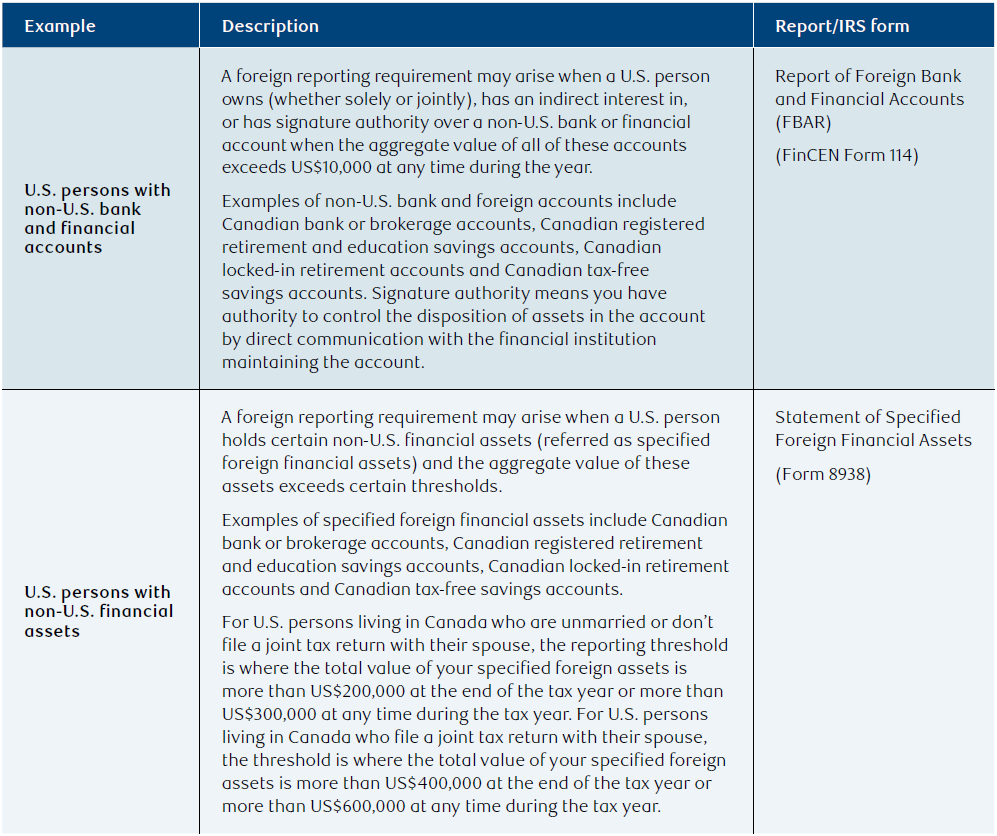
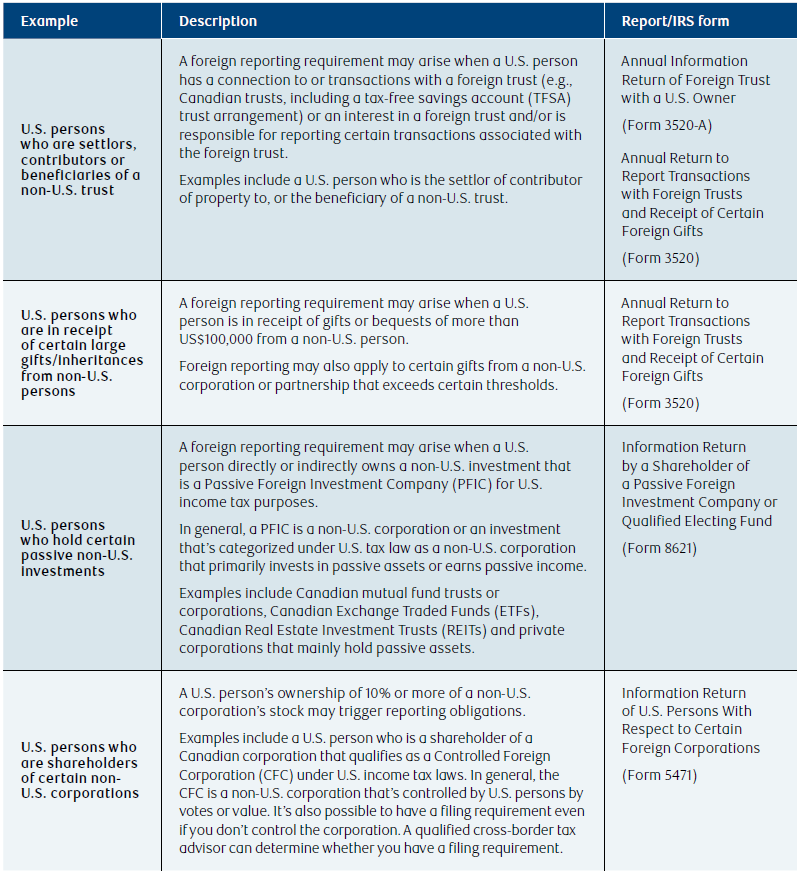
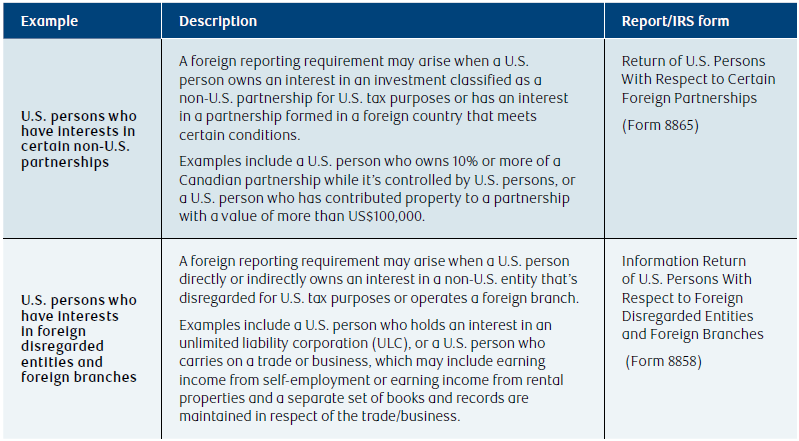
A table is provided in the appendix, which lists some of the more common examples where U.S. persons may have foreign reporting requirements for U.S. income tax purposes. The table provides general information only and is not an exhaustive list; therefore, you should consult with a qualified professional cross-border tax advisor for more information on the foreign reporting requirements that may apply to you.
Foreign Account Tax Compliance Act (FATCA)
The Foreign Account Tax Compliance Act (FATCA) was legislated in 2010. By way of an Inter-Governmental Agreement (IGA) between the Canadian government and the IRS, the Canada Revenue Agency (CRA) will collect certain information, which is in turn exchanged with the IRS.
FATCA requires non-U.S. financial institutions, such as Canadian brokerage firms and banks, to report relevant information about certain financial accounts held by U.S. persons to the CRA.
Voluntary disclosure for U.S. non-filers
In the interest of encouraging all U.S. persons to be compliant with their U.S. income tax and information return filing requirements, the IRS has implemented various voluntary disclosure programs over the years. Such programs provide methods by which noncompliant taxpayers, whether they live in the U.S. or not, can get up to date on their U.S. income tax and other filings. Depending on the program(s) in effect at the time, a certain number of previous year's U.S. income tax returns and U.S. foreign reporting returns must be filed with the IRS.
While there may be little or no U.S. income tax owing on your annual U.S. tax return due to the deductions and FTCs discussed earlier, there may be substantial penalties and, in some cases, criminal proceedings associated with wilful failure to comply with your U.S. tax obligations.
If you're not filing annual U.S. income tax returns or other required filings, you should speak to a qualified professional tax or legal advisor regarding your options.
U.S. state filing requirements
In addition to federal income tax reporting requirements, a U.S. person may have state reporting requirements. State filing requirements may arise if you've maintained your domicile in a state that taxes based on domicile, or if you have income from sources within that state, such as income from workdays in a particular state. Since each of the 50 states have different requirements, you should consult with your qualified professional tax advisor whether you're subject to state tax reporting.
Summary
It's important to be aware that although you're living in Canada, as a U.S. person, you continue to be subject to U.S. income tax filing and reporting requirements. In addition to having to file a U.S. income tax return, the U.S. tax law imposes various other information reporting requirements that may apply to you.
Since you're subject to both Canadian and U.S. tax laws, it's important to speak to a qualified professional cross-border tax advisor before you implement any type of tax planning based on the income tax laws of one country because it may be in conflict with the income tax laws of the other country. This may lead to unexpected tax consequences, such as double taxation.
This article may contain strategies, not all of which will apply to your particular financial circumstances. The information in this article is not intended to provide legal, tax or insurance advice. To ensure that your own circumstances have been properly considered and that action is taken based on the latest information available, you should obtain professional advice from a qualified tax, legal and/or insurance advisor before acting on any of the information in this article.
If you would like to schedule some time to discuss the items outlined in this article, please click here to access our meeting scheduler.
Appendix – Examples of foreign reporting requirements for U.S. persons
The following table lists some of the more common foreign reporting requirements that may apply to U.S. persons. This table provides general information only and is not an exhaustive list of all the possible foreign reporting requirements under U.S. income tax laws. You should consult with a qualified professional cross-border tax advisor for more information on the foreign reporting requirements that apply to you.
If you would like to schedule some time to discuss the items outlined in this article, please click here to access our meeting scheduler.