Wealth planning for health-care professionals – The peak earning years
Addresses tax, financial and retirement planning strategies for healthcare professionals in their peak earning years, including the benefits of incorporation, tax deferral strategies, family shareholder involvement, income splitting, professional corporation structuring, and wealth accumulation options such as holding companies, family trusts, individual pension plans and life insurance.
Addresses tax, financial and retirement planning strategies for healthcare professionals in their peak earning years, including the benefits of incorporation, tax deferral strategies, family shareholder involvement, income splitting, professional corporation structuring, and wealth accumulation options such as holding companies, family trusts, individual pension plans and life insurance.

Family Office Services
December 14, 2024
Wealth planning for health-care professionals – The peak earning years
Tax, financial and retirement planning will always play a key part at every stage of your career, whether you're a new graduate, working as an associate, running your own practice or approaching retirement. As your personal, professional and financial situations evolve, you should ensure that you've done appropriate planning to help you achieve your goals and objectives throughout the different stages of your professional life. This article addresses some of the issues you may face when you are in your prime earning years and you are well positioned to strategize on how you'll use the excess funds earned in your practice.
The terms "corporation" and "company" are used interchangeably to refer to a Canadian-controlled private corporation (CCPC) in this article. In simple terms, a CCPC is a Canadian corporation that isn't controlled by a non-resident of Canada or a public corporation or a combination of both. In addition, no class of shares of a CCPC can be listed on a designated stock exchange.
Peak earning years
In your peak earning years, your priorities will most likely include minimizing taxes, mitigating risks and accumulating wealth. If your practice is generating more income than you need to maintain your current lifestyle, incorporating your practice may have some tax advantages. These include the opportunity to defer tax by leaving surplus funds in the corporation, the ability to draw dividend income from a corporation when needed, the potential to income split with adult family members who are shareholders of the professional corporation (PC) in certain circumstances and, the potential to multiply the lifetime capital gains exemption (LCGE) on an eventual sale of shares of the PC.
Potential tax deferral
Perhaps the most significant advantage of operating your practice within a corporation is the ability to defer taxes. Professional income earned within a corporation is taxed at two levels – once at the corporate level and then again at the personal level when the income is distributed. By incorporating and earning professional income within your corporation, you can defer personal taxation on the professional income until the time you withdraw it from your corporation. Generally, the longer you can leave the funds in your corporation, the greater the deferral advantage will be.
This tax deferral is available because income earned from operating your practice within a corporation may be taxed at lower corporate tax rates than professional income earned while operating as a sole proprietor, where the income is taxed at your individual marginal tax rate. If the professional income is earned by your corporation, the taxable income may be considered active business income (ABI) for tax purposes and be subject to a general federal corporate tax rate of 15% plus the applicable provincial or territorial corporate tax rate. Further, if your corporation is a CCPC throughout the tax year, your corporation may benefit from the small business deduction (SBD) which lowers the federal tax rate to 9% on its first $500,000 of ABI (known as the "business limit").
As a result of these lower corporate tax rates for ABI, if you incorporated your practice, you may have more after-tax professional income to invest inside your corporation. Due to the larger amount of starting capital, you may realize after-tax returns that exceed what you may have realized in a personal investment account.
In an attempt to limit this tax deferral benefit for corporations, the federal government introduced rules to restrict access to the SBD for CCPCs that have significant income from passive investments. A CCPC will have its federal small business limit reduced on a straight-line basis where the CCPC and its associated corporations earn between $50,000 and $150,000 of passive investment income in a year. The business limit will be reduced by $5 for every $1 of passive investment income above the $50,000 threshold. The business limit will be eliminated if a CCPC, and its associated corporations, earn at least $150,000 of passive investment income in a year. The provincial or territorial small business limit may also be reduced for CCPCs that have significant income from passive investments. Confirm the specific rules for your province or territory of residence with a qualified tax advisor.
All provinces and territories also provide a SBD and have a small business limit of $500,000, except for Saskatchewan, which has a limit of $600,000. Additional criteria must be met in order to qualify for the Quebec SBD. Corporations will only qualify for the Quebec SBD if they operate in the primary or manufacturing sectors or where the corporation meets the minimum number of remunerated hours test.
In addition to the reduction based on passive investments, the federal business limit may be reduced based on taxable capital. For corporations (and their associated corporations) that have taxable capital employed in Canada of more than $10 million, the federal business limit is reduced on a straight-line basis and is eliminated when taxable capital is $50 million or more. The actual reduction of a corporation's business limit is the greater of the reduction based on taxable capital employed in Canada and the reduction based on passive investment income. Finally, the business limit must be allocated among all associated corporations.
Practical issues in structuring a PC
The Income Tax Act (the Act) allows for several tax-deferred transfers involving taxable Canadian corporations, which includes PCs. If you already have a non-incorporated professional practice and you want to transfer it into a PC, you must first establish a corporation and obtain the appropriate license or permit from your professional governing body. You should contact the appropriate professional governing body regarding conditions of incorporation specific to your profession in the jurisdiction. Once the PC has obtained the appropriate licence or permit, you may transfer the practice assets to the PC. You may be able to transfer the assets on a tax-deferred basis.
If you're an individual partner of a partnership and wish to incorporate, you must first form a PC licensed to carry on the practice of your profession by applying to the appropriate governing body. You can then transfer your interest in the partnership to that corporation. It may be possible for you to transfer the interest of the partnership to the corporation on a tax-deferred basis. Alternatively, in certain instances, the partnership may be transformed into a PC on a rollover basis without adverse tax consequences to the partners. The partnership would transfer its property to a PC for consideration that includes shares of the PC. The partnership would then distribute the shares of the PC and any other assets received on the rollover to its partners. The partners would thereby become shareholders of the PC and would personally hold any other assets distributed to them by the partnership.
You should consult with a qualified tax professional when restructuring your professional practice and engage a qualified valuator when determining the fair market value (FMV) of the assets to be transferred, such as the value of the goodwill in your practice.
GST/HST issues
There are a number of goods and services tax (GST)/harmonized sales tax (HST) issues faced by medical and dental professionals and their PCs. The application of the GST/HST rules must be determined on a case-by-case basis. Depending on the type of services and supplies provided by you on behalf of your PC, the supply of property or service may be GST/HST taxable, exempt or zero-rated (taxable at the rate of 0%). For example, while most healthcare and dental services are exempt from GST/HST, the sale or supply of medical devices such as hearing aids and artificial teeth are zero-rated. On the other hand, surgical services rendered for cosmetic purposes and not for medical or reconstructive purposes are subject to GST/HST. It's important to know which goods and services are taxable and at what rate, not only to determine whether the PC should charge GST/HST on the goods and services provided but also to determine whether your PC is eligible to claim input tax credits on the GST/HST paid by your PC. You should speak with a qualified tax professional with expertise in this area to ensure your PC is complying with GST/HST legislation and is claiming credits that are available to your PC.
Corporate share structure
The articles of incorporation are legal documents that set out a corporation's purpose and regulations. It also sets out the number and various classes of shares that the corporation can issue and generally describes the rights, privileges, restrictions and conditions attached to the shares of each class. Examples of different rights and restrictions are:
- Voting rights;
- Participation in corporate surplus – shareholder's right to receive dividends;
- Redemption feature – corporation's right to buy back the shares for a fixed amount;
- Retraction feature – shareholder's right to sell the shares back to the corporation for a fixed amount;
- The right to cumulative dividends – cumulative dividends accrue each year even when they are not declared or entirely paid out to shareholders;
- The right to non-cumulative dividends – the right to non-cumulative dividends is extinguished if the directors do not declare the dividend in the period to which it relates (for example, by the end of the year); and
- The right to receive the residual property of the corporation on wind-up and dissolution.
Most corporations have a number of different types of shares authorized for issue, each with its own characteristics. A corporation may authorize an unlimited number of common shares to be issued. Preferred shares are a class of corporate capital stock that normally hold priority over common shares in terms of dividend payments and in distribution of the corporate assets on liquidation. Typically, the common shareholders have the right to a portion of the remaining assets of the corporation after any creditor claims against the corporation have been settled.
The type of share to be issued by your corporation will depend on a number of factors, including the need for asset preservation, the use of the SBD, and the general share ownership restrictions imposed by the provincial legislative bodies. Consult with a qualified legal advisor to determine what type of share is appropriate in your circumstances.
Introducing family members to the corporation as shareholders
Depending on the corporate structure permitted in your jurisdiction by the appropriate regulatory body, family members may be able to become direct shareholders or indirect shareholders of a PC through the use of a holding corporation or a trust. Family members may acquire shares through subscription from treasury or through acquisition of existing shares from the professional or other shareholders of the corporation, if applicable. They must acquire the shares of the PC at their FMV, otherwise various provisions of the Act may apply resulting in undesired tax consequences.
New PC
For a newly incorporated PC, planning may include identifying the types of authorized capital required, determining the subscription prices for shares and the persons who will subscribe for the shares.
A newly incorporated PC will have no value prior to issuing shares; therefore, the directors can issue shares at a nominal value. Once the assets are transferred to the corporation, the value of the corporation is equal to the value of those assets transferred in less debts of the corporation. The shares held by the professional represent the consideration for the net value of the assets transferred in.
Existing PC
Generally, family members who wish to become shareholders of an existing PC will need to pay FMV to purchase the shares of the PC, and they may not have sufficient capital available to acquire an interest in the corporation if the shares have a high value. You may be able to use an estate freeze to overcome this issue. An estate freeze may be implemented in various ways. One common technique to achieve an estate freeze is through the use of a share exchange whereby the professional exchanges their existing shares for fixed value special/ preferred shares of the PC, with a redemption price equal to the FMV of the existing shares. A valuation may be necessary if the existing PC is to be reorganized to admit new shareholders.
When you transfer property, such as common shares, to a corporation in return for fixed redemption-price special/ preferred shares, you have effectively frozen the value of that exchanged property (the "old" common shares) in the new special/preferred shares. New non-voting common shares of the PC with nominal or negligible value can now be issued to your family members, holding company or family trust, where applicable. To avoid the income attribution rules from applying, the new common shareholder(s) (family members, holding company or trust) should use their own funds or borrow to subscribe for these new shares and repay the loan and accrued interest with their own funds or dividend payments received from the PC. It may be possible to effect an estate freeze without triggering any immediate tax liability.
It's important to note that there are restrictions as to who can own shares of a PC depending on which jurisdiction the PC is authorized to practice in. For more information, please refer to the section on "Who can hold shares other than the professional?" You should speak with a qualified legal advisor before restructuring your PC to determine whether it's possible to include your family members as shareholders and if yes, how to proceed.
Who can hold shares other than the professional?
Each provincial jurisdiction has legislation governing the PC that includes restrictions on direct or indirect share ownership of the PC. The following table shows who can own shares of the medicine and dentistry PC other than the professional, in each jurisdiction:
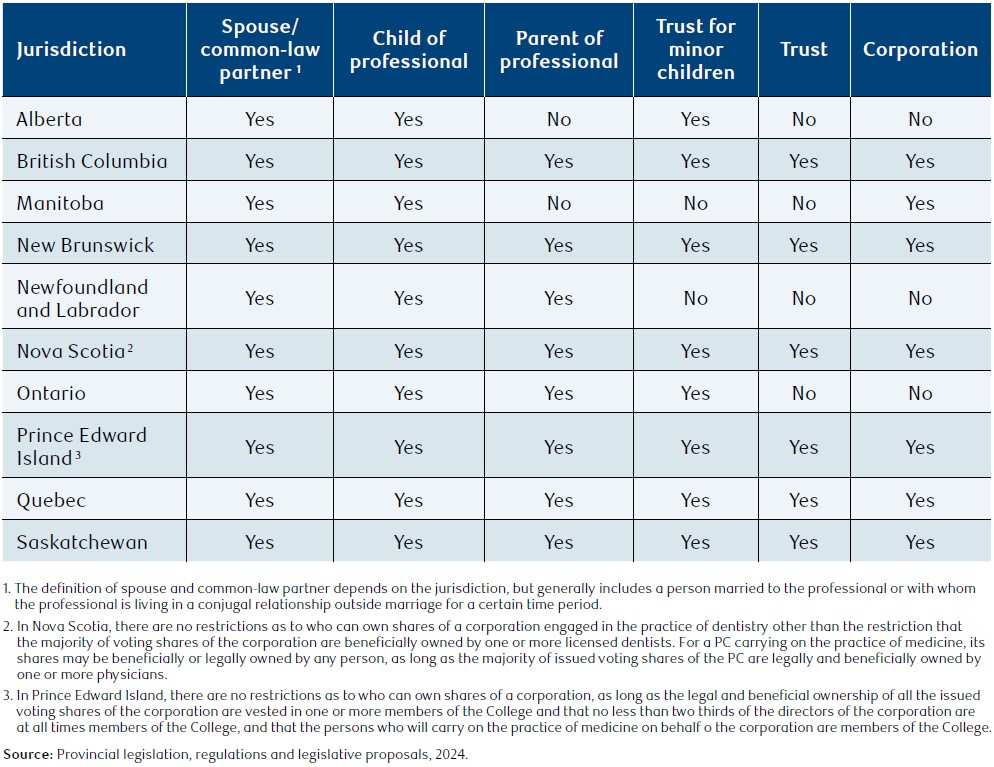
It should be noted that shares owned by persons other than the professional would have to be non-voting in order to comply with regulatory requirements. Most provinces only permit the professional to own voting shares of the PC.
Income splitting by paying dividends
The PC's retained earnings may be used to fund a number of expenses including the post-secondary education for a professional's child. If you're the sole shareholder of the PC, the dividend paid by the PC would be subject to tax in your hands at your marginal tax rate. If other family members are shareholders of the PC and their taxable income is nominal or nil, it's possible for your PC to pay them dividends to take advantage of their lower marginal tax rates. This strategy may be less applicable to PCs situated in provinces or territories where share ownership is restricted to members of a particular profession. In addition, it's important to note that there are "tax on split income" (TOSI) rules which limit splitting certain types of income with family members.
These TOSI rules apply to many types of income received from a private corporation, including interest, dividends, as well as certain capital gains but they don't apply to salaries or bonuses. Where TOSI applies, the income is subject to tax at the highest marginal rate, regardless of the individual's actual marginal tax rate. In addition, the individual who receives split income loses the ability to claim certain personal tax credits on the split income, such as the basic personal tax credit.
There are some exclusions to TOSI, however the exclusions are more restrictive for PCs. The exclusions mainly differ depending on the age of the individual receiving the income. The age categories include minors under age 18, adults aged 18 to 24, and adults aged 25 and over. The exclusions mainly rely on whether the family member is significantly involved in the business and are generally more restrictive for minors. There's also an exclusion available to the spouse of a professional who is age 65 or older. For more information on the TOSI rules, please ask your RBC advisor for an article discussing income splitting through private corporations.
A payment of salary although not subject to the TOSI rules, would have to be reasonable in the circumstances and be based on the work performed by the family member. Speak with a qualified tax advisor to determine if you can income split with your family members through your PC.
Be mindful of corporate attribution
Corporate attribution rules apply when an individual transfers or lends property to a corporation and one of the main purposes of the transfer or loan is to benefit a spouse or a related minor child (which includes a grandchild, niece or nephew for the purposes of these rules) who owns 10% or more of any class of shares in the corporation. If corporate attribution applies, the individual who transferred or lent the property to the corporation is deemed to have received interest income in the year equal to the Canada Revenue Agency (CRA) prescribed rate of interest on the amount of the transferred property or loan.
Generally, where a freeze has occurred to benefit a spouse or a related minor child who owns 10% or more of any class of shares in the PC, the professional would be required to include in their income a deemed interest amount based on the value of the preferred shares distributed to the professional as part of the estate freeze.
This attribution rule does not apply if at least 90% of the PC's assets are used in the active business of the practice and not for passive investment purposes. The deemed interest income may be reduced by any interest received from the corporation or taxable dividends paid to the professional on the preferred shares. Therefore, it's important to consider the application of corporate attribution and the steps which may need to be taken to overcome this issue.
Association rules
As discussed earlier in the article, professional income earned in a PC is considered active business income for tax purposes and may be able to claim the SBD to lower the general corporate tax rate. However, the SBD is subject to a business limit, which must be allocated between associated corporations in a taxation year.
The association rules are complex and include several deeming rules. The following are just common examples of a variety of ways a PC can find itself associated with another corporation.
- Common control. If you own all the voting shares of your PC and also have a controlling interest in another incorporated business, both corporations will be associated.
- Cross-ownership. If you own a PC and your spouse controls another corporation and you own 25% or more of any class of shares of the corporation controlled by your spouse, either directly or indirectly as a beneficiary of a discretionary trust or shareholder of a wholly owned holding corporation, the corporations will be associated for tax purposes.
- Child/trust look-through rules. For the purposes of the association rules, a parent is deemed to own the shares owned by their child who is under the age of 18. The rules also deem each beneficiary of a discretionary trust to own all the shares that are owned by the trust. Together, these rules provide that the parent of a child under 18 years of age owns all the shares held by a discretionary trust of which the child is a beneficiary. If you and your spouse own a corporation and you set up a family trust that holds the shares of another corporation with minor beneficiaries, both corporations may be associated.
There may be ways to avoid the application of the association rules, such as issuing only shares of a "specified class" in certain instances. However, in addition to the above association rules, the Act also contains an anti-avoidance provision that will deem two corporations to be associated if it may reasonably be considered that one of the main reasons for the separate existence of one or more corporations is to reduce the amount of tax that would otherwise be payable.
The association rules are very complex, and you should seek advice from a qualified tax professional to determine whether these rules may apply in your circumstances.
Acquire another practice
If you enjoy running a practice and would like to expand your operations, you may consider investing in another practice. The purchase of the target practice can be structured as an asset purchase or a share purchase. If the seller is selling you the assets of the professional practice, you can either make the purchase as an individual buyer or you can first incorporate a new PC or use your existing PC to buy the assets. If the vendor is selling you the shares of a PC, you can incorporate another PC or have your existing corporation buy the shares from the vendor and subsequently merge the two PCs together to form one corporate entity. Although there is no tax advantage to having two separate PCs as both corporations would have to share one business limit due to the association rules, having two separate practices in two legal entities may provide you with greater flexibility down the road should you decide to sell the practice later on.
There are a number of options to consider when you are deciding on how to fund the acquisition of a second or subsequent practice. Speak with a qualified financial advisor to help you consider your options.
SR&ED program
If the PC earns revenue from clinical activities and research, the PC may be able to increase its cash flows with the Scientific Research and Experimental Development (SR&ED) incentive program. The SR&ED incentive program was established to encourage Canadian businesses of all sizes and in various industries to conduct research and development in Canada. Medical and dental industries are among those that are eligible for the SR&ED incentive. The program does not provide a grant but provides assistance in the form of a refundable investment tax credit, a reduction of taxes payable, or both, based on the allowable SR&ED expenditures claimed. To qualify for this incentive program, the work must advance the understanding of scientific knowledge or technology, address scientific or technological uncertainty and involve a systematic investigation or search by qualified personnel.
If a substantial portion of your PC's payroll expenses can be attributed to the development of the PC's dental or medical clinical innovation or research, the PC may be eligible to receive benefits under the SR&ED program. If you think you may qualify for this incentive program, you should contact a qualified professional with specialized SR&ED experience and knowledge for more information on how you may be able to benefit from the SR&ED program.
Surplus cash
Taking advantage of the tax deferral benefit of retaining funds in a corporation may ultimately lead to a buildup of surplus cash in the PC. Unfortunately, there are limited investment options for a PC since its activities are restricted to carrying on the practice of the profession and activities related to or ancillary to the practice of the profession. Although the investment of surplus cash earned by the PC is allowed, in some jurisdictions, the PC may not be allowed to invest in or hold real estate not used by the practice. In provinces where a holding corporation is permitted to hold shares of a PC, the PC may be able to move excess funds to a holding corporation via a tax-free intercorporate dividend and the holding corporation may then be able to invest in real estate opportunities or other investments.
Setting up a holding company
As stated previously, in some provinces, a holding company can own shares of a PC. A holding company that is properly positioned between a professional and a PC can have many uses. It can be used to distribute ownership interest; facilitate an estate freeze; provide a degree of creditor protection by holding excess cash, investments, insurance policies or land (note that a holding company cannot provide creditor protection against professional malpractice); possibly allow for income-splitting; and, potentially facilitate the use of the LCGE. When used in conjunction with professional advice, it may be able to provide greater flexibility in succession and estate planning.
Setting up a family trust
Where available, there are several benefits to having a family trust as a shareholder of your PC. For example, there is an opportunity for income splitting and tax minimization. Dividends can be paid from the PC to the family trust and allocated to and taxed in the hands of the adult children or grandchildren beneficiaries, who may have little to no income. Keep in mind that the TOSI rules may limit the benefits of using this strategy. There is also the opportunity for family members to have indirect ownership in the practice through the control of a trustee. The option of holding shares of a PC in a trust is not available for PCs governed by certain provincial regulatory bodies.
A family trust can also be used by the professional to split income with their low-income family members without the trust holding shares of the PC. You would first have to extract funds from your PC and then contribute the after-tax funds to a trust. If structured properly, you can shift investment income and capital gains earned on the funds that would otherwise be taxed in your hands at a high marginal tax rate, to the hands your intended beneficiaries.
Implementing an individual pension plan (IPP)
If you haven't already set up an IPP and you have been drawing an annual salary from the PC, now may be a good time to consider an IPP as you have likely accumulated funds in the corporation. An IPP is a defined benefit pension plan that a PC can set up for a professional. It's usually setup for one individual member but the benefits can also be extended to your spouse or other family members, if they are employed by the PC. In certain situations, an IPP can provide greater annual contribution limits than an RRSP. Contributions made to an IPP by the PC are deductible against the PC's income. An IPP is ideally suited for professionals over the age of 40 with significant employment income.
In addition to annual contributions, your PC can potentially make a large contribution when the plan is initially setup to cover your previous years of service (as far back as 1991 or the year of incorporation, whichever is later) prior to the IPP being established. Additional tax-deductible contributions may also be made to the IPP to make up for investment returns in the plan that are less than the 7.5% expected actuarial interest rate (in some provinces, this additional contribution is a requirement).
Assets in an IPP may be protected from creditors; however, they may be subject to locking-in provisions during retirement. Note that any asset protection strategy may not be effective if there are existing or potential creditor claims. It's essential you speak with a qualified legal advisor before exploring the asset protection options available to you.
Private health services plan (PHSP)
The PC can establish a PHSP for the professional who is also an employee of the PC. A PHSP is basically a plan established by an employer under a contractual arrangement with an insurer or a self-insured arrangement under which the employer pays for employee medical expenses (e.g., medical, dental, vision care, hospital care). The advantage of a PHSP is that payments made by the employer are tax-deductible and the professional is not required to include any of the payments in their income. Since the professional is also a shareholder, it is important that the amount is not considered to be a shareholder benefit; otherwise, the payments would become a non-deductible expense to the PC and a taxable benefit to the professional. To avoid the risk of the benefits paid under the plan being considered as a shareholder benefit, the benefits under the PHSP should be consistent with that which would be offered to an arm's length employee performing similar services.
Corporate-owned life insurance
If you need life insurance, for example to provide income protection for survivors, fund buy-sell agreements or pay capital gains tax on death, a corporate owned, tax-exempt insurance policy may be a solution. Life insurance premiums are generally not tax-deductible to the corporation. However, it's usually less expensive to fund the policy using after-tax corporate dollars as opposed to after-tax personal dollars. Provided the corporation is both the policyholder and beneficiary of the insurance policy, the professional will generally not be assessed a shareholder benefit. For example, if the PC's tax rate is 15% and the professional's effective tax rate is 40%, corporate owned insurance allows for the funding of the policy using $0.85 after-tax rather than $0.60. In the event of the death of the professional whose life is insured under the corporate life insurance policy, the non-taxable death benefit is paid to the corporation, which increases the corporation's capital dividend account by the amount of the insurance proceeds received in excess of the policy's adjusted cost base. The balance in the capital dividend account may be paid tax-free to the surviving shareholders.
If you plan on selling the shares of your PC, you should consider holding the life insurance policy in a holding corporation (if applicable) or personally rather than in your PC. Speak with a life licensed professional to determine if insurance makes sense in your circumstances.
Conclusion
As a professional that has operated your practice for a number of years and started accumulating excess funds in your practice, you may want to consider tax planning strategies such as incorporating to benefit from tax-deferral. Speak with a qualified tax advisor to consider your options and to determine if there are ways to maximize your after-tax earnings and savings.
This article may contain strategies, not all of which will apply to your particular financial circumstances. The information in this article is not intended to provide legal, tax or insurance advice. To ensure that your own circumstances have been properly considered and that action is taken based on the latest information available, you should obtain professional advice from a qualified tax, legal and/or insurance advisor before acting on any of the information in this article.
If you would like to schedule some time to discuss the items outlined in this article, please click here to access our meeting scheduler.