
Ari Black, CFA
Investment Advisor
August 17, 2026
Unplugging and enjoying nature

I forgot how much I enjoy camping and had the chance to get back to Algonquin over the August long weekend. It helps that camping is a lot more comfortable these days - 50 lb canoes, portable cots and air mattresses, chairs, gravity-fed water filters…and no wanigan!
And considering the rest of this month’s newsletter is unusually heavy on tax and financial planning, I thought I’d ease you in with a nice picture of the outdoors first.
This Month:
- Asset Location Is Usually An Easy Win.
- So Many U.S. investment Tax rules. Which Should You Care About?
- Beating the S&P 500 Is Harder Than It Looks.
- Should You Hedge Your USD Exposure? Probably Not.
- Is This Cool?
1. Asset Location Is Usually An Easy Win
Most investors spend a lot of time thinking about asset allocation - how much to hold in stocks versus bonds or other investments. Far less attention is paid to asset location: which investments should be held in which accounts.
A recent Vanguard study estimated that thoughtful asset location can add up to roughly 0.3% per year in after-tax returns for investors with a balanced portfolio and meaningful amounts in both taxable and tax-advantaged accounts.
This doesn’t require taking more investment risk and it’s likely just the starting point for improving tax efficiency.
Consider a simple example:
Assume an investor has a $1 million RRIF, a $1 million non-registered account, a $200,000 TFSA and a target asset allocation of 60% equities / 40% fixed income.
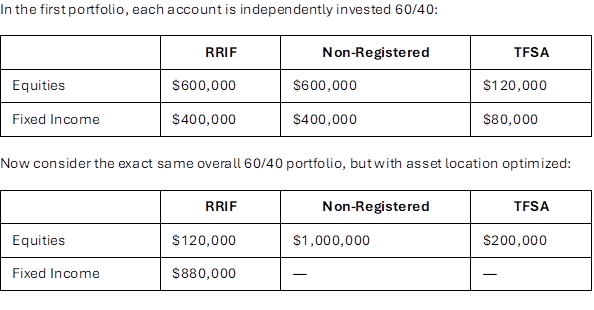
Source: Illustrative example
Nothing has changed about the investor’s overall asset allocation. They still own $1.32 million of equities and $880,000 of fixed income.
What has changed is where those investments are held.
Using simplified assumptions of a 5% fixed-income yield, a 2% equity dividend yield, and approximate tax rates of 50% on interest and 40% on dividends, the annual tax bill on the non-registered portfolio falls from roughly $14,800 to $8,000.
That’s about $6,800 per year—or 0.3% of the entire $2.2 million portfolio. But if the benefit continues and remains invested, it can add roughly $230,000-$300,000 of wealth over 15 years, assuming a 6-8% return.
Additional Opportunities
Beyond asset location, additional tax efficiency can come from deferring capital gains, harvesting losses when opportunities arise, and favouring more tax-efficient forms of return in non-registered or corporate accounts.
That’s why I think about tax-efficient investing in this order: get the asset allocation right, then the asset location, then look for opportunities to make the investments themselves more tax efficient.
2. So Many U.S. Investment Tax Rules. Which Should You Care About?
I run the risk of trying to pack too much into one piece with this topic. There are a surprising number of tax and reporting considerations for Canadians who own U.S. investments, and several could warrant their own article.
So consider this an overview. The table below summarizes some of the key differences between owning U.S. and Canadian investments personally and through a Canadian corporation.
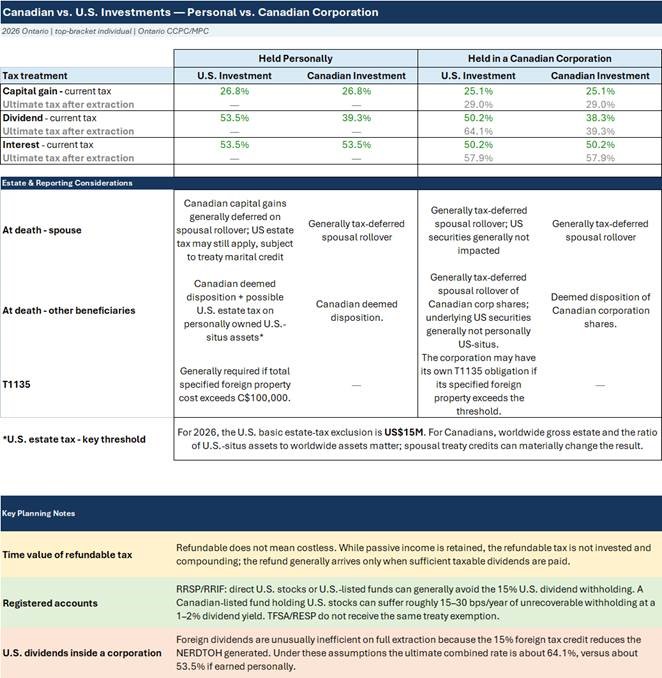
Source: RBC Wealth Management analysis, based on 2026 federal and Ontario tax rates and Canada/U.S. tax rules.
The $100,000 question
If the cost of your specified foreign property exceeds C$100,000 at any point during the year, you generally have an additional reporting requirement called a T1135.
For clients, this is typically a relatively minor administrative issue — we can provide your accountant with the foreign investment report needed to complete the filing.
Where you own it matters
One of the more counterintuitive areas is registered accounts.
In an RRSP or RRIF, directly owning a U.S. stock or U.S.-listed ETF can generally avoid the 15% withholding tax on U.S. dividends. Hold the same exposure through a Canadian-listed fund and that withholding can become an unrecoverable cost.
For a broad U.S. equity portfolio yielding 1–2%, that alone can represent roughly 15–30 basis points per year.
Asset location can matter even more in a non-registered account. U.S. dividends are taxed as foreign income and don’t receive the Canadian dividend tax credit. The impact becomes increasingly important for portfolios focused on higher-dividend U.S. stocks.
Corporations add another layer
Canada’s refundable-tax system is intended to broadly integrate corporate and personal taxation, but as the table shows, the result isn’t identical for every type of income.
The biggest outlier is U.S. dividends earned through a Canadian corporation, which can be particularly tax-inefficient once ultimately extracted personally.
There is also a time-value cost that isn’t obvious from the eventual tax rate. Some corporate passive tax may ultimately be refunded when dividends are paid, but until then that money isn’t invested and compounding.
The bigger issue at death
For wealthier Canadians, direct ownership of U.S. assets introduces another consideration: U.S. estate tax.
For 2026, the key number is USD$15 million of worldwide assets — not USD$15 million of U.S. assets. Once worldwide wealth exceeds that level, personally owned U.S.-situs assets can create U.S. estate-tax exposure, with federal estate-tax rates reaching as high as 40%.
Canada can also tax accrued capital gains at death. The Canada-U.S. tax treaty is designed to mitigate double taxation, but the combined tax burden can still become significant.
There is also an important distinction at the first death. Canadian assets can generally roll to a Canadian-resident spouse on a tax-deferred basis. U.S.-situs assets can still create a U.S. estate-tax issue, although additional treaty credits for assets passing to a spouse can materially change the result.
And once again, how you own the investment matters. U.S. securities held through a Canadian corporation or Canadian-domiciled investment fund generally don’t create the same personal U.S.-situs estate exposure as owning the U.S. securities directly.
For readers who want to dig into the calculations, PwC has a useful overview showing how U.S. estate tax depends on the relationship between U.S. assets, worldwide wealth and available spousal treaty credits.
The takeaway
None of this is a reason to avoid U.S. investments. It’s a reason to think beyond simply what you own.
Where you own it, how you own it and eventually how it passes to the next generation can all affect the after-tax result.
There are several other wrinkles I haven’t touched on here — including currency and adjusted cost base, U.S.-listed versus Canadian-listed funds, unusual structures such as U.S. partnerships, and the very different rules that apply to U.S. citizens living in Canada. I’ll come back to some of these in future notes.
Sometimes improving after-tax returns doesn’t require finding a better investment. It simply requires owning the same investment more efficiently.
This is a general overview only. Cross-border tax rules depend on individual circumstances. Investors with U.S. citizenship or other U.S. tax connections can face additional rules and should obtain appropriate cross-border tax advice.
3. Beating the S&P 500 Is Harder Than It Looks
Most professional investors eventually learn the hard way just how difficult it is to consistently beat the S&P 500.
Morningstar’s latest Active/Passive Barometer Report found that only 10.5% of active U.S. Large Blend funds survived and outperformed the S&P 500 over the past 10 years. Over 20 years, that success rate falls to just 4.9%.

Source: Morningstar
Lower fees improve the odds, but only so much. Over 10 years, 23.1% of the cheapest quintile of funds succeeded, compared with just 9.1% of the highest-cost funds.
And those numbers are already after fees, but don’t account for the potential tax impact of higher portfolio turnover in taxable accounts.
The takeaway isn’t that active management can’t work. Some managers will outperform. The problem is identifying them in advance - which may be almost as difficult as picking the winning stocks themselves.
So rather than making the entire portfolio dependent on getting manager selection right, it makes sense to hedge that bet: own some of the market beta directly and be selective about where we pay for active management.
4. Should You Hedge Your USD Exposure? Probably Not
Currency hedging sounds sensible: if you own U.S. or international investments, why take the additional risk that currencies move against you?
But for a long-term Canadian investor, I generally prefer not to hedge foreign equities.
There are a few reasons:
Currencies tend to be rangebound over long periods. Unlike equities, there is no fundamental reason to expect the Canadian dollar to compound higher over time.
Foreign currency can provide a natural hedge. The U.S. dollar, in particular, has historically tended to strengthen during periods of market stress. That can soften the impact of falling equity markets for a Canadian investor.
Hedging isn’t free. Based on current interest-rate differentials, hedging U.S. dollars back to Canadian dollars can cost roughly 1.5% per year. That means the Canadian dollar needs to strengthen by more than that simply for the hedge to pay off.
The hedge itself isn’t perfect. Fund flows, timing and implementation can all create tracking differences between the theoretical hedge and what an investor actually receives.
The historical numbers are interesting as well. Using a portfolio of one-third each in Canadian, U.S. and international equities, the unhedged version has outperformed the currency-hedged version over each of the periods I looked at:
Annualized return | 1 yr | 3 yr | 5 yr | 10 yr | 15 yr |
Hedged | 25.4% | 21.8% | 13.3% | 12.5% | 12.3% |
Unhedged | 26.1% | 23.3% | 14.4% | 13.1% | 13.5% |
Source: RBC Wealth Management analysis
That doesn’t mean unhedged will always win. A sharp rise in the Canadian dollar can absolutely hurt foreign investment returns in any particular year.
There are also situations where hedging makes sense - particularly when the money will be needed in Canadian dollars over a relatively short period, or when minimizing portfolio volatility is more important than maximizing long-term return.
But for long-term equity investors, I generally view foreign currency exposure as part of the diversification rather than a risk that automatically needs to be eliminated.
5. Is This Cool?
I keep hearing about neck fans. Maybe I should just skip a step and get ahead of the next trend.

Source: Financial Times
Closing Thoughts
A common thread this month is that improving investment results doesn’t always require finding a better investment. Where you hold it, how you structure it, what you pay and which risks you choose to take can all quietly make a meaningful difference over time.
Sometimes the boring details matter most.