
Ari Black, CFA
Investment Advisor
July 21, 2026
Start investing early. Compounding is powerful.

This past week was special as we celebrated my daughter’s Bat Mitzvah. Along with the celebration came some generous gifts – and her first meaningful opportunity to decide how much to spend and how to invest it for the future (with some significant guardrails!)
Starting early can matter more than people realize – as the graphic below shows (and brought to attention by President Trump and Michael Dell in their recent launch event on the Trump Accounts), time is the most important factor in building long-term wealth. Hopefully Canadians follow suit with something similar to help seed investments accounts compounding at birth.
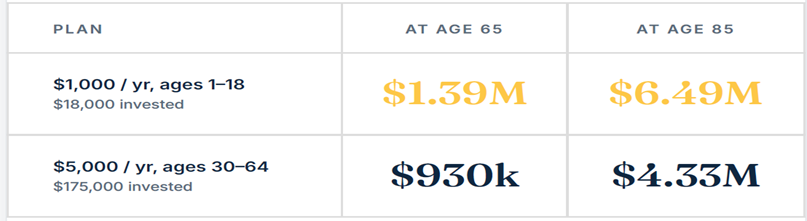
Source: Illustration of retirement amounts with an 8% return
This Month:
- Mid-Year Market Outlook: Participate, but Don’t Chase
- Autocallable notes are all the rage. A lot of them don’t make sense.
- The Market Is Not Always Efficient.
- Million-Dollar Watches Are Booming. That Doesn’t Make Them Investments.
- The World Cup Hasn’t Been The Expected Boost to the Economy
1. Mid-Year Market Outlook
Participate, but Don’t Chase
At this stage of the market cycle, I am comfortable earning the market return. I do not believe pursuing a small amount of additional upside is worth taking significantly more risk—particularly after a strong period for many of the market’s recent winners. That does not mean becoming bearish or moving away from equities. It means remaining invested while being more selective about where risk is taken.
There are still several reasons for optimism. Corporate earnings have remained resilient and continue to support equity prices, even at elevated valuations. Investment in artificial intelligence and related infrastructure remains a meaningful economic tailwind, with spending by large technology companies continuing at extraordinary levels. Over time, that investment may also translate into broader productivity gains.
Inflation appears to be gradually easing, helped by cooling shelter costs, while interest-rate expectations have become more realistic. Markets have moved from anticipating several cuts to expecting very little—or only modest easing. With expectations already reset, lower inflation or softer economic data could create room for a positive surprise. Fiscal policy also remains supportive, with government spending continuing to provide a backdrop for economic growth.
There are also reasons to be more cautious. As some indictors suggest, investor optimism has increased, and retail investors are showing a greater willingness to use leverage. Historically, periods of widespread enthusiasm have often been followed by more modest returns, even when the underlying economy remains healthy.
Expectations for AI are also extremely high. The technology may ultimately prove transformative, but today’s valuations require companies to deliver meaningful earnings growth for years to come. When expectations are this elevated, even strong results can disappoint investors if they fall short of what is already reflected in share prices.
There are also early signs of softness in employment, particularly among lower-income workers. Some current market tailwinds may become less dependable after the U.S. midterm elections, including low oil prices and continued fiscal stimulus. Geopolitical risks remain elevated as well, creating the possibility of disruptions that markets may not always be willing to overlook.
Our portfolio positioning reflects both sides of this outlook. We continue to maintain meaningful exposure to equities, but with an emphasis on high-quality companies with durable earnings, strong balance sheets and the ability to perform across different economic environments. Diversification remains important, particularly after a period in which returns have become increasingly concentrated among a relatively small group of companies.
We are also being selective in lower-quality credit, speculative businesses and highly leveraged companies. The goal is not to avoid risk altogether—it is to make sure the risks we take are appropriately rewarded.
There may still be further upside ahead, but this is not an environment where investors need to chase every opportunity. Remaining disciplined, diversified and focused on quality should allow portfolios to participate in continued gains while remaining better prepared if market conditions become more difficult.
2. Autocallable notes are all the rage. A lot of them don’t make sense.
Would you buy an investment offering a 14.3% return after six months? Most people say yes before hearing the second half of the sentence.
A structured note is issued by a bank and pays a return based on a formula linked to a stock, index or basket of securities. One of the most popular versions today is the autocallable note, which appears to combine a high headline return with downside protection.
But the protection is conditional.
Consider a five-year note linked to a single large technology company. Every six months, the stock is compared with its initial price.
If the stock is at or above where it started after six months, the note ends and pays a 14.3% return. If that does not happen until the one-year mark, the cumulative return rises to 28.6%. The payment continues to increase at each observation date, potentially reaching approximately 143% after five years.
There are three broad outcomes:
•If the stock is at or above its starting price on an observation date, the note ends and pays the accumulated return.
•If the stock never recovers but finishes no more than 30% lower at maturity, the investor receives their principal back but earns nothing over five years.
•If the stock finishes more than 30% lower at maturity, the investor absorbs the stock’s full decline.
The 30% protection barrier is measured only at maturity. The stock can fall below that level during the five years without triggering a loss, provided it recovers before the maturity date.
In a flat or moderately rising market, the structure can work well. But if the stock rises substantially, the investor gives up most of that upside. If it suffers a major decline, the investor can still experience an equity-like loss.
The investment also depends on one company rather than a diversified index. That concentration is a major reason the potential return is so high.
Capped upside. Equity-like downside. One stock.
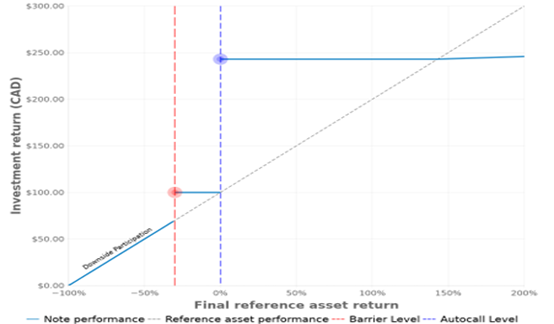
Source: hypothetical payout structure
That does not automatically make the product bad. The question is whether the return adequately compensates the investor for the concentration, downside risk and upside being surrendered. Tax treatment matters too: in a non-registered account, the return on many notes is taxed as interest income, although the specific treatment depends on the individual structure.
Regulators are also paying attention. In May 2026, FINRA began reviewing a related category of non-principal-protected structured products after some investors suffered significant losses from concentrated positions.
This is not an argument against every structured note. The structures vary widely, and some can serve a useful purpose. Just make sure someone has run the full range of outcomes—and calculated not only what you could receive, but also what you are giving up.
3. The Market Is Not Always Efficient
Source: Korean Times
SK Hynix listed its shares on the U.S. exchange on July 10th and its shares traded at a 50% premium to the same shares in Korea!
This article explains how traditional arbitrage works and why it may take time for the prices to converge.
The more important takeaway is that investors are ignoring valuation, fundamentals etc and focused on the momentum. If you can make money selling it to the next guy, it’s a smart trade – just don’t be left holding it when the music stops.
4. Million-Dollar Watches Are Booming. That Doesn’t Make Them Investments
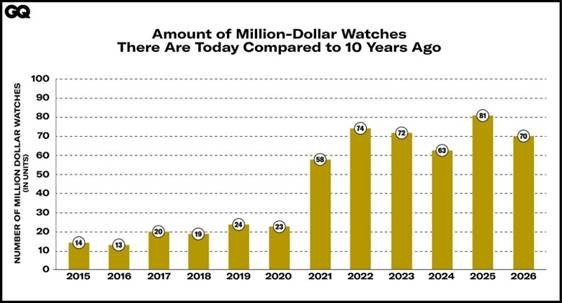
Source: GQ; EveryWatch
During the first half of 2026, there have been 70 watches sold for more than $1 million. In 2016, only 13 watches crossed that threshold. The article attributes this to “parking money in collectibles like art and watches feels like a safe bet, especially with an economy this wobbly”.
If owning a beautiful mechanical watch makes you happy, go for it. There are worse ways to spend money. But buy it because you appreciate the craftsmanship and enjoy wearing it - not because someone tells you it is a scarce investment that can only appreciate.
To me, the market is starting to resemble baseball cards. Individual releases may come in small batches, but there are more brands, editions and supposedly rare collectibles competing for buyers. Something can be scarce on its own without the overall category being scarce.
I always tell my son to buy the player he likes or the card he thinks looks cool—and then assume it could be worth zero someday. The same approach makes sense with watches. Any appreciation should be viewed as a bonus, not the reason for buying.
The investment pitches also tend to overlook the friction involved in eventually selling: authentication, dealer spreads, insurance, commissions and uncertain liquidity. Auction prices can be particularly misleading because the headline hammer price may not reflect the buyer’s premium and other costs added to the transaction.
A good test is simple: Would you still want the watch if it never appreciated and nobody else knew what it cost? If the answer is yes, it is probably a hobby worth enjoying. If the answer is no, it may be speculation dressed up as collecting.
And if private funds begin aggressively pitching watches as a new asset class, we will probably know the trend has reached the late innings.
5. The World Cup Hasn’t Been The Expected Boost to the Economy

Source: Toronto Life
In the run-up to the World Cup, officials repeatedly predicted Toronto could receive as many as 300,000 out-of-town visitors – both foreign and domestic – as a result of the matches.
This G&M article highlights number of U.S. and non-U.S. residents who entered Canada by vehicle did increase by 106,700 in June from the year before, or 7.2 per cent. But that was also in line with cross-border travel increases in the months before the World Cup.
Statscan’s traveller data tells a similarly underwhelming story to domestic spending data. For instance, spending at Toronto restaurants and bars between June 12 to 26 climbed by only 3 per cent compared with the same period last year.
Looks like we are going to have to point to the qualitative impacts of the $1-billion investment to justify hosting any future World Cups.
If you have any issues opening these articles or any thoughts, please reach out to me.
Closing Thoughts
The common thread this month is to avoid chasing what has worked in the past, focusing on high quality businesses or asset classes that have predictable cash flows and compensate you for the risks that you are taking.
Ari Black, CFA, HBA | Investment Advisor
RBC Dominion Securities Inc.
| T: 416-756-8886 | 2 St. Clair Ave West, Suite 1900, Toronto, ON M4V 1L5 | Personal Website | LinkedIn
If you ever want an objective second opinion, not a sales pitch, I’m always happy to help where appropriate.