
Ari Black, CFA
Investment Advisor
September 15, 2026
Shana Tova to everyone celebrating.

One of my favourite parts of this time of year is the chance to slow down, reflect on the year behind us and think about what we want from the year ahead (which is always easier from our seats by the lake). Wishing you and your families a happy, healthy and sweet new year.
This Month:
- Tariffs Are the Noise. Competitiveness Is the Story
- One of the Worst Runs Ever for Bonds
- Does Oil Still Work as a Hedge?
- Trading Cards Meet the Casino
- Apparently, the Mall Isn’t Dead
1. Tariffs Are the Noise. Competitiveness Is the Story
It is easy to get lost in the tariff headlines. A new threat, another exemption, another round of negotiations. My base case is still that the worst-case tariff outcomes do not persist indefinitely. But I also doubt we simply return to the world we had before. For Canada, the more useful question is not where every tariff ultimately lands. What do we need to do regardless?
The answer starts with productivity and investment. By 2023, real investment per Canadian worker had fallen to just 85% of its 2014 level. Over the same period, U.S. investment per worker increased 21%. Canada also invests about 6.6% of GDP in infrastructure, compared with 7.4% among high-performing peer countries, according to PwC Canada. Closing that gap would require roughly US$34 billion of additional annual investment by 2050.
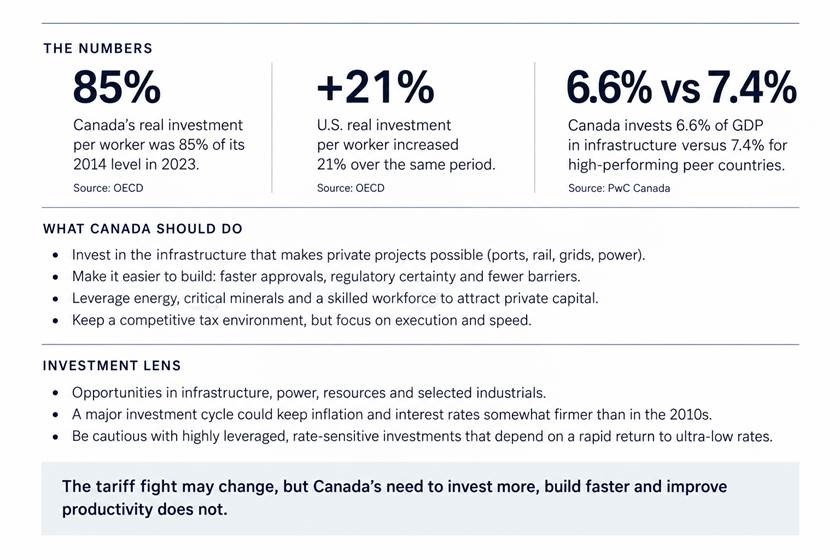
Fortunately, Canada has plenty to invest in. We have abundant energy, critical minerals, a skilled workforce and growing demand for power-intensive projects such as data centres. But having the resources is not enough. We need the ports, rail, pipelines, transmission and power generation that make private projects economically viable. We also need to make projects easier to build through faster approvals, regulatory certainty and a competitive tax environment.
Government has an important role, particularly in building the infrastructure that makes private investment possible. But government spending alone cannot solve the problem. Government can build the runway. Private capital still has to take off. Ultimately, businesses need a reason to invest in Canadian mines, factories, energy projects, technology and equipment.
There are investment implications as well. A sustained Canadian capital-spending cycle could create opportunities across infrastructure, power, resources and selected industrial businesses. It could also keep inflation and interest rates somewhat firmer than investors became accustomed to during the 2010s. Tariffs complicate that picture because they can raise costs while also weakening demand, something the Bank of Canada has highlighted. That makes me more cautious about highly leveraged investments whose thesis depends on a rapid return to ultra-low rates.
We still cannot know the exact tariff level, where the Canadian dollar goes or what the next policy announcement will be. Fortunately, a diversified portfolio reduces the need to get those calls exactly right. Different outcomes will favour different assets, which is precisely why we own more than one type of investment.
The tariff fight may change, but Canada’s need to invest more, build faster and improve productivity does not. And from an investment perspective, the goal is not to predict every outcome, but to build a portfolio that can handle several of them.
2. One of the Worst Runs Ever for Bonds
Bonds are supposed to be the boring part of the portfolio. The last decade has been anything but. The chart below shows rolling 10-year annualized U.S. bond returns going all the way back to 1793. As of July, the return had fallen to roughly -1.9% per year, the worst period shown in more than 200 years, and that is before inflation.
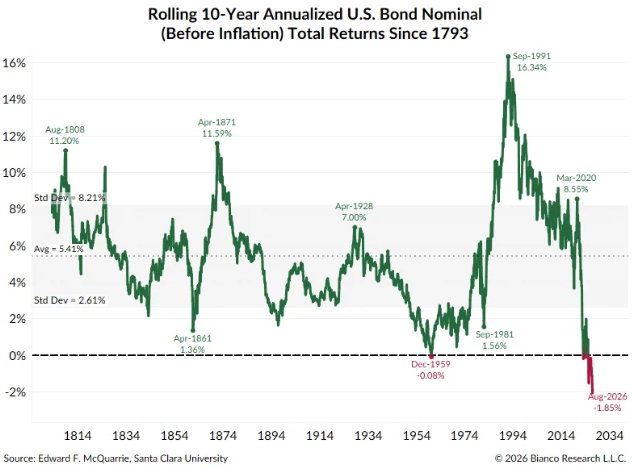
The main culprit has been rising interest rates. If you bought a bond several years ago yielding 2% and new bonds are now being issued at 5%, nobody is going to pay you full price for the old 2% bond. Its price has to fall to make its return competitive with what investors can buy today. That repricing has been painful for anyone who thought bonds were the “safe” part of their portfolio.
So why are long-term rates still so high? A recent Bruegel analysis argues that this doesn’t appear to be primarily about investors losing faith in the Fed or U.S. fiscal institutions. In fact, long-term yields have risen across most major developed economies. Over the six months through August, 30-year yields rose 45 to 79 basis points across six major economies, with the U.S. increase of 58 basis points right in the middle.
The explanation may be much simpler: supply and demand. Governments are issuing more long-term debt, companies are borrowing to fund investment in areas like AI and infrastructure, and some of the huge buyers that previously absorbed bonds largely regardless of price, including central banks and foreign reserve managers, have stepped back. Government deficits still matter because they add to the supply of bonds, but that is different from saying investors have suddenly lost confidence in U.S. debt. With more capital being demanded and more debt to absorb, investors are simply demanding a higher yield to lend their money.
The silver lining is that after one of the worst periods ever for bond investors, higher yields also mean bonds finally offer much better starting returns than they did when yields were near 1% or 2%.
3. Does Oil Still Work as a Hedge?
Times like these tend to bring the oil super-bulls back out. Prices spike, geopolitical risk dominates the headlines and suddenly there are plenty of reasons why oil can only go higher. The harder thing is finding some perspective in the middle of the move.
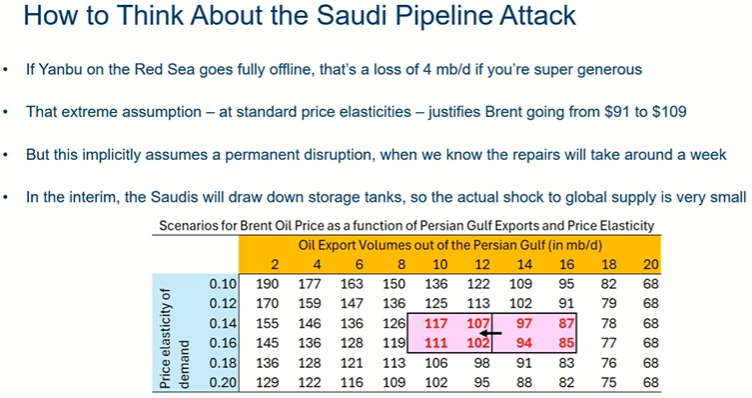
One person I’ve found particularly useful throughout the conflict is Robin Brooks. He has focused less on the headlines and more on the actual flow of oil. His latest work argues that the Saudi pipeline attack caused a legitimate disruption, but markets may be treating a temporary problem as something much more permanent. Brooks estimates that losing another 4 million barrels per day permanently could justify Brent around $109, not far from where prices have recently traded. But permanently is the important word. Pipelines get repaired, oil gets rerouted and markets adapt.
Source: Robin J Brooks Substack
That doesn’t mean oil has failed as a hedge. Quite the opposite. Oil has done exactly what you would want it to do during a geopolitical and inflationary shock. The question is whether investors should chase it after the hedge has already worked.
There is also a political element. With U.S. midterm elections approaching, high gasoline and diesel prices have become increasingly sensitive politically. Trump has even said the Iran war would end after the November elections. The U.S. cannot dictate the price of oil, but decisions about how aggressively it prosecutes the conflict can clearly influence the geopolitical premium embedded in it.
I remain constructive on oil over the medium to longer term. Geopolitical risks aren’t disappearing, supply remains vulnerable and oil continues to have value as a hedge against exactly the type of events we’re seeing today. But after a sharp move higher, I’d rather recognize how much has already been priced in than assume the latest shock lasts forever.
Oil still works as a hedge. I just wouldn’t chase it here.
4. Trading Cards Meet the Casino
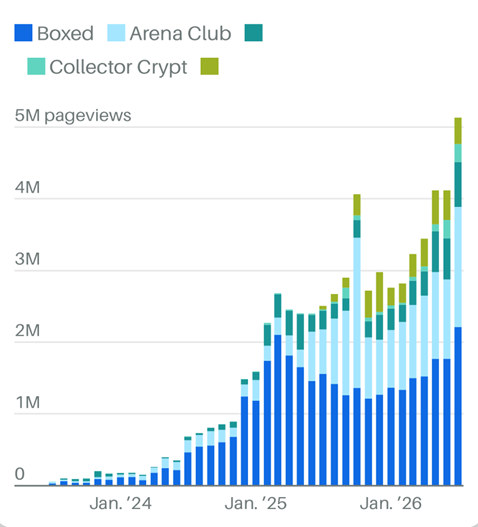
A new type of collecting is starting to look a lot like gambling. You buy a virtual pack, sometimes for thousands of dollars, open it online and get one random card. The card is real and sitting in a vault somewhere, but fewer than 5% of buyers actually take physical delivery. Most leave it there, trade it, or sell it back for cash almost immediately.
That changes the experience quite a bit. The excitement is increasingly about chasing a rare “hit” and what it’s worth, not necessarily owning the card itself. Fanatics, GameStop and dozens of other platforms are moving into the space, and I may need to hide this one from my kids, who have already managed to blow hundreds of dollars on Pokémon cards. Trading cards have always involved some luck, but when almost nobody even takes possession of the card, is it still collecting?
Source: Similarweb, Barron’s
5. Apparently, the Mall Isn’t Dead
For about 15 years, we’ve been told the shopping mall is dying. Amazon, e-commerce and then the pandemic were all supposed to finish it off. Apparently nobody told Gen Z.
Mallmaxxing has become a thing, with younger shoppers heading back to malls to hang out, try things on and shop brands they originally discovered online. And it’s showing up in the numbers. U.S. mall property values have risen 13% over the past year, making malls the best-performing part of commercial real estate since 2022. There’s something amusing about the generation raised on smartphones helping revive one of the places smartphones were supposed to kill.
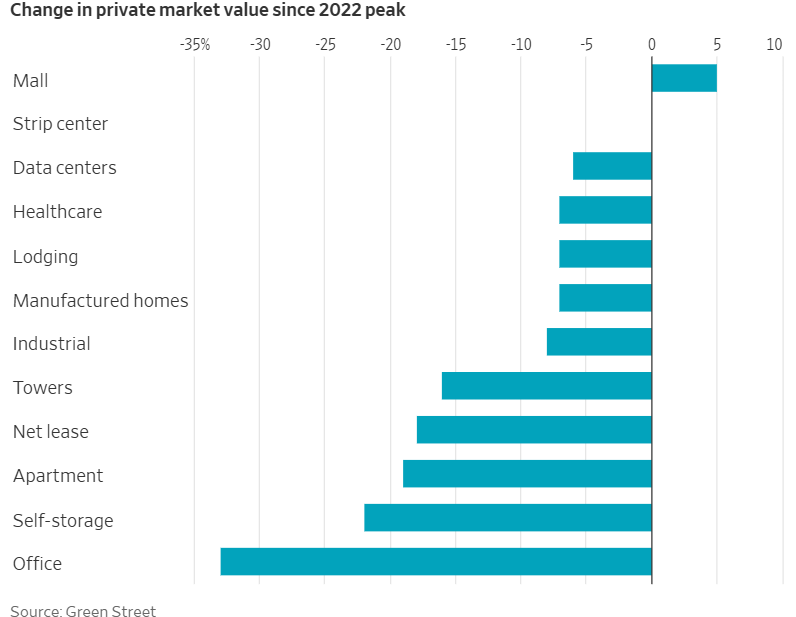
Source: Green Street, WSJ
Closing Thoughts
If there’s a common thread this month, it’s that the obvious story is rarely the whole story. Tariffs lead back to productivity, terrible bond returns have created better starting yields, oil can be a useful hedge without being something you want to chase, and apparently even malls can come back from the dead.
Markets have a habit of surprising us. That’s another reason I keep coming back to diversification. You don’t need to predict every outcome correctly. You need a portfolio that can handle being wrong about some of them.

Ari Black, CFA, HBA | Investment Advisor
RBC Dominion Securities Inc.
| T: 416-756-8886 | 2 St. Clair Ave West, Suite 1900, Toronto, ON M4V 1L5 | Personal Website | LinkedIn
If you ever want an objective second opinion, not a sales pitch, I’m always happy to help where appropriate.