
Janice Domaratzki
Senior Portfolio Advisor
November 3, 2026
The Plot You Didn’t Choose
Everyone carries a money story. Yours likely started long before your first paycheque, and there’s a good chance it’s still shaping your decisions today.
A money story is the narrative we form early in life about what money means. Maybe you overheard tense conversations at the kitchen table. Maybe you watched a parent save every spare dollar, or spend freely and worry later. Without anyone saying it out loud, you learned what money was for, who got to have it, and what it said about you.
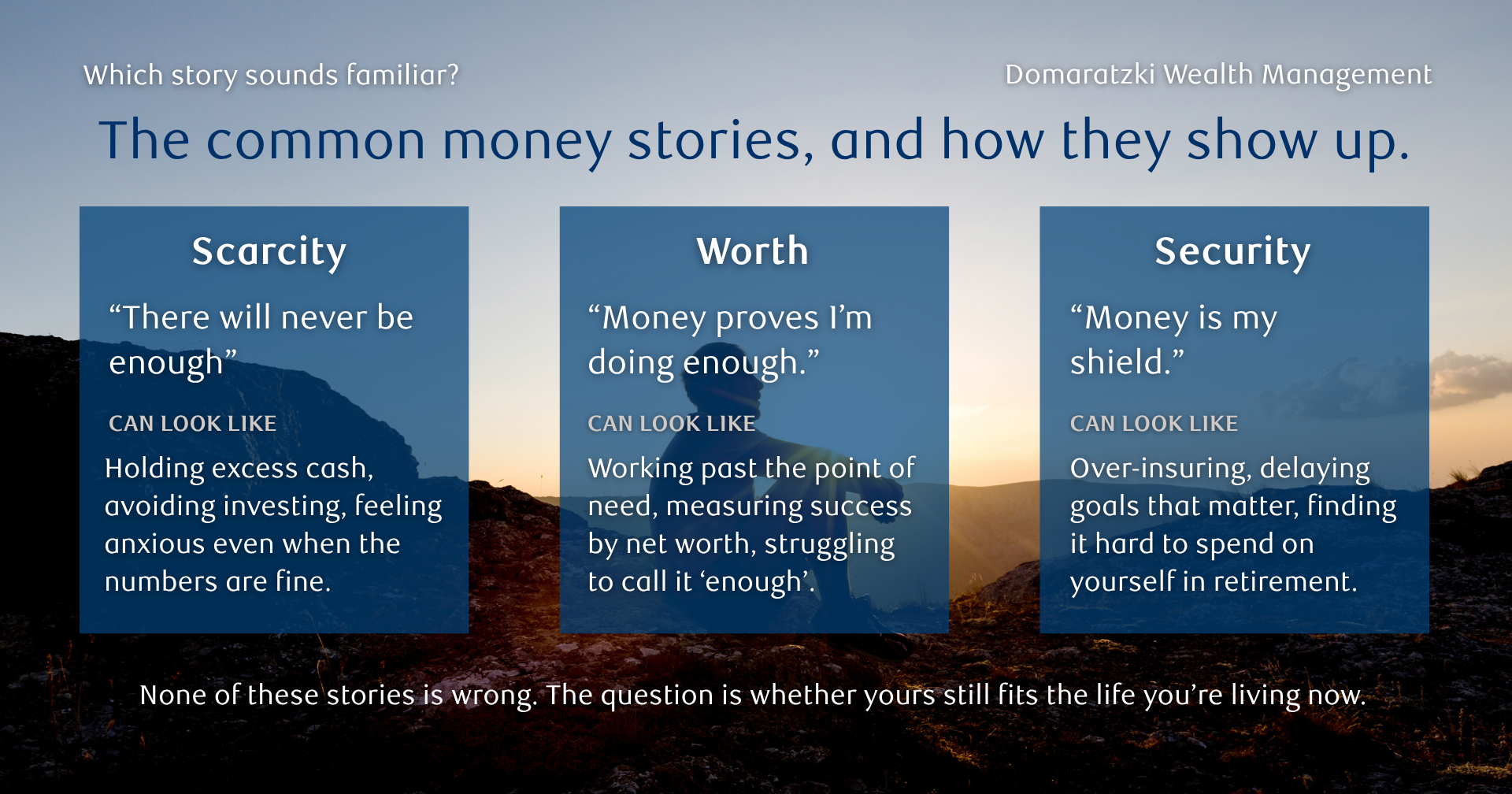
For some of us, it’s a story about scarcity: money is the thing that disappears if you’re not careful. For others, it’s a story about worth: money is proof that you’re doing enough, something you have to keep earning over and over. Some stories are about safety, some about freedom, and some about guilt.
Most of these stories were written before we were old enough to question them, and most of us have never gone back to check whether they’re still true. We’ve grown up, built careers, raised families, weathered markets and learned a great deal along the way. Yet the plot is often still being written by a much younger version of ourselves.
These stories aren’t only personal. They’re also shaped by the economic moments we came of age in and by our own early experiences: a first job, a first debt, a first big loss or windfall. Someone who started out during a recession may carry a very different story than someone who started in a boom, even with identical finances today.
This November, for Financial Literacy Month, I’d like to invite you to do something a little different. Instead of starting with a budget or a balance sheet, start with the story. Name it, look at it honestly, and then decide, with the benefit of hindsight and experience, whether it deserves to keep writing the plot.

Financial Literacy: Naming Your Money Story
Financial literacy is usually framed as a knowledge problem. Learn the terminology, master the ratios, build the budget, and good decisions will follow. Knowledge matters. But just as often, financial literacy is a story problem.
Two people can understand compound interest equally well and still make very different choices. One holds far too much cash because a market drop feels like a personal threat. The other can’t stop taking on more work because “enough” never quite arrives. Neither is missing information. Each is following a narrative running quietly underneath the numbers.
Naming that narrative is the first step to deciding whether you still agree with it. I find it helps to think of it in three parts: where the story began, where it shows up today, and where you’d like it to go.
Look back. Start with the earliest belief you can remember forming about money. Was money discussed openly in your home, or never mentioned? Was it a source of comfort, conflict or pride? Then ask whether that belief is still guiding your decisions today. The first lesson we absorb often becomes the default we return to under pressure.
It’s also worth listening for whose voice you hear when you make a cautious, or a risky, financial decision. Often it isn’t our own. It might belong to a parent, a grandparent, a first boss or a mentor. Recognizing the voice lets you appreciate its good intentions and still choose differently.
Look at today. Pick one concrete financial decision from the past year, such as a large purchase, an opportunity you passed on, or a call you kept putting off, and look for your story inside it. What were you really protecting, or proving, in that moment?
Then try to name the theme. Is your story one of scarcity, where there will never be enough? One of security, where money is a shield? Or something else entirely, like freedom, status or obligation? Once a pattern has a name, it becomes much easier to spot the next time it appears.
Look ahead. Stories persist because we notice what confirms them and overlook what doesn’t. So go looking for the evidence from your own financial life that contradicts yours: the times you had enough, recovered from a setback, or made a sound decision the old story said you couldn’t.
Finally, imagine what would change if you rewrote the story on your own terms. How would that version of you approach saving, spending, giving or planning for retirement? That picture is often a better guide to your real goals than any spreadsheet.
None of these questions ask you to judge where your story came from. Most money stories were formed for good reasons, often as a way to feel safe in circumstances we didn’t choose. The goal isn’t to blame the story. It’s to notice when it no longer fits the life you’re actually living.
You may find it helpful to write your answers down rather than simply think them through. Seeing the words on paper often reveals patterns that are easy to miss in your head.
Rewriting the Next Chapter
If you recognized yourself in any of this, you’re in good company. Everyone has a money story, including the people who seem most confident with their finances. Having one isn’t a flaw; it’s simply part of being human.
What makes the difference is awareness. Once you can see your story, you can choose whether to keep following it. In my experience, that awareness is often the real starting point of financial literacy, more than any specific number, ratio or rule of thumb. The numbers matter, but they work best when the story behind them is one you’ve chosen.
If you’d like a place to begin, it can be as simple as two sentences on a piece of paper:
1. The money story I was raised with is…
2. The money story I’d rather be living by now is…

Your story can also change with the season of life you’re in. The habits that served you well while building savings, like caution and restraint, can quietly hold you back once it’s time to draw on those savings in retirement. Checking in on your story at each new chapter keeps your plan working for the life you have now.
Keep them somewhere you’ll see them, and come back to them the next time a financial decision feels heavier than it should. If you’d like help turning that new story into a plan, I’m always happy to start the conversation.
Janice
Follow along on LinkedIn and Facebook, or reach out if you’d like to talk through your own situation or refer someone who could use support.
Janice Domaratzki, CIM │Senior Portfolio Manager & Investment Advisor, Domaratzki Wealth Management │ RBC Wealth Management │ RBC Dominion Securities Inc. │ T. 613-564-4840 │ T. 1-800-267-7680 │ 333 Preston Street, Suite 1100, Ottawa, Ontario K1S 5N4 │janice.domaratzki@rbc.com │Domaratzki Wealth Management website
RBC Wealth Management is a business segment of Royal Bank of Canada. For further information on the entities that are member companies of RBC Wealth Management, click here. The content in this publication is provided for general information only and is not intended to provide any advice or endorse/recommend the content contained in the publication.
® / ™ Trademark(s) of Royal Bank of Canada. Used under licence. © Royal Bank of Canada 2026. All rights reserved.