
Janice Domaratzki
Senior Portfolio Manager
September 1, 2026
I spend a lot of my working life thinking about basis points. Fees, allocations, tax drag, rebalancing bands - the discipline of optimizing a portfolio down to the smallest detail is part of what I love about this job, and it's part of what I owe every client who trusts me with their plan. Get the details right consistently enough, over a long enough stretch of time, and the compounding takes care of the rest. It's satisfying work, and it's the work most of us think of when we think about wealth management.
But every so often it's worth stepping back and asking a different question: optimizing toward what, exactly? Not in the abstract - not "retirement" or "security" as line items on a plan - but toward the actual texture of a life. What are the mornings supposed to look like once the number gets big enough? Who's around? What's filled in and what's finally been cleared out? It's a harder question than it sounds, mostly because so few of us are ever asked it directly. We get asked about risk tolerance and time horizon and income needs. We're rarely asked what we're actually building toward.
The honest answer, for almost everyone I sit across from, isn't a number. It's a feeling - of freedom, of margin, of having options. The dollar figure was always meant to be the means, not the point. And yet it's remarkably easy to spend decades refining the financial plan without ever running the same rigor on the calendar that plan is supposed to support. We track net worth quarterly. We rebalance on schedule. We revisit the plan every time something in the market or the tax code changes. Few of us track, with anything like that same discipline, how we're actually spending our days - and fewer still stop to ask whether the answer still matches what we said we wanted five or ten years ago.

That gap tends to open quietly. Nobody decides, in a single moment, to let their calendar drift away from what they actually value. It happens a commitment at a time - a "yes" here, a deferred vacation there, a promise to slow down "once things settle" that keeps getting pushed a year further out. None of those individual decisions look like a problem. It's only when you add them up over a decade that the pattern becomes obvious, and by then it can feel less like a choice and more like a groove you've worn into your own life.
This month's blog is a more personal, reflective one. It's not about a new product or a market call - it's an invitation to notice the gap, if one exists, between how your wealth is being managed and how you actually want to spend your time. There's no homework attached, and no wrong answer. Just a question worth sitting with for a few minutes before you get back to your day.

Measuring Wealth in Time
For most people, “enough” was never really about a dollar figure. It was about a feeling of freedom that a dollar figure was supposed to eventually buy. Somewhere along the way, though, the number becomes the goal itself. We watch it grow, we optimize around it, we measure success by it, and we quietly forget it was only ever supposed to be a means to something else.
That something else is time. Specifically, control over how you spend it. And yet time almost never comes up in financial planning the way money does. We build spreadsheets for retirement income, stress-test portfolios against downturns, run tax projections a decade out but we rarely ask what a genuinely good Tuesday looks like, or whether the plan is actually built around the life it's meant to support. A portfolio can be perfectly optimized and still be pointed in the wrong direction. You can hit every savings target and retire with more than enough, and still discover the plan never asked what you wanted your time to look like along the way, not just at the finish line, but this year, and the one after that.
So here's an exercise worth trying, ideally with a coffee rather than a spreadsheet: work backward from the feeling you're actually after instead of forward from the balance in your account.
- If I measured my wealth in time instead of dollars, would my plan look different?
- What am I actually saving for: more free time, more security, or more options?
- Why does slowing down sometimes feel harder than working hard did?
- What would it look like to spend money in a way that buys back time, not just things?
- Is there a version of my week, five or ten years from now, that my current plan is actually built to support?
- What's one thing I'd do with an extra day a week, and what's actually stopping me from having it?
None of these have a single right answer, and you don't need a tidy response to any of them today. Some of the answers are financial, a savings rate, a withdrawal strategy, a decision about when to step back from work. Others aren't. Plenty of financially disciplined people never give themselves permission to spend money in a way that buys back time, even when they can clearly afford it, because busyness has quietly become part of their identity. A plan can clear the runway for more free time. It can't make peace with using it, that part is separate work, and it's real work.
But if one of these questions stops you for a moment, if it sits with you a little longer than you expected, that pause is worth paying attention to. It's often the first sign that a plan built around a number could use a second look through the lens of time.
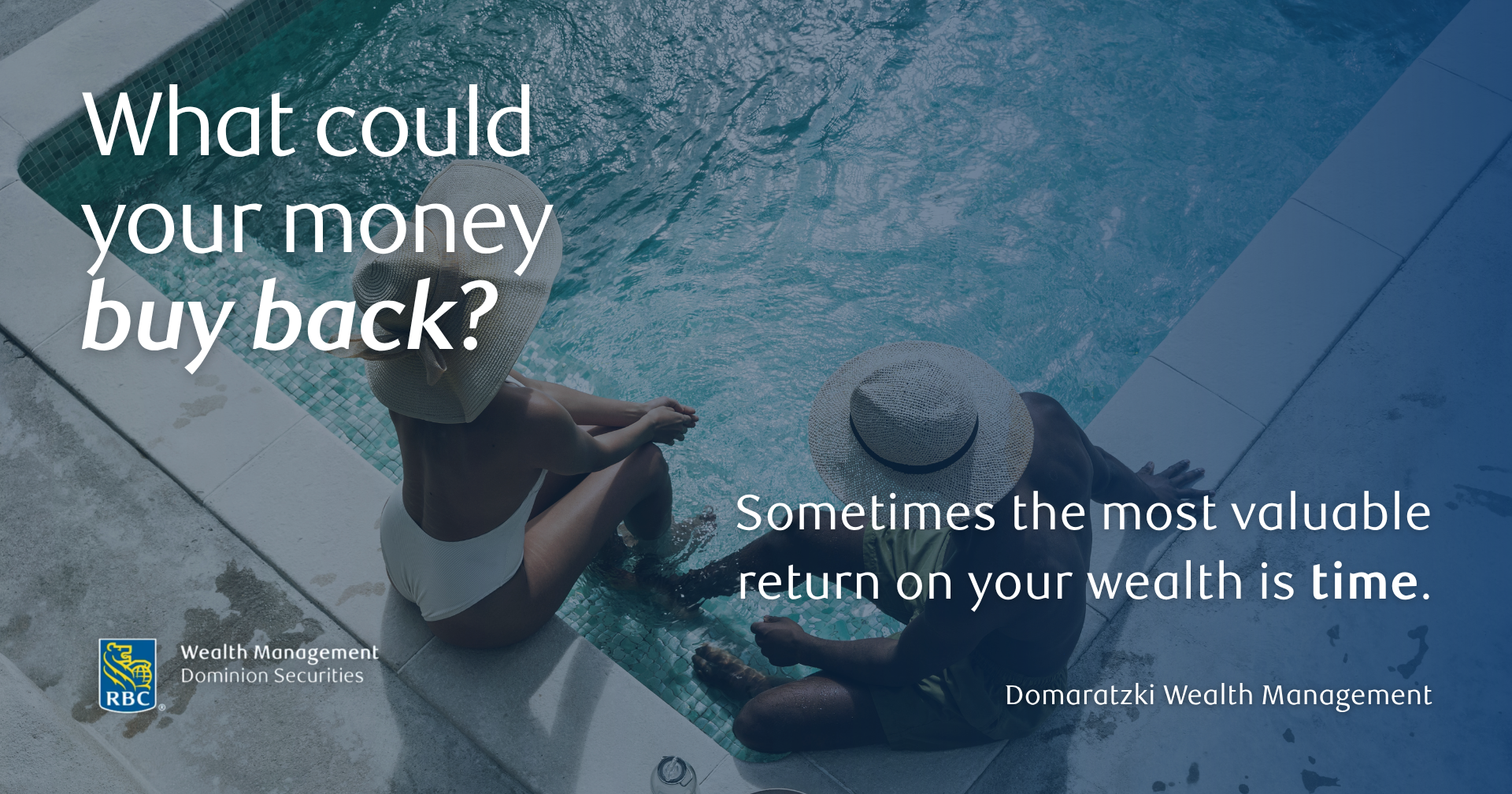
So here's the question I'll leave you with: if your wealth already bought you more time, would you know what to do with it? I don't think the answer is obvious for most people - and I think it's a better measure of whether a plan is working than any account balance ever could be. If it's not obvious for you yet, that's not a failure. It's just the next thing worth working on together.
Janice
Follow along on LinkedIn and Facebook, or reach out if you’d like to talk through your own situation or refer someone who could use support.
Janice Domaratzki, CIM │Senior Portfolio Manager & Investment Advisor, Domaratzki Wealth Management │ RBC Wealth Management │ RBC Dominion Securities Inc. │ T. 613-564-4840 │ T. 1-800-267-7680 │ 333 Preston Street, Suite 1100, Ottawa, Ontario K1S 5N4 │janice.domaratzki@rbc.com │Domaratzki Wealth Management website
RBC Wealth Management is a business segment of Royal Bank of Canada. For further information on the entities that are member companies of RBC Wealth Management, click here. The content in this publication is provided for general information only and is not intended to provide any advice or endorse/recommend the content contained in the publication.
® / ™ Trademark(s) of Royal Bank of Canada. Used under licence. © Royal Bank of Canada 2026. All rights reserved.